
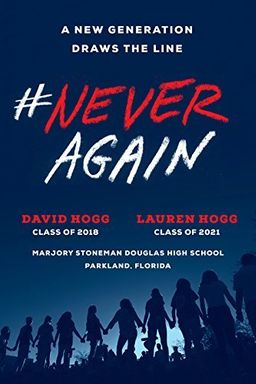
#NeverAgain cover

#NeverAgain

by David Hogg & Lauren Hogg

In #NeverAgain, David and Lauren Hogg recount the Parkland school shooting''s aftermath and their journey to initiate a national movement for gun reform. This compelling narrative reveals how determined youth can inspire change and challenge powerful establishments.

Refusing to Accept the Unacceptable: The Birth of #NeverAgain

What would you do if the unimaginable suddenly became your reality? When the ordinary sounds of a fire drill turned into the crack of real gunfire, David and Lauren Hogg faced that question head-on at Marjory Stoneman Douglas High School. Their answer, and the book’s central argument, is that you cannot stay silent in the face of violence and injustice. In #NeverAgain, they contend that when tragedy strikes, the only moral response is to transform anger and grief into organized action—because change begins the moment you refuse to accept the unacceptable.

The Hoggs’ story begins with February 14, 2018—the day a gunman murdered seventeen people in their school—and unfolds into a sweeping reflection on trauma, activism, and hope. The book alternates between their voices, revealing two parallel emotional journeys rooted in a shared conviction: that America’s deadly relationship with guns is not inevitable. Through heartbreak and courage, they find power not in despair but in resistance.

A Generation Forged in Fear

David and Lauren belong to what they call the “mass-shooting generation.” Born after Columbine and raised amid lockdown drills, they were schooled to survive what adults had failed to prevent. That generational conditioning gave them two things: deep fear and a startling degree of preparedness. When their own school became the next statistic, they already spoke the language of trauma—and turned that vocabulary into a movement.

The Hoggs describe how active-shooter drills normalized danger for students, even as adults around them accepted gun violence as an unsolvable feature of American life. But when Parkland happened, they refused to accept that norm. As David puts it, “After you spend a few hours hiding in a classroom while your friends and teachers are slaughtered, you can’t stop thinking about how insane this is and how to change it.”

From Survivors to Storytellers

One of the book’s most striking insights is how the act of storytelling itself became a survival mechanism. David, a self-taught student journalist, began filming from inside a classroom while shots were still being fired. For him, documenting the chaos was a way to stay calm—and a declaration that their voices mattered. After escaping the school, he uploaded footage, gave interviews, and repeated one plea to adults everywhere: “We’re the kids. You’re the adults. Please do something.”

Meanwhile, Lauren, just fourteen, processed her trauma through grief and writing. Her firsthand recollections of texting friends who never responded or seeing their faces later on the evening news lend the book both emotional gravity and rare moral clarity. Together, their twin perspectives—David’s analytical and fiery, Lauren’s raw and reflective—show that activism is not born from certainty but from unbearable emotion channeled into purpose.

The Anatomy of a Movement

From those early days came “#NeverAgain,” coined in a late-night brainstorming session at Cameron Kasky’s house. The group of Parkland students quickly grew into the founders of the March for Our Lives movement, mastering Twitter battles, talk shows, and public rallies with the speed of a generation fluent in digital life. They refused to be reduced to victims or dismissed as “kids who don’t understand politics.” By speaking authentically—and yes, angrily—they made gun reform a youth-driven national issue.

The book recounts key victories: pressuring corporations to sever ties with the NRA, helping pass gun reform in Florida, and organizing one of the largest youth-led protests in American history. But just as important, it chronicles how the movement confronted racism and privilege, acknowledging that media attention favored them because they were mostly white and middle class. In doing so, the Hoggs argue for solidarity that includes all communities touched by gun violence, from Miami’s Liberty City to Washington, D.C.

Why This Story Matters

At its core, #NeverAgain is about reclaiming agency in a culture paralyzed by “learned helplessness.” The Hoggs transform that psychological concept—people giving up because they feel powerless—into a rallying cry against political apathy. As students, they learned that helplessness can be unlearned, but only through deliberate, collective action. Like the civil rights marches or Greta Thunberg’s climate strikes, their campaign reframed despair as instruction: if adults won’t lead, young people will.

Ultimately, the Hoggs’ narrative is not just about Parkland—it’s about purpose. They insist that every generation inherits both the trauma and the opportunity of its time. For theirs, ending gun violence is that defining moral test. Across chapters that blend memoir, manifesto, and mourning, they show that love—of community, truth, and each other—is the ultimate resistance to entropy. For anyone wondering whether change is still possible in a fractured America, #NeverAgain offers a resounding, youthful yes.


Childhood, Privilege, and the Making of Activists

The Hoggs’ early lives on California’s “Candy Cane Lane” reveal how their activism was shaped long before tragedy struck. Growing up in a family that valued hard work, frugality, and moral duty, David and Lauren absorbed both independence and empathy. Their father’s service as an FBI agent and their mother’s devotion as a teacher grounded them in civic responsibility while exposing them to America’s contradictions about security and fear.

Learning Self-Reliance Early

David and Lauren’s homemade entrepreneurship—selling overpriced cookies and drinks to holiday tourists—became more than a childhood hustle. It became an early lesson in resourcefulness. When their father refused to waste money, they learned to “figure it out” themselves, testing the capitalistic and moral muscles they’d later flex in advocacy. Their stories of learning to make money, fail in school, and face dyslexia illustrated that life’s obstacles are training for bigger battles.

Family and the Second Amendment

Unlike the caricature of anti-gun activists, the Hoggs grew up in a household with firearms. Their dad carried one daily for work, and both children were taught to respect guns as dangerous tools—not symbols of power. That background gave their later activism nuance: they champion “common-sense gun laws,” not confiscation. It also shaped their empathy for responsible gun owners, grounding their criticism in logic rather than ideology.

Privilege and Perspective

David points out that his and his classmates’ privilege—a safe neighborhood, supportive mentors, and good media access—amplified their voices beyond those of victims in marginalized communities. This self-awareness keeps the movement humble. Lauren reminds readers that children in poorer or nonwhite communities face daily fear long before the news cameras arrive. Their acknowledgment of this disparity invites readers to expand empathy beyond Parkland.

The Hoggs’ California-to-Florida journey—from sunny privilege to painful awakening—demonstrates how moral conviction often begins with comfort disrupted. As David later realizes, every experience, from selling cookies to arguing in debate club, was unwitting training for the day he’d need to speak up for lives beyond his own.


The Day the World Shattered

On February 14, 2018, ordinary life at Marjory Stoneman Douglas High School dissolved into chaos. Through alternating narratives, David and Lauren Hogg reconstruct the terror with haunting clarity. Lauren describes seeing students running, hearing panicked screams, and realizing with chilling certainty that this time it wasn’t a drill. David, meanwhile, handled fear by switching into reporter mode, filming from his classroom—a teenage journalist documenting his own near-death experience.

Trauma and Frozen Time

Lauren’s version of events, soaked in sensory detail, captures the helplessness of children taught to “stay calm” amid horror. Huddled in a broadcast room behind a flimsy wall, she and classmates whispered final words and checked phones for updates: messages like “I love you” or “He’s shooting down my hall.” David’s experience mirrors this paralysis but overlays it with his instinct for action. His camera became both shield and therapy—proof that the truth mattered even as everything unraveled.

Survivor’s Purpose

Emerging from the building into a storm of sirens and disbelief, David felt an immediate duty: document, speak, act. Lauren, meanwhile, broke down completely upon realizing her friends were gone. Their diverging reactions—his numb activism and her raw grief—show two sides of trauma’s aftermath. One seeks control through doing; the other confronts the unbearable through feeling. In blending both, #NeverAgain shows how activism and emotion together form a healing loop.

The Valentine’s Day massacre became their “before and after” line in life. As David later writes, “After you spend a few hours hiding while your friends are slaughtered, you can’t stop thinking about how insane this is.” That shift—from incomprehension to forced understanding—became the gravitational core around which their movement formed.


From Grief to Grassroots: Building #NeverAgain

The #NeverAgain movement didn’t emerge from consultants or political veterans—it began on a couch. Within days of the shooting, a handful of teenagers gathered at Cameron Kasky’s home, channeling pain into purpose. Their modest goal—“make sure this never happens again”—became a hashtag, a rally cry, and ultimately a global campaign. David called for immediate legislative change; Emma González offered moral clarity; Delaney Tarr, Sarah Chadwick, and others planned logistics. Together, they became a spontaneous think tank of trauma survivors.

Discovering the Power of Media

Armed with smartphones and social media savvy, these teens flipped the typical post-tragedy narrative. Instead of fading after two news cycles, they dominated them. When David tweeted at corporations to sever ties with the NRA, giants like Hertz and Delta responded within days. When Sarah Chadwick lampooned Senator Marco Rubio’s NRA funding—$1.05 per Florida student—it became a viral symbol of moral arithmetic. Their humor and candor proved that authenticity could outmaneuver propaganda.

Facing Backlash and Troll Armies

Success came with cruelty. Conspiracy theorists branded them “crisis actors.” Fox News pundits mocked their grammar. David and Lauren describe learning resilience through digital warfare—responding with facts, wit, and solidarity. Rather than silencing them, attacks amplified their platform. Their strategy: transform every insult into fuel. As Lauren tweeted to the First Lady about cyberbullying, she demonstrated how moral clarity could trump power.

In a time when political movements often fracture, the Parkland students found unity through shared mission and humor. Their secret? They embraced being authentically young—sarcastic, hopeful, flawed—and that authenticity rekindled public empathy in a nation jaded by violence.


The Parkland Manifesto and the 11-Point Plan

Midway through the book, David presents a bold call to action: “The Parkland Manifesto.” Part reflection, part policy blueprint, it reframes gun violence as a symptom of America’s deeper moral disarray. Political corruption, poverty, racism, failing schools, and corporate greed—these are all connected threads in the web of entropy, the universal drift toward chaos. Their task is to reverse it.

A Realistic, Not Radical, Reform Plan

The Manifesto outlines an eleven-point plan for “common-sense gun laws.” These include universal background checks, funding gun violence research, banning assault weapons and high-capacity magazines, closing domestic-violence loopholes, and establishing red flag laws. The final and most crucial point? Vote. “Register. Vote. That might be the most important one of all,” David writes. For the Hoggs, civic participation is the moral antidote to despair.

Beyond Guns: Intersectional Activism

But their solution goes further. The Hoggs confront the racial inequalities behind gun violence: poorer, Black, and brown students face daily gun threats the media ignores. Recognizing this double standard, they call for systemic investment in education, mental health, and poverty reduction. Gun violence, they argue, isn’t isolated—it’s an ecosystem of neglect. Fixing it means addressing all social conditions that breed despair and rage.

The Parkland Manifesto closes with a human truth: collective action heals. As David writes, “We came together to try to heal the world, and found that was the best way to heal ourselves.” In their unity—improvised yet unwavering—they embody the movement’s deeper philosophy: rebellion, compassion, and love are not opposites but synonyms.


Survivors, Symbols, and the Power of Memory

If action was their first response, remembering was their second. The final chapters of #NeverAgain turn elegiac. “#Neverforget” lists victims from Columbine to Parkland, memorializing each name and life detail—their hobbies, hopes, smiles. This exhaustive catalog transforms statistics back into human beings. By documenting stories across decades, the Hoggs remind readers that activism loses its soul if it forgets whom it serves.

Humanizing the Epidemic

Where news coverage reduces victims to numbers, the book insists on personhood. Lauren’s portraits of her friends—Jaime the dancer, Alyssa “Giggles,” Gina the avid reader—underline the cost of every policy failure. She asks readers not to offer pity but presence: “Don’t tell me you’re sorry. Just say, ‘I’m here for you.’ Then actually mean it.” That sentence becomes both an ethical demand and a civic creed.

Memory as Activism

In preserving victims’ stories, the Hoggs connect grief to accountability. Forgetting, they warn, is society’s most dangerous reflex. History shows that apathy, not evil, sustains violence. By archiving tragedy in full, they weaponize memory against complacency. Each recited name is an act of defiance: a promise that these lives will not vanish into entropy’s void.

Ultimately, the book closes where it began—with the duty to remember and act. “Love each other as much as you can, hate each other as little as you can,” the Hoggs urge. In doing so, they redefine activism not as endless outrage, but as disciplined empathy made public.

Dig Deeper

Get personalized prompts to apply these lessons to your life and deepen your understanding.

Go Deeper

Get the Full Experience

Download Insight Books for AI-powered reflections, quizzes, and more.