
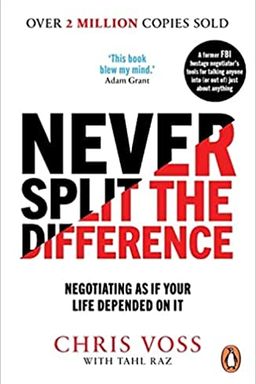
Never Split the Difference cover

Never Split the Difference

by Chris Voss and Tahl Raz

Never Split the Difference offers a masterclass in negotiation from former FBI lead negotiator Chris Voss. Drawing on real-life experiences, it provides practical strategies to master any negotiation scenario, whether in business, personal life, or high-stakes situations. Empower yourself to get what you want by understanding and influencing others effectively.

Negotiation as Life: The Power of Tactical Empathy

Have you ever felt trapped in a conversation — whether arguing at work, trying to negotiate a salary, or even convincing a child to go to bed — wondering why logic never seems to work? In Never Split the Difference, former FBI negotiator Chris Voss argues that negotiation isn’t a cold, mathematical exchange; it’s an emotional dance that defines every interaction in life. From hostage crises to business deals, Voss contends that effective negotiation begins by acknowledging the messy, irrational side of human nature.

At its heart, the book explores what Voss calls tactical empathy — the ability to understand another person’s emotions and worldview without judgment, and to use that understanding strategically to influence outcomes. Drawing from more than two decades of real-world hostage negotiations, Voss demolishes the rational theories of traditional negotiation, especially those taught at places like Harvard Law School. He found that logic and compromise, the hallmarks of books like Getting to Yes (by Roger Fisher and William Ury), failed in situations full of fear, stress, and human unpredictability. What saved lives — and what works just as well in boardrooms — was emotional intelligence on steroids.

From Hostage Negotiations to Everyday Life

Voss discovered these insights not in classrooms but in crisis situations where failure could mean death. Starting his career in the FBI’s elite Crisis Negotiation Unit, he led missions that spanned kidnappings in Haiti, bank robberies in Brooklyn, and the high-stakes rescue of American hostages in the Philippines. Along the way, he learned that the principles used to save a life under gunfire apply equally to negotiating a contract, mediating workplace conflict, or persuading your teenager to cooperate. Life, as Voss puts it, is negotiation — every conversation is about information gathering and behavior influencing.

Voss’s core argument challenges the old idea that negotiation should strive for rational win-win outcomes. Rational frameworks like BATNA (Best Alternative to a Negotiated Agreement) assume people make logical decisions. But as psychologists like Daniel Kahneman and Amos Tversky revealed through behavioral economics, human beings are emotion-driven, risk-averse, and often irrational. Voss builds on this research, arguing that understanding emotions — fear of loss, need for security, hunger for respect — is the key to guiding real decisions.

The FBI’s New Rules for Negotiation

Throughout the book, Voss develops what he calls the New Rules of Negotiation, replacing sterile tactics with tools forged from crisis communication. These rules emphasize listening intensely, labeling emotions, and asking calibrated questions that create the illusion of control while directing the conversation toward your goals.

  • Be a Mirror: Build rapport through subtle imitation, repeating key phrases or emotions to encourage your counterpart to keep talking.
  • Don’t Feel Their Pain, Label It: Instead of sympathizing, identify and articulate what the other person feels — “It seems like you’re frustrated” — to defuse negative emotions.
  • Beware “Yes” — Master “No”: Real negotiations begin with “No,” because saying “No” gives people safety and the feeling of control.
  • Bend Their Reality: Frame decisions using psychological principles like loss aversion and anchoring to reshape someone’s perception of value.
  • Find the Black Swan: Discover the unknown, transformative details hidden in any negotiation that can completely alter leverage.

Each technique mirrors the unpredictable realities of human emotion. Instead of forcing rational compromise — what Voss calls “splitting the difference” — he teaches you to use empathy, patience, and curiosity to make your counterpart reveal information and rethink their position.

The Conversation as an Emotional Landscape

The emotional terrain of negotiation, Voss explains, revolves around primal instincts: the desires to feel safe, secure, and respected. Effective negotiators don’t fight these impulses; they exploit them. The best question isn’t “How do I win?” but “How can I make the other person feel understood enough to open up?” In one example, Voss’s team persuaded a bank robber to free hostages not by arguing, but by labeling his fear and mirroring his words until he felt heard. It was a masterclass in tactical empathy, proving that empathy isn’t weakness — it’s leverage.

As the chapters unfold, Voss maps out a process that guides you through the five stages of influence — active listening, empathy, rapport, influence, and behavioral change. These evolve through specific techniques, including calibrated questions (“How am I supposed to do that?”), the “late-night FM DJ voice” to calm tensions, and strategic silence that forces the other person to speak. He also teaches how to use “that’s right” to trigger breakthroughs, since people embrace ideas they feel they’ve discovered themselves.

Why It Matters

Voss’s message is both philosophical and practical. In an age dominated by digital communication and corporate rationalism, he reminds us that negotiation is deeply human. We crave connection, validation, and autonomy more than logical arguments or numbers. Whether you’re buying a car, managing employees, or navigating a difficult relationship, success depends not on dominating or compromising but on transforming conflict into collaboration.

Ultimately, Never Split the Difference redefines negotiation as a form of emotional intelligence. When you stop splitting the difference and start listening, labeling, and asking the right questions, you stop reacting mindlessly and start influencing strategically. Voss shows you how anyone — yes, even someone facing armed kidnappers — can use empathy and curiosity to create understanding, disarm opposition, and get results. And that, he argues, is the smartest — and most humane — way to win.


Be a Mirror: Connecting Through Reflection

Chris Voss introduces one of his simplest yet most powerful negotiation tools: mirroring. Drawing on neuroscience and decades of field experience, he shows how repeating a person’s words — or even just the last few — creates instant rapport. The brain, he says, is hardwired to trust what feels familiar. When someone hears their words reflected back, they unconsciously relax, open up, and reveal deeper information. Mirroring isn’t mimicry; it’s psychological alignment.

The Science of Similarity

Humans instinctively fear what’s different and are drawn to what’s similar. We mirror each other unconsciously when we’re connecting — couples walking in sync, friends crossing their legs simultaneously. Voss applies this insight deliberately in negotiation, using verbal mirroring to create the illusion of similarity. Repeating one to three critical words from your counterpart’s last sentence (“You chased my driver away?”) invites them to elaborate while feeling heard. Psychologist Richard Wiseman’s study on waiters proved this effect: those who mirrored customers’ orders received 70 percent higher tips than those who responded with simple affirmations like “Sure” or “Great.”

Quieting the Voices in Your Head

Voss argues that most people don’t truly listen — they rehearse. We’re consumed by internal noise, preparing arguments instead of processing what’s said. Real listening, he says, quiets those schizophrenic voices. His method involves adopting the mindset of discovery rather than defense. When you mirror, you shift focus away from yourself and onto the other person. Suddenly, conversations become a form of investigation. You gather information instead of fighting for position.

Using Voice and Tone

Mirroring works best when paired with deliberate tone control. Voss teaches negotiators to use one of three deliberate voices: the late-night FM DJ voice (slow, calm, downward inflection) to convey control; the positive/playful voice to encourage collaboration; and the direct/assertive voice, used rarely, to convey finality. In one Brooklyn bank robbery, Voss calmed a volatile hostage-taker by speaking in a smooth, confident tone that signaled authority without aggression. That voice — a blend of empathy and quiet power — made the criminal feel safe enough to talk, ultimately leading to surrender.

Mirroring in Practice

To make mirroring practical, Voss outlines a simple process: use a calm tone, start with an apology (“I’m sorry…”), mirror the last few words, and remain silent for at least four seconds. The silence gives the mirror time to work. He illustrates this with a story of a consultant who avoided a week’s worth of unnecessary work simply by mirroring her impulsive boss’s unreasonable demand. Each mirrored response led the boss to reconsider his own assumptions — not because she argued, but because he heard his own words reflected and reasoned with himself.

Why Mirroring Works Everywhere

Mirroring transforms confrontation into collaboration. It lets you disagree without being disagreeable — a Jedi mind trick of human connection. Whether negotiating a contract or resolving family conflict, mirroring shifts the dynamic from argument to empathy. Oprah Winfrey, whom Voss calls one of the greatest negotiators of all time, masterfully uses mirroring to draw out deep emotions from her guests. By subtly echoing their words and adopting a warm, empathetic tone, she disarms defenses and coaxing authenticity. The same principle holds true for you: mirror, pause, and watch as people reveal what really matters.


Don’t Feel Their Pain, Label It

Sympathy comforts; empathy transforms. Voss insists that negotiators must stop trying to comfort their counterparts and start labeling their emotions instead. To ‘label’ means to observe feelings objectively and then verbalize them — “It seems like you’re hesitant,” or “It sounds like you’re frustrated.” This technique validates emotions without taking them on yourself, turning irrational fear or anger into manageable dialogue.

From Emotional Chaos to Control

In one Harlem standoff, Voss calmed armed fugitives without speaking to them face-to-face. By repeatedly naming what they must have felt — fear of being shot, dread of jail — he made them feel understood enough to surrender. Neuroscience supports this approach: UCLA’s Matthew Lieberman found that labeling emotions activates rational parts of the brain and quiets the amygdala, the center of fear responses. Naming feelings literally reduces their intensity.

The Art of Tactical Empathy

Voss distinguishes between empathy (understanding emotions) and tactical empathy (using that understanding strategically). Tactical empathy doesn’t mean agreement; it means recognizing perspective to influence behavior. When you label someone’s emotions, you demonstrate deep listening — and once someone feels listened to, they’re more likely to listen to you. This becomes especially powerful in crises where rational problem-solving fails. In situations from Ruby Ridge to corporate negotiations, tactical empathy bridges emotional distance and builds psychological safety.

Neutralizing Negativity: The Accusation Audit

Fear and suspicion can ruin deals before they begin. To disarm negativity, Voss prescribes the Accusation Audit — listing all the negative things your counterpart might say about you before they do. “You probably think I’m unreasonable,” “You might believe I’ve wasted your time.” By acknowledging these fears first, you steal their thunder. One student used this technique to negotiate $1 million from a resistant business partner by starting with her opponent’s potential accusations, diffusing defensiveness before discussing value.

Religion, Politics, and Compassionate Honesty

Labeling cuts across contexts. Hillary Clinton once said leaders must “empathize even with enemies,” a statement criticized as naive but supported by psychology. Tactical empathy transforms conflict into understanding. It’s not about compromise — it’s about influence. As Voss’s fugitives said upon surrender, “You calmed us down.” That’s the power of empathy that speaks their fear aloud.


Beware "Yes" — Master "No"

Most people chase “Yes” as the holy grail of negotiation, but Voss reveals that “No” is where real negotiation begins. “Yes” often signals evasion or premature agreement; “No,” on the other hand, creates safety. When people say “No,” they regain autonomy and feel secure enough to tell the truth. Once you stop fearing rejection and start inviting “No,” conversations become more authentic and productive.

The Psychology of Safety and Control

Voss learned this lesson through painful experience. Early in his FBI career, senior negotiator Amy Bonderow told him “No” repeatedly when he asked to join her hostage team — yet each “No” moved the conversation closer to a constructive “Yes.” She felt in control by saying “No,” which made her safe enough to consider helping him. In behavioral psychology, this aligns with autonomy theory: giving people a sense of choice reduces resistance. Voss calls “No” the start of negotiation, not its end.

Reinterpreting No

When someone says “No,” they rarely mean absolute refusal. Instead, “No” often means one of seven things: “I’m not ready,” “I’m uncomfortable,” “I need more information,” or “I want to talk to someone else.” Treat “No” as data, not as defeat. Ask follow-up calibrated questions — “What about this doesn’t work for you?” or “What would you need to make it work?” — to transform static resistance into dialogue.

Triggering “No” to Build Trust

Counterintuitively, asking questions designed to elicit “No” can create focus and engagement. Instead of asking, “Do you have a minute to talk?” ask, “Is now a bad time?” The person feels empowered when saying “No” and chooses to continue. One entrepreneur improved fundraising success by reframing confirmation questions to “No”-based forms: “Are we going to sit and watch this fail?” instead of “Will you help us succeed?” His results jumped 23 percent.

Why No Is Protection

“No” isn’t rejection; it’s protection — a boundary that lets people feel secure and respected. When negotiators dismiss “No” as failure, they miss the chance to uncover true motives. Voss even uses “No”-oriented questions to revive dead email threads (“Have you given up on this project?”), triggering immediate responses by tapping into our aversion to loss. As Mark Cuban once said, “Every ‘No’ gets me closer to a ‘Yes.’” For Voss, mastering “No” means mastering trust — and trust is the foundation of every deal.


Trigger “That’s Right”: Creating Epiphanies

In negotiation, your goal isn’t to make someone agree with you — it’s to make them summarize your point in their own words. The magic phrase for that moment is “That’s right.” When someone says “That’s right,” they’ve internalized your perspective and made it their own. It’s not persuasion by argument, but by guided discovery. Whereas “You’re right” merely ends conversation, “That’s right” signals transformation.

The Schilling Hostage Breakthrough

Voss illustrates this through the Jeffrey Schilling case in the Philippines. For months, terrorist leader Abu Sabaya demanded $10 million in “war damages.” Reasoning failed, threats failed, and progress stalled. To reset the discussion, Voss had his local negotiator summarize Sabaya’s worldview — his history of oppression and sense of injustice — in detail. When Sabaya replied, “That’s right,” everything shifted. The money demand vanished. He eventually released the hostage. That two-word response marked psychological alignment.

From “You’re Right” to “That’s Right”

Voss contrasts his son Brandon’s football experience to illustrate why “You’re right” fails. When Brandon nodded “You’re right” to his coach’s instructions, he didn’t change his behavior. He only said it to end the conversation. “You’re right” is polite avoidance. But when Voss reframed feedback in Brandon’s perspective (“You think it’s unmanly to dodge a block”), his son admitted, “That’s right.” That moment of recognition produced real change. Understanding precedes action.

How to Elicit “That’s Right”

To trigger “That’s right,” use summaries that combine two earlier techniques: paraphrasing and labeling. Restate both the logic and the emotion behind your counterpart’s view — “You seem to feel overlooked after years of hard work.” Once they say “That’s right,” you know they feel fully understood. From there, they become open to your ideas because belief feels voluntary, not imposed. In essence, “That’s right” converts empathy into influence.

Why It Works

Humans have an inherent need for validation. Behavioral scientist Carl Rogers called this “unconditional positive regard.” Instead of arguing facts, great negotiators shine a spotlight on the other person’s emotions until they view you as an ally. “That’s right” represents the instant their defenses drop and collaboration begins. Whether convincing a hostile rebel leader or negotiating a job offer, it’s the gateway to breakthrough.

As Voss’s examples show, breakthroughs happen not when you prove your point, but when your counterpart feels safe enough to discover it themselves. “You’re right” closes doors; “That’s right” opens them.


Bend Their Reality: Frame What’s Fair

Every negotiation exists within a psychological frame — a perception of what’s fair, possible, and valuable. Voss teaches you to bend that reality. By controlling how people perceive risk and reward, you can make your offer look irresistible. Using principles from prospect theory (by Kahneman and Tversky), he shows that people fear loss more than they desire gain and respond more intensely to emotional framing than logical argument.

The Fallacy of Compromise

Traditional negotiators idolize compromise as fair, but Voss calls it failure. “Splitting the difference,” he says, produces mediocrity — like wearing one black shoe and one brown. In hostage deals, that mindset would mean saving only half the hostages. In everyday life, it means settling for less out of fear of conflict. Voss urges negotiators to replace compromise with creativity, using psychological insight to generate winning solutions.

Manipulating Time and Deadlines

Deadlines weaponize anxiety. Voss warns that most deadlines are imaginary — self-imposed pressures that cause irrational decisions. Instead of chasing time, use it. In a Haitian kidnapping case, criminals wanted “weekend money.” Knowing their self-imposed deadline, Voss stalled until Friday, forcing them to lower ransom demands. Similarly, telling your own deadline can increase cooperation because it makes the other side value resolution sooner. Time is leverage, not a trap.

The Power of Fairness

“Fair” is the most dangerous word in negotiation. People use it to manipulate emotions: “We’ve given you a fair offer.” When hearing that phrase, mirror it — “Fair?” — and ask for evidence. Better yet, preempt manipulation by saying “I want you to feel treated fairly at all times.” By owning fairness early, you anchor trust. Fairness isn’t moral; it’s emotional leverage.

Prospect Theory in Action

People will take irrational risks to avoid loss. That’s why Voss reframes choices so declining his offer feels like losing something valuable. During negotiations, he anchors emotions low (“I’ve got a lousy proposition for you”) to make an eventual concession feel like a win. In one story, he cut contractors’ fees by 75 percent by making them fear missing out rather than feeling shortchanged. Emotionally, people prefer avoiding pain to gaining pleasure — and great negotiators exploit that truth.

In short, bending reality doesn’t mean lying. It means anchoring perception, reframing fairness, and using timing to highlight what people fear most — loss of respect, opportunity, or safety. Once they see refusing you as a loss, they’ll choose your offer willingly.


Create the Illusion of Control

Negotiation dangers often explode when people feel cornered. To defuse power struggles, Voss teaches the art of giving others the illusion of control. By asking open-ended calibrated questions—particularly “How” and “What”—you let your counterpart lead, even as you guide the path. The technique turns confrontation into collaboration, making them feel in charge while you quietly shape outcomes.

The Power of “How” Questions

“How am I supposed to do that?” is Voss’s signature question. It stops demands cold while inviting empathy. Instead of rejecting a high price outright, you ask “How,” forcing the other side to consider your constraints. During a Colombian kidnapping, this simple query kept rebels negotiating for weeks—eventually lowering ransom from millions to $16,000 before the hostage escaped. “How” makes tough conversations collaborative by shifting problem-solving onto your counterpart.

Suspending Unbelief

Kevin Dutton’s concept of “unbelief” explains resistance: people start negotiations trying not to believe you. Calibrated questions suspend that unbelief by engaging curiosity. Instead of “You can’t leave,” you ask, “What makes leaving important right now?” You turn obstacles into openings. The illusion of control arises from your ability to lead through questions instead of commands. It’s listener’s judo; you use their energy against resistance.

Self-Control and Emotional Regulation

To use “How” questions effectively, you must control your emotions. Anger and defensiveness ruin their power. Voss emphasizes the discipline of silence, patience, and calm tone—what Japanese negotiators achieve by translating responses to buy time. When attacked verbally, pause and respond with a gentle “How” instead of retaliation. Emotional regulation turns tension into insight. You can’t influence others until you master yourself.

Understanding the Team Behind the Table

Every deal involves hidden players—managers, committees, unseen influencers. Successful negotiators identify and influence these people through calibrated questions like “How does this affect your team?” or “How on board are others?” Voss learned this the hard way when one unseen stakeholder killed a major corporate deal despite CEO approval. Remember, leverage comes from winning not just the conversation in front of you, but the ones behind it.

When you ask instead of tell, listen instead of argue, you create collaboration disguised as control. The other side feels in charge—and that feeling is your greatest advantage.


Guarantee Execution: The Rule of Three

A deal isn’t done when someone says “Yes.” It’s done when it’s executed. Voss’s mantra—“Yes is nothing without How”—reminds you that commitment must translate into action. The key is to confirm sincerity and ensure follow-through through what he calls the Rule of Three: get your counterpart to agree to the same idea three times in conversation. It flushes out counterfeit commitments and ensures clarity.

Driving Real Consent

Voss’s Ecuador hostage case revealed how constant “How” questions drive real agreement. By asking “How can we raise that?” and “How can we pay you anything until we know he’s okay?” the negotiators made kidnappers articulate implementation themselves. Each “How” forced them to collaborate in their own solution. Similarly, in business, asking “How will we know we’re on track?” makes partners define success metrics in their own words, taking ownership of execution.

Spotting Liars and Decision-Makers

Implementation fails when you trust the wrong person. To identify true authority, Voss examines language: those who avoid “I, me, my” often have power; those who overuse it often don’t. In a bank robbery, the supposed negotiator hid behind “they” and “we,” revealing he was actually the leader. The pattern—called the Pinocchio Effect—also applies to liars. People lying use more words and complex sentences to sound credible. Pay attention not just to content but to tone and pronouns.

The Chris Discount: Humanizing Yourself

Negotiation isn’t just logical; it’s human. Voss’s “Chris discount” story captures this truth. When confronted by an angry man, he neutralized aggression by shaking hands and saying, “My name’s Chris.” Suddenly, hostility melted. Later, using his own name casually at a store earned him a surprise 10 percent discount. Revealing humanity triggers empathy, turning transactions into relationships. People deal with people, not positions.

Ensuring Follow-Through

To guarantee execution, combine calibrated questions with labels and summaries. Ask, “How would you like to proceed?” and finish with, “It sounds like you feel confident about this approach.” Get them to say “That’s right” — and then re-confirm agreement twice more through different means. Repetition uncovers hesitation and anchors commitment. As Voss says, it’s hard to lie three times in a row.

Execution separates talkers from closers. By verifying truth, humanizing communication, and redefining “Yes” through “How,” you ensure deals are not just promised—but delivered.


Bargain Hard: The Ackerman Method

When conversation turns to numbers, emotional intelligence meets disciplined strategy. Voss’s FBI-tested Ackerman Bargaining Method lays out a precise formula to secure your target price without guessing or caving. It’s not about aggression—it’s about psychology and preparation. The process uses progressive concessions, empathy, and precise numbers to make your counterpart feel victorious while you get what you want.

The Formula

1) Set your target price. 2) Make your first offer at 65% of that number. 3) Raise incrementally to 85%, 95%, and finally 100%. 4) Use empathy and varied ways of saying “No” to force counteroffers. 5) End with precise, non-round numbers and a small nonmonetary item. These decreasing increments exploit reciprocity—the human desire to return favors—and loss aversion, convincing the other side they’ve squeezed the last drop.

Red Toyota 4Runner Case

Voss’s Salsa Red Pearl 4Runner negotiation demonstrates it perfectly. Starting far below the sticker price, he first offered $30,000 on a $36,000 car, emphasizing empathy (“It’s worth more than I can pay”). Each refusal brought smaller increases from the salesman—until Voss got his dream truck for $30,000. His secret weapon wasn’t brute insistence but calm repetition and precise framing, letting discomfort and silence push the dealer toward his number.

Psychological Armor

Negotiators often face extreme anchors—a first offer far higher or lower than expected. Instead of reacting emotionally, Voss advises reframing: ask, “What are we trying to accomplish here?” or pivot to terms (“What else could make that price work?”). These questions collect information and neutralize intimidation. Great negotiators anticipate punches, maintain poise, and let the other side fight themselves into your target range.

Real-World Applications

From MBA students negotiating rent cuts to professionals seeking salary raises, Voss shows how deliberate structure beats improvisation. Using odd numbers and slow increments tricks perception: $37,893 sounds calculated and final. Add an empathetic touch—“Your offer is generous, but I’m afraid I can’t do that”—and people feel respected while you retain power. Emotional poise turns numbers into leverage.

In negotiation, fairness is psychological, not mathematical. When you prepare thoroughly, manage emotion, and progress strategically, bargaining becomes a controlled game that ends with satisfaction on both sides—even when you get everything you want.


Find the Black Swan: Unknowns That Change Everything

Every negotiation hides information that could transform the outcome—what Voss calls Black Swans. These are the unknown unknowns: facts, motivations, or relationships no one is aware of but that, once uncovered, shift leverage dramatically. Voss borrows the term from Nassim Nicholas Taleb’s theory of unpredictable events. In negotiation, Black Swans aren’t cosmic surprises; they’re human blind spots waiting to be discovered.

The Rochester Bank Lesson

When a hostage-taker in Rochester killed a hostage on deadline—a first in FBI history—negotiators were blindsided because they’d ignored anomalies. Hidden clues (“after police take my life”) were dismissed as irrelevant. The tragedy taught Voss that assuming predictability blinds you to warning signs. Every conversation has data beneath words: pauses, emotions, odd behaviors. If observed closely, these reveal truth. Failure to notice is failure to negotiate.

Three Types of Leverage

  • Positive leverage: Your power to give others what they want.
  • Negative leverage: Your power to make others suffer or lose something.
  • Normative leverage: Your ability to use people’s values and norms against contradictions (“You said you value fairness—does this align?”).

Black Swans multiply leverage by revealing unseen motivations. In one case, a protesting veteran surrounded by snipers surrendered when Voss reframed “three days of honor” through his Christian faith—connecting his wait to Christ’s resurrection. By understanding his “religion,” Voss gave him a dignified narrative for surrender. That’s normative leverage through empathy.

How to Find Black Swans

Voss offers practical methods: get face time (humans disclose more in person); observe unguarded moments (before and after meetings); review conversations repeatedly, listening between lines; and identify contradictions between words and behavior. In a real estate negotiation, an MBA student discovered the seller’s hidden debt, drastically lowering the price. The clue came from one odd remark—unnoticed until labeled and explored.

Turning Chaos Into Opportunity

When people act irrationally, they’re usually constrained, uninformed, or driven by hidden interests—not crazy. Instead of labeling chaos as madness, search for what you don’t know. As Voss says, “If it doesn’t make sense, there’s cents to be made.” Black Swans thrive in contradictions, emotions, and silence. You find them by asking, listening, labeling—and refusing to assume.

For Voss, mastering Black Swans means embracing conflict as discovery. Negotiation isn’t about persuasion but exploration. Every pause, every objection, every irrational act conceals insight. When you listen deeply, even crises reveal profit. That’s not just negotiation—it’s a way to understand people.

Dig Deeper

Get personalized prompts to apply these lessons to your life and deepen your understanding.

Go Deeper

Get the Full Experience

Download Insight Books for AI-powered reflections, quizzes, and more.