
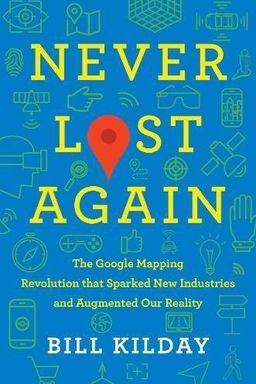
Idea 1
Building the Digital Earth
What if you could spin the planet on your computer and dive, at will, into any rooftop on Earth? That question ignited a small group of engineers and entrepreneurs at the turn of the millennium, eventually birthing Google Earth and Google Maps. This story isn’t only about code or mapping — it’s about vision, belief, and the fusion of art, innovation, and persistence that turned a dazzling demo into a global infrastructure for how humanity navigates, documents, and plays in the real world.
At its heart, the narrative follows John Hanke, Brian McClendon, Chikai Ohazama, and a team of game-engine veterans who believed the planet could be visualized and streamed in real time. From their living room demo in 1999 to the public launch of Google Earth in 2005, the group’s journey reveals how great technological leaps are made: through iterative pivots, creative business deals, and the hard-won integration of data, design, and daring ideas.
From Demo to Vision
The spark began in Austin, Texas, when Hanke and McClendon showed Bill Kilday a spinning 3D globe built from satellite imagery. When he zoomed to his own roof, he uttered the now-famous reaction: “Holy shit.” That visceral moment captured what would later define Keyhole’s ethos — making the abstract concrete through lived experience. The demo didn’t just show technology; it made people believe in the possibility of interacting with the planet itself.
But Keyhole’s founders quickly realized that belief alone wasn’t a business model. In the dot-com landscape of 2000, the challenge wasn’t whether the digital Earth could be built — it was who would pay to sustain it. The nascent company spun out from Intrinsic Graphics, leaving behind their gaming origins to become the first serious 3D mapping startup.
Technology as Enabler: Clipmapping and Streaming Earth
You couldn’t stream a whole planet in 1999 — not without a trick. Clipmapping, developed by SGI alumni like Chris Tanner, became the secret sauce that allowed Keyhole’s EarthViewer to run on ordinary PCs. By loading only the visible parts of the map and blending multi-resolution tiles, Keyhole built the illusion of infinite zoom. Game-engine logic met planetary scale, and users could now “fly” across landscapes the way Superman did in films.
Pairing this with a thick-client PC application, Keyhole used servers to stream imagery dynamically. That blend — local rendering plus streamed data — foreshadowed modern cloud computing models. The Earth was no longer a static atlas, but a living, navigable interface.
Data as Differentiator
A map is only as good as its data. Keyhole stitched together a mosaic of sources: NASA’s Blue Marble for global backdrops, commercial satellites like Ikonos and QuickBird for urban detail, and aerial partners such as Airphoto USA to capture high-resolution city imagery. Through creative revenue-sharing contracts instead of costly licenses, Keyhole achieved what few startups could: near-global coverage without running out of money. Their Earthfusion pipeline stitched, color-balanced, and tiled the world into a streamable dataset — a foundation that would later power Google Earth and Maps.
Finding Customers — and a Breakthrough on CNN
After the dot-com bust, Keyhole floundered until it found stability in enterprise customers: real estate, municipalities, and television broadcasters. The company’s trajectory changed dramatically when CNN used EarthViewer to visualize the 2003 Iraq War. What had been niche software suddenly became national news, drawing attention from the intelligence community and investors like In-Q-Tel. A $1.5 million government contract provided both validation and survival capital — proof that Keyhole wasn’t just a demo, but a defensible platform.
From Startup to Platform
As Keyhole matured, it solved another problem: sharing maps as data. Keyhole Markup Language (KML) allowed users to send entire map views — pins, annotations, even 3D flyovers — as files. This transformed maps from solitary experiences into tools for collaboration, whether in police departments, firefighting units, or courtrooms. Geography, once private and static, became communicable, dynamic, and social.
The Leap to Google and Beyond
By 2004, Hanke faced a defining choice: raise another venture round or join a fast-growing search company that wanted to organize the world’s information. Google’s acquisition offered scale and the promise of reaching billions. Despite legal delays (a patent dispute with Skyline Software), the deal closed — and Keyhole’s EarthViewer became the nucleus of Google Earth and, later, Google Maps.
Why This Story Matters
This book shows that transformative technology often starts with a moment of wonder, gains power through technical genius, and scales through pragmatic business strategy. Each phase — the living-room demo, the breakthrough CNN segment, the Google acquisition — illuminates a universal principle: innovation is not about one brilliant feature; it’s about matching vision with viable systems of data, infrastructure, and human collaboration.
The central lesson
Big maps are metaphors for big ideas: they require perspective, detail, and the courage to zoom between the two. If you want to build something world-changing, make it visceral first — and only then make it viable.