
Idea 1
When Achievement Becomes a Measure of Worth
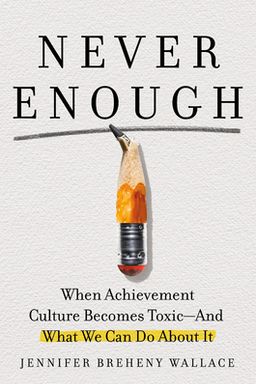
How can we raise children who thrive without crushing them under the pressure to succeed? In Never Enough, journalist Jennifer Breheny Wallace argues that modern achievement culture—one that equates success with worth—is quietly eroding our children’s mental health, balance, and joy. Drawing on extensive interviews, research in psychology and neuroscience, and firsthand stories from families across America, Wallace contends that we’ve built an environment in which being “enough” is always conditional—based on grades, trophies, or reputation—rather than intrinsic self-worth.
The book’s central argument rests on the concept of mattering: the feeling that we are valued and that we add value to society. Mattering, Wallace explains, is the antidote to performance-based identity and the key to protecting youth from anxiety, depression, and burnout. She frames this idea against an unsettling paradox—children from privileged, high-achieving schools are now identified by researchers as an “at-risk” group, suffering rates of mental illness comparable to those in poverty or violence-plagued environments.
The Achievement Pressure Trap
Wallace depicts a nation obsessed with performance. From affluent suburbs to elite prep schools, students endure relentless expectations to excel academically, athletically, and socially. Parents, shaped by status anxiety and fears of scarcity, unwittingly become agents of this pressure—engineering résumés in childhood, optimizing every moment, and viewing success as the ultimate proof of good parenting. The book’s opening story, of a high school athlete named Molly who studies until midnight and literally runs laps with her eyes closed, encapsulates this phenomenon of “children running with their eyes shut.” They pursue excellence without purpose, rest, or reflection.
A Crisis Hidden in Plain Sight
Wallace’s investigation began after the U.S. Surgeon General reported that one in three American high school students and half of female students feel persistently sad or hopeless. What startled her most was research revealing that adolescents in high-performing schools are now classified as “at-risk,” facing elevated levels of anxiety, depression, and substance abuse. These children aren’t struggling because they are poor or disenfranchised—they are suffering because they feel they only matter when they achieve. Their communities equate success with safety, creating what psychologists Suniya Luthar and Madeline Levine have called the “gilded pressure cooker.”
Why the Adults Are Anxious Too
Parents feel trapped by hypercompetitive norms. Wallace’s national parenting survey revealed that 83% believe their child’s success reflects their own parenting and 80% agree that children in their communities are under “excessive pressure to achieve.” They fear falling behind socially or professionally if they don’t keep pace. These emotions—status safeguarding and scarcity fear—stem from societal shifts: widening income inequality, declining upward mobility, and uncertainty about the future. Parents equate achievement with security, inadvertently transmitting their anxiety to their children. In Wallace’s interviews, even loving parents admitted that their affections sometimes felt conditional—that their warmth spiked when their kids excelled and cooled when they stumbled.
The Power of Mattering
The turning point of Wallace’s argument emerges in her introduction to mattering, a term coined by sociologist Morris Rosenberg and expanded by psychologist Gordon Flett. Mattering means believing that you are noticed, valued, and depended on; it is the psychological core of belonging and purpose. Children who know they matter—who feel appreciated for their character, not just their performance—are more resilient and compassionate. Wallace identifies students and families who thrive despite pressures: they emphasize connection over competition, treat rest and relationships as sacred, and model self-worth independent of results.
A Blueprint for Change
Each subsequent chapter expands this framework. Wallace unpacks parental anxiety (“Name It to Tame It”), explores how to untangle self-worth from achievement (“The Power of Mattering”), urges caregivers to prioritize their own emotional health (“You First”), and describes how communities and schools can “take the kettle off the heat.” She also examines envy and hyper-competition, showing how relationships built on mattering—not rivalry—protect against isolation. Later chapters move from individual transformation to social impact, illustrating how fostering mattering can ripple outward—to homes, classrooms, and entire towns.
Ultimately, Wallace’s message is both urgent and hopeful. We live in a culture that insists achievement equals value, but you—and your child—are worthy simply by being. When we build environments where children know they matter, we don’t lower standards; we create the conditions for genuine excellence and enduring mental health. The book provides not just diagnosis but direction—a call to slow down, reconnect, and redefine success as something that sustains rather than destroys.