
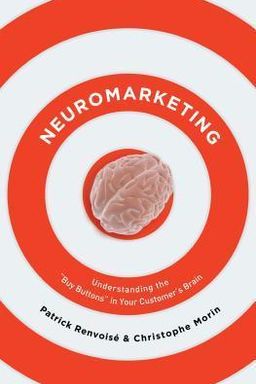
Neuromarketing cover

Neuromarketing

by Patrick Renvoise & Christophe Morin

Neuromarketing by Patrick Renvoise & Christophe Morin delves into the brain''s decision-making processes, providing innovative strategies to influence consumer behavior. By understanding and targeting the old brain, marketers can create compelling messages that resonate deeply, ultimately closing more deals and motivating action.

Selling to the Brain’s Decision-Maker

Have you ever wondered why a perfectly logical pitch fails to persuade someone, while a simple, emotionally charged message closes the deal almost instantly? In Is There a ‘Buy Button’ in the Brain?, Patrick Renvoisé and Christophe Morin argue that successful persuasion and selling are not about logic at all—they’re about speaking to the true decision-maker: the primitive part of the human brain they call the OLD BRAIN.

The authors contend that all purchasing decisions—whether we’re choosing a laptop, signing a contract, or supporting an idea—are made by this instinctive, survival-driven mechanism. The NEW Brain may reason and rationalize, and the MIDDLE Brain may feel, but it’s the OLD Brain that decides. Renvoisé and Morin call this revolutionary approach Neuromarketing, blending neuroscience and marketing to teach sellers how to engage the part of the brain that actually triggers action.

Understanding the Three Brains

Before you can sell effectively, you must understand how the human brain functions in three layers. The New Brain thinks rationally, handling data and logic. The Middle Brain feels—processing emotions, empathy, and social connection. But the Old Brain decides. This reptilian layer has evolved for millions of years to secure survival. It reacts quickly to danger, comfort, and familiarity, making decisions long before conscious thought enters the picture. Research from neuroscientists like Joseph LeDoux and Antonio Damasio (as cited in the book) supports this, showing that emotion and instinct govern choices far more than analysis does.

Renvoisé and Morin argue that most communication fails because it targets the New Brain with facts and data, which cannot make decisions. But when you speak the language of instinct and emotion—using six types of stimuli such as contrast, tangibility, and visuals—you awaken the Old Brain and compel it to act.

The Promise of Neuromarketing

The book promises a structured method for crafting and delivering messages that appeal directly to this decision-maker. It’s not just about selling merchandise—it’s about influencing any kind of human decision. You learn why buyers resist despite logical advantages, how fear shapes risk-taking, and how stories override skepticism. The authors reveal that persuasion begins with understanding what keeps your audience’s Old Brain awake—pain, emotional triggers, and tangible proof.

Through examples—from IBM’s fear-deflecting reputation (“No one ever got fired for buying IBM”) to a homeless man’s cardboard sign rewritten as “What if you were hungry?” —the book demonstrates how powerful shifts in language and emotion can double or triple persuasion success. Neuromarketing reframes selling as psychology in motion.

Why This Matters to You

Whether you’re presenting, interviewing, writing ads, or pitching clients, every attempt at influence depends on how well you trigger someone’s instinctive response. Renvoisé and Morin show you how to craft credibility, differentiate claims, and focus your message on the recipient’s pain, not your product. They promise a repeatable four-step process: Diagnose the PAIN, Differentiate your CLAIMS, Demonstrate the GAIN, and Deliver to the OLD BRAIN.

You’ll find that this framework is built on 6 Message Building Blocks—Grabbers, Big Pictures, Claims, Proofs of Gain, Handling Objections, and Closings—each of which can be supercharged with 7 Impact Boosters like emotion, contrast, and storytelling. Every step links back to neuroscience: the brain remembers beginnings and ends, not middles; it trusts faces and energy; it fears uncertainty. Your job is to translate logical value into emotional certainty.

The End Goal

Ultimately, Is There a ‘Buy Button’ in the Brain? is about mastering communication that feels compelling at a primal level. By learning the Old Brain’s language, you can turn data into stories, facts into emotions, and pitches into meaningful experiences. The authors promise that once you learn to sell to the true decision-maker in the brain, you won’t just close more deals—you’ll profoundly change how you influence, teach, and lead. The book invites you to think less like a salesperson and more like a neuroscientist who speaks directly to human nature.


The Six Stimuli That Speak to the Old Brain

Renvoisé and Morin identify six triggers that the OLD BRAIN reacts to instantly—six stimuli that bypass logical analysis and activate instinct. These are the sensory and emotional cues that determine whether someone pays attention or takes action. Mastering these makes persuasion almost automatic.

1. Self-Centeredness

The Old Brain only cares about one thing—survival. That means it’s completely self-centered. When you talk about your product, your company, or your features, you lose it. But when you talk about what’s in it for them, you win. This is why the word “you” is described as an instant brain trigger. When the homeless man changed his sign to “What if you were hungry?”, people projected the pain onto themselves—and responded. (Ken Blanchard’s advice echoes this: “Your listeners won’t care how much you know until they know how much you care.”)

2. Contrast

Without contrast, there’s no decision. The Old Brain decides by comparison—hot vs. cold, safe vs. risky, before vs. after. Renvoisé’s vivid “frog in boiling water” metaphor teaches that gradual change doesn’t register; sharp contrast provokes action. Ads that show before-and-after images use this principle perfectly. Contrast is how you show the difference between the pain of staying the same and the gain of choosing you.

3. Tangibility

The Old Brain craves the concrete, not the conceptual. Abstract phrases like “scalable solutions” or “integrated frameworks” don’t compute. But solid words—“saves money,” “stops pain,” “24-hour response”—make it trust. That’s why props, demos, and physical evidence are so effective. A cube representing Silicon Graphics’ 3D geometry engine, for instance, imprinted the message more strongly than any slide deck could.

4. Beginnings and Endings

The Old Brain remembers the start and the finish but forgets the middle. Beginning and end are prime real estate for impressions. This fact underlies the idea of a strong “Grabber” at the start and a decisive “Close” at the end. What happens in the middle is mostly forgotten—so structure your message to hit hard at entry and exit.

5. Visual Input

Vision is the fastest route to the Old Brain. The optic nerve sends signals 25 times faster than sound. That’s why ads, props, and stories that create pictures are so persuasive. From the Air Canada ad showing a sleeping passenger’s laptop still powered to Microsoft’s before/after visuals, your goal is to make prospects see their future with your product.

6. Emotion

No emotion, no decision. Emotions deliver chemical “markers” that permanently link feelings with memories and action. Fear, excitement, belonging—each triggers decision faster than logic. IBM sold “security.” Heinz sold “comfort.” Renvoisé cites neuroscientist Antonio Damasio’s proof that even intellectual reasoning depends on emotional data from the Old Brain. So if your message doesn’t touch the gut, the deal doesn’t close.


Four Steps That Turn Persuasion Into Science

The entire method of Selling to the Old Brain is summarized in one formula—four steps that rhyme for easy recall. Each step maps directly to the buyer’s subconscious process of moving from pain to relief.

Step 1: Diagnose the PAIN

Nothing happens until you understand their pain. Buyers make decisions to escape discomfort, not to gain features. Renvoisé compares this to a doctor identifying symptoms before prescribing medication. Prospects have Financial Pain (loss of money), Strategic Pain (inefficiency, poor process), or Personal Pain (stress, fear, frustration). The smartest sellers listen deeply, ask open-ended questions, and help the client acknowledge that pain. The Domino’s slogan “Thirty minutes or less” worked because it cured a specific pain: anxiety about uncertain delivery time.

Step 2: Differentiate your CLAIMS

You must prove you’re the only one who can fix their pain. Claims are your unique promises—the specific contrasts that set you apart. Instead of saying “We’re a leading provider,” say “We’re the only provider who does this.” Avis’s famous “We Try Harder” slogan is the perfect example: it reframed being number two as a service advantage. Each claim should speak directly to a type of pain—financial, strategic, or personal—and be memorable enough for prospects to repeat.

Step 3: Demonstrate the GAIN

It’s not enough to talk about value—you must prove it. The Old Brain trusts evidence, not promises. Renvoisé lists four proof types ranked by strength: customer stories (80–100%), demos (60–100%), data (20–60%), and visions (10–40%). A start-up’s product demo convinced tired investors, while other competitors only showed charts. And it worked—they funded the company the same day. Proof transforms claims into tangible gain.

Step 4: Deliver to the OLD BRAIN

Once you’ve built content around pain, claims, and gain, you must deliver it in a way that appeals to instinct. This means designing messages around six building blocks: a Grabber (to wake the brain), a Big Picture (to visualize value), short Claims, Proofs of Gain, Handling Objections, and a Close that uses “positive public feedback.” Delivery is not just talking—it’s performing, visualizing, and emotionally connecting. Every movement, pause, or expression is part of persuading the decision-maker that survival—choosing you—is safe and rewarding.


Message Building Blocks: How to Deliver Impact

When it comes time to deliver your message, Renvoisé and Morin give you six structural tools—called Message Building Blocks—that translate your ideas into brain-friendly communication. Each has one job: to engage the Old Brain from start to finish.

1. Grabbers

Grabbers catch attention at the moment of highest alert. You can use mini-dramas (like reenacting a customer’s day in pain), wordplays, rhetorical questions (“What if you…?”), props, or stories. The Agnes Perrot example, where a job applicant turned her interview into a live mini-drama of a Spanish client rescue, won her the job instantly—because she moved the panel’s emotions first.

2. Big Picture

The Big Picture is a simple, visual summary that lets your audience “see” the benefit of your product in their world. The Air Canada ad showing passengers able to charge laptops midflight is a visual cue that solves a pain—dead batteries—that words alone could not explain. Contrasted Big Pictures (before/after images) supercharge this effect.

3. Claims, Proofs, Objections, and Close

Claims are your chapter headlines. Proofs of Gain add evidence—stories, demos, data, visions. Handling Objections uses reframing, turning negatives into positives with credibility and empathy (“Some think our product costs more—but that price buys peace of mind.”). And your Close should invite Positive Public Feedback: asking “What do you think?” publicly commits people to consistency, a principle studied extensively by psychologist Robert Cialdini.

Together, these six building blocks create messages that follow a natural rhythm—engagement, visualization, reasoning, reassurance, and action—exactly as the Old Brain prefers. Instead of long, logical presentations, you design brief, sensory-rich experiences. Less telling, more selling.


Credibility: The Six Variables That Build Trust

According to Renvoisé and Morin, credibility is the invisible force behind persuasion. The Old Brain instantly reads sincerity, passion, and fear just as animals read danger—they feel it before they think it. Credibility comes from six behaviors:

1. Creativity

Be different. Add variety—colors, visuals, stories, formats—that wake the Old Brain. One SalesBrain client used a time-travel email from a future CEO congratulating the buying committee 16 months after choosing their product. It was so creative that everyone opened it within hours.

2. Fearlessness

Fear dulls credibility. Customs agents can smell anxiety, literally—the Old Brain detects sweat as danger. Practice “high intention, low attachment”: act decisively but without fear of loss. Confidence feels safe.

3. Passion

Passion is contagious. Research by Elaine Hatfield shows emotion spreads like fire. When you truly love what you do, audiences mirror your energy. Passion amplifies every word, voice, and gesture.

4. Integrity

Be honest even when it costs you. The Old Brain detects inconsistency—fake gestures, mismatched words, or dishonest claims—as survival threats. Admit what you don’t know; never fake expertise.

5. Accessibility

Similarity breeds trust. Through techniques like NeuroLinguistic Programming and “mirroring,” align yourself with your prospect’s style—dress, tone, words. The story of John Metcalfe matching the suit of an Indian university dean demonstrates that small acts of similarity create huge rapport.

6. Expressiveness

Communication lives in your voice, words, and body language. Words contribute only 7% of impact; voice adds 38%; body language supplies 55%. Stand tall, move purposefully, and make eye contact for at least five seconds—it’s the primal handshake of trust. The Vietnam War soldier’s life saved by eye contact epitomizes its power. These six factors define whether your Old Brain radiates authenticity or triggers alarm.


Emotion, Stories, and Learning Styles

Renvoisé and Morin emphasize that humans are story-driven, sensory learners. To sell effectively, you must evoke feelings and activate all learning channels—visual, auditory, and kinesthetic. Emotion, stories, and sensory variety make your message unforgettable.

Emotion: The Trigger

Emotion moves memory. Research by Joseph LeDoux and Antonio Damasio shows decisions begin emotionally, not rationally. Ads that place you “inside the action,” like a first-person perspective of speeding over rocky terrain, pull viewers into gut-level reaction. The DrugFreeAmerica ad that showed a child spraying inhalants created instant parental fear—a visceral Old Brain charge.

Stories: The Language of the Old Brain

Stories create sensory worlds where your audience feels experiences rather than analyzes words. Churchill’s tale about the Gatling gun shifted military policy because it allowed listeners to live the fear and relief of war. When you tell stories about customers or your own struggles, you signal caring—the primal bond that opens the audience’s defenses. (Noel Tichy ranks storytelling among top leadership traits.)

Learning Styles: Visual, Auditory, Kinesthetic

40% of people learn visually, 20% by hearing, and 40% kinesthetically. Most presentations rely only on auditory information—words and slides. The Old Brain prefers multisensory input: let people see with images, hear emotion in your voice, and feel by touching props or participating. Involve them directly—ask for opinions, have them move, or perform demos themselves. This keeps attention alive and ensures retention beyond logic.

When you combine emotion, story, and sensory experience, your message bypasses skepticism entirely. The Old Brain can’t tell fiction from reality—so use imagination ethically to make truths vivid. Great sellers, teachers, and leaders are all storytellers who help others feel the gain before they analyze it.


The Power of Simplicity: Less Is More

Once you understand how the Old Brain works, you realize it hates complexity. Renvoisé and Morin’s final lesson is simple: simplify. “Less is more” means focus your message on one pain and one gain, remove clutter, and leave only what causes movement.

A complex pitch demands energy the Old Brain won’t spend. The authors show that simplifying presentations not only improves clarity but also shortens sales cycles dramatically. One client reduced a two-hour pitch to forty minutes and ended up winning the deal—because the audience had time to converse instead of glaze over.

Simplification doesn’t mean dumbing down; it means sharpening contrast and emphasizing essentials. Ask yourself, “So what?” about every part of your message. If it doesn’t answer the prospect’s pain or clarify the gain, cut it. Focus on your top three claims, because research shows humans remember in groups of three. Remove middle sections, clean up words, and tighten visuals until only the core remains.

“Instead of telling more, sell less—but better,” the authors write. Every second, every image, every sentence must have purpose. This is not minimalism for style—it’s precision for memory.

So, when you build your next presentation or email, think like the Old Brain: keep it short, concrete, emotional, and visually strong. Remove everything that doesn’t make the decision easier or safer. You’ll sell faster, persuade deeper, and be remembered longer—not for what you said, but for what you made them feel.

Dig Deeper

Get personalized prompts to apply these lessons to your life and deepen your understanding.

Go Deeper

Get the Full Experience

Download Insight Books for AI-powered reflections, quizzes, and more.