
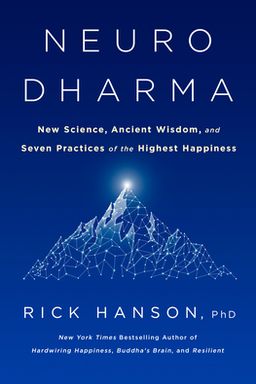
Neurodharma cover

Neurodharma

by Rick Hanson

Neurodharma presents a transformative journey to true happiness by blending the wisdom of Buddhism with breakthroughs in neuroscience. Rick Hanson outlines seven practices that foster calmness, compassion, and presence, offering meditation techniques to enhance well-being and resilience.

Awakening the Mind Through the Brain

Have you ever wondered how science and spirituality could come together to explain human flourishing? In Neurodharma, psychologist Rick Hanson offers one of the most comprehensive syntheses of ancient Buddhist wisdom and modern neuroscience. He argues that awakening—the highest potential of the human mind—is not a mystical mystery but a trainable process grounded in our biology. Through cultivating seven progressive practices—steadiness, lovingness, fullness, wholeness, nowness, allness, and timelessness—you can reshape your brain toward profound peace, compassion, and insight.

Hanson contends that enlightenment is not a supernatural state or reserved for monks and mystics. Instead, it’s a natural expression of the brain’s ability to change itself through repeated experiences—a process known as positive neuroplasticity. Where Buddhism identifies the path to end suffering, neuroscience explains the mechanism by which this can happen physically. Every moment of mindfulness, kindness, or calm strengthens neural networks that support those qualities. Over time, they move from fleeting states to lasting traits. Awakening, in this sense, is an applied science of self-directed evolution.

The Mountain of the Mind

Hanson begins with a vivid metaphor: awakening is like climbing a mountain. At the summit are the enlightened beings who embody peace and wisdom; the path below is where each person takes steps toward their own potential. We’ve all glimpsed this “highest happiness”—moments of wholehearted presence, compassion, or stillness—but rarely stay there. Neuroscience, he says, gives us tools to climb more efficiently. By understanding how attention and emotion are encoded in brain networks, we can turn spiritual insights into practices that literally rewire our nervous system for joy and resilience.

Mind in Life: The Bridge Between Worlds

The book begins by connecting mind and life. Hanson defines mind as the flow of experiences and information represented by the nervous system. The brain, a three-pound organ of roughly 85 billion neurons, constantly fires to create the tapestry of consciousness—a modern echo of the Buddha’s teaching that life and mind are interdependent. This “enchanted loom,” as he calls it, weaves our perceptions, emotions, and insights moment by moment. Understanding this biological basis does not reduce spirituality; instead, it empowers it. The mind is more than mere matter—it’s the pattern of meaning that matter makes possible.

Why It Matters: Ending Suffering in Practical Terms

The central problem of human life, Hanson reminds us, is suffering—what Buddhism calls dukkha. Most of our pain is not physical but psychological, generated by the reactive patterns of craving, aversion, and grasping. The Buddha’s Four Noble Truths describe this process as a cycle; Hanson translates these truths into tasks the nervous system can accomplish: understand suffering, let go of craving, experience its cessation, and cultivate the path. By reframing spiritual progress as biological learning, Hanson turns enlightenment into a practicable goal for us all.

Seven Practices of Awakening

Each of the seven practices builds on the previous, moving from stabilizing the mind and heart toward transcending the boundaries of time and self:

  • Steadying the Mind: Cultivating laser-like concentration and emotional equilibrium.
  • Warming the Heart: Opening compassion and kindness through both psychology and neural circuitry.
  • Resting in Fullness: Dissolving craving by feeling already safe, satisfied, and connected.
  • Being Wholeness: Healing internal divisions by integrating all parts of the self.
  • Receiving Nowness: Living fully at the leading edge of experience—the ongoing creation of time itself.
  • Opening into Allness: Realizing interconnection with all beings and phenomena.
  • Finding Timelessness: Touching what is unconditioned—beyond birth and death, cause and effect.

Hanson holds that these practices are not mystical abstractions but measurable psychological states that have neural correlates. They unfold gradually—let be, let go, let in—and culminate in “taking the fruit as the path”: living everyday life from the fullness of awakening itself. The result is not detachment or ascetic withdrawal but a vibrant, embodied peace available to anyone, anytime. By blending dharma and neuroscience, Hanson shows that awakening is the natural flowering of your brain’s deepest potential.


Steadying the Mind

The journey begins with balance. Hanson notes that before you can realize higher insights, you must learn to hold your attention steady—like a flame undisturbed by wind. This is the foundation of Buddhist samadhi (concentration) and modern cognitive training. Without steadiness, he explains, the mind is a skittering monkey, jumping between distractions, emotions, and impulses. With steadiness, it becomes a laser beam—illuminating reality clearly and cutting through confusion.

The Brain Behind Attention

Neuroscience mirrors this ancient insight. Hanson cites studies showing that mindfulness and meditation increase the thickness of the prefrontal cortex, the seat of executive control, and calm hyperactivity in the amygdala, the brain’s alarm center. These changes enable sustained focus and emotional equanimity. When attention is steady, it activates neural systems for pleasure and reward, making concentration feel good. The jhanas—deep states of meditative absorption described by the Buddha—are the apex of this practice when the mind merges completely with its object.

HEAL: Rewiring for Calm

To cultivate steadiness, Hanson introduces his signature HEAL Process: Have a beneficial experience, Enrich it, Absorb it, and Link it. These steps translate neuroplasticity into daily practice. When you notice peace or joy, stay with it for several breaths, feeling it in your body. This sustained activation strengthens neural circuits for calm. Through repetition, fleeting moments of focus become ingrained traits. Over weeks and months, you “install” inner strength as physical structure in your nervous system (similar to practices in Hardwiring Happiness). The result is a mind that stabilizes itself naturally even amid chaos.

From Monkey Mind to Mountain Stillness

Hanson recounts his own evolution from distracted college meditator to seasoned practitioner. He realized that relaxation and effort are not opposites—they cooperate. You need both the willful “top-down” focus of intention and the embodied “bottom-up” sense of flow that emerges when awareness steadies itself. The Dalai Lama, he notes, exemplifies this union: calm yet vibrant, disciplined yet spontaneous. When the nervous system returns again and again to this resting state of equanimity, it becomes our default home base—the biological equivalent of peace.

“Going down to a river that is flooded and turbulent, if you are swept away by the current—how can you help others across?” (Sutta Nipata 2.8)

At its core, steadying the mind is about building the inner keel that keeps the boat upright amid life’s worldly winds—gain and loss, pleasure and pain, praise and blame. Once concentration is firm, insight naturally follows. You stop being pulled by craving and reactivity, and instead rest in clarity, stability, and joy. The still mind is not suppression—it’s freedom. Hanson says: “To steady the mind is to make it your friend.”


Warming the Heart

Steadiness without warmth can become cold discipline. Hanson’s second step, Warming the Heart, transforms inner stability into compassion. Drawing on both psychology and the Dalai Lama’s teachings, he describes love not as sentimentality but as a biological capacity that can be strengthened like a muscle. In the same way that meditation thickens the cortex, lovingkindness practice (metta) rewires the brain’s social networks for empathy and connection.

The Biology of Kindness

Acts of compassion trigger the release of oxytocin and dopamine, dampening the stress-driven amygdala and promoting feelings of safety. Hanson’s “bodyguard of the Dalai Lama” story personifies this balance: strength without aggression, vigilance without hate. Love protects without clinging. In neuroscience terms, it integrates the social engagement system of the vagus nerve—connecting heart, face, and voice—with emotional regulation centers. This physiological grounding makes kindness a literal state of calm in the body, not mere ideology.

Cultivating the Boundless Heart

The Buddha’s Metta Sutta forms the spiritual blueprint: cultivate good will “above, below, and all around.” Hanson reinterprets this through categories of practice: benefactor, friend, neutral person, self, and challenger. You learn to send kindness first to someone you love, then expand the circle outward to those indifferent or difficult. This progression dissolves the illusion of separation. Over time, “us” expands to include all beings. Empathy becomes effortless.

Self-Compassion and the Two Wolves

Self-compassion—often the most neglected form of love—is crucial. Hanson likens our emotional life to two wolves inside each heart: one of love, one of hate. The wolf we feed wins. Modern science agrees; negative bias makes anger stick easily, so you must deliberately reinforce kindness to balance it. He encourages small, physical acts—placing a hand on your heart, breathing warmth into your chest—to embody compassion. This rewires your nervous system toward tenderness and reduces shame.

“Just as a mother would protect her child, her only child, with her own life, even so you should cultivate a boundless heart.” (Sutta Nipata 1.8)

When the heart warms fully, it becomes blameless. Generosity and forgiveness flow naturally. You stop harming others—or yourself—and live from what Hanson calls “the bliss of blamelessness.” Like tides drawn by gravity, love becomes the energy that moves life without effort. Compassion, he writes, is not weakness—it’s our true strength.


Resting in Fullness

If craving is the root of suffering, then fullness is its remedy. Hanson argues that the key to liberation lies in feeling already complete—safe, satisfied, and connected. This is not rejection of desire but recognition that beneath all wanting is a sense of lack, and that lack can be dissolved by directly cultivating its opposite: the feeling of enoughness. Resting in fullness transforms the reactive mind into what Hanson calls the responsive mode or “Green Zone.”

Understanding Craving

Drawing from both Buddhist insight and neuroscience, Hanson explains that craving has three roots—social, visceral, and cognitive. Social craving arises from insecurity and comparison; visceral craving from unmet biological needs for safety, satisfaction, and connection; cognitive craving from misunderstanding reality as permanent or self-contained. Each form can be healed through corresponding practices of relationship, fullness, and recognition. Psychology brain-maps these drives to the salience, default mode, and executive networks, which regulate our responses to threat and reward.

Petting the Lizard, Feeding the Mouse, Hugging the Monkey

One of Hanson’s most memorable metaphors describes how we meet our needs across evolutionary layers of the brain: the reptilian brain seeks safety (“pet the lizard”), the mammalian seeks satisfaction (“feed the mouse”), and the primate seeks connection (“hug the monkey”). Each layer must be calmed and fulfilled. Through mindful attention, gratitude, and love, you can reassure each level—helping the body relax and recover from chronic stress. Physiologically, this strengthens the parasympathetic nervous system and engages neurochemicals like oxytocin and natural opioids, promoting genuine contentment.

The HEAL Practice Applied

To install the sense of enoughness, Hanson extends his HEAL method. After recognizing a positive experience—peace, gratitude, love—stay with it for a dozen seconds, sense it in your body, and absorb it deeply. Link it to old wounds or feelings of lack, letting the positive soothe and replace the negative. Over time, these micro-moments accumulate into an enduring core of fulfillment. “Each breath,” he says, “plants a flower where there once was a weed.”

Resting in fullness doesn’t mean complacency. You still pursue goals and help others—but without pressure or grasping. It is aspiration without attachment. When you truly feel already full, you stop fighting life and begin sailing with its winds. The Buddha’s teaching echoes this perfectly: “There is no greater woe than discontent.” Contentment, Hanson writes, is not small satisfaction—it is liberation itself.


Being Wholeness

Wholeness is the antidote to inner division. After calming craving, Hanson turns inward to heal the fragmented mind. Modern life encourages compartmentalization—roles, identities, emotions—all like separate rooms in a house. Being whole, he explains, means opening every room. It means accepting every part of yourself without judgment while aligning them in harmony. When nothing inside you fights with anything else, peace becomes enduring.

The Split Mind

Our sense of self arises from midline cortical networks that support narration, self-evaluation, and emotional rumination. They create stories—the “I,” the “me,” the “mine.” While useful, these also fragment us. The lateral networks on the sides of the brain represent holistic, sensory experience. Meditation shifts activity from those midline areas of “doing” to lateral ones of “being.” Hanson describes this shift as moving from verbal analysis to embodied awareness—from thinking your life to feeling it.

Acceptance and Integration

Tara Brach’s concept of radical acceptance runs throughout this chapter. You start by acknowledging what’s present: fear, shame, anger, joy. Nothing is denied. “Light and air heal,” Hanson says. Acceptance is not resignation; it’s the integration of truth. He suggests exercises like focusing on bodily sensations, naming emotions aloud, and visualizing inner parts meeting each other kindly. The act of inclusion itself is transformative.

Tranquility Through Unity

As you open every inner door, serenity arrives. When the brain no longer partitions experiences, it quiets. Hanson compares this state to a pond settling after turbulence, revealing its clear water and the jewels beneath. Tranquility is not escape—it’s clarity born of wholeness. The ancient sutras call this condition “unhindered mind.” It’s the same neural peace that follows when cortisol drops and the parasympathetic system dominates.

Over time, the mind learns to rest as a single undivided field—awareness with everything included. Thoughts become clouds in a vast sky; they can pass without storm. Hanson invites you to experience this directly: “Simply be what you are—a whole person unfolding seamlessly in the present.” Wholeness is not perfection—it is completion.


Receiving Nowness

What is the present moment, really? In one of the book’s most striking chapters, Hanson merges physics, psychology, and mindfulness to reveal the mystery of time itself. He draws on physicist Richard Muller’s claim that the universe continually creates new moments as it expands—meaning every breath literally generates time. “We are at the leading edge of creation,” Hanson marvels, “witnessing the birth of now.”

The Neuroscience of Attention

Your awareness of the present depends on four neural networks: wakefulness (vigilance), alerting, orienting, and evaluating. They each activate in microseconds when something new enters consciousness—the phone rings, the deer crosses the road. Meditation trains these networks to stay active without stress, keeping you “tranquil and alert.” Hanson likens consciousness to a windshield moving through time; by sharpening attention, you draw closer to the front edge of that windshield—to the instant creation of reality.

Tranquil and Alert

The town motto of Barre, Massachusetts, home of two meditation centers, becomes Hanson’s mantra: Tranquil and Alert. He explains that modern attention disorders stem from underdeveloped right-brain networks that govern spacious awareness. By practicing wakefulness (not stress), alerting (fresh curiosity), and orienting (knowing where you are), we rebuild these circuits. Simple acts—like noticing breath at the chest and belly, labeling sensations “rising…falling,” or watching thought waves pass—anchor us in now.

Freedom Before Suffering

In Buddhist psychology, experiences consist of five aggregates: forms, tones, perceptions, formations, and awareness. Hanson notes that in the first three—raw sensation, tone, and categorization—there is little suffering; craving hasn’t yet attached. By staying close to that frontier, you live “before suffering arises.” This is how present-moment mindfulness dissolves pain: it undercuts the neural machinery of craving before it takes hold.

Receiving nowness, then, is both scientific and spiritual. It lets you inhabit each instant before stories form. Hanson ends with an image from Zen master Dōgen: “For the time being is all the time there is.” When you abide at the front edge of now, you realize timelessness flickering beneath time—the awareness that never fades even as moments come and go.


Opening into Allness

Once steady in presence, you can dissolve boundaries altogether. Hanson’s sixth practice, Opening into Allness, explores the disappearance of the self and the direct experience of interconnection with everything—the ocean rather than the wave. Drawing from both Buddhism’s concept of non-self and James Austin’s neurotheological research, he explains that such experiences reflect a shift from egocentric to allocentric brain processing. When the self-centered networks quiet, the world shines forth as unity.

From I to Everything

The Buddha’s teaching to Bahiya frames this paradox: “In seeing, there is only seeing.” When we stop adding an “I see,” perception becomes unbounded. This dissolves the illusion of a fixed self, which neuroscience confirms is an ever-changing pattern scattered across many brain regions—impermanent, compounded, and dependent. Hanson compares it to a unicorn: a vivid idea with no true existence. Once this “I-maker” quiets, consciousness unfolds impersonally, freeing us from defensiveness and fear.

The Neural Leap Into Oneness

Neuroscientist James Austin describes spontaneous awakenings as moments when GABA-releasing neurons suppress the thalamus, halting the normal flow of self-referential signals. The result is a non-dual state—no inside or outside, no me or you. Hanson calls this “allocentric experiencing,” a wide-angle view that replaces the narrow tunnel of ego. Some awakenings arrive suddenly, others gradually, but they share a neurological quieting of separation. “It is not that you merge with the world,” Austin writes, “but that you realize you were never apart.”

Allness in Daily Life

Hanson blends cosmic science with everyday practice. You can sense allness by expanding awareness outward—seeing the sky, feeling air enter and leave, knowing plants exchange breath with you. He quotes Thich Nhat Hanh: “You cannot drink your tea without drinking your cloud.” In these insights, inter-being becomes fact. On the cellular level, every atom of the body comes from stars; on the psychological level, every thought arises from relationships and culture. Realizing allness transforms isolation into participation.

Ultimately, Hanson says, “Allness as allness is still.” It’s the recognition that while everything changes, totality itself remains unchanged. When you live from this, compassion expands naturally—you act without effort because the boundaries that separated self and other have dissolved. You do not become the universe; you awaken as its expression.


Finding Timelessness

The seventh and final practice—Finding Timelessness—is Hanson’s synthesis of philosophy, neuroscience, and mysticism. It explores what he calls “the unconditioned,” that which lies beyond cause and effect, birth and death. For Hanson, timelessness is not an abstract eternity but the still ground from which every moment arises—a dimension that can be intuited, if not fully comprehended, when the mind and body grow utterly quiet.

Three Approaches to the Unconditioned

Hanson distinguishes three ways to touch the unconditioned. First, psychological: unconditioning the mind by releasing habitual reactivity. Second, experiential: entering states of complete stillness within ordinary reality, such as deep meditative absorption. Third, transcendental: intuiting something beyond the natural frame altogether—what Buddhists call nibbana. Whether transcendence exists objectively or metaphorically is less important, he says, than the liberation it points toward: freedom from fabrication, the “quiet beneath the eddies.”

Quantum and Consciousness

Hanson aligns this idea with modern physics. If quantum entanglement requires observation for potentialities to become actualities, awareness itself may be woven into the fabric of the cosmos—a field of infinite possibility creating each moment anew. He suggests that every particle and thought arises from this same “substrate of freedom.” In meditation, when neural signals fade to near silence, we glimpse the mind’s own quantum foam: unpatterned, fertile noise before conditioning begins.

Living From the Eternal

For Hanson, timelessness is not escape but engagement. When you rest in the awareness before thought, compassion arises effortlessly. When you open to the stillness before sound, activity unfolds without strain. He writes of enlightened teachers who live this daily: “If you treat them well, they love you; if you treat them badly, they still love you.” Such love is unconditional because it flows from the unconditioned—a direct manifestation of eternity within time.

Moments of awakening, Hanson concludes, are small perforations in the veil of ignorance through which infinite light enters. Each insight tears another hole until the veil itself disappears and everything shines. To live from timelessness is to take the fruit as the path—to act, love, and serve from the realization that peace is not ahead somewhere, but already here, in the stillness beneath all change.

Dig Deeper

Get personalized prompts to apply these lessons to your life and deepen your understanding.

Go Deeper

Get the Full Experience

Download Insight Books for AI-powered reflections, quizzes, and more.