
Idea 1
Transforming the Nonnegotiable
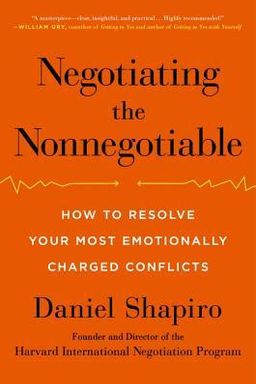
Why do some conflicts feel hopeless—so charged with moral or emotional urgency that negotiation collapses? In Negotiating the Nonnegotiable, Daniel Shapiro—founder of Harvard’s International Negotiation Program—argues that what makes many disputes intractable is not simply interests or emotions but identity. When identity comes under threat, reason alone cannot save you. People fight for meaning, belonging, and dignity—terrain far deeper than economics or logic.
Shapiro’s central claim is that to turn "impossible" conflicts into collaborative relationships, you must learn to recognize and transcend the forces that hijack identity. His model unfolds in three movements: understanding the Tribes Effect (how conflicts become tribal wars), diagnosing the emotional traps that sustain these dynamics, and practicing integrative dynamics—a relational method for rebuilding trust and shared meaning.
From Tribes to Shared Humanity
Shapiro begins with the "Davos Tribes Exercise," a microcosm of how quickly even world leaders turn cooperation into moral chaos. When participants are asked to form tribes and defend tribal values, they instantly fracture into identity-based rivalries. This illustrates the Tribes Effect: an adversarial mindset that casts the other side as immoral, contagious, and beyond redemption. Once that lens takes hold, logic fades and relationships unravel.
To prevent this slide, you must recognize that humans operate on three overlapping levels: Homo economicus (rational interest-seeking), Homo emoticus (emotionally driven), and Homo identicus (identity-driven). Most negotiation models emphasize the first two, but identity—values, rituals, and allegiances that anchor meaning—is often the hidden engine. Intractable conflict becomes negotiable only when all three dimensions are integrated.
Mapping the Identity Terrain
Identity has both a core and a relational side. Shapiro captures the essence of core identity with the acronym BRAVE—Beliefs, Rituals, Allegiances, Values, and Emotionally meaningful experiences. When one of these pillars is threatened, conflict feels existential. At the relational level, identity oscillates between two drives: affiliation (desire for closeness) and autonomy (need for freedom). When affiliation is low and autonomy feels invaded, relationships spiral. Shapiro’s practical advice is to identify which pillars and drives are under strain, then intervene modestly: offer procedural autonomy where identity feels constrained, or build affiliation through shared rituals where distance reigns.
Emotion, Vertigo, and Repetition
Even when you understand identity, volatile emotion can derail you. Shapiro calls this vertigo—a psychological trance in which you lose perspective and become consumed by the argument. Vertigo makes trivial issues feel existential. His practical antidote: name the state, jolt the relationship with a surprise act (humor, apology, or shared purpose), expand perspective, and externalize negative emotion. Handled skillfully, vertigo can become a cue for mindfulness rather than a trap.
Another emotional snare is the repetition compulsion—your unconscious drive to replay old wounds. You might provoke distance to avoid abandonment or sabotage collaboration to preserve pride. Shapiro’s TCI model—Trigger, Cycle, Impact—teaches you to map the pattern, resist the impulse, reclaim power over emotions, and replace old rituals with new habits. By making implicit patterns explicit, you can break loops that once felt fated.
From Sacred Taboos to Creative Reconciliation
Beyond everyday emotion lies a deeper territory: the sacred. When values, places, or symbols carry infinite meaning, even small threats feel catastrophic. Shapiro distinguishes between taboos (social prohibitions) and the sacred (existential meaning). Both must be handled with care, not dismissal. His ACT system—Accept, Chisel, or Tear down a taboo—helps you choose when to respect boundaries, when to gradually erode them, and when to courageously dismantle them (as Mandela did under apartheid). The same logic applies to sacred conflicts: acknowledge reverence, disentangle sacred from secular elements, and seek symbolic forms of respect that restore moral order without betrayal.
Shapiro builds toward integrative dynamics—a process that begins with uncovering your personal and collective mythos (the narrative lens shaping your identity), processes emotional pain through witnessing and mourning, builds crosscutting ties (through REACH levels of connection), and reconfigures relational structures using the SAS model of Separation, Assimilation, and Synthesis. The end goal is not compromise but co-creation: establishing a new identity system that honors difference while fostering shared humanity.
The Book’s Essential Arc
In sum, Shapiro invites you to move from the zero-sum lens of survival to a dynamic mindset of coexistence. You begin by understanding identity’s anatomy (BRAVE, affiliation-autonomy), tame emotional turbulence (vertigo, repetition compulsion), navigate the untouchable (taboos and the sacred), and rebuild through integrative dynamics and relational design. The ultimate takeaway: every seemingly nonnegotiable conflict hides a path to reconstruction through empathy, structure, and myth-making. You don’t have to obliterate differences; you can turn them into the foundation of a new shared meaning.