
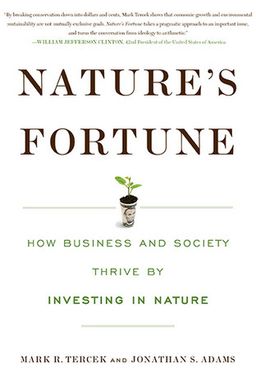
Nature’s Fortune cover

Nature’s Fortune

by Mark R Tercek and Jonathan S Adams

Nature’s Fortune challenges conventional views on development and conservation, illustrating how green investments can drive economic growth. With insights from a former investment banker, the book highlights successful cases where nature outperforms man-made systems, offering a roadmap for sustainable prosperity.

How Business Thrives by Investing in Nature

What if protecting forests, rivers, and oceans wasn’t just an act of charity—but a smart investment? In Nature’s Fortune: How Business and Society Thrive by Investing in Nature, Mark Tercek (President and CEO of The Nature Conservancy, formerly at Goldman Sachs) and coauthor Jonathan Adams argue that conserving nature is not merely a moral imperative—it’s essential to human prosperity and the foundation of modern economic success.

Tercek poses a simple but radical question: what is the true economic value of nature? He contends that ecosystems—forests, wetlands, coral reefs, grasslands—function as natural assets that provide crucial services to business and society. Water purification, soil fertility, flood control, carbon absorption—these are not free gifts, he insists, but vital components of our economic infrastructure. Yet corporations and policymakers rarely account for them in balance sheets. Tercek’s mission is to reframe nature not as scenery or charity, but as an indispensable form of capital—“natural capital”—whose proper investment enables businesses and communities to flourish.

The Natural Capital Revolution

Tercek’s story begins with his transformation from a Wall Street investment banker to environmental leader. His career at Goldman Sachs taught him to evaluate return on investment, risk, and long-term assets. When he applied those concepts to nature, he realized that the same financial principles—maximizing gains, managing assets, diversifying risk—could guide environmental conservation. Nature, he discovered, behaves like any other form of capital: invest wisely, and you yield sustainable dividends; ignore or exploit it, and the system collapses.

This principle frames the entire book. The authors explore how conservation can and should align with self-interest—how companies, governments, and individuals can find profit and resilience by restoring wetlands, forest watersheds, or coral reefs. Tercek coins crucial metaphors: nature as a “three-legged stool” where business, government, and citizens must cooperate; conservation as infrastructure akin to bridges and roads; and the environmental movement as an engine of innovation rather than a brake on growth.

Stories That Bridge Ecology and Economy

Throughout the book, Tercek weaves vivid stories showing the economic value of natural systems. We meet Carlos Salazar, CEO of Coca-Cola FEMSA, whose Latin American bottling empire depends on forested watersheds for clean water. His business dilemma—how many dollars of water come from each dollar of forest protection?—illustrates Tercek’s thesis perfectly: nature underpins every supply chain.

In New York City’s Catskills watershed, the city avoided building a multi-billion-dollar filtration plant by investing $1.5 billion in forest and farm management—saving money while preserving clean water. In Colombia, sugarcane growers fund upstream forest protection through “water funds,” creating a stable resource for irrigation and demonstrating that environmental stewardship can be good economics. In Louisiana, oyster reef restoration not only rebuilds vital ecosystems but produces jobs and boosts flood resilience—a striking image of “green infrastructure” competing with concrete seawalls.

From Wall Street to Wetlands

Tercek explains why business alliances—often viewed skeptically by traditional environmentalists—are vital for progress. Corporations control vast resources, often more efficiently than governments. When firms like Dow Chemical reimagine wetlands as part of their water-treatment strategy rather than a regulatory burden, they save millions—and set new precedents for sustainability. Such partnerships redefine conservation from protest to collaboration, a shift Tercek calls “optimistic realism.”

His argument echoes thinkers like Paul Hawken (The Ecology of Commerce) and E. O. Wilson (Biophilia): nature’s worth is both economic and emotional. Tercek expands these insights with hard data and case studies, moving beyond moral appeals to pragmatic action. “Saving nature means saving ourselves,” he writes—an assertion that rings as both moral truth and business strategy.

Why This Matters Now

The timing of Tercek’s book is crucial. Climate change, water scarcity, deforestation, and the decline of fisheries expose the fragility of economies built on natural systems. He aims to show that protecting nature is not philanthropy but smart risk management. Investing in nature, like diversifying assets, guards against long-term instability—economic and ecological alike. His vision challenges both executives and environmentalists to think beyond zero-sum trade-offs and instead find synergy between profitability and sustainability.

By reconfiguring nature as a productive asset, Tercek invites readers—especially business leaders—to see conservation as an investment opportunity. When you protect watersheds, restore wetlands, or manage forests sustainably, you’re not just preserving beauty or biodiversity; you’re securing your future cash flow, your clean air, your flood defenses, your food supply. In his words, “Saving nature means saving wild species and wild places, but it also means saving ourselves.”


Natural Capital: Seeing Nature as Infrastructure

Tercek’s central metaphor—nature as capital—frames the idea that ecosystems are assets generating quantifiable returns. Like roads or factories, forests and wetlands deliver services: water filtration, flood prevention, carbon storage, pollination. Yet these values remain invisible in conventional accounting. Businesses pay for steel beams or concrete but not for the natural infrastructure that undergirds their operations.

The Business Lens on Conservation

Coming from finance, Tercek views nature as an investment portfolio that demands careful management. Neglecting natural assets is akin to eating your seed corn—destroying future returns for short-term gain. He urges companies to manage ecosystems with the same rigor they give to financial assets. Forests, rivers, and coral reefs should appear on balance sheets as capital worthy of protection.

One striking example is Dow Chemical’s Seadrift plant in Texas. Faced with a $40 million engineering project to expand its water treatment, an employee proposed building a constructed wetland instead. Cost: $1.4 million. The wetland met regulatory standards, purified millions of gallons daily, and created wildlife habitat—proving that nature often delivers cheaper, more resilient solutions than conventional infrastructure.

The Three-Legged Stool of Sustainability

Tercek describes sustainability as a three-legged stool supported by business, government, and individuals. Each must invest in nature for society to thrive. Governments can provide incentives and clear policies—like carbon pricing or watershed protection. Businesses can innovate and fund large-scale restoration. Citizens, as consumers and voters, create demand for sustainable products and pressure lawmakers to act. When one leg falters, the system collapses.

Through this structure, Tercek reframes the role of corporations. They’re not villains but potential partners. Since big firms control huge swaths of land and resources, they hold immense power to influence outcomes. Their long-term planning horizons often exceed those of governments driven by election cycles. When corporations like Coca-Cola FEMSA fund watershed conservation in Latin America because cleaner water equals healthier profits, we see profit aligning with environmental protection.

Natural Capital and Risk Management

For Tercek, valuing nature also means managing risk. Ignoring environmental costs—deforestation, water scarcity, climate change—is not sustainable business strategy. Just as investors diversify portfolios to mitigate risk, companies must diversify resource use and invest in ecological resilience. The failure to do so (seen in Kerala, India, where Coca-Cola’s water depletion shut down production) exposes how environmental mismanagement translates into financial loss.

In Tercek’s words, “Valuing nature does not replace the moral argument for conservation; it adds an economic one.”

This approach transforms conservation from moral persuasion into business logic—inviting CEOs and policymakers to see forests and wetlands not as burdens but as assets. When companies balance profit with ecology, Tercek contends, nature’s fortune becomes humanity’s fortune.


Green Infrastructure: Natural Solutions That Pay Off

How much would you pay to stop a city’s water from turning toxic? Tercek shows that investing in ecosystems—the “green infrastructure” of forests, wetlands, and floodplains—often provides better returns than concrete engineering. From New York’s Catskill watershed to Louisiana’s oyster reefs, he documents how natural solutions can outperform expensive technical ones.

The Catskills: A Billion-Dollar Lesson

In the 1980s, New York City faced pressure to build an $8 billion filtration plant to comply with Clean Water Act standards. Instead, officials led by Al Appleton invested $1.5 billion in preserving the forests and farmlands that naturally filter water in the Catskill watershed. Collaborating with farmers and towns, they improved land management, reduced pollution, and secured clean water for generations—saving taxpayers billions and proving nature’s efficiency.

This watershed became the template for a new model called “green infrastructure”—where natural systems replace built ones. Rather than pipes, filters, and walls, cities can invest in wetlands and forests that clean water, moderate floods, and support biodiversity. Appleton’s success inspired Quito, Ecuador’s water fund, where public utilities and private companies jointly finance conservation of high-altitude grasslands (“páramo”) to maintain water supplies for two million residents.

Floodplains and Oyster Reefs: Nature as Defense

After hurricanes and floods, Tercek argues for restoring wetlands and floodplains instead of raising levees ad infinitum. In Iowa, voters passed a $150 million annual fund to rehabilitate floodplains, showing how investing in natural defenses yields social, economic, and environmental payoffs. Similarly, along the Gulf of Mexico, $1 million per mile can rebuild oyster reefs that buffer coastal communities, create jobs, and revive fisheries. This “Million-Dollar Mile” of restoration shows that resilient coasts are profitable ones.

Cities Join the Movement

Philadelphia’s $2 billion “Green City, Clean Waters” plan also exemplifies this logic. Instead of a massive pipeline system, the city invests in rain gardens, green roofs, and porous pavements to handle stormwater—saving hundreds of millions while beautifying communities and reducing pollution. (In contrast, Washington D.C.’s $3 billion gray-infrastructure tunnel plan shows the cost of ignoring natural solutions.)

Tercek urges readers to “think like an investor in nature,” asking which solution delivers the best returns over time. His answer: the ones that let nature do the work.

By highlighting cities and coastlines worldwide, he makes a persuasive case that green infrastructure isn’t sentimental—it’s efficient. Whether you’re a mayor or a CEO, protecting wetlands or watersheds is a move that pays dividends in dollars, resilience, and quality of life.


Water: The New Gold of Business

For Tercek, water scarcity—often unseen until crisis hits—is the perfect lens to show how ignoring nature’s value threatens business survival. Water is indispensable yet underpriced, mismanaged, and increasingly scarce. When Coca-Cola closed its bottling plant in Kerala, India because local wells ran dry, it revealed a corporate vulnerability Tercek calls “the hidden water risk.”

The Global Water Crisis

Tercek cites shocking figures: half of China’s rivers are severely polluted; over 300 million Chinese lack safe water. In the U.S., the Colorado River is “oversubscribed”—tapped by seven states until it runs dry before reaching Mexico. Water scarcity drives trade-offs between farmers, cities, and ecosystems, and mispricing exacerbates waste. “Water flows uphill toward money,” wrote Marc Reisner in Cadillac Desert; Tercek extends that insight by urging markets and ethics to balance who benefits and who pays.

From California to Colombia: Water Funds Work

In Colombia’s Cauca Valley, sugarcane growers created a “water fund” that invests in upstream forest conservation to guarantee reliable irrigation. With help from The Nature Conservancy and local research centers, businesses calculated that $8 million invested in watershed protection could save $45 million in avoided costs—proof that nature can outperform technology.

Throughout Latin America, over 30 water funds operate on similar principles: downstream users pay to protect upstream ecosystems. These financial instruments blend science, business, and community, turning conservation into a market mechanism. The promise: secure water supplies, reduce conflicts, and distribute benefits fairly.

Putting Price on What Shouldn’t Be Free

Tercek doesn’t shy from the moral tension: water is a human right, yet pricing it helps conservation. He argues that markets must be designed ethically—no one should be denied access, but waste must have a cost. When Nestlé bought extraction rights in Florida for $230, allowing unlimited pumping for bottled water, the absurdity proved his point: mispricing nature’s goods invites exploitation.

His fundamental lesson: ignore the economics of water, and economies themselves will dry up.

Water is the thread connecting all of Tercek’s examples—from Coke’s bottlers to Ecuador’s páramo grasslands. It’s nature’s dividend, and protecting its source may be the smartest investment any company can make.


Fisheries and the Economics of Cooperation

Tercek turns to the oceans to show how collaboration can solve the “tragedy of the commons.” Overfishing, once thought inevitable, can be reversed when communities manage their own resources through trust, property rights, and shared knowledge. The Morro Bay case in California exemplifies this shift—from conflict to co-management.

Elinor Ostrom’s Legacy

Tercek draws on Nobel laureate Elinor Ostrom, who proved that communities can successfully govern common resources without state control. In Morro Bay, fishermen and conservationists sat down together to map the seafloor and agree which zones to protect and which to fish. The Nature Conservancy bought thirteen trawling permits, leased them back under new rules, and substituted damaging nets with hooks and traps. The result: fewer bycatch losses, higher quality seafood, and healthier reefs.

Markets that Encourage Responsibility

By designing “catch share” systems where fishermen own tradable rights to harvest sustainable quotas, the frenzy of overfishing gave way to long-term thinking. Prices rose for quality fish—black cod fetching $3.50 per pound instead of 90 cents—and Morro Bay’s economy began to rebound. Technology like eCatch, an electronic mapping tool developed with TNC, allowed fishermen to share data in real time, avoiding overfished zones and improving transparency.

From Conflict to Partnership

This collaboration transformed fishermen from adversaries to allies. By viewing fish as a renewable stock rather than an infinite resource, they became stewards of the sea. The approach mirrors Ostrom’s insight: social trust is as important as regulation. Communities that govern themselves often achieve what bureaucracy cannot—resilience and shared prosperity.

“Freedom in a commons brings ruin to all,” Garrett Hardin warned; Ostrom and Tercek reply: freedom with responsibility brings renewal to all.

For Tercek, Morro Bay’s success encapsulates his core message: when people value nature deeply enough to invest in cooperation, both markets and ecosystems flourish.


Climate Change and Natural Adaptation

Climate change, Tercek warns, is the ultimate reminder of nature’s value. Rising seas, floods, droughts, and heatwaves expose how much our economies depend on ecological stability. Yet his optimism shines through: investing in natural capital—forests, reefs, wetlands—can both mitigate and adapt to climate change.

Nature as Climate Protection

Up to 15% of greenhouse gas emissions come from tropical deforestation—more than all cars and planes combined. Preserving forests is thus climate policy. Programs like Brazil’s forest protection or Indonesia’s REDD efforts (Reducing Emissions from Deforestation and Degradation) show how carbon markets can fund conservation. When you save a rainforest, you save carbon sinks, water cycles, and biodiversity—all crucial to stabilizing climate.

Putting a Price on Carbon

Tercek supports carbon pricing—whether through tax or cap-and-trade schemes—as essential to align markets with environmental reality. He cites economist William Nordhaus, who argues that raising carbon’s price is “necessary and sufficient” to curb emissions. History backs this up: when OPEC raised oil prices in the 1970s, U.S. energy use dropped dramatically. Properly designed carbon pricing can achieve similar efficiency while funding renewable energy and conservation.

Adaptation through Restoration

In Louisiana and New Jersey, wetlands and dunes protect coasts more effectively than seawalls. In Mexico’s Chiapas, trees in pastures slow floods and sustain grass during droughts. In the western U.S., “water-efficient forests” preserve snowpack longer, securing water supplies for millions. These examples show how natural systems act as living infrastructure against climate extremes.

Tercek’s equation is simple: every dollar invested in nature reduces the cost of climate disasters later.

His vision of “climate optimism” rests on recognizing nature’s resilience. If society invests intelligently now—in wetlands instead of walls, in forests instead of fuels—it can adapt and thrive even as the climate shifts. Nature’s fortune, properly managed, becomes humanity’s insurance policy.


The Business Case: Partnering for Planetary Gains

Tercek’s final argument synthesizes all others: to secure a prosperous future, business must embed nature in every decision. The “business case for nature” isn’t about charity—it’s about survival, innovation, and profitability. Businesses invest in assets; nature is the ultimate one.

From Dow Chemical to Interface

Dow’s collaboration with The Nature Conservancy exemplifies corporate transformation. At its Freeport, Texas facility, Dow calculates the dollar value of forests (for pollution control), marshes (for storm protection), and rivers (for water supply). This data-driven approach embeds ecological thinking in corporate strategy. Similarly, Ray Anderson’s carpet firm Interface aimed for “Mission Zero”—no waste, no footprint—proving innovation and profit can coexist.

Sustainability Goes Mainstream

By the 1990s, environmental responsibility evolved from rhetoric to core business strategy. Companies like 3M, DuPont, and SC Johnson embraced sustainability officers and biodiversity accounting. Studies confirm that firms with strong sustainability cultures outperform peers over decades. “The argument about sustainability is over,” economists Eccles and Serafeim conclude; it creates long-term shareholder value and resilience.

Investing in Success—Not Sacrifice

Tercek portrays corporate sustainability as enlightened self-interest. Coke protects watersheds to secure supply and reputation. Wal-Mart’s partnerships reduce resource risk. These aren’t concessions—they’re strategic investments. The more firms internalize nature’s value, the more profitable and adaptive they become in an age of scarcity.

“Saving nature means saving ourselves,” Tercek concludes, urging collaboration between corporations, governments, and citizens. Conservation isn’t counter to capitalism—it’s its next evolution.

In this closing vision, environmental investment becomes a driver of innovation, not a cost of doing business. Companies that measure and cultivate nature’s value will define the sustainable economy of the future—and ensure that both business and the planet thrive.

Dig Deeper

Get personalized prompts to apply these lessons to your life and deepen your understanding.

Go Deeper

Get the Full Experience

Download Insight Books for AI-powered reflections, quizzes, and more.