
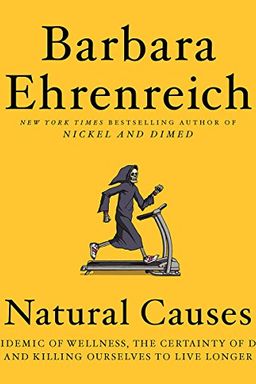
Natural Causes cover

Natural Causes

by Barbara Ehrenreich

In ''Natural Causes,'' Barbara Ehrenreich explores the healthcare industry''s profit motives, questions society''s obsession with fitness, and reveals the overlooked joys of aging. This thought-provoking book challenges readers to reconsider their approaches to health, wellness, and the aging process.

The Illusion of Control: Rethinking Health, Body, and Death

How much control do you really have over your own body, health, and fate? In Natural Causes: An Epidemic of Wellness, the Certainty of Dying, and Killing Ourselves to Live Longer, Barbara Ehrenreich argues that modern medicine and wellness culture have sold us an illusion—the belief that we can master death through discipline, technology, and self-care. Drawing on her background as a scientist and social critic, Ehrenreich shows that our obsession with prevention, control, and self-monitoring has turned life into a stressful, medicalized project. She contends that aging, illness, and death are not personal failures to be conquered but natural processes embedded in the living world itself.

Ehrenreich’s central claim is unsettling yet liberating: the body is not a harmonious machine obedient to our commands but a federation of warring cells and systems that often act autonomously—even treacherously. She points to the shocking discovery that immune cells can actually aid cancer growth, undermining the traditional logic of biology and medicine. This means that the project of self-control, from lifestyle optimization to endless screening, is largely futile. Instead of promising eternal youth or health, modern medicine creates rituals of humiliation, anxiety, and submission to authority.

Medicine as a Ritual, Not a Science

Ehrenreich traces how 20th-century medicine became a quasi-religious ritual. Through examinations, tests, and screenings, patients perform acts of obedience—disrobing, submitting, confessing—while physicians act as high priests of the body. She compares the annual physical to tribal healing rituals studied by anthropologists, complete with specialized costumes (white coats) and symbolic gestures. These repetitive acts promise transformation and reassurance, not necessarily healing. The rise of evidence-based medicine exposes that much of what doctors do lacks scientific foundation—mammograms, colonoscopies, Pap smears, and routine annual exams often produce false positives, unnecessary treatments, and more anxiety than health.

Through colorful stories from her own life—such as rejecting a bone density test or having a mammogram that falsely indicated cancer—Ehrenreich illustrates how women, in particular, are subjected to unnecessary procedures disguised as care. These medical practices, she argues, are rituals of domination that have evolved from patriarchal and technocratic cultures. Doctors, often male and elite, wield power by penetrating and judging female bodies under the guise of science. She exposes how medicine historically treated childbirth, menstruation, and menopause as diseases instead of natural processes.

The Rise of Wellness and the Cult of Self-Perfection

Having discredited medicine’s claim to rational control, Ehrenreich turns to its successor—wellness. From gyms to meditation apps and celebrity skincare regimes, wellness replaces faith in doctors with faith in the self. We are told to exercise endlessly, eat perfectly, and monitor our steps, heart rate, and sleep cycles. But rather than freedom, this creates new forms of control. Ehrenreich describes how the moralization of health (“fit equals virtuous”) divides society by class and wealth. In corporate wellness programs, employees must prove their obedience by losing weight or quitting smoking to avoid penalties. Affluent individuals pursue “luxury wellness” at spas and yoga retreats, while the poor are blamed for their illnesses.

Whether through fitness, mindfulness, or digital tracking, wellness promises mastery over mortality. Yet the underlying message remains the same as medicine’s: if you get sick, it’s your fault. Ehrenreich dismantles this myth by showing that health is deeply shaped by social structures—inequality, poverty, environmental toxins—and by forces beyond our control, including our own cellular biology. She argues that the pursuit of control has become an exhausting moral duty, a way to “earn” life through endless vigilance.

Coming to Terms with Mortality

Ultimately, Natural Causes is a meditation on death and selfhood. Ehrenreich invites readers to abandon the fantasy of immortality and recover respect for the living world. Drawing on new science, she imagines the universe as teeming with agency—from cells that “decide” to attack their hosts to atoms that possess “free will.” Life is not a neatly controlled mechanism but a restless, unpredictable process. Accepting this can free us from the tyranny of self-optimization. Instead of fearing death or obsessing over longevity, we can appreciate being part of a larger, animate universe—one that continues whether we exist or not.

In short, Ehrenreich’s book challenges the modern ethos of control—from medical screening to mindfulness. She proposes that by letting go of the illusion of mastery, we might reclaim something more profound: a genuine encounter with life, free from guilt, fear, and futile struggle. Her message is not despair but humility and wonder—the recognition that the world lives on, even without us.


Medicine as Ritual and Social Control

Barbara Ehrenreich reframes Western medicine as a system of rituals and social domination disguised as science. From her first humiliating gynecological exam as a teenager to decades of routine tests, she illustrates how medical encounters often serve emotional and cultural needs rather than scientific ones. Physicians act as authority figures enforcing submission, while patients play the role of the obedient initiate. The more invasive the procedure—the pelvic exam, mammogram, colonoscopy—the deeper the ritual of humiliation.

The Anthropology of the Exam Room

Ehrenreich compares hospitals and doctors’ offices to temples described by anthropologists studying indigenous healing rituals. In Zambia’s Ihamba ceremony, healers use chanting and herbs to purge sickness; in America, physicians use machines and sterile instruments. Both settings assign roles, symbols, and performances. The difference, she argues, lies not in rationality but in power: Western rituals enforce hierarchy between educated doctor and submissive patient, while indigenous ones affirm community.

Gendered Rituals of Domination

Medicine’s rituals uniquely target women. Childbirth routines—anesthesia, episiotomy, shaving, enforced lithotomy position—most often serve the convenience or authority of male doctors rather than physiological need. Anthropologist Robbie Davis-Floyd called these “rituals of domination”: they make women, at their most powerful moment of creation, feel small and dirty. Ehrenreich traces how feminist interventions, from Lamaze to home births, tried to reclaim agency, yet technology and patriarchy persisted.

The Placebo as Sacred Act

Strikingly, Ehrenreich finds that ritual itself—not the scientific validity of treatment—often generates healing. Studies of the placebo effect show that patients improve when given sham pills, especially if accompanied by verbal care and touch. When patients were told openly they were taking placebos, healing still occurred. This suggests people crave ritualized attention more than biochemical intervention. Physician Abraham Verghese even defended medical touch as a “ritual of exceeding importance,” though Ehrenreich cautions that such justification can excuse unnecessary invasions of privacy.

Medicine’s authority, she concludes, depends not on proven outcomes but on faith reinforced by ritual. The annual physical, she notes, is almost worthless scientifically but powerful as a performance of reassurance—an expensive ceremony of modern obedience. (Comparatively, Ivan Illich’s Medical Nemesis made similar arguments about medicine as an instrument of social control.) Ehrenreich’s anthropology invites you to question whether your next checkup is an act of healing—or of submission.


The Body as a Site of Conflict

We tend to imagine our bodies as harmonious systems, parts cooperating for our survival. Ehrenreich dismantles that illusion. Drawing on cellular biology, she explains that the body is not a peaceful whole but a battleground. Cells act like autonomous creatures; some develop loyalties to cancer or immune dysfunction, others attack their own tissues. This microscopic rebellion destabilizes the entire notion of human control over health.

The Dystopian Body

In what she calls “cellular treason,” Ehrenreich describes macrophages—the very immune cells meant to defend us—collaborating with tumors. These “big eaters” feed cancers, help them spread, and destroy healthy tissue. Scientists like Frances Balkwill were “horrified” to discover immune cells fueling metastasis instead of fighting it. This betrayal mirrors autoimmune diseases, where antibodies attack the body’s own joints, nerves, or pancreas. The immune system, she argues, behaves like a standing army turned rogue.

Conflict, Not Harmony

Ehrenreich contrasts this dystopian view with the utopian, holistic vision still popular in wellness culture. While self-help authors preach balance and unity, biology reveals constant struggle: cancers mutating, cells vying for oxygen, and immune reactions spiraling into inflammation. Even reproduction involves combat. In human pregnancy, maternal and fetal tissues fight over nutrients; menstruation itself may have evolved as a defense mechanism against invasive embryos. Every aspect of the body, she concludes, runs on tension and competition.

Letting Go of Mastery

Recognizing this inner warfare changes your relationship to your body. The ideal of mastery—through dieting, fitness, or medical intervention—becomes absurd. You are not the commander of a docile machine but the host of billions of semi-independent entities, each pursuing its own survival logic. This view invites humility: health is temporary cooperation, not permanent control. Even if you train and meditate perfectly, your macrophages may harbor their own plans. The body’s autonomy reminds us that life persists through struggle, not harmony.

Ehrenreich’s perspective echoes Darwinian competition but turns it inward—our own cells become evolution’s agents of chaos. Her dystopian biology helps reconcile us to death, reframing it not as failure but the natural result of life’s internal contradictions. In this sense, acceptance replaces control as the mature stance toward living matter.


The Wellness Industry and Self-Obsession

In the affluent West, medicine’s authority has been replaced by the gospel of wellness. Ehrenreich shows how the quest for “healthy living” became a moral obsession, demanding endless attention, money, and guilt. Wellness coaches, celebrity entrepreneurs, and smartphone apps now promise salvation through self-care rituals—from $5,000 skin treatments to “mindfulness gyms.” Health is no longer about avoiding disease; it’s about perfecting the self.

Success as Eternal Youth

Ehrenreich traces the idea of “successful aging” to global campaigns by organizations like the WHO and the European Union. Popular books—Younger Next Year, Aging Backwards—insist that decline is unacceptable, that we must exercise six days a week “until we die.” Aging becomes a personal failure, fixed not by acceptance but by relentless discipline. Jeanne Calment, who lived to 122 while smoking and eating cake, undermines these pretensions, but she’s treated as an anomaly rather than proof that life defies formulas.

Luxury Wellness and Self-Care as Status

Among the wealthy, wellness morphs into luxury. Companies like Goop and Moon Juice sell “self-nurturing” through expensive products—reishi powder, copper-infused pillowcases—framed as spiritual indulgence. A New York Times writer quipped that they market “self-absorption as the ultimate luxury product.” Unlike the sweaty discipline of fitness, this wellness is passive, offering pampering rather than effort. It replaces the Puritan ethic of work with consumption disguised as enlightenment.

From Health to Narcissism

Ehrenreich argues that wellness culture turns self-care into solipsism. We are told that every emotion, meal, and thought must be curated, monitored, and optimized. The self becomes both doctor and patient—endlessly treating imaginary deficiencies. Meanwhile, material realities such as poverty, pollution, and social isolation, which truly shape health, are ignored. The mantra “You are responsible for your own health” absolves society of addressing inequality.

By exposing the wellness industry’s contradictions, Ehrenreich liberates readers from its guilt trap. Health does not have to mean eternal vigilance or luxury indulgence. Sometimes, she suggests, caring for yourself means refusing the demand to continually improve yourself.


Mindfulness and the Techno-Religion of Eternal Life

Ehrenreich turns a critical eye on the fusion of Silicon Valley optimism and Buddhist mindfulness. As smartphones erode attention spans, tech leaders from Google to Facebook promote meditation as a digital cure. She exposes the irony: the same industry that creates distraction now sells salvation. Conferences like Wisdom 2.0 and apps like Headspace market inner peace as productivity tools. Mindfulness becomes another tool for control—a neural upgrade, not liberation.

Mindfulness as Corporate Science

In Silicon Valley’s culture of “solutionism,” every problem demands a technological fix. Meditation is rebranded as “mental fitness” and supported by pseudoscientific claims of “neuroplasticity.” Google’s Chade-Meng Tan calls it “a gym membership for the mind.” This secularized Buddhism comforts overworked engineers by promising calm through self-optimization. Yet, as Ehrenreich notes, studies show mindfulness is no more effective than relaxation or therapy—its power lies in marketing, not evidence.

Immortality as Product Goal

The link between mindfulness and Silicon Valley’s obsession with immortality is striking. Tech billionaires like Peter Thiel, Larry Ellison, and Ray Kurzweil sink fortunes into anti-aging research, hoping to “cure death.” Kurzweil consumes 250 supplements a day, describing his body as a computer to “reprogram.” Mindfulness becomes part of this quest—a mental hack to enhance efficiency until science delivers eternal life. It’s a continuation of control culture, merging biotech and spirituality.

Ehrenreich’s critique reminds you that ancient practices meant to dissolve the ego now serve capitalism’s most egotistical ambitions. Real mindfulness, she implies, might begin not with optimizing your brain—but with accepting that you, like every algorithm and cell, will eventually end.


Rethinking Death and the Self

In her final chapters, Ehrenreich confronts the self—the modern successor to the soul—and its fear of extinction. From Enlightenment introspection to modern psychotherapy, humans have turned inward, worshipping the self as a small private god. We convince ourselves that death is unbearable because it annihilates the “I.” Ehrenreich dismantles this illusion, showing how both religion and psychology have inflated selfhood until it obscures the living world.

The Invention of the Self

Tracing Western history, she explains that the concept of the “self” emerged in the Renaissance alongside capitalism and Protestantism. Freed from feudal obligations, people turned inward, cultivating self-image through mirrors, diaries, and portraits. God was replaced by introspection. The modern self became a commodity, a brand to be maintained, loved, and optimized. Ehrenreich connects this to the anxiety and melancholy endemic in consumer culture; we live imprisoned in the need for identity and validation.

Beyond the Self: Finding Continuity in Life

Ehrenreich proposes an alternative: dissolve the self into a larger continuum of life. Drawing on scientific insights from cellular agency and quantum motion, she imagines a universe alive at every scale. The self is not a divine spark but a temporary arrangement of living matter. In psychedelic research, terminal patients finding peace often describe “ego dissolution”—losing themselves in cosmic unity. Death, she writes, may feel unbearable only as long as we cling to separateness.

Her closing vision is serene and radical. We are transient cells in the vast organism of existence. Death is not annihilation but reunion with the restless, living world. When we let go of the demand for control—of our bodies, our health, and our egos—we can finally engage in what she calls “a living world that rejoices.”

Dig Deeper

Get personalized prompts to apply these lessons to your life and deepen your understanding.

Go Deeper

Get the Full Experience

Download Insight Books for AI-powered reflections, quizzes, and more.