
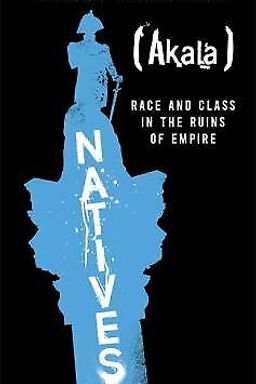
Natives cover

Natives

by Akala

Akala''s ''Natives'' masterfully combines memoir and analysis to dissect race and class in Britain. With personal anecdotes and historical insights, it challenges prevailing narratives and highlights systemic injustices endured by Black Britons. This powerful work urges readers to confront uncomfortable truths and rethink societal structures.

Race, Class and Identity in Modern Britain

How do you grow up in a society that both denies and obsesses over race? In his book, Akala argues that modern Britain’s challenges—educational inequality, policing bias, and cultural myths—can only be understood through the entwined histories of race and class. He shows how empire, whiteness, and structural hierarchy continue to shape who gets to belong, succeed, or speak, even long after slavery and colonial rule officially ended.

Akala blends autobiography, historical analysis and social critique. His mixed-heritage childhood becomes a microcosm of Britain’s racial contradictions: a five-year-old boy who learns that skin colour determines how others treat him; a mother who fights prejudice with pan-African education; and a community that builds Saturday schools to repair what mainstream institutions neglect. This personal lens widens into a panorama of imperial memory, education policy, economic inequality and cultural resistance.

The Roots of Racial Consciousness

Akala's awakening begins with a playground slur. That moment crystallises the way race intervenes in intimate spaces. His mother’s strategic honesty—explaining both her whiteness and Germany’s otherness—demonstrates how families navigate identity under racial tension. She responds by giving him political tools: tapes of Malcolm X, visits to the pan-African Winnie Mandela School, and history lessons that turn personal shame into collective understanding.

For mixed-heritage children, race becomes both inherited and imposed. You learn that identity is not a biological fact but a social script, mediated by power and history. The idea that ‘blackness’ is a social reality rather than a colour is central to Akala’s argument throughout the book.

Whiteness as Political Power

Akala deconstructs whiteness with the help of thinkers like James Baldwin, Frantz Fanon and Theodore W. Allen. He explains that whiteness is not just a skin colour—it is an evolving system of privilege designed to maintain social order. The category arose in Virginia after multiracial revolts like Bacon’s Rebellion, when colonial elites offered legal advantages to poor Europeans to divide them from Africans. Since then, whiteness has acted as a metaphor for power, shifting to protect dominant groups.

Globally, the meaning of whiteness adjusts to context. In Brazil, money itself can ‘whiten,’ transforming status and safety. Akala’s account of a gun being pointed at him in Rio until his social identity was clarified shows how racial hierarchy interacts with class and geography.

Empire, Memory, and Selective History

Britain’s discomfort with its imperial past threads through the book. At seven, Akala stands before Wilberforce’s portrait and learns a one-man abolition myth—a comforting distortion that hides centuries of exploitation and economic interests. Akala revises that narrative by reminding readers how Britain fought to preserve slavery in Haiti, paid slaveholders compensation rather than victims, and concealed colonial atrocities through projects like Operation Legacy. Memory becomes political management.

Education, Policing, and Material Reality

The heart of Akala’s critique lies in state institutions—especially schools and police. In classrooms he was labeled ‘special needs’ without cause, and in Year Ten he met teachers who equated the Ku Klux Klan with crime control. Studies confirm his experience: black children enter above average but leave as the lowest performing group due to biased assessments and disproportionate exclusions. Then, as teenagers, they meet a police apparatus that teaches them suspicion before citizenship.

Stop-and-search becomes a ritual message: who belongs, who doesn’t. From his first search at twelve to the bookstall incident decades later, Akala describes policing as social engineering masquerading as crime prevention. Alternative models like Glasgow’s Violence Reduction Unit prove that prevention and dignity work better than humiliation and fear.

Culture, Diaspora, and Resistance

Culture is both escape and strategy. Akala’s journeys to Jamaica and Scotland teach him that identity is relational and chosen. His embrace of Black British hip-hop fuses sound-system culture with political education, showing how art becomes resistance when it speaks its own vernacular rather than imitating American tropes. In sport and media, he reveals how racialized obsession and sexualisation mirror deeper fragility in whiteness.

By connecting diasporic pride to analysis of empire and class, Akala demonstrates that cultural awareness is as crucial as policy reform. Historical amnesia and media caricature—whether of Linford Christie or Frank Bruno—feed the same system of hierarchy he critiques in law and education.

Global Power Shifts and Future Resistance

Akala widens the frame to the global level: as Asia rises and Western dominance wanes, whiteness faces a crisis of identity. Brexit and Trump are not anomalies but reactions to shrinking privilege. Yet the book ends on hope. From Cuban doctors fighting disease to community mentors saving youth in London, resistance proves possible. The challenge is continuity—turning inherited wounds into active solidarity.

Core message

Race and class are intertwined systems of power, not parallel stories. To change them, you must combine education, historical truth, cultural creativity and policy courage. The book refuses despair—it offers a blueprint for clarity, dignity and resistance.


Family, Schooling and Early Racial Education

Akala’s childhood functions as a laboratory for racial socialisation. You watch how identity forms inside ordinary institutions: family conversations, classroom bias, playground cruelties. His mother’s strategy to counter racism combines emotional protection and political education—Malcolm X tapes, Muhammad Ali documentaries, and pan-African Saturday school that offers community and pride rather than assimilation.

The 'Winnie Mandela School' represents informal community innovation. These supplementary schools emerged because, as Bernard Coard’s 1971 pamphlet documented, Black children were being systematically placed in lower educational tracks. Akala’s story confirms that lived truth: misclassification as 'special needs' and teachers' lowered expectations produced psychological wounds that data later quantified.

Data and Consequences

Empirical studies by Gillborn, Mizra and others show that teacher-assessed ability consistently underestimates Black pupils compared with blind standardized marking. This gap cascades through tiered exam systems: fewer entries for higher papers, more exclusions, and reduced university access. The Department for Education’s own research confirmed institutional racism yet failed to implement preventative measures.

Akala frames school as a microcosm of structural power: what happens in education predicts inequality in adulthood. He argues that changing outcomes means acting early—by reforming curriculum content, teacher training, and evaluation systems to remove bias. Communities cannot wait for policy alone; they must retain their grassroots educational spaces where Black children can encounter themselves positively.

Key insight

Education is not neutral. It either reproduces social hierarchy or equips children to question it. Akala's life shows how collective education can transform injury into empowerment.


Policing, Violence and Structural Inequality

Policing forms another core dimension of Akala’s argument. The author recounts stops from age twelve to adulthood—each one reinforcing belonging by negation. Whether in Elephant and Castle or Sloane Square, officers’ curiosity about why a Black man inhabits affluent space expresses Britain’s racial boundaries. Stop-and-search, he notes, rarely catches criminals; it teaches who has authority.

Akala connects these patterns to historic antecedents: the 'sus' laws that resurrected vagrancy statutes and allowed suspicion itself to justify arrest. Special Patrol Group brutality in the 1980s paralleled tactics that later reappeared under different names. The political defense of such methods—seen in statements by Met Commissioners or tabloid coverage—casts racialised youth as national threats.

Class and Violence

The section on knife crime reframes public debate. Akala exposes 'black-on-black' narratives as distractions from poverty and hopelessness. He describes the psychological need for protection and status that drives teenage boys to carry weapons—a rational reaction to insecurity, not moral failing. Class emerges as the real constant: poor communities of all colours manifest the same violence when opportunity collapses.

Drawing comparison between London and Glasgow, Akala highlights how the latter’s Violence Reduction Unit successfully treated youth aggression as a public-health issue. Prevention, mediation and education achieved results where stop-and-search failed. Britain's crime conversation therefore mirrors its race conversation—focused on visibility rather than causes.

Core lesson

Justice and security depend on dignity. Policing without equality produces fear, and fear produces retaliation. Akala challenges readers to imagine safety that doesn’t depend on humiliation.


Empire, Slavery and National Amnesia

Britain’s official memory of empire is selective. Akala dismantles the comforting tale of abolition and humanitarianism represented by William Wilberforce’s portrait. In this story, empire becomes moral instruction rather than economic exploitation. Yet archival evidence reveals that British abolition compensated slave owners, punished Haiti for independence, and prolonged racial hierarchy through 'apprenticeships.'

Operation Legacy, the government’s destruction of colonial documents, exemplifies the national strategy of forgetting. By erasing evidence, Britain sustains moral innocence. Akala contrasts this with Haiti’s revolutionary courage, the Jamaican persistence of colour hierarchies, and diaspora communities’ defensive pride. You realise that the same myths that comfort the majority also suffocate honest dialogue on identity and reparative justice.

Diaspora Connections

Through travels to Jamaica and Scotland, Akala experiences how global fragments of empire shape interpersonal relations. In Jamaica, he discovers colorism—a legacy of plantation class divisions where 'high colour' signals wealth. In the Hebrides, he experiences benign curiosity rather than hostility, proving that racism is learned, not innate. Diaspora identity becomes a patchwork of geography, ancestry and politics rather than bloodlines.

Historical message

Nations choose which ancestors to celebrate and which to erase. Akala insists that confronting real imperial history is essential if Britain wants honesty rather than nostalgia.


Culture, Media and Representation

Culture in Akala’s book operates as battlefield and sanctuary. Sport, music and media become sites where black achievement triggers both admiration and anxiety. The obsession with Linford Christie’s 'lunchbox' or the BBC’s pseudo-scientific explanations for Usain Bolt reveal how success threatens entrenched notions of superiority. Media framing sexualises or pathologises excellence instead of celebrating it.

Hip-Hop and Local Voice

Akala’s own musical journey parallels this struggle for representation. Early British rappers mimicked American speech until confidence grew to embrace local accents and realities. Hip-hop became political education: Public Enemy provided vocabulary, while Channel U and SBTV democratized production and access. Cultural empowerment depended on authentic self-expression, not borrowed tropes.

Diasporic identity also underlines difference within solidarity—Harry Belafonte and Samuel L. Jackson misunderstand British racism because America’s template does not perfectly fit Britain’s subtler hierarchies. Akala urges transatlantic dialogue grounded in specificity, where solidarity honors differences rather than imposing universality.

Creative takeaway

Representation is resistance. Authentic cultural production rewrites who gets visible, who gets humanised, and who sets the narrative frame.


Global Shifts and Memory Politics

Akala widens his discussion to the global stage, exploring how shifts in power undermine whiteness as ideology. The rise of China, India and other non-Western nations forces a reevaluation of racial hierarchy that relied on Western dominance. As Akala notes, the sight of Asian women leading India’s Mars mission contradicts centuries of Eurocentric assumptions that intelligence and progress are white attributes.

Contemporary right-wing populism responds to this crisis. Trump’s election and Brexit are emotional reactions to lost status, not just economic grievances. Lord Ashcroft’s polling and Ta-Nehisi Coates’ analysis confirm that racial identity drives much modern political mobilisation, cloaked beneath nationalism or class rhetoric.

Mandela, Castro and Selective Solidarity

Akala contrasts how the West venerates Mandela while vilifying Castro, although Cuban soldiers and doctors directly helped defeat apartheid. The Battle of Cuito Cuanavale exemplified practical solidarity across borders—African liberation supported by black and brown internationalists. Western memory politics praises moral reconciliation but forgets material revolution because the latter unsettles corporate comfort.

Core reflection

Global rebalancing exposes whether racial equality is genuine principle or temporary rhetoric. Memory politics determines whether change becomes hopeful cooperation or fearful retreat.


Future Choices and Collective Resistance

In closing, Akala looks forward rather than backward. A child born into today’s Britain faces shrinking public services, harsher policing, and deepening inequality. Yet resilience remains a choice. History provides models—from anti-apartheid activism to local community schooling—to show that sustained resistance works.

Akala blends realism and optimism. His vision of progress depends on merging policy reform with cultural consciousness. He advocates policing that protects rather than provokes, education that uplifts rather than excludes, and politics that measures progress by dignity rather than GDP. Cross-cultural solidarity—between diaspora communities and across borders—offers the most durable path toward equality.

Final message

History is not inevitable. Every generation chooses whether to reproduce privilege or build fairness. Akala invites you to take the latter route—for yourself, your community, and the unfinished future of Britain.

Dig Deeper

Get personalized prompts to apply these lessons to your life and deepen your understanding.

Go Deeper

Get the Full Experience

Download Insight Books for AI-powered reflections, quizzes, and more.