
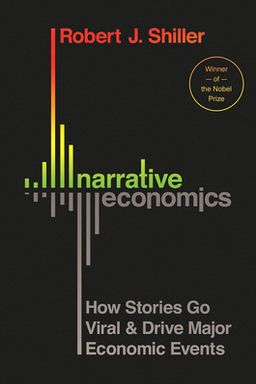
Narrative Economics cover

Narrative Economics

by Robert J Shiller

Narrative Economics by Robert J. Shiller explores how viral stories, rather than just numbers, drive major economic events. From Bitcoin''s rise to stock-market crashes, it reveals the powerful role collective narratives play in shaping economies, providing insights that go beyond traditional economic analysis.

Stories as Economic Forces

What if booms, busts, and policy shifts were not only about data and models, but about the stories you and others tell? In Narrative Economics, Nobel laureate Robert J. Shiller argues that contagious narratives—economic stories marked by emotion, moral meaning, and repetition—drive real-world outcomes as powerfully as interest rates or productivity trends. He asks you to look at the economy as a network of storytellers whose shared beliefs can amplify or calm business cycles.

This view challenges the sterile image of homo economicus. Shiller urges economists to embrace cross-disciplinary methods—epidemiology, history, psychology, literary theory—to understand how ideas spread. Words, images, and icons, once viral, alter consumption, investment, regulation, and policy. As he puts it: “Changes in the popular narrative cause changes in the economy.”

From Curiosity to Causality

Narrative economics moves beyond treating stories as colorful background. It treats them as causal mechanisms that change expectations and behavior. When people believe “house prices always rise,” they borrow more and fuel bubbles; when the tale turns to “automation will take your job,” they spend less, deepening recessions. Shiller shows how such beliefs explain forecasting failures: traditional models rarely include the contagious spread of confidence or fear.

This is not an argument against quantitative science. It’s a call for consilience—using psychology, linguistics, and epidemiology to build a broader economics that mirrors how humans actually think and talk. (Note: This echoes work by Keynes, who integrated psychology and uncertainty into early macro theory, but Shiller adds modern data and diffusion modeling.)

Epidemics of Ideas

Shiller draws on epidemic models—especially the SIR framework—to show how ideas propagate. Some people are “susceptible” (open to the story), some become “infectious” (retelling it), and others “recover” (stop retelling). The balance of contagiousness versus forgetting determines if a narrative fades or becomes an outbreak. Think of the bimetallism craze of the 1890s or the Bitcoin boom of the 2010s: both show hump-shaped epidemic curves in media and public interest data.

Crucially, small differences in contagion or recovery rates—boosted by media attention or iconic imagery—can make the difference between a transient fad and a macroeconomic upheaval. Super-spreaders matter: celebrities, journalists, or thought leaders can push a narrative above its critical threshold.

Why Stories Stick and Spread

Virality depends on emotional resonance, simplicity, and shareability. Memorable visuals or metaphors—Laffer’s napkin curve, “cross of gold,” or “rocket to the moon” memes in crypto—act as mnemonic anchors. These features make narratives not just recalled but retold. Mutation also plays a role: small changes in phrasing or context give the story new life, much like genetic adaptation in biological epidemics.

Randomness still matters, but Shiller emphasizes structure: successful stories usually have identity appeal, social proof, and moral stakes. Even false narratives can outperform truth because they circulate faster, reach larger audiences, and reinforce belonging. Policymakers must therefore pair facts with effective counternarratives, not just fact-checking.

Narratives as Macroeconomic Engines

Across history, Shiller identifies recurring families of narratives—panic and confidence, technological unemployment, housing bubbles, patriotic identity, or moral blame. Each reappears in new forms depending on economic context. For instance, labor-saving machine fears in the nineteenth century echo today’s AI and automation debates; frugality and conspicuous consumption alternate in post-crisis cultures. These sequences show that narrative contagion shapes collective behavior, not isolated beliefs.

In all such cases, the numbers—the GDP or inflation rate—reflect narrative states. Confidence surveys, policy outcomes, and investment surges follow waves of shared stories. From FDR’s “only thing we have to fear is fear itself” to Reagan’s supply-side optimism, effective leaders shape economic direction through narratives that blend facts with emotion.

A Discipline of Consilience

For the field to mature, Shiller calls for systematic data collection: large-scale text analysis of historical documents, digital archives of public rhetoric, and psychological experiments on narrative persuasion. Neuroscience confirms that stories activate empathy-related hormones like oxytocin and cortisol—biological channels through which stories influence motivation and trust.

Ultimately, Shiller’s message is that stories are not noise—they are the code beneath economic behavior. If you learn to track their spread, measure their force, and craft new ones with integrity, you can forecast and influence economic tides. Narrative economics, then, is both diagnosis and therapy: it teaches you how belief becomes behavior, and how storytelling can become a tool for economic resilience.


Epidemics of Economic Ideas

One of Shiller’s most creative contributions is modeling narratives the same way epidemiologists model diseases. Using the SIR framework (Susceptible, Infectious, Recovered), he shows that ideas circulate through populations with measurable contagion rates. The strength of a narrative’s spread depends on how often people encounter it, how persuasive it feels, and how slowly they forget it.

Contagion, Recovery, and Thresholds

You can think of “contagion” as the number of people exposed through conversation, media, or memes; “recovery” as the rate at which they lose interest. If the contagion-to-recovery ratio exceeds one, the story spreads exponentially. This helps explain boom cycles (e.g., 1920s optimism or Bitcoin euphoria) and sudden collapses when stories saturate and fade.

Shiller compares narrative curves with disease data and finds strong parallels: Google Ngram frequencies for “bimetallism,” “Keynesian multiplier,” or “Bitcoin” mimic epidemic shapes. Co-epidemics can occur when reinforcing stories mix—like technological unemployment plus income inequality—leading to bigger psychological and economic impacts than any single narrative could produce.

Super-Spreaders and Institutions

In the age of social media, some actors act like “Typhoid Marys” for ideas: Elon Musk, celebrity investors, viral journalists, or policy influencers with massive reach. A handful of super-spreaders can push a narrative above its tipping point. Institutions—from newspapers to online platforms—thus play the same role as crowding in diseases: they boost exposure density and accelerate outbreaks.

(Note: Epidemiological thinking isn’t new in social science, but Shiller’s innovation is quantifying it with economic data and time series. It bridges macroeconomics and memetics.)

Forecasting Implications

If you know the mechanics of contagion, you can anticipate which stories might move markets. Monitor contagion rates (media frequency, topic search spikes) and recovery rates (declining mentions, novelty exhaustion). For policymakers, this suggests that turning points—when an idea begins to fade or merge with others—may precede economic shifts, just as declining infection rates anticipate epidemic peaks.

Takeaway

Narrative epidemics can be measured, modeled, and perhaps managed. The challenge is not knowing which story starts next—but understanding when a familiar one becomes dangerously contagious.


Case Study: Bitcoin and Modern Mythmaking

Bitcoin is Shiller’s showcase example: a contemporary story that went from obscure technical proposal to global belief system. He interprets Bitcoin not just as cryptocurrency but as narrative contagion—an idea whose power lies more in its mythos than in its math.

Narrative Ingredients

The Bitcoin saga combines several contagious elements: an anarchic plot (“freedom from government control”), a mysterious hero (Satoshi Nakamoto), and early-adopter legends (ordinary coders becoming millionaires). These give ordinary investors emotional attachment and moral justification. Its language—“mining,” “blockchain,” “digital gold”—transforms abstract code into tangible imagery.

Ideological and Emotional Hooks

Bitcoin thrives on identity. It resonates with libertarian ideals, hacker ethics, and post-2008 distrust of elites. Many see it as rebellion against central banks or as protection from inequality. Shiller traces that emotional DNA to nineteenth-century anarchism and twentieth-century cyberculture. Even people who can’t define “elliptic curve cryptography” feel empowered by its moral theme of autonomy.

(In parallel, Warren Buffett’s dismissal of Bitcoin as “a gambling device” misses the point that narrative belief—not intrinsic value—drives demand.)

Lessons for You

Watching cryptocurrencies through a narrative lens reminds you why valuation moves faster than technical progress. Prices follow faith in others’ faith—classic contagion dynamics. Market manias, whether tulips or tokens, grow when narrative energy builds; they crash when the story loses believers. If you want to understand speculative assets, track the storytellers, not the spreadsheets.

Bitcoin demonstrates Shiller’s broader claim: even in the digital age, emotion and myth, not technology alone, move markets.


The Power of Visual and Viral Simplicity

Why do certain stories explode while others vanish? Shiller shows that virality often depends on small, almost random mutations in form or timing. Yet those that stick share key traits: visual simplicity, moral tension, and conversational utility. Vivid icons or props—napkins, slogans, logos—anchor ideas in memory.

The Laffer Curve Example

Arthur Laffer’s “napkin curve” epitomizes how a sketch can reshape policy. The 1974 dinner anecdote—Laffer, Cheney, Rumsfeld, and a napkin—became a talisman for supply-side economics. Even though the story may be apocryphal, the image of one curve that simultaneously promised growth and lower taxes spread faster than technical arguments ever could. Reagan and Thatcher turned it into a political north star.

Mutation and Chance

Shiller borrows from experiments like Matthew Salganik’s “Music Lab,” showing that early visibility and randomness create winner-takes-all outcomes. A catchy song—or a viral idea—need not be the best, just the first to gain attention. Similarly, once a narrative like “cut taxes, boost growth” acquires social proof, it dominates regardless of evidence. The moral: visibility breeds belief.

Memorable Visual Anchors

Visual cues preserve contagion by lowering the “forgetting rate.” The Laffer napkin parallels other props—the Rubik’s Cube, campaign logos, product mascots—that make abstract ideas tangible. As Cicero sensed centuries ago, bizarre or emotive imagery enhances recall. Shiller thus urges communicators to focus on the visual and ritual sides of storytelling: repetition, anniversaries, and shared symbols keep narratives alive long after facts fade.

If you want to shape public understanding, simplicity and imagery often beat complexity and data.


Recurring Story Families in Economic Life

After laying out his framework, Shiller catalogs what he calls perennial narrative families—archetypal storylines that resurface across centuries and shape collective behavior. They act like cultural genes that mutate but never disappear.

Panic and Confidence

Financial history swings between fear and optimism. From the Panic of 1907 to Northern Rock’s 2007 run, stories about confidence and collapse determine market dynamics. Public reassurances—like Roosevelt’s 1933 promise that “fear itself” was the enemy—function as counternarratives halting economic contagion.

Frugality and Consumption

During the Great Depression, “poverty chic” valorized thrift; later decades reframed consumption as patriotic via the “American Dream.” Stories about spending thus govern savings rates, housing demand, and business cycles. When the narrative flips—say from “save for rainy days” to “you deserve it”—entire industries expand or contract.

Gold, Money, and Fairness

The 1890s bimetallism debate over gold versus silver showed how monetary policy becomes moral theater. William Jennings Bryan’s “Cross of Gold” speech dramatized injustice; the imagery bled into popular culture through allegories like The Wizard of Oz. Likewise, digital-payments movements revive similar fairness and autonomy themes in modern guise.

Technology and the Job Fear Cycle

Every generation rediscovers the fear that machines will make people obsolete—from Luddites to self-driving cars. Stories mutate through terms like “automation,” “cybernation,” and “AI.” Each new wave anchors its anxiety in technological icons, from Chaplin’s lunch-feeder machine to Siri’s voice. These fears affect hiring, investment, and policy—from 1960s automation commissions to today’s basic income debates.

These recurring families endure because they address universal anxieties: security, fairness, and identity.


Moral Narratives in Crises

Economic downturns rarely stay technical; they become moral dramas. Shiller shows that when blame narratives form—profiteers during wars, unions during inflation, financiers during crashes—they shape real economic choices. People boycott, hoard, or postpone spending based on perceived justice, not only prices.

Boycotts and Profiteers

The 1880 “boycott” against Charles Boycott himself and the World War I accusations against “profiteers” demonstrate how a single word can mobilize collective anger. Such moral memes justify taxes, controls, and consumer strikes that dampen demand. After both world wars, fear of profiteering shaped economic management and inflation policy.

The Wage–Price Spiral Story

From the 1950s through the 1980s, the “wage–price spiral” narrative dominated public perception of inflation. The tale of greedy unions and complacent firms reinforced distrust and supported the rise of independent central banks. Even as data evolved, the moral story persisted: surveys showed citizens blaming “greed” rather than money supply. Public belief, not theory, sustained support for tight monetary policy.

Crash Myths as Cautionary Tales

Stock crashes become moral parables—punishments for hubris. The vivid anecdotes of 1929 (shoeshine boys giving tips) and 1987 formed long-lasting cautionary myths that influenced risk aversion and regulation. These stories create “flashbulb memories” that survive longer than any index data and shape intergenerational attitudes toward investing.

In crises, moral framing determines policy reaction. Recognizing when blame becomes contagion is critical for financial stability.


Building a Science of Narrative Economics

Shiller closes with a vision for turning narrative economics into an empirical discipline. To move from metaphor to measurement, he proposes systematic collection and modeling of stories across time. Just as economists standardize GDP or inflation, they must now track narrative frequency, emotion, and reach.

Data and Methods

He calls for longitudinal surveys, digitized archives of sermons, diaries, and news stories, and text-mining tools like Google Ngrams or semantic engines such as AlphaSense. Repeated interviews would capture evolving folk-economics—what ordinary people believe about inflation, housing, or unemployment. These methods, combined with SIR-style modeling and network analysis, could quantify how quickly narratives spread and decay.

Controlled experiments (like Salganik’s music study) serve as microcosms of contagion. Tracking co-epidemics—when multiple supporting stories coincide—could improve forecasts, just as combining weather variables refines climate models.

Policy and Practice

Leaders, Shiller argues, must realize that communication is economic policy. Franklin Roosevelt’s fireside chats were early examples of deliberate counternarratives restoring confidence. Similarly, modern institutions can seed truthful but emotionally resonant stories to resist harmful contagions such as panic or misinformation. Doing so responsibly can stabilize expectations and behavior.

Toward a Consilient Future

Narrative economics demands collaboration: economists with historians, neuroscientists, and data scientists. Neuroscience reveals that engaging stories stimulate empathy-linked brain regions and hormone responses—direct biological routes to action. Measuring this scientifically allows you to design interventions grounded in human psychology, not abstract rationality.

Shiller’s final challenge is philosophical as well as technical: use narratives not for manipulation but for better foresight and collective resilience. If you ignore storytelling, you ignore half the economy—the half inside people’s heads.

Dig Deeper

Get personalized prompts to apply these lessons to your life and deepen your understanding.

Go Deeper

Get the Full Experience

Download Insight Books for AI-powered reflections, quizzes, and more.