
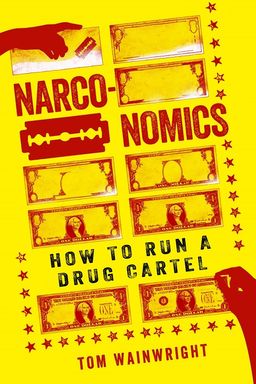
Narconomics cover

Narconomics

by Tom Wainwright

Dive into the fascinating world of Narconomics, where drug cartels operate like multinational corporations. Learn how cartels use business tactics like franchising and PR to thrive, and discover innovative strategies for combating this global issue.

The Economics of Narco Capitalism

What if the world’s most violent cartels were run less like mafias and more like Fortune 500 companies? In Narconomics, Tom Wainwright makes exactly that argument. He shows that the global drug trade obeys the same economic forces that shape legitimate industries—supply and demand, competition and collusion, franchising and offshoring—except that prohibition distorts every link in the chain. The result is a multibillion‑dollar business whose inefficiencies and human costs are built into its illegal design.

Wainwright’s core claim is simple but revolutionary: you understand the drug war not by moralizing about it but by treating it as an economic system. Follow the product from coca farms and meth labs to the street corner and the dark web, and you can see clear patterns that explain why violence persists and why enforcement so often fails. Prohibition doesn’t just criminalize supply; it multiplies profits, creates monopolies, and shifts activity to weaker states that can’t fight back. To fix it, he argues, you have to think like an economist.

The supply chain distortion

Every step in the narcotics chain—from coca leaf to line of cocaine—shows extreme price inflation. Farm‑gate coca worth a few hundred dollars turns into a six‑figure product on U.S. streets. That markup isn’t about production cost; it’s about risk. As enforcement risk rises, so do prices, and most of that value accrues to middlemen and traffickers, not the farmers who grow the crop. Wainwright calls this the “cockroach effect”: eradicate coca in one country and it simply reappears in another. The war on supply displaces harm geographically but rarely reduces it. (Note: economists Jorge Gallego and Daniel Rico confirmed that eradication campaigns barely affect farm‑gate prices in Colombia.)

Markets that kill or calm

Cartels, like corporations, respond to market structure. In Mexico’s Ciudad Juárez, competing cartels fought for a scarce resource—border crossings that act as chokepoints for U.S. trade—and violence soared. In El Salvador, rival maras negotiated a truce and murder rates dropped by two‑thirds. Competition breeds chaos; collusion breeds stability but entrenches crime. Wainwright’s lesson is practical: if you can widen bottlenecks, unify police authority, and create alternative jobs, you reduce the economic payoff from fighting over turf.

Corporate organization and franchising

Like any expanding company, cartels face scaling challenges. Groups such as the Zetas turned to franchising, licensing their brand and violent reputation to regional gangs. It’s the McDonald’s model with guns instead of cheeseburgers—rapid expansion without central control. The result is predictable: local franchisees feud, abuse the brand, and trigger public backlashes, as after the notorious mass kidnapping in Iguala. Franchising spreads power but erodes discipline, making cartels fragile networks rather than single hierarchies.

Labor and loyalty economics

Running a cartel, Wainwright notes, is above all an HR nightmare. Turnover is constant—members die, defect, or are jailed—and recruiting under secrecy ensures unreliability. Prisons act as training colleges, transforming petty offenders into organized criminals. In contrast, reforms such as the Dominican Republic’s humane prison management under Roberto Santana show that when incarceration builds skills instead of criminal networks, the recruitment pipeline dries up. Cutting off talent supply is thus an economic weapon against organized crime.

Industrial displacement and globalization

Cartels behave like multinationals—they offshore production, diversify products, and exploit regulatory gaps. When U.S. meth laws squeezed precursor supplies, production shifted to industrial Mexican labs, doubling purity and cutting prices. When Colombian coca was sprayed, cultivation moved to Peru or Bolivia. Weak Central American states, with low wages and corruptible institutions, became new hubs. This “cartel competitiveness” mirrors corporate investment metrics: where corruption is high and policing weak, illicit capital flows in.

Innovation, technology, and regulation

The rise of legal highs, darknet markets, and legal cannabis shows how innovation reshapes risk. Chemists continually design unbanned analogs faster than legislators can outlaw them. TOR and Bitcoin enable global drug bazaars like Silk Road, where feedback systems mimic Amazon’s trust architecture. Meanwhile, legalization experiments—from Switzerland’s heroin prescriptions to Colorado’s cannabis industry—demonstrate that regulation can shrink black markets by competing on safety, consistency, and transparency.

The policy logic reversal

Across these stories lies a central inversion: the more you fight supply without touching demand, the stronger the industry grows. Enforcement rewards risk takers, eradication hurts the poor, and prohibition encourages innovation precisely where regulation forbids it. Wainwright asks you to reimagine anti‑narcotics policy as market engineering—redirect spending from helicopters and prisons to treatment, education, and coordinated regulation. In doing so, you attack the incentives that sustain criminal enterprise rather than chasing its symptoms.

Key takeaway

The drug war fails because it misunderstands its opponent: not just traffickers, but a functioning global market distorted by prohibition. To defeat that market, you must manage it—change the incentives, not just the laws.


Supply Chains and the Cockroach Effect

Wainwright begins where every industry starts—with production. Drug crops behave like any agricultural commodity, except the market is illegal and hyper‑profitable. A kilo of cocaine’s inputs cost less than $400; by the time it reaches U.S. consumers, that kilo can yield more than $120,000. The extraordinary price spread arises not from supply cost but from prohibition’s risk premium. When eradication campaigns destroy crops, production pops up elsewhere. This is the 'cockroach' or 'balloon effect'—squeeze one region and the supply inflates in another.

Monopsony and farmer exploitation

Cartels often operate as monopsonies—single buyers controlling many small producers, just as big‑box retailers dictate farm‑gate prices. Farmers in the Andes earn pennies while cartels absorb eradication costs without passing them on to buyers. This structure ensures stability: supply barely falters, but rural poverty deepens. Destroying crops thus punishes those with the least power and leaves retail prices unchanged. (Note: this mirrors how commodity monopolies in legitimate industries can suppress supplier income while protecting downstream profit margins.)

Technological adaptation

Supply control also triggers innovation. In Bolivia, new processing technologies—from backyard centrifuges to redesigned ovens—doubled cocaine yield per hectare. Colombia’s productivity revisions show similar jumps. Each crackdown invites technological adaptation that offsets lost acreage. Like any resilient firm, traffickers turn adversity into R&D.

Lesson

Eradication attacks the lowest‑value link in the chain. If you ignore middlemen, refiners, and retail logistics, you only prune branches while the trunk keeps growing.

Policy alternative

Smart policy looks for leverage points upstream and downstream. Improving rural incomes through legal crops, providing credit, or guaranteeing market access cuts farmers’ need for illegal buyers. Coupling that with oversight of precursor chemicals and transportation logistics can raise cartel costs effectively. The key insight: to change outcomes, follow the money, not the plants.


Markets, Violence, and Organization

Violence in the drug world, Wainwright shows, is not random—it’s economic. Cartels fight when market structure rewards conflict and collude when cooperation preserves profit. Ciudad Juárez and San Salvador offer textbook contrasts: competition for a scarce border gateway produced thousands of deaths, while El Salvador’s gang truce cut murders by two‑thirds. When rare strategic assets—like customs crossings—become choke points, blood follows the money.

Why structure matters

In Juárez, fragmented policing let rivals appeal to different layers of authority, turning cops into combatants. In El Salvador, tattoos and gang loyalty made members immobile; that stability enabled a peace deal. Structural factors—mobility, territorial control, enforcement overlap—shape how much violence markets produce. For policy, unifying police command and reducing monopoly rents from scarce crossings offer big returns at low cost.

The franchise dynamic

Cartel franchising magnifies this logic. The Zetas’ brand model—letting local gangs 'license' their name—created scale and terror but also chaos. Franchisees who defied guidance caused public disasters like the Iguala disappearances, harming the whole organization. Much as fast‑food chains worry about franchise standards, cartels suffer when affiliates defect or overstep. Scale comes with loss of control.

Governing criminals

Even gangs design governance systems. Prison groups such as La Nuestra Familia wrote constitutions with impeachment procedures to reduce leader abuse. Rational organization helps survival. But when states reform prisons to emphasize education, family access, and integrity—as the Dominican Republic did—the supply of disciplined recruits falls dramatically. Violence declines not through more crackdowns, but through fewer skilled enforcers entering the market.

Operational insight

Market competition explains killings better than moral rot. Reduce the value of territory and you reduce the value of violence.


Globalization and Offshoring Crime

Just as manufacturers move to cheaper countries, drug producers shift geography to exploit weak institutions. Central America’s Mosquito Coast became the next frontier after Colombian and Mexican enforcement raised costs. Honduras and Guatemala offer cheap labor, porous borders, and underpaid police; ex‑military elites like the Kaibiles moonlight for cartels. Land transfers and clandestine airstrips confirm investment patterns identical to those of multinationals chasing favorable conditions.

The meth analogy

When U.S. laws restricted pseudoephedrine, meth production didn’t fall—it globalized. Mexican 'super‑labs' emerged, leveraging economies of scale and corruption savings. Prices dropped and purity rose. This migration turned an American health reform into an unintentional industrial policy for Mexico’s cartels. It exemplifies how misaligned national strategies externalize violence to poorer regions.

Reading metrics in reverse

Wainwright proposes an ironic tool: a 'Cartel Competitiveness Index' derived from World Economic Forum data. Where governance is weakest, criminal investment potential is highest. Publicizing security metrics—police pay, corruption perception, extradition strength—can help governments track progress as if improving a business ranking.

Policy implication

Offshoring crime won’t stop without regional coordination and economic alternative. Strengthening institutions, monitoring land sales, and raising public-sector wages are preventive investment, not charity. Otherwise, poor states will continue to absorb the spillover from rich countries’ enforcement experiments.


Diversification and New Markets

Cartels survive because they diversify. When one product weakens, they pivot. After the U.S. intensified cannabis legalization, Mexican cartels lost up to three‑quarters of their marijuana revenue and shifted toward heroin and human smuggling. The logic is businesslike: reallocate resources where margins rise.

People smuggling as a service industry

More fortified borders raised the 'price' of crossing. From the 1990s to the 2000s, coyote fees doubled and professionalized. Drones, sensors, and walls only increased smuggler value. Cartels entered to provide logistics, forged documents, and security guarantees. The result: highly organized migration pipelines that exploit enforcement budgets as market‑making interventions.

Heroin’s rebound

The U.S. opioid crisis generated fresh demand just as Mexican poppy fields expanded post‑2006. Higher U.S. prescription controls shifted addicts from OxyContin to heroin. Mexican suppliers stepped in, vertically integrating from field to street. The demographic of heroin users flipped—older, whiter, more suburban—underscoring how supply follows demand, not stigma.

Strategic lesson

Whenever enforcement creates scarcity, criminals rebrand that scarcity as opportunity. Without parallel demand‑side fixes—treatment and legal options—policy merely shifts profits from one product to another.


Innovation from Legal Highs to the Dark Web

Innovation defines the modern drug economy as much as violence does. Laboratory chemists produce ever‑new synthetic highs; technologists carve digital trading floors on the Dark Web. Each innovation turns prohibition’s constraints into growth incentives. You can outlaw a molecule but not the curiosity that replaces it.

The chemistry race

In New Zealand, Matt Bowden’s benzylpiperazine (BZP) empire proved how legality drives experimentation. Each government ban spawned new analogs—TFMPP, DMAA, and beyond—tested first on consumers, not in labs. Traditional prohibition lags behind such molecular agility. The Psychoactive Substances Act tried reversing the burden of proof, requiring safety certification, but regulators couldn’t reconcile ethics and evidence rules. Still, the logic endures: regulation can shape safer innovation if governments lead, not chase.

The online marketplace revolution

Silk Road and its successors transformed retail trade. Using TOR for anonymity and Bitcoin for payment, they created price transparency, reputation systems, and global reach. For buyers, purity rose and street violence fell—because corners became obsolete. For sellers, competition sharpened and loyalty eroded. Enforcement’s challenge shifted from arresting dealers to tracing encrypted logistics and financial flows.

Regulatory perspective

The same technology that frustrates police also offers insight. Transaction data, escrow accounts, and Bitcoin forensic tools can illuminate networks better than street surveillance. Instead of eradicating markets that reappear instantly, governments can use these digital footprints to manage harm and monitor behavior dynamically.


Reputation, CSR, and Legitimacy

Cartels understand branding. Beyond bullets, they invest in PR and community goodwill. Banners hung from bridges, charity donations, and social media campaigns all serve to cultivate legitimacy. The goal is stability—public sympathy reduces informants and discourages resistance. Pablo Escobar built housing; La Familia mended disputes. In Sinaloa, marches celebrated El Chapo as a local hero. Narco‑charity transforms terror into soft power.

Controlling the narrative

Media intimidation ensures silence in cities like Reynosa, where reporters vanish and Twitter feeds replace newspapers. Yet the Internet rebelled: anonymous blogs such as El Blog del Narco broke the blackout. Cartels retaliated by targeting bloggers, revealing that communication control, not just profit, is central to power. (Comparison: Warlords and multinationals alike use PR to maintain legitimacy under weak governance.)

Counter‑strategy

Governments can only delegitimize narco‑CSR by supplying better public goods. Build schools, clinics, and pensions so citizens no longer credit traffickers for welfare. Protect journalists with targeted security funds and link reporting to citizen safety apps. Pair policing with communication—because losing the story means losing the war for loyalty.


Legalization, Regulation, and Smarter Policy

After dissecting the illegal economy, Wainwright turns to what might replace it. Legalization isn’t a magic bullet, but regulated markets can collapse criminal profits. Colorado’s cannabis experiment revealed this vividly: legal producers offer cleaner, stronger, tested products under tax oversight, while cartels struggle to compete on quality or cost. First‑year state revenues hit $76 million, and legal pot’s lower cost per potency unit undercut Mexican suppliers in most U.S. states.

Managing side effects

Legalization introduces leakage—marijuana shipped illicitly to prohibition states—but it demonstrates control rather than chaos. Packaging, labeling, dosage limits, and age restrictions mitigate overconsumption. Firms like Dixie Elixirs learned quickly to reformulate after accidental overdoses, proving that legal businesses respond to consumer pressure better than clandestine ones ever could.

Beyond cannabis

Switzerland’s supervised heroin program and New Zealand’s cautious legal‑high framework show how markets can be governed, not suppressed. Regulation compresses profit margins, moves trade above ground, and converts addicts from customers into patients. The lesson isn’t liberalization—it’s control through design. (Note: like alcohol’s post‑Prohibition experience, stability comes not from freedom but from structure.)

From enforcement to engineering

The book’s conclusion unites its themes. Supply‑side obsession wastes billions; treatment and prevention yield higher returns. Acting nationally against globalized networks is doomed; multilateral collaboration is essential. Prohibition promises order but breeds innovation in evasion. The antidote is smarter economics: reallocate funding to demand reduction, rebuild institutions, and regulate where evidence supports safety.

Strategic conclusion

You can’t outlaw an industry that meets urgent demand and adapts faster than its regulators. But you can redesign its environment so crime earns less and legality earns more. That, Wainwright argues, is real control.

Dig Deeper

Get personalized prompts to apply these lessons to your life and deepen your understanding.

Go Deeper

Get the Full Experience

Download Insight Books for AI-powered reflections, quizzes, and more.