
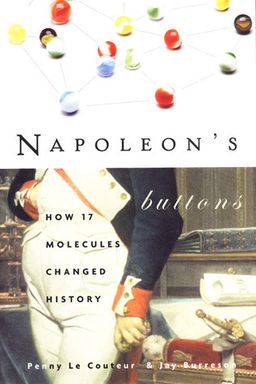
Napoleon’s Buttons cover

Napoleon’s Buttons

by Penny LeCouter & Jay Burreson

Napoleon’s Buttons reveals the astounding impact of 17 simple molecules on world history. From spices that fueled exploration to innovations in medicine and industry, this fascinating narrative uncovers the profound connections between chemistry and significant historical events.

Dark Romance, Power, and the Illusion of Freedom

What would you give for freedom? In Buttons and Lace, Penelope Sky confronts that question with a visceral and disturbing story that merges psychological pain, coercion, and desire. Sky plunges you into a dark world where captivity blurs into seduction, and trauma intertwines with twisted intimacy. This isn't a simple story of victim and villain—it’s an exploration of the human ability to adapt, to find power even in the places where none should exist.

At its core, the book tells the story of Pearl, a woman abruptly ripped from her life and thrust into the underworld of sexual slavery. What begins as a horrific ordeal beneath her kidnapper Bones shifts when she’s later captured by another man—Crow Barsetti—who claims her for revenge rather than money. Crow, an Italian arms dealer, sees her as leverage against his enemy. Yet as their relationship unfolds, domination gives way to fascination, control turns to protection, and mutual dependence grows in the corrupt soil of captivity.

The Female Journey in a Masculine World

Through Pearl’s eyes, you experience the brutal realities of exploitation and survival. She begins as a woman betrayed by the very man she loved—her boyfriend Jacob—only to fall into a labyrinth of violence and degradation. Her early abduction under Bones is the book’s most brutal portrait of humanity—physical violation, emotional breaking, and total powerlessness. But Sky doesn't stop there; instead, she asks: what happens when survival demands adaptation? Pearl learns to read people, sense their intentions, and manipulate situations for the smallest ounce of control. For every wound, she grows another layer of armor.

When Crow enters the story, the dynamic shifts. He’s not virtuous—he’s calculating, obsessive, and predatory—but to Pearl, he becomes something different from the monsters she’s known. Her captor, yet paradoxically her savior. This paradox drives the tension of the book: between violence and care, between ownership and protection, and between forced submission and chosen surrender. Sky uses this tension to probe uncomfortable psychological truths—how trauma reshapes intimacy, how power becomes addictive, and how desire can bloom in the shadow of fear.

Power, Consent, and Psychological Survival

Sky’s narrative isn’t just about physical captivity—it’s about psychological domination. “Freedom,” in Buttons and Lace, becomes a trading currency, represented by the book’s title object: each sexual act earns Pearl a button, one step closer to the illusion of independence. These buttons symbolize both degradation and empowerment. While Pearl initially resists, she gradually begins making choices, reclaiming agency in the only way left to her—through control of her own reactions and through her power to choose how to survive.

Sky uses this transactional system to reveal that consent is not binary. In Pearl’s world, it exists on a sliding scale between coercion and self-preservation. Every decision becomes morally tangled, every moment of desire tainted by fear. Yet Sky’s brilliance lies in showing Pearl’s endurance without romanticizing her abuse. Even as love and lust entwine, their connection remains toxic, intense, and profoundly human.

Why This Disturbing Tale Resonates

Readers are drawn to Buttons and Lace not because it’s comfortable but because it reveals something lurking in everyone—the yearning for control, the fascination with danger, and the endless tension between fear and desire. Unlike more idealized romantic thrillers, Sky’s story confronts the shadow side of intimacy. It doesn’t promise happy endings—it promises transformation through suffering. If you look closely, Pearl’s evolution echoes classic gothic heroines—from Du Maurier’s Rebecca to Anaïs Nin’s erotic narrators—women who navigate oppression through intelligence and will.

Ultimately, Buttons and Lace forces you to reflect on your own boundaries of morality and empathy. It asks: can a relationship rooted in violence evolve into genuine care? Can redemption exist when love and manipulation intertwine? Penelope Sky doesn’t give you easy answers. What she gives you is a haunting meditation on what it means to reclaim your body—and your heart—after unimaginable betrayal.


Pearl’s Captivity and the Rebirth of Will

Pearl’s story begins in heartbreak and horror. Betrayed by her boyfriend Jacob, drugged, and sold into human trafficking, she awakens on a ship bound for exploitation. Her early chapters are raw depictions of dehumanization—a reminder that violence operates on both physical and psychological levels. Yet through Sky’s lens, this initial darkness creates the foundation for Pearl’s rebirth.

Crushed but Unbroken

The scenes aboard the cargo ship are some of the story’s most intense. Pearl witnesses other women being assaulted and killed. Her only weapons are her intellect and defiance; she kills a would-be rapist using his own belt and a syringe. This moment defines her character: even when powerless, she refuses surrender. The brutality she faces shapes her evolution from victim to survivor, echoing psychological resilience theories (as explored in Viktor Frankl’s Man’s Search for Meaning).

Adapting to Domination

After surviving the ship, she finds herself auctioned to the highest bidder—a villain named Bones, whose wealth and sadism define his rule. Sky immerses you in Pearl’s inner turmoil: numbness, rage, fleeting hope. Bones’s cruelty is contrasted with Pearl’s inner spark, her capacity to manipulate tiny acts of resistance into acts of dignity. As she’s stripped of everything external, she discovers the only freedom left—mental resistance. It’s a concept that recalls Stoic philosophers like Epictetus, who taught that true freedom lies in controlling one’s response to suffering.

That mindset prepares Pearl for everything that follows. In a world where she’s treated as property, she reasserts herself as a person. It’s the quiet courage of a woman who refuses to be defined by the cruelty of others.


Crow Barsetti’s Code: The Honor of a Villain

Crow enters Pearl’s life as another captor—but he isn’t the same kind of monster. A calculating arms dealer driven by revenge, Crow buys her to wound his enemy. Yet his own moral code begins to complicate that vengeance. He’s violent but not indiscriminate, a man who operates in darkness by choice and habit, not pleasure.

Strength and Ethic in Conflict

Penelope Sky crafts Crow as a study in moral duality. He kills without hesitation in business but refuses to inflict nonconsensual harm. He represents the paradox of the honorable sinner—someone who lives by rules in an amoral world. When he spares Pearl, it isn’t out of empathy, but because he can’t reconcile his internal code with senseless cruelty. That decision shifts his character from executioner to complex antihero.

The Illusion of Control

Crow’s relationship with Pearl exposes the limits of his control. He demands obedience but softens under her defiance. He rewards her courage even as it infuriates him. Sky’s portrayal of his fascination echoes classic Byronic characters—men like Heathcliff in Wuthering Heights or Mr. Rochester in Jane Eyre, whose power unravels when confronted with a woman who refuses submission. The more authority Crow exerts, the more he loses his emotional independence.

In the world Sky builds, even power has its price. Crow’s dominance becomes his prison—his obsession with control keeps him enslaved by his own darkness.


The Economy of Freedom: Buttons as Currency

One of the most striking metaphors in Sky’s novel is the “button” system. Crow tells Pearl that for every sexual act, she’ll earn a button. Collect enough, and she can buy her freedom. It’s a perverse game that transforms intimacy into economics, and survival into a contract.

Trade, Power, and Survival

Through this exchange, Sky examines how power operates when desire and dependence intertwine. Each button becomes a symbol of Pearl’s compromised agency—each choice laden with shame but also calculation. This mirrors real-world trauma recovery models, where survivors reclaim autonomy through small, practical decisions. For Pearl, saying “yes” becomes strategic, not submissive. She manipulates her captor’s game to create her own leverage.

The Moral Cost of Survival

The button system also serves as Sky’s critique of moral absolutism. Readers may judge Pearl’s choices, yet under the weight of coercion, those judgments collapse. Her body becomes her bargaining chip, but her mind remains unbroken. By placing a literal price on sex, Sky makes you feel the sheer imbalance of gendered power in a world ruled by men with money and guns.

Each button represents both loss and progress. The system forces Pearl to trade pieces of her soul for liberty, blurring the boundary between exploitation and reclamation.


Desire and Defiance: The Psychology of Stockholm

As Pearl and Crow’s dynamic deepens, Buttons and Lace delves into the territory of Stockholm Syndrome—when kidnapped victims develop emotional ties to their captors. Sky doesn’t glorify this process; she dissects it. She shows how proximity, fear, and kindness create psychological confusion strong enough to blur moral lines.

Trauma Bonding and the Need for Safety

Pearl begins to associate Crow with safety because he rescues her from physical torture. Over time, that protection becomes emotional. This form of dependency, known in psychology as trauma bonding, makes victims attach to abusers as a coping mechanism. Sky portrays this with unflinching awareness—Pearl hates Crow for his power but also needs him to survive. Her body responds with desire even as her mind rebels. (Psychologists note similar dynamics in survivors of domestic abuse or war captivity.)

Love as Adaptation

When Pearl begins to desire Crow, it’s not love in a romantic sense—it’s adaptation. Yet Sky complicates this by making their intimacy feel real. Crow listens. He protects. He even gives her choices. These gestures, trivial in ordinary relationships, become monumental under oppression. Love becomes a survival mechanism—an illusion that grants emotional oxygen in the vacuum of fear.

By the time Pearl realizes she wants him, the line between choice and necessity has vanished. It’s the ultimate depiction of entrapment: the heart learning to bloom in a cage.


Betrayal, Revenge, and the Collapse of Innocence

Midway through the story comes the revelation that redefines everything: Pearl’s boyfriend Jacob sold her. This twist transforms grief into rage. What began as a story of victimization becomes a study in betrayal and moral decay. With this, Sky addresses not just physical captivity, but emotional violation—the kind inflicted by people you trust.

The Weight of Betrayal

Learning that the person you love handed you over to suffering is a deeper form of damnation. Pearl’s relationship with Jacob had represented normalcy and safety in her former life. His betrayal annihilates that world completely. When Crow tells her the truth, he both destroys and liberates her. Now she has no reason to go back—her past is as corrupt as her present.

Revenge Transformed

This revelation also changes Crow. His purpose was revenge against Bones, but through Pearl, he discovers a different kind of vengeance: protecting what’s his, healing through destruction. His promise to hurt Jacob for her becomes a twisted act of love. Sky subtly redefines justice—not as virtue, but as balance restored through pain.

By the time Pearl accepts Crow’s arms as her sanctuary, the reader must confront an uncomfortable truth: sometimes safety grows from the ruins of innocence.


When Captivity Becomes Connection

The final chapters of Buttons and Lace explore what happens when submission becomes choice. By now, Pearl and Crow share a relationship built on paradox—violence and tenderness, dominance and trust. Their intimacy is complex, both healing and damning. Sky dares to ask: what if love could grow in the darkest places?

Trust After Terror

Crow grants Pearl autonomy in increments—offering her real choices, a safe word, and genuine empathy. For someone who’s been stripped of control, these gestures reconstruct a fragile sense of personhood. In psychological terms, Crow functions as both the trauma and the cure—his affection retraumatizes and repairs simultaneously. This mirrors how trauma survivors may attach to the very people or situations that echo their pain—a dynamic Sky portrays with chilling realism.

The Paradox of Healing

Sky doesn’t offer an easy happy ending. Pearl remains a captive, yet she finally sleeps without nightmares. Crow remains violent, yet he keeps her safe. Their connection doesn’t erase the horrors of the past—it builds something fragile on top of them. The book closes not with liberation, but with acceptance: that healing doesn’t always mean escape. Sometimes it means finding peace within the chaos.

It’s this layered, paradoxical ending that gives Buttons and Lace its resonance. Penelope Sky doesn’t absolve her characters of sin—she reminds you that love, power, and survival are never clean.

Dig Deeper

Get personalized prompts to apply these lessons to your life and deepen your understanding.

Go Deeper

Get the Full Experience

Download Insight Books for AI-powered reflections, quizzes, and more.