
Idea 1
Nailing Before Scaling: The Entrepreneur’s New Playbook
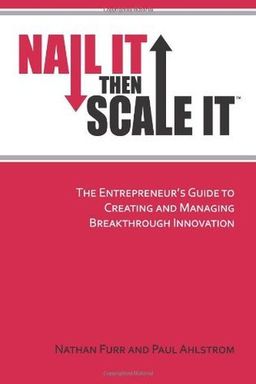
Why do so many determined, passionate entrepreneurs fail even after following all the startup advice they've ever been given? In Nail It then Scale It, Nathan Furr and Paul Ahlstrom turn the conventional startup wisdom inside out. They argue that doing what entrepreneurs are usually told—writing a business plan, raising money, building a product, and then selling aggressively—actually kills most startups. The reason is simple: those actions are based on guesses, not facts, and each guess hardens into dogma before it’s ever tested against the real world.
Furr and Ahlstrom contend that entrepreneurial success doesn’t result from a magical idea or a heroic founder personality. Instead, it comes from a disciplined process of discovery. The authors call this process Nail It then Scale It (NISI): a research-driven, experiment-based method that helps entrepreneurs prove their assumptions about customers, solutions, and markets before they waste years and fortunes building the wrong thing. Once you’ve nailed the problem and solution, only then should you scale the business.
The Entrepreneur’s Paradox
The story of Greg Whisenant, founder of CrimeReports.com, captures the book’s central insight. Greg followed every rule of traditional entrepreneurship: he wrote a business plan, designed a product, attracted venture capital, and worked tirelessly to sell. Yet despite passion and capital, his company stalled. Only when he stopped building and started validating assumptions through customer conversations did his fortunes change. Within a year, CrimeReports went from one client to hundreds. The lesson: process matters more than passion.
The authors identify this as the entrepreneur’s paradox—doing everything right by conventional standards leads to failure because the process itself is wrong. Startups collapse not from poor execution but from executing the wrong plan.
The Three Myths That Derail Startups
Furr and Ahlstrom dismantle three damaging myths at the heart of startup failure: the Hero Myth, the Process Myth, and the Money Myth. The Hero Myth says success is all about having vision, passion, and perseverance. Yet, the book argues, those very traits can turn into liabilities—passion can become obstinacy, and vision can blind founders to feedback. The Process Myth assumes that building products like large corporations—plan, build, test, then sell—works for startups. But startups don’t know what they should be building. They must search, not execute. Finally, the Money Myth insists you need lots of capital to win, yet too much money can lull entrepreneurs into a false sense of confidence, delaying hard lessons and accelerating failure (think Webvan or 3D Realms).
From Guessing to Testing: The Scientific Approach
The NISI method reframes entrepreneurship as a scientific experiment. Rather than assuming you’re right, you treat your ideas as hypotheses to be tested quickly and cheaply in the real world. You don’t learn by polishing a product—you learn by talking to customers, building quick prototypes, and running rapid experiments. The key is to turn assumptions into measurable data, letting facts, not faith, guide your decisions.
Like a good scientist, you need to be intellectually honest and unafraid to fail. As Edison famously said after his many failed experiments, he hadn’t failed—he’d found ways that didn’t work. You “fail fast” to learn faster, changing course before money and time run out. Successful entrepreneurs behave like explorers charting an unknown continent: they listen, observe, and adapt constantly rather than sticking to a rigid map drawn in their heads.
The Five-Phase Framework
The practical NISI roadmap moves through five iterative phases: Nail the Customer Pain, Nail the Solution, Nail the Go-to-Market Strategy, Nail the Business Model, and finally Scale It. You start by validating an urgent customer pain—what Furr calls a “shark bite,” not a “mosquito bite.” Next you design the simplest solution—a product with a minimum feature set that directly addresses the pain and nothing else. Only once you’ve proven demand and a repeatable sales process do you scale operations and investment.
The method demands relentless testing, simplicity, and humility. It’s not glamorous; it’s gritty, data-driven learning. But those who master it—like IMVU, Intuit, Cisco, or Ancestry.com—discover products customers love before burning through cash. Ultimately, this approach transforms entrepreneurship from gambling to learning science.
Why It Matters
Today, when Lean Startup (Eric Ries) and Customer Development (Steve Blank) are reshaping how innovation happens, Nail It then Scale It offers a practical foundation rooted in two decades of investor and entrepreneurial experience. Whether you’re a scrappy founder or a corporate innovator, the book challenges you to stop assuming and start discovering. You don’t win by believing harder—you win by learning faster.