
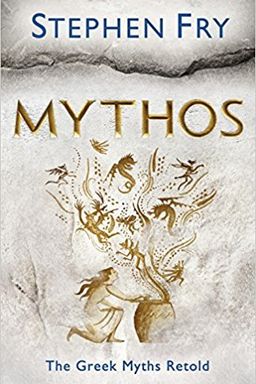
Mythos cover

Mythos

by Stephen Fry

Stephen Fry''s ''Mythos'' is a masterful retelling of Greek mythology, inviting readers to explore the vibrant tales of gods and heroes. This engaging book offers a fresh perspective on ancient narratives, making these timeless stories accessible and relevant to modern audiences.

From Chaos to Cosmos: Myth as World-Making

When you open Stephen Fry’s retelling of Greek myth, you are not entering a world of dusty legends but a map of how humans imagined existence itself coming into focus. The story begins with Chaos—a void that is not so much an absence as pure potential. Out of that blank stage arise the primordial deities: Night, Darkness, Earth, and the Abyss. They are the first patterns, not personalities, and they establish the material and moral coordinates that all later stories will build upon. Out of their unions, even time itself is born. The Greeks didn’t separate physics, psychology, and theology—these origins explain why there is day and night, birth and decay, love and vengeance. Fry’s genius is to show you how myth serves as both cosmology and anthropology: a way ancient thinkers translated phenomenon into story.

The Birth of Time and Order

From the darkness of Chaos emerges structure. Gaia (Earth) births the sky Ouranos and sea Pontus—without a father, through self-engendering creation—establishing the blueprint of the world. From their offspring you get a cosmic family tree: each new being expressing a duality or moral tension—Night gives birth to Sleep, Doom, and Strife; Light generates Day and Hope. The drama of existence begins once these elemental forces start to interact, creating the rhythm of contrast that all storytelling depends on. (Note: Fry often reminds you how mythic dualities mirror the human mind’s need for opposites—love and hate, mortality and transcendence.)

The Invention of History

Greek myth situates time not as an abstract measure but as an emotional and moral invention. When Ouranos rules as the sky god and suppresses his monstrous children in Gaia's womb, his cruelty ignites history’s first act of rebellion. Gaia recruits her son Kronos to overthrow his father with a sickle—violence births change, and time begins to flow. Out of Ouranos’s blood spring the Furies, Giants, and Aphrodite—a powerful reminder that beauty and terror share the same roots. This is the Greeks’ way of telling you that creation always requires fracture. Each generation of gods must confront the previous one, and so myth becomes a perpetual mirror of human succession: authority versus rebellion, order versus renewal.

From Chaos to Civilization

By the time Zeus rises and defeats the Titans, Fry translates these battles into allegories of cosmic organization. The Titanomachy—Zeus’s war against Kronos’s generation—is both physical and symbolic. The sky shakes, mountains shift, and rivers roar, all embodying the transformation from raw elemental disorder to structured cosmos. The Cyclopes forge thunderbolts; alliances and new forms of intelligence (Metis, Prometheus) turn brute strength into strategic harmony. You watch power evolve from violence to law. When Zeus claims his throne, the world gains an administrative order—the Olympian Cabinet—a divine bureaucracy balancing marriage (Hera), sea (Poseidon), earth (Demeter), and reason (Athena). The cosmos is now political: domains, roles, and taboos structure both gods and mortals.

Humanity, Hope, and the Divine Experiment

Prometheus, the Titan who sympathizes with humankind, becomes a hinge between divine myth and human story. When he fashions clay figures and steals fire from Olympus, Fry marks the beginning of culture—an act of compassion and defiance that inaugurates human self-determination. But Zeus’s revenge through Pandora’s opened jar introduces suffering, mortality, and the paradox of hope. Life becomes tragic and creative at once. What began as cosmic geometry now enters the moral domain. Through Deucalion’s flood, Persephone’s abduction, and Psyche’s trials, you see the Greek cosmos expanding beyond divine quarrel into a map of human emotion—fear, love, jealousy, and the longing for balance.

Why These Myths Endure

Fry’s sequence of tales—from Chaos to Dionysus—plays like a symphony of human understanding. Each myth is both a story and a model of consciousness. Chaos teaches you to imagine beginnings without purpose; the Titan revolt warns that progress requires rupture; Prometheus and Pandora define creativity’s risks; Demeter and Persephone encode the agricultural year; and Dionysus reveals the cost of ecstatic freedom. What persists across all is a principle: order and disorder coexist, beauty arises from catastrophe, and understanding the universe means accepting its perpetual motion between creation, loss, and renewal.


Succession and the Birth of Cosmic Law

The story of Ouranos, Kronos, and Zeus captures the Greek fascination with inheritance, power, and the cost of rule. You meet a universe that polices itself through cycles of rebellion: a son destroys his father to seize the throne, only to fear his own children will do the same. Fry’s prose highlights the intimacy of cosmic politics—how family drama illustrates metaphysical law. The violence that shapes the universe also generates justice, beauty, and social order.

From Tyranny to Time

Ouranos’s cruelty—forcing his children back into Gaia—creates the first definition of tyranny: power without mercy. Gaia’s retaliation through Kronos’s sickle turns physical revolt into temporal progress. By castrating his father, Kronos doesn’t just end his reign; he sets biological and historical succession in motion. From Ouranos’s spilt blood come avengers (the Furies) and from the foam of the sea arises Aphrodite, linking punishment and beauty in one gesture. The Greeks locate justice in symmetry: injury produces its counterpart, rule follows ruin.

The Curse of Prophecy

As Ouranos dies, he prophesies that Kronos will be overthrown by his own child. This curse gives divine politics an eternal feedback loop—the awareness that fear sustains tyranny. Kronos imprisons his offspring in his stomach, echoing his father’s cruelty. Yet destiny, embodied by Rhea’s cunning and Zeus’s birth in secret, ensures the pattern will play out again. Fry treats each generational revolt as a shift from bodily to intellectual power: Zeus’s advantage is not strength alone but mind, alliance, and technology—the thunderbolt forged by Cyclopes marking the transition from chaos to craftsmanship.

Establishing the Moral Universe

Every act of rebellion in these myths creates an institution: the castration creates the sea’s fertility, Zeus’s revolt produces the Olympian order, and even the punishments—the imprisonment of Titans, Atlas’s burden—explain enduring features of the world. Through such metamorphoses, Fry shows that Greek myth encodes law into landscape: mountains become prisons, oceans memorialize wounds, and beauty crowns pain. The moral you glean is simple but profound: the cosmos self-regulates through conflict, and power without empathy inevitably provokes its undoing.


Prometheus, Pandora, and the Dawn of Humanity

Prometheus’s story marks humanity’s entrance into the divine stage. A Titan siding with the weak, he sculpts mortals from clay, then steals fire—technology, craft, and thought—from Zeus’s domain. That theft sets humans apart from beasts yet curses them with divine wrath. Fry invites you to see this as the mythic justification for consciousness: an act of rebellion that grants freedom and suffering in equal proportion.

The Fire and Its Meaning

Fire is more than flame; it’s imagination, invention, and the power to alter nature. When Prometheus carries it down hidden in fennel stalk, he introduces civilization itself. Humans learn metallurgy, cooking, and craft, ushering in the Golden Age. But knowledge destabilizes divine control, and Zeus’s punishment defines the rift between creators and their creations—a god against curiosity itself. Prometheus’s enduring torment, liver eaten daily by a bird, becomes the eternal symbol of visionary sacrifice. (Think of scientific revolutions later punished by authority.)

Pandora’s Jar and the Architecture of Suffering

Zeus answers Titan compassion with trickery: the invention of woman. Hephaestus crafts Pandora—an impossibly gifted being endowed by all the gods—and sends her with a sealed jar. When curiosity compels her to open it, disease, strife, jealousy, and despair flood humanity. Only Hope (Elpis) remains. Fry treats this not as misogyny but anthropology: a recognition that pain is part of being human. The paradox is subtle—Hope trapped inside the jar may either console or deceive us, keeping us striving despite futility.

Flood, Renewal, and Moral Cycles

The myths press onward to Deucalion’s flood and humanity’s rebirth from stones, remaking the race after corruption. You see the perpetual Greek pattern: creation, fall, renewal. Whether through fire, water, or the clay of the earth, the human story repeats the divine one—resilience through destruction. Prometheus and Pandora frame a truth Fry underscores repeatedly: knowledge liberates yet endangers, love redeems yet wounds, and every gift from the gods comes with a hidden tax. To be human is to live inside that moral experiment.


Olympians and the Architecture of Divine Order

With Zeus victorious, Olympus becomes a cosmic government. Each god receives a portfolio—Zeus rules sky and law, Poseidon governs the seas, Hades oversees death, Hera guards marriage, Athena wisdom, and so forth. Fry likens it to an ancient cabinet, balancing forces that mirror society’s own institutions. This division of domains transforms mythic chaos into theology of order.

Balance and Character

The Olympians embody contradictions that hold the world steady. Athena’s intellect tempers Ares’s violence; Hermes’s movement offsets Hestia’s stillness; Poseidon’s ambition challenges Zeus’s sovereignty. Through their interactions, you glimpse a political allegory: civilization demands balance between war and wisdom, freedom and fidelity. Fry’s retelling personalizes these forces—Athena emerging fully armed from Zeus’s head symbolizes reason born from power’s mind, not its body; Hephaestus’s fall and return as craftsman proves that weakness can yield utility. The pantheon thus becomes a moral ecology.

Emergence of Culture

After the Titanomachy, creation proliferates. The Muses appear, granting arts and history; the Fates spin human destiny; the Graces animate beauty. Divine craft becomes human art—the world now brims with narrative and song. Olympus, ruled through Zeus’s law and Hera’s ceremony, institutionalizes morality: what began as cosmic chaos ends as civic life, with rituals, music, and craft embodying social order.

Dionysus and the Seat of Ecstasy

Among Olympus’s later arrivals, Dionysus stands out as a paradox—a god of both fertility and frenzy. Born from Zeus’s thigh after mortal Semele perishes, he bridges death and rebirth. His gifts—wine, music, ecstasy—blur boundaries between reason and rapture. When Hestia yields her seat to him, you witness divine compromise: stability making space for passion. Fry sees in Dionysus the ancient recognition that culture requires both order and trance, governance and release. Too much discipline smothers vitality; too much frenzy dissolves law. Mount Olympus thus becomes a council permanently negotiating chaos’s remnants within civilization.


Mortals, Hubris, and the Fragility of Limits

Once the gods are established, attention shifts to mortals, whose ambitions and faults mirror divine traits in miniature. Fry organizes their stories—Io’s torment, Phaeton’s fall, Niobe’s pride, Sisyphus’s deceit—as cautionary lessons about boundary and respect. Each myth dramatizes hubris—the overreach that provokes rebalance from above.

Missteps of Passion and Pride

In Io’s transformation into a cow, you see how divine jealousy turns love into exile. In Phaeton’s fatal joyride across the sky, hubris literally scorches the earth—explaining deserts and reminding humanity that imitation of gods brings ruin. Niobe’s boastful motherhood meets nemesis through Apollo and Artemis’s arrows, showing that comparison to the divine is not courage but folly. Fry means these as moral architecture: transgression invites proportional correction.

Laws of Hospitality and Justice

Beyond pride, the Greeks sanctify civility. In the myths of Ixion, Tantalus, and Sisyphus, betrayal of hospitality or deceit of death earns eternal penalties—flaming wheels, unreachable fruit, endless toil. When Philemon and Baucis welcome disguised gods, they achieve apotheosis as intertwined trees, affirming that virtue lies in simple generosity. Fry treats these as civic theology: myths that functioned as moral regulation for communal life.

Metamorphosis as Moral Mirror

Transformation stories—Arachne turned spider for artistic defiance, Narcissus fading into his reflection, Echo reduced to voice, and Pygmalion’s statue reborn as love—externalize psychological truths. The Greeks express emotion through nature: envy becomes arachnid weaving; vanity turns flesh to flower. Each metamorphosis is both punishment and preservation, suggesting that art and memory redeem suffering.

The Order of Death

Even the underworld functions by ethical design. Fry reminds you through Sisyphus’s binding of Thanatos that death is a social necessity; its absence breeds chaos. Proper burial rites restore balance, while eternal punishments like Sisyphus’s rock reaffirm mortality’s place in cosmic rhythm. In these tales, the gods reinforce the fragile equilibrium keeping life meaningful: limits define worth, and transgression redefines those limits again.


Foundations, Healing, and the Power of Culture

Fry closes his arc by turning to myths of foundation and renewal—from Cadmus and Thebes to Asclepius and Arion—showing how culture arises from violence and cure follows catastrophe. These are stories about civilization’s debt to both construction and compassion.

From Dragon’s Teeth to City Walls

Cadmus’s slaying of the serpent and sowing of its teeth produces armed men—the Spartoi—who fight until only a few survive to found Thebes. Civic order thus sprouts from blood. The cursed necklace of Harmonia, later haunting her lineage, reminds you that founding deeds carry generational cost. Fry interprets this as a political allegory: society’s stability arises from disciplined violence restrained by law and ritual.

Dionysus and the Ethics of Ecstasy

Dionysus embodies the ambivalent gift of culture itself—wine, theatre, and frenzy bringing both joy and madness. His followers, maenads and satyrs, dance the edge between worship and chaos. Acceptance into Olympus through Hestia’s concession marks how Greek thought institutionalized ecstasy: recognizing it as essential yet dangerous. Civilization, Fry suggests, must periodically release control to renew itself.

Asclepius and the Law of Limits

In Asclepius’s legend, healing becomes science but collides with taboo. Raised by Chiron, armed with Gorgon blood that can resurrect, Asclepius pushes medicine beyond divine permission. Zeus strikes him down to preserve order—restoring death’s necessity—but elevates him as constellation Ophiuchus. The myth articulates a timeless tension between progress and restraint: curing is holy until it defies mortality itself.

Music, Mercy, and the Civil Heart

The stories of Philemon, Baucis, and the musician Arion return to social virtue. Hospitality and art become twin salvation routes: generosity preserves life, beauty redeems injustice. When Arion’s song summons a dolphin to his rescue, music literally restores moral balance. For Fry, the final moral of myth is simple but transformative—civilization depends on empathy, artistry, and the acceptance that every gift from gods or humans is double-edged: capable of saving or undoing its recipient.

Dig Deeper

Get personalized prompts to apply these lessons to your life and deepen your understanding.

Go Deeper

Get the Full Experience

Download Insight Books for AI-powered reflections, quizzes, and more.