
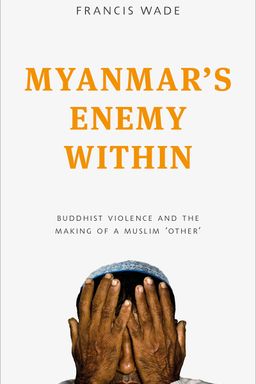
Myanmar''s Enemy Within cover

Myanmar''s Enemy Within

by Francis Wade

Myanmar''s Enemy Within delves into the 2012 violence against the Rohingya, exploring historical and political roots. It reveals how colonial legacies and nationalism fueled ethnic divisions, offering a profound understanding of Myanmar''s ongoing identity and human rights challenges.

How Fear and Identity Fueled Myanmar’s Tragedy

Why do ordinary people who have lived side by side for generations suddenly turn against each other? That agonizing question drives Myanmar’s Enemy Within by journalist and scholar Francis Wade, who disentangles one of the 21st century’s most shocking transformations: how Myanmar’s transition from military dictatorship to democracy unleashed a wave of violence against the country’s Muslim minority, especially the Rohingya.

Wade argues that beneath Myanmar’s apparent path toward openness lay fragile, unresolved anxieties about identity, belonging, and purity. Democracy, rather than instantly creating harmony, acted as a solvent–it loosened the authoritarian grip that had frozen the country’s divisions in place, allowing long-suppressed nationalisms and fears to erupt. Religion became a rallying cry, Buddhism turned militant in parts of society, and the military’s decades-long propaganda about protecting the nation found fertile new ground among civilians who now wielded their own forms of power.

The Heart of the Argument

At its core, the book explores how violence between Buddhist and Muslim communities emerged not from ancient hatreds, but from engineered hierarchies and decades of state manipulation. The military’s obsession with “one blood, one nation” had long positioned ethnic diversity as a threat to unity. When reforms began in 2011, they didn’t dismantle that project of social engineering—they democratized it. Ordinary citizens, newly empowered, started enacting the same logic of purification once monopolized by the generals. Monks in robes issued sermons echoing the military’s slogans, community militias arose, and “outsiders” were once again hunted in the name of stability.

Wade contends that to understand Myanmar’s tragedy, you must grasp the country’s dual inheritance: a history of colonial manipulation that hardened ethnic lines, and a postcolonial militarism that deepened them through citizenship laws, population engineering, and propaganda. The Rohingya, stateless and vilified, became the ultimate victims—but their plight also serves as a mirror for global anxieties over nationhood and fear of the “Other.”

Structuring Fear: How the Book Unfolds

Across its chapters, Wade builds a mosaic of stories and analysis. He begins with intimate portraits—people like the Rakhine fisherman Ko Myat, who joined mobs in 2012 to attack Muslim neighborhoods in Sittwe, convinced that he was defending his race. Through such encounters, the reader sees how fear is manufactured and moral logic inverted. Subsequent chapters trace the historical scaffolding of that fear, from British colonial taxonomy that solidified ethnic boundaries, to General Ne Win’s 1962 coup that turned nationalism into a tool of control, culminating in the modern-day ideology of movements like 969 and Ma Ba Tha.

Wade also weaves in voices of courage and solidarity—monks and villagers who still reached across divides. Their quiet resistance reminds readers that hatred is manufactured, not inevitable. The book closes with vignettes of fragile coexistence: a mixed crowd sharing beer at a cinema hut, activists teaching civic rights in Mandalay, and a monk who sheltered both Buddhists and Muslims when violence engulfed his town.

Why It Matters to You

Reading Myanmar’s Enemy Within compels you to ask unsettling questions about your own society. What stories define who “belongs” where you live? Who benefits when neighbors start to fear each other? Wade’s analysis of Myanmar reveals how group identity—religious, racial, or national—can be weaponized in times of uncertainty. The transition from dictatorship to democracy did not erase prejudice; it redistributed authority, allowing latent fears to erupt into open conflict. This paradox resonates far beyond Southeast Asia—in every place struggling with populist nationalism or identity-based exclusion.

By combining on-the-ground reporting with sweeping political insight, Francis Wade delivers more than a chronicle of suffering. He offers a mirror reflecting humanity’s shared vulnerability: our need for belonging, and the dangerous ease with which that need can transform into a crusade for purity. As you read, you realize that Myanmar’s story is not just about Buddhists and Muslims—it’s about all of us, and what happens when fear becomes the foundation of identity.


The Roots of Division: Colonial and Military Engineering

To grasp the violence that exploded after 2012, you must first look backward—to how British colonizers and later Myanmar’s generals engineered the country’s ethnic map. The idea that ethnic identities are fixed, pure, and non-overlapping is itself a colonial invention, Wade reminds us. Before the British, groups like the Mon, Rakhine, and Bamar existed, but their boundaries were fluid. One could ‘become’ another group by changing clothing or language. The colonial administration, however, craved taxonomy. They classified and ranked Myanmar’s population into distinct “races,” hardening divisions that had previously been negotiable.

From British Files to Ne Win’s Ethnic Index

After independence, General Ne Win perfected this racial arithmetic. His 1982 Citizenship Law excluded anyone not among the 135 recognized “national races.” The Rohingya—called “Bengali interlopers”—were deleted from the list entirely. Even ethnic minorities like the Mon found themselves rewriting family trees to appear Bamar, as the story of Hla Hla, a young Mon woman, illustrates. Her family bribed local officials to change her identity card, ‘becoming’ Bamar Buddhist to escape discrimination. This was not simply bureaucratic; it was existential—deciding who had the right to education, travel, or dignity.

Burmanization and the Myth of Unity

Ne Win’s project of “Burmanization” fused nationalism with Buddhism, presenting Bamar Buddhists as the natural owners of the nation and all others as guests. Posters screamed warnings like “The Earth will not swallow a race to extinction—but another race will.” This racial paranoia masqueraded as patriotism, creating a moral hierarchy: to protect Myanmar, one must protect Buddhism. Over time, this logic seeped into everyday consciousness, normalizing suspicion of anyone different in language, skin tone, or faith.

(Similar patterns appear elsewhere: in Sri Lanka’s Sinhalese Buddhist nationalism, or India’s partition politics, where religious identity became entwined with statehood. Wade links Myanmar’s trajectory to that broader colonial legacy.)

Control Through Citizenship and Fear

Citizenship became the instrument through which the state punished or rewarded loyalty. The “national races” were granted legitimacy; others were treated as pending cases, perpetually under suspicion. Wade shows how bureaucratic cruelty masqueraded as law: from the Rohingya losing IDs and movement rights, to Chin Christians coerced into Buddhist conversions. Assimilation was presented as civic duty; refusal meant exclusion or worse. By turning belonging into an act of compliance, the regime prepared the soil for the later eruptions of ethnic violence that ordinary citizens themselves would enforce.

The result was a nation where identity—once fluid and overlapping—became a trap. People learned not only to mistrust others but to hide their own origins. When Myanmar began its democratic transition decades later, this distorted consciousness of race and purity erupted into chaos. The “nation,” as Wade puts it, was already built on fear.


The Spark of 2012: Flames in Rakhine

When the violence began in June 2012, it seemed spontaneous. A Buddhist woman named Ma Thida Htwe was raped and murdered, allegedly by Muslim men. Within days, mobs retaliated by dragging ten Muslim travelers from a bus in Taungup and killing them. In the weeks that followed, Buddhist and Muslim neighborhoods across Rakhine State burned. Wade’s reporting captures the dizzying speed of the transformation. In villages like Par Da Lek, fishermen were told to board buses into Sittwe to “defend their race.” One, Ko Myat, joined, convinced he was protecting Buddhism. Hours later, he was guarding roads as fellow villagers set Muslim houses on fire.

From Rumors to Riots

This was not a sudden eruption of hatred but an orchestrated conflagration. Fake news and pamphlets circulated for months beforehand—warnings of Muslim invasions, out-of-context rapes, and “Bengali breeding conspiracies.” When rumors spread that Muslims had attacked monks, hysteria followed. Local authorities, far from stopping it, often stood aside or encouraged it. For every Rohingya torching Buddhist property, dozens of Rakhine retaliated, backed by police complicity. Countless ancient villages were wiped from the map.

A Manufactured Logic of Self-Defense

Wade argues the riots’ psychology replicates genocidal scripts seen elsewhere: the perpetrators perceive themselves as defending their nation. Buddhists believed they were protecting their future from extinction—a mindset cultivated by decades of military rhetoric equating diversity with decay. “If we don’t protect our race, it will disappear,” Ko Myat told Wade years later. That belief transformed fear into virtue, cleansing into duty.

Aftermath: Camps and Apartheid

By year’s end, more than 100,000 Muslims were herded into coastal camps, cut off by barbed wire and checkpoints. Segregation was framed as security but became permanent containment. The state enforced an apartheid structure: no intermarriage, no trade, no shared schools. Wade compares it to South Africa before 1994—a moral and physical partition designed not only to protect Buddhists but to erase the presence of Muslims from public life. In 2012’s ashes, the architecture of exclusion was rebuilt in plain sight, legitimized by fear and policy alike.


Democracy’s Dark Shadow

You might expect democracy to heal old wounds. Yet Wade shows how Myanmar’s transition deepened them. As Aung San Suu Kyi’s National League for Democracy (NLD) gained power, democratic freedoms added oxygen to dormant prejudices. A freer press meant freer hate speech; public rallies amplified exclusion rather than inclusion. When violence erupted in Rakhine, many icons of the pro-democracy movement either stayed silent or sided with the persecutors.

The Silence of the Saints

Wade recounts how revered activists like Ko Ko Gyi and even Suu Kyi herself dismissed the Rohingya crisis as a national security issue. Ko Ko Gyi called for joining hands with the military to repel “outsiders.” Suu Kyi avoided the word “Rohingya,” fearing it might alienate Buddhist voters. “Both sides are to blame,” she told journalists, echoing the moral equivalence often used to justify inaction. Her silence shattered international illusions about Myanmar’s moral awakeners and revealed democracy’s paradox: empowerment without empathy can legitimize oppression.

Ethnic Politics and Political Survival

Local Rakhine parties exploited the turmoil to win votes, while the NLD avoided fielding Muslim candidates to placate ultranationalist groups. In place of dictatorship’s central control came populist fear-mongering from below. Wade shows this dynamic vividly in Meikhtila, where democracy emboldened nativist monks to mobilize mobs under banners of free speech. In this sense, liberalization did not fail; it succeeded—in allowing individuals to act on prejudices the junta had long monopolized.

The lesson resonates beyond Myanmar: democracy’s health depends not simply on institutions, but on inclusive imaginations. Without them, liberty soon mirrors tyranny.


Militant Buddhism and the Ma Ba Tha Machine

Perhaps the book’s most startling revelation is how Buddhist monks became drivers of persecution. From revered moral figures, some transformed into architects of fear. Groups like 969 and its successor Ma Ba Tha (Organization for the Protection of Race and Religion) mixed spiritual charisma with political clout. Their message was simple yet incendiary: to love Buddhism is to mistrust Islam.

Preachers of Purity

Abbott U Wirathu of Mandalay’s Masoyein Monastery told followers to boycott Muslim shops, warning that Buddhists would be “swallowed” morally and demographically. Pamphlets with the number 969 appeared everywhere, mirroring Islamist numerologies like “786” to frame religion as a numbers game. Another monk, U Parmoukkha, justified persecution by declaring that when Buddhism is threatened, even violence could become “merit-making.” As he told Wade, “If there is no Buddhism, there will be no peace.” The paradox was chilling: killing in defense of nonviolence.

A Political Partner in Robes

Ma Ba Tha acted as a lobbying powerhouse. It pushed through the 2015 “Protection of Race and Religion” laws restricting interfaith marriage and women’s reproductive rights. Politicians—including the military-backed USDP—courted its endorsement. Even the NLD buckled, dropping Muslim candidates to avoid its backlash. Wade shows that Ma Ba Tha’s power thrived precisely because democracy gave monasteries a platform; what the military had done with coercion, monks achieved through persuasion.

Faith Turned Political Weapon

This monk-led nationalism was not uniquely Burmese. Parallels abound—in Sri Lanka’s Bodu Bala Sena, India’s Hindutva movements, and even Western populist Christians. But in Myanmar, it was intensified by centuries of monastic authority and public reverence. Few dared criticize monks for fear of karmic backlash. As one NLD spokesman candidly admitted to Wade, “We don’t cross them; we might suffer for it in the next life.” Religion thus provided both the ideology and shield for Myanmar’s extremists—a divine cover for earthly hatred.


The System of Apartheid: Everyday Suffering

What happens when fear becomes policy? Wade documents the aftermath of 2012 through heartbreaking microhistories of segregation. Muslim quarters in Sittwe turned into fenced ghettos; Rohingya villages north of Kyauktaw became open-air prisons guarded by armed checkpoints. Travel, education, and healthcare depended on permits—and bribes. For many, seeking medical help could mean death.

Stories of Denial and Despair

One man, Aarif, watched his wife die giving birth because police refused permission to reach a hospital; by the time an ambulance arrived, it was too late. Others succumbed to curable diseases, trapped by bureaucracy and terror. Even citizens like the Kaman Muslims, historically integrated and recognized as indigenous, were swept into the same system of exclusion. After decades of living peacefully among Buddhists, they too became targets—beaten in marketplaces, barred from travel, marked as “kalar,” a racial slur for dark-skinned foreigners.

Segregation as a Way of Life

The disdain reached bureaucratic extremes: Muslims were forced to seek police escorts for hospital visits, pay ‘tea money’ at checkpoints, and live under curfews. Aid workers who helped Rohingya were branded traitors. Even humanitarian operations became nationalist battlegrounds, accused of favoring Muslims. Wade convincingly describes this as a system of “racialized healthcare”—a quiet genocide by neglect.

The Psychological Toll

Beyond physical fences, mental walls hardened. Former friends began describing their Muslim neighbors as inherently “bad blood.” Children grew up believing segregation natural. For Rohingya confined to camps, myths circulated that hospitals killed Muslim patients, reinforcing despair and isolation. The violence thus evolved: no longer machetes and fires, but structures and fears that ensured suffering would outlast headlines. In Wade’s words, Myanmar perfected “a slow violence—erasure through everyday control.”


Echoes and Lessons: Humanity in the Ruins

Despite the despair, Wade’s final chapters uncover glimmers of compassion that challenge the narrative of universal hatred. In Buthidaung, Buddhists and Muslims still gathered at a shabby cinema to cheer English football teams—small acts of coexistence amid fear. In Mandalay, young activist Myo designed neighborhood workshops that taught civic rights to both Buddhist monks and Muslim elders, subtly restoring trust. Even in Meikhtila—scene of horrific massacres—Abbot U Witthuda opened his monastery to hundreds of fleeing families, Buddhist and Muslim alike.

Moral Resistance and Quiet Heroes

Such individuals risked being branded traitors. U Witthuda told Wade he sheltered victims during the riots, defying mobs who demanded he surrender Muslims hiding in his monastery. “You must kill me first,” he told them. His faith, rooted in compassion rather than fear, demonstrates the other face of Buddhism—the one that extremists had buried beneath propaganda.

Hope in Contact and Understanding

Wade ends not with policy recommendations but with human encounters. When communities interact, mistrust wanes; when they’re segregated, rumors metastasize. Projects like Myo’s civic education workshops hint at how contact can rebuild society from below. Democracy’s survival, Wade implies, requires empathy to be institutionalized as rigorously as elections are.

His closing image is unforgettable: a group of young Rakhine and Rohingya playing chinlone together under a rainbow after a rainstorm—amid checkpoints, propaganda, and pain, still choosing play over fear. “Myanmar is a rainbow nation,” Wade writes, “if only it were allowed.” The image reminds you that even after engineered hatred, the human desire for connection endures.

Dig Deeper

Get personalized prompts to apply these lessons to your life and deepen your understanding.

Go Deeper

Get the Full Experience

Download Insight Books for AI-powered reflections, quizzes, and more.