
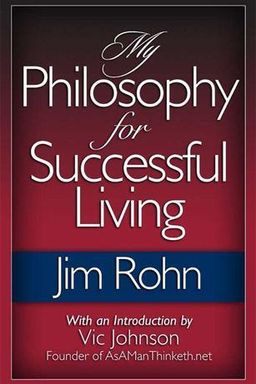
My Philosophy for Successful Living cover

My Philosophy for Successful Living

by Jim Rohn

In ''My Philosophy for Successful Living,'' Jim Rohn shares transformative insights on achieving financial success and personal fulfillment. By redefining your philosophy and focusing on self-improvement, you can unlock your potential and pave the way to a prosperous life.

My Philosophy for Successful Living: Transforming Yourself to Transform Your Life

How would your life change if you realized that success isn’t something you pursue but something you attract? This simple yet profound question lies at the heart of Jim Rohn’s timeless classic My Philosophy for Successful Living. In this concise yet potent book, Rohn argues that true success—whether financial, personal, or spiritual—stems not from luck, opportunity, or circumstance, but from the continuous refinement of your personal philosophy. He contends that when you change yourself—your attitude, mindset, and actions—the external rewards naturally follow.

Rohn’s core argument revolves around a radical, empowering truth: you get paid for the value you bring to the marketplace, and you become valuable by becoming more yourself. Through this lens, work, wealth, and happiness are not separate pursuits but expressions of who you choose to become. The centerpiece of his philosophy is this simple maxim: “Work hard on your job and you’ll make a living; work hard on yourself and you’ll make a fortune.”

Jim Rohn’s Timeless Philosophy

Jim Rohn, once a broke Idaho farm boy who couldn’t afford a $2 box of Girl Scout cookies, turned his life around through what he calls self-education. Unlike formal schooling, which teaches you how to earn a living, self-education teaches you how to design a life of purpose, wealth, and contribution. Rohn’s transformation from struggling salesman to millionaire mentor came not from external changes but from internal evolution—rethinking his excuses, redefining his philosophy, and rebuilding himself from the inside out.

His methodology is both practical and philosophical. It blends ancient wisdom with American pragmatism: freedom through discipline, opportunity through responsibility, and prosperity through contribution. Rohn’s influence has rippled across generations, shaping thought leaders like Tony Robbins, Les Brown, and Mark Victor Hansen. His message is deceptively simple but profoundly transformative: success is predictable because it is governed by principles.

The Book’s Core Structure

Each chapter of My Philosophy for Successful Living explores a distinct dimension of success, building a step-by-step framework for personal transformation:

  • In Chapter 1, The American Economic Ladder and Girl Scout Cookies, Rohn lays out his central thesis on personal value and self-education through a candid story of early failure.
  • Chapter 2, The Philosophy of Performance and Productivity, explores how serving others and developing multiple skills can lead to lasting wealth.
  • Chapter 3 emphasizes Working with Others—mastering communication, rewarding progress, and building quality teams.
  • Chapter 4, A Look at the Fundamentals, defines the unchanging basics of success and the difference between wages and profits.
  • Chapter 5 focuses on Refining and Strengthening Your Personal Philosophy—the heart of lasting self-mastery.
  • In Chapter 6, Your Financial House and Measuring Success, he explores independence, responsibility, and how to measure your progress.
  • Finally, Chapter 7, Six Steps for Leading an Extraordinary Life, offers a blueprint for living with purpose, productivity, relationships, and spiritual awareness.

Why These Ideas Matter Today

Rohn’s philosophy feels even more relevant in an age defined by distractions, entitlement, and quick fixes. In a world obsessed with hacks and external validation, he reminds you that the soil of success lies within. The market doesn’t owe you; your relationships don’t guarantee anything; governments, companies, or luck are unreliable allies. What endures is what you cultivate in yourself—skills, mindset, contribution, and good character.

“Success is not something you pursue. Success is something you attract by the person you become.”

That single sentence encapsulates Rohn’s legacy. His life and teachings argue that transformation is not an event but a process of disciplined self-cultivation—growing from within, learning from your and others’ failures, and continuously refining your personal philosophy. By doing so, you align your work, wealth, and well-being with timeless principles.

In the chapters that follow, we’ll unpack each of these principles in depth—from developing a performance philosophy to building your financial independence, from valuing relationships to nurturing a thoughtful spiritual life. Together, they compose not just a guide for success, but for living an extraordinary, purpose-driven life.


The Value Ladder: You Get Paid for Who You Become

At age 25, Jim Rohn had a painful wake-up call. A Girl Scout knocked on his door selling cookies for $2, and he couldn’t afford them. Too embarrassed to admit the truth, he lied to her. That moment of discomfort became his turning point—a reminder that if nothing changes inside, nothing changes outside. This dramatic anecdote anchors his first and most crucial lesson: the marketplace pays you for the value you bring, and your value grows as you do.

The Two Rules of the Marketplace

Rohn learned two principles that forever changed his life. First, you are paid for the value you provide to others. Second, you are paid for what you become. Income is not determined by hours worked, but by the kind of person you become in those hours. This realization ignited his obsession with self-education—what he calls “working harder on yourself than on your job.”

Formal education can help you earn a living, but self-education—reading, learning, studying people who have achieved success—can help you earn a fortune. Rohn's point resembles what personal development thinkers like Napoleon Hill and Earl Nightingale preached decades earlier: your mind is your most valuable economic resource.

Climbing the Economic Ladder

Rohn explains America’s “Economic Ladder,” where anyone can move from earning a few thousand to millions by climbing through personal development. He dismisses dependence on government wage increases or corporate promotions as limited philosophies. Instead, he champions the “Philosophy of Performance and Productivity,” which turns self-improvement into the ultimate economic advantage.

You rise on the ladder by increasing the quality of your performance, the diversity of your skills, and the depth of your character. For example, someone earning $50 per hour isn’t necessarily working ten times harder than someone earning $5 per hour; they’ve simply become ten times more valuable through knowledge, skill, and contribution.

Destroying Excuses and Taking Ownership

Rohn’s mentor (Earl Shoaff) helped him dismantle his “excuse list.” Shoaff asked him to list everything he blamed for his problems—taxes, the government, his boss—and then rip it up. The only name left to write on the next page was “me.” That dramatic act symbolized a lifelong truth: personal responsibility is the root of prosperity. You will never grow richer than your philosophy allows.

This is not merely motivational—it’s economic realism. Companies, markets, and societies reward those who continuously become more capable, not those who wish their conditions were easier. Rohn concludes, “Don’t wish it were easier, wish you were better.” That shift—from complaint to capability—marks the beginning of real financial freedom.

If you work hard on your job, you’ll make a living. If you work hard on yourself, you can make a fortune.

Once you embrace this mindset, you stop chasing success and start attracting it by becoming the kind of person success wants to find. It’s a philosophy of personal power in its purest form—one that turns the American Dream from wishful thinking into disciplined growth.


The Philosophy of Performance and Productivity

In the second major principle of his book, Jim Rohn anchors prosperity in one timeless truth: success comes to those who find ways to serve more people. Great wealth and influence are not about selfish ambition but about creating value for others. Echoing Zig Ziglar’s famous maxim—“You can have everything you want if you’ll help enough other people get what they want”—Rohn turns this from a slogan into an operating system for your life.

Wealth Through Service

The simplest way to build wealth is to help many people solve important problems. Whether you’re a teacher, entrepreneur, or artist, your income expands in proportion to your impact. This insight reframes business success from exploitation to contribution. Serving others—your customers, team, and community—is both moral and profitable.

Develop Multiple Skills

Rohn also stresses adaptability. In a changing marketplace, those with multiple skills—like communication, sales, leadership, and even speaking new languages—become indispensable. He points to examples like American workers who lost jobs because they stayed specialized too long. In contrast, people who continually learn new abilities become “unfireable.”

Rohn’s own life illustrates this principle. From milking cows on an Idaho farm to teaching capitalism in post-Soviet Russia, he turned every skill he learned into a new opportunity. Each new skill added leverage, making him more valuable to new audiences and markets.

The Philosophy of the Rich

One of Rohn’s most striking contrasts is between the philosophy of the rich and the poor. Poor people, he says, “spend what they earn and invest what’s left,” while the rich “invest what they earn and spend what’s left.” The math is simple, but the mindset difference is profound. Wealth starts not with income, but with intention.

He combines this with a Biblical principle: seek and you will find. Rohn expands it to business—seek, and you will find good people. You can’t build meaningful wealth without assembling capable, independent-minded partners. The process may be like “herding cats,” but once you find even two or three aligned people, incredible things happen.

Don’t be afraid to multiply yourself. Teach others how to get rich, earn, sell, and lead—and you will multiply your wealth and your impact.

In essence, productivity isn’t just about working harder. It’s about creating systems, people, and value that outlast your effort. In that sense, the philosophy of productivity is also a philosophy of leadership—and of legacy.


Working with Others and the Power of Communication

Human success, Rohn argues, doesn’t exist in isolation. Building wealth and meaning depends on how you connect, communicate, and collaborate. In Chapter 3, he emphasizes the necessity of rewarding others, communicating effectively, and building strong teams. The wealthiest people, he insists, are those who invest not just in self-development but in the development of others.

Reward and Recognition

If you want to build a thriving team or company, Rohn says, make appreciation part of your culture. Recognize small wins; reward progress, not perfection. His “Wealth Philosophy” says it best: Be so busy giving others recognition that you don’t need it yourself. The act of appreciating others creates a magnetic energy that inspires commitment and excellence.

The Three Levels of Communication

Rohn outlines three progressive levels of communication mastery:

  • Training – Simply showing someone how to do a task; mechanical and replicable.
  • Teaching – Helping a person acquire a new skill and understand a process.
  • Inspiring – Elevating someone’s sense of who they are and what they can do. This is leadership communication.

As he puts it, inspiration is communication that changes lives. The great teacher doesn’t just pass knowledge; he awakens possibility. (This echoes Dale Carnegie’s insight in How to Win Friends and Influence People—people are moved by emotion and recognition more than intellect.)

Language, Globalization, and Lifelong Learning

Rohn observes that the global economy now rewards those who can adapt across languages and cultures. He highlights how Europeans and Asians often speak multiple languages, giving them an edge in business and relationships. For American readers, he issues a challenge: encourage your children—and yourself—to learn new languages. Each new language is not just a communication tool, but a gateway to markets, cultures, and relationships you couldn’t access otherwise.

Having more than one skill and more than one language builds a financial wall around your family.

Ultimately, Rohn reframes networking and communication as spiritual arts. They are not manipulations but expressions of appreciation, growth, and shared vision—the glue that holds success together.


Profits Are Better Than Wages: The Fundamentals of Wealth

In Chapter 4, Rohn shifts from attitude to architecture—laying out the fundamental principles that sustain wealth creation over the long run. His most quoted axiom here: profits are better than wages. Wages make you a living; profits make you a fortune. While you can—and should—have both, it’s critical to understand the difference.

Working Full Time on Your Job, Part Time on Your Fortune

Rohn recommends using your job to build financial stability, while simultaneously developing entrepreneurial ventures that create profit. The goal isn’t to quit your job impulsively, but to use spare time to grow assets. He calls this “working full time on your job and part time on your fortune.” This echoes Robert Kiyosaki’s later concept in Rich Dad Poor Dad—the transition from employee to investor mindset.

Danger and Opportunity

Another fundamental truth Rohn identifies is the dual nature of every opportunity: danger walks side by side with reward. You must therefore create a personal guidance system—a moral and strategic compass—to distinguish between the two. This ability to judge wisely, he says, is what separates prosperity from disaster.

In illustrating this, Rohn draws parallels between political liberty and economic freedom. Just as liberty eventually overcame tyranny in world history, so personal discipline will always overcome excuses in an individual’s life. Freedom—political or personal—requires work, awareness, and courage.

Health as a Fundamental

Rohn also reminds readers that health is a fundamental of wealth. Without energy, no goal or skill can be sustained. Taking care of your body is an economic strategy as well as a moral duty. “How can you pursue your dreams,” he asks, “if you lack the energy to chase them?” In Jim’s philosophy, success is holistic—mental, spiritual, and physical vitality form an inseparable trinity.


Refining and Strengthening Your Personal Philosophy

At the heart of Rohn’s entire system lies a single imperative: refine your personal philosophy. Everything you become and achieve flows from how you think about life, people, and opportunity. This refinement happens in three ways—through experience, observation, and goals.

Learning from Experience

Rohn argues that success depends on your ability to learn not just from pleasure, but from pain. He often says, “Discipline weighs ounces, regret weighs tons.” Every setback is tuition in the school of self-education. Learn faster by reflecting deeply on what happened—and even more importantly, by examining why.

Equally crucial is learning from others’ experiences. You don’t have enough time to make every mistake yourself, he reminds you. Study others’ successes and failures and apply their lessons before life forces them on you. This is leverage in its purest form.

Attitude and Mobility

Rohn famously declares, “You are not a tree.” Meaning, you can move, change, and grow. Don’t let your past anchor your future. You can alter your direction at any time by changing your philosophy and your attitude. Feelings about your past and fears about the future subtly influence all choices, but awareness gives you power. By cultivating a constructive attitude, you direct those emotions instead of being ruled by them.

The Power of Purposeful Goals

Rohn’s mentor taught him the art of goal-setting—the single greatest gift one can give another person. By writing down specific, inspiring objectives for your family, work, and contribution, you transform vague hope into disciplined vision. He shares Andrew Carnegie’s example: spend half your life earning money and the second half giving it away. Great goals, Rohn explains, come from great reasons. When your reasons are powerful enough, you’ll find the discipline to match them.

Reasons and goals can serve as powerful motivators that not only change your life, but the world around you.

Refining philosophy isn’t an intellectual exercise—it’s about deciding who you will be and what legacy you will leave. That choice, repeated daily, refines your destiny.


Financial Independence and Measuring Success

In Chapter 6, Rohn brings philosophy down to the practical realm of money management. His father taught him the importance of living debt-free and building a financial wall of independence around one’s family. Today, when debt dominates global headlines, this wisdom is prophetic: “You can’t be independent if you owe everyone else.”

Financial Independence Begins with Excitement

To achieve financial independence, Rohn says you must first love what you do. Passion fuels discipline. When work feels meaningful, you naturally give more energy and creativity. Enjoying your work doesn’t mean avoiding hardship—it means finding excitement in progress.

Measure Your Progress

Rohn likens progress without measurement to losing weight without a scale. Goals only work when tracked. Your financial and personal success require consistent evaluation—monthly, quarterly, yearly. Otherwise, you can be busy but blind. He humorously says no parent wants their child to spend more than one year in fourth grade; yet many adults spend years stuck in the “fourth grade” financially because they never measure progress.

Personal Responsibility Over External Demands

Society doesn’t force you to become wealthy, healthy, or wise. No law compels you to save money or learn new skills. That’s why Rohn calls personal responsibility the foundation of freedom. Success is voluntary—and so is failure. You must demand more from yourself than the world demands of you.

He also draws an important ethical distinction: good people can make bad choices, and bad people can make good ones. Success isn’t moral by default; it’s philosophical. If you want better outcomes, strengthen your ability to distinguish between danger and opportunity—a recurring motif throughout Rohn’s philosophy.


Six Steps for Leading an Extraordinary Life

Rohn ends with his vision of the “good life”—six practical steps that translate all his abstract principles into lived experience. These are not career strategies but life strategies for significance, connection, and contribution.

1. Be Productive

Happiness, Rohn says, flows from productivity. To be fulfilled, you must produce something valuable for others. Create, don’t consume. Work brings dignity and purpose. Whether you produce ideas, art, or services, meaning comes from contribution.

2. Value Relationships

Friendship and love are emotional wealth. Cultivate relationships that make you better and that you make better. “Be interested, not interesting,” echoes Carnegie again. Self-centered people end up lonely; servants end up fulfilled.

3. Respect Your Origins

Know your culture, language, and history. Rohn celebrates America’s diversity—its strength is the blending of gifts from around the globe. Understanding where you come from anchors you in gratitude and broadens your respect for others’ origins too.

4. Nurture Spiritual Health

Regardless of your faith, take time to explore the spiritual dimension. Shared beliefs strengthen societies and families. Spirituality connects you to meaning beyond material success, reminding you that life’s ultimate return isn’t measured in dollars but in growth and contribution.

5. Build Your Inner Circle

Surround yourself with an “inner circle” that lifts and inspires you. Mutual encouragement is essential because even the most disciplined individuals face setbacks. When life knocks you down, your circle helps you stand again. As Jim often says, “You are the average of the five people you spend the most time with.”

6. Plant the Seeds

Finally, he ends with a spiritual metaphor: God doesn’t ask you to make a tree; He asks you to plant the seed. That’s the essence of personal growth—take small, faithful actions, and trust that natural laws will multiply them. “If you plant the seed,” Jim reminds, “God will make the tree.”

These six steps summarize Rohn’s lifelong message: live a life of productivity, gratitude, character, faith, and contribution—and you will live extraordinarily well.

Dig Deeper

Get personalized prompts to apply these lessons to your life and deepen your understanding.

Go Deeper

Get the Full Experience

Download Insight Books for AI-powered reflections, quizzes, and more.