
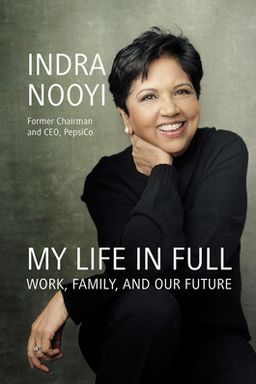
My Life in Full cover

My Life in Full

by Indra Nooyi

In ''My Life in Full,'' Indra Nooyi offers a candid glimpse into her journey from India to becoming PepsiCo''s CEO. She shares insights on balancing a demanding career with family life while advocating for impactful changes in workplace culture to support women globally.

Balancing Work, Family, and Purpose in a Changing World

How do you balance ambition and family without losing yourself in the process? In My Life in Full, Indra K. Nooyi—former CEO of PepsiCo and one of the world’s most celebrated business leaders—offers a deeply personal and profoundly practical answer. Through her journey from a modest home in Madras, India, to the commanding heights of global business, Nooyi argues that the future of both corporations and societies depends on rethinking how we integrate work, family, and care. She believes that making space for both professional and personal flourishing isn’t just possible—it’s essential for progress.

Nooyi’s central contention is that the existing economic and social structures were designed for a world in which men worked and women stayed home. In a modern, dual-career society, this outdated model punishes not just mothers but everyone—employees, companies, and communities. She insists that only by creating a genuine “care infrastructure” and fostering what she calls Performance with Purpose can we build an economy that sustains both growth and humanity.

From Madras to PepsiCo: Two Worlds, One Vision

The book opens with the evocative story of Nooyi’s upbringing in Madras (now Chennai) in the 1950s and ’60s. Her family valued education and discipline above all else, even as her mother pressured her daughters to dream big while warning them about the limits women faced. In this environment, Indra learned resilience and the idea that love, ambition, and duty could coexist in tension. Her grandfather, a retired judge, taught her the rigor of learning; her father modeled quiet wisdom and integrity. These seeds of diligence and duality later became the foundation for her global perspective.

When she left India for Yale University in 1978, Nooyi experienced a cultural rebirth—both liberating and terrifying. It was in America that her professional courage merged with a growing awareness of how gender and cultural expectations defined success. Her early struggles—working late nights, wearing ill-fitting Kresge suits to interviews, learning how to shop, cook, and survive in a new country—make her relatable. The immigrant’s journey, she suggests, is a universal one: leaving home to find both belonging and purpose.

Performance with Purpose: Redefining Corporate Success

At PepsiCo, Nooyi introduced one of the most ambitious corporate reinventions of the modern era: Performance with Purpose (PwP). The idea was deceptively simple yet transformative. Business, she argued, should deliver sustained financial performance—and contribute positively to society through healthier products, environmental responsibility, and talent inclusion. She broke PwP into three pillars—Nourish, Replenish, and Cherish—which meant developing better-for-you foods and beverages, safeguarding water and the planet’s resources, and investing in a diverse, empowered workforce.

This concept placed Nooyi at the forefront of sustainable capitalism long before ESG (environmental, social, and governance) goals became corporate buzzwords. PwP turned PepsiCo into a case study of “linked prosperity,” harmonizing shareholder returns with the long-term health of people and the planet. Yet, as she recounts, not everyone embraced the vision. Investors demanded near-term profits; critics questioned her focus on “healthy snacks.” Balancing conviction with compromise became her calling card as CEO.

The Care Economy: Work and Family as Infrastructure

Beyond business, Nooyi calls for a grand societal redesign centered around care—paid leave, flexible work, and universal childcare. Her own life story illustrates the stakes. Without her mother’s unpaid labor raising her daughters, she admits, she could not have led a global corporation. She describes vividly how, even as one of the most powerful CEOs in the world, she came home after negotiating billion-dollar deals only to be told to get milk for the family. Her mother’s message—“Leave your crown in the garage”—became a symbol of the impossible dual expectations placed on women: lead like a CEO, nurture like a mother, and apologize for both.

Through policy and persuasion, she argues that care should be treated as economic infrastructure, not a private problem. Paid parental leave, childcare investment, and flexible scheduling, she writes, are not luxuries but necessities for national competitiveness. These are not just “women’s issues”—they are growth issues. This is a theme echoed by other thinkers like Anne-Marie Slaughter (Unfinished Business) and Sheryl Sandberg (Lean In), but Nooyi brings the CEO’s data-driven pragmatism and a global sensibility rooted in empathy.

Why It Matters

The power of My Life in Full lies in its dual lens. It’s part autobiography, part manifesto for economic redesign. Nooyi’s journey reminds you that leadership—like life—thrives in contradiction: ambition tempered by care, performance guided by purpose, power balanced with humility. Her story is also an invitation for you to reconsider your own definitions of success. Are you chasing titles or meaning? Can institutions be reshaped to uplift individuals rather than consume them?

In telling her life story in full, Indra Nooyi ultimately invites a collective reimagining of what progress looks like—where men and women, business and government, ambition and empathy are no longer in opposition but in partnership. That is the transformation she calls for, one that starts in our boardrooms, our homes, and perhaps within ourselves.


Roots of Ambition: Growing Up in Madras

Indra Nooyi’s story begins under the warm sun of Madras, in a lively Brahmin household that fused discipline, debate, and deep family connection. The home her grandfather built in 1939, with separate men’s and women’s living rooms, shaped her early understanding of gender, hierarchy, and love. Her mother’s swing, where the women discussed everything from food to politics, became an early classroom in leadership and resilience.

A Culture of Learning and Limitations

Though her family was progressive in educating daughters, Nooyi was keenly aware of cultural expectations. Her mother often scolded her for her “tomboy” ways, worrying who would marry her. Yet both parents insisted that financial independence was essential. “Be your own person,” her father told her, and those words drove every major decision she made later. Their values taught her that learning was sacred—she couldn’t rest her feet in front of elders or eat while studying because books were divine.

Formative Education and the Spark of Rebellion

At Holy Angels Convent, a strict Catholic girls’ school, Nooyi’s curiosity exploded. Between music, scouting, and debating, she honed the multitasking that later became her leadership trademark. The school emphasized discipline and rigor but also provided exposure to a cosmopolitan world through nuns from Ireland and a diverse student body. Her debating and elocution skills helped her discover her voice—literally and metaphorically—and hinted at the oratory power she later wielded in boardrooms.

A turning point came when she saw how her sister Chandrika fought to attend business school against family resistance. That fight, culminating in Chandrika becoming one of India’s first women at IIM Ahmedabad, proved that courage could change tradition. Indra followed suit, earning her way to IIM Calcutta, one of only six women in her class. There she found not only math and management but a glimpse of the professional woman she could become.

Lessons from Family and Loss

Tragedy struck when her father’s motorcycle accident left him severely injured and nearly bankrupted the family. The experience was formative. She saw how the absence of social safety nets could destroy even stable households. It crystallized her lifelong conviction that companies and governments must protect families during crisis—a lesson that resurfaced decades later in her push for paid family leave.

By the time she graduated, playing cricket and leading a girl band called “The LogRhythms,” she had developed the confidence to defy convention. Her Madras roots—steeped in love, order, and respect for learning—remained her moral compass. They taught her that strength doesn’t require shouting, and progress requires tradition as ballast. As she puts it, family is both “the foundation and the force that propels us.”


Becoming a Global Citizen at Yale

Arriving at Yale in 1978, Indra Nooyi was a stranger in a world that looked nothing like Madras. Carrying $400 in cash and a suitcase full of saris, she encountered an America of open debate, self-expression, and individualism. Her first days were marked by loneliness and culture shock—discovering that “curds” were called yogurt and eating tomato sandwiches for dinner. Yet these bewildering moments became her initiation into independence.

Learning to Belong

Yale’s School of Organization and Management, then a new experiment blending business and public policy, challenged Indra to think about the social role of institutions. She was struck by how casually students called professors by their first names (“Vic,” “Dave”) and munched sandwiches in class—liberties unimaginable at her Indian schools. These cultural differences forced her to balance humility with confidence. As an immigrant and woman of color, she quickly recognized how to observe, adapt, and assert herself.

Yale also gave her her first lessons in meritocracy. When she appeared for interviews in an ill-fitting polyester suit and orange loafers, everyone stared—but she still landed the job on merit. Her professor’s reassuring advice to “be yourself” became a lifelong mantra. Later, wearing her turquoise sari to a Booz Allen Hamilton interview, she realized authenticity could be a competitive advantage. That choice marked the moment Indra Nooyi, the global professional, was born.

Building Professional Courage

At Yale, Indra discovered the thrill of real-world problem-solving through case studies and consulting projects. She worked night shifts to pay tuition, lived on a tight budget, and learned the discipline of self-reliance that mirrored her grandfather’s lessons back home. Each obstacle—cultural, financial, or personal—strengthened her determination to prove that “a woman from India could not only survive but thrive in America.”

Her summer at Booz Allen cemented her ambition for strategy and consulting, and her friendship with fellow student—and soon-to-be husband—Raj Nooyi added emotional grounding. Their partnership, she later wrote, was built on respect and “shared willingness to carry each other’s dreams.” It was a prelude to the dual-career balancing act that would define the rest of her life.


Navigating Corporate America: From BCG to Motorola

Indra Nooyi’s entry into corporate America came through the Boston Consulting Group, where she learned to decode the logic of business. For six years, she analyzed industries from orange juice processing to tissue paper, tracing profitability to its smallest levers. It was at BCG that she fell in love with the power of data-driven storytelling—convincing CEOs not with authority but with evidence. “Strategy,” she wrote, “is about marrying numbers with narrative.”

Learning Empathy in Leadership

Consulting also showed her something many business texts ignore: the humanity inside corporations. Interviewing tailors about thread quality or factory workers about orange concentration levels, she noticed how every number in a spreadsheet represented someone’s labor and hope. That human awareness became a lifelong leadership hallmark, later visible in her letters to employees’ parents at PepsiCo.

Motorola: The Mentor Who Changed Everything

A serious car accident in 1986 nearly ended her career—but it led her to the job that shaped her future. Recruited by Gerhard Schulmeyer at Motorola, she found a boss who valued intellect over pedigree or gender. He taught her the art of ‘simplifying complexity,’ making problems intelligible enough to act on. Schulmeyer became the prototype for the mentor she later was to younger women—demanding, loyal, and unafraid to stretch her vision of herself.

At Motorola, Indra learned to lead through influence in heavily technical environments. When she didn’t know how semiconductors worked, she hired professors to teach her. She embraced humility as a form of power: “If you don’t know something, learn it fast.” Schulmeyer’s insistence on clarity and integrity later guided her through corporate turbulence all the way to PepsiCo’s top floor.


The PepsiCo Transformation: Performance with Purpose

When Indra Nooyi joined PepsiCo in 1994, she entered a world that prized volume and velocity—selling “soda and chips” faster than anyone else. By 2006, she had become the first woman of color to lead one of America’s largest corporations. Yet she quickly realized that financial growth without conscience was a dead end. Her answer was revolution: Performance with Purpose (PwP).

Three Pillars: Nourish, Replenish, Cherish

PwP reimagined what capitalism could look like. “Nourish” meant investing in healthier products and gradually reducing salt, sugar, and fat; “Replenish,” protecting the planet’s water and resources; and “Cherish,” caring for PepsiCo’s people and their families. It was both business strategy and moral stance. At a time when “junk food” corporations faced mounting scrutiny, Nooyi gambled not on defending the past but inventing the future. She backed her conviction with heavy R&D spending and recruited experts from academia, public health, and design to transform PepsiCo from within.

The changes were tangible: water usage dropped by billions of liters; hybrid delivery trucks reduced emissions; and Pepsi’s product portfolio expanded to include Quaker Oats, Tropicana juices, and Sabra hummus. Critics called PwP “too soft” or “idealistic,” but Nooyi equated it with tough realism. “No business can succeed in a society that fails,” she said—a sentiment echoing Peter Drucker’s vision of management as a moral art.

Resistance and Resilience

Not everyone agreed. Investors demanded short-term returns; some executives rolled their eyes at the word “cherish.” An analyst even asked if she thought she was “Mother Teresa.” But while others managed for quarters, Nooyi managed for decades. Under her leadership, PepsiCo’s market capitalization grew by $57 billion, and it weathered the 2008 financial crisis stronger than competitors. Her story demonstrates that profit and purpose are not opposing forces but mutual reinforcements.

PwP also elevated PepsiCo’s culture. From changing the company’s gender balance to pioneering on-site childcare, Nooyi humanized corporate leadership. When she wrote to parents of her senior executives to thank them for “the gift of your child,” it wasn’t a PR stunt—it was her belief that organizations thrive when they remember their humanity.


The Crown in the Garage: Leadership and Humility

One of the book’s most iconic moments comes when Indra Nooyi recounts being named president of PepsiCo in 2000, rushing home ecstatic—only to have her mother tell her to go pick up milk. When Nooyi protested, her mother replied, “You may be president of PepsiCo, but when you come home, you are a wife and a mother. Leave your crown in the garage.”

Humility as a Leadership Virtue

For Nooyi, the crown-in-the-garage story isn’t about diminishment—it’s about balance. True leadership, she argues, comes from anchoring success in humility. You can occupy corner offices and sign billion-dollar deals, but if you forget who you are at home, you lose your grounding. She credits this lesson for keeping her ego in check amid fame and scrutiny. The practice of “leaving the crown in the garage” taught her to separate the person from the position—a crucial skill for those leading in volatile corporate environments.

Reimagining Power and Identity

This anecdote also highlights gender expectations—women are still expected to succeed at work and excel at home. Nooyi doesn’t romanticize this reality; she calls it what it is: structural hypocrisy. Yet she also finds empowerment in redefining success as both career excellence and grounded presence. Humility, she says, enhances credibility. Unlike leaders who blur authority with arrogance, she led by empathy—listening, learning, and connecting across cultures and ranks.

Nooyi compares this philosophy to the leadership ideals of leaders like Nelson Mandela and Mahatma Gandhi, who paired conviction with humility. In her world, humility wasn’t passivity—it was strategic wisdom: the ability to listen without surrendering authority. The “crown” story became her metaphor for the delicate coexistence of ambition and grace—a reminder that great power doesn’t have to silence tenderness.


Women, Work, and the Broken System

In her final chapters, Nooyi turns from memoir to manifesto. Her argument is clear: the work-family system is broken. As she experienced firsthand, society expects women to excel like men at work while maintaining the emotional labor of caretaking at home—with no institutional support. “If you want jobs and kids,” she writes, “it’s your problem. That must change.”

The Infrastructure of Care

Her policy blueprint rests on a triad: paid leave, flexibility, and care infrastructure. She shines a spotlight on America’s lag among developed nations in providing paid maternity and paternity leave, arguing that it’s not an expense but an investment. Companies, she says, need families to thrive just as families need work. Flexibility and predictable schedules—especially for shift workers—are not luxuries but dignity rights. And universal childcare isn’t a “perk” but economic infrastructure as vital as roads.

Drawing on global examples like Quebec’s subsidized daycare and France’s national childcare system, Nooyi calls for a moonshot to build a care economy that enables both parents to work and children to thrive. Her proposals echo and expand ideas championed by economists like Claudia Goldin and Anne-Marie Slaughter, merging compassion with pragmatic economics. Care, in her model, drives GDP, not drains it.

Men, Power, and Partnership

Nooyi also confronts men’s roles directly. Real progress, she argues, depends on male leaders stepping in, not just cheering from the sidelines. Her husband Raj’s unwavering support—sacrificing his own career to ensure family stability—embodied this partnership model. She likens it to a dance, quoting her ballroom instructor: “Sometimes, if you learn to follow, you lead better.”

Ultimately, her call to action is grounded in gratitude and urgency. The next great economic transformation, she insists, is not digital or technological—it’s human. Societies that value care, flexibility, and equality will win the future. And the measure of progress won’t be shareholder returns alone, but the fullness of lives lived—at work, at home, and in between.

Dig Deeper

Get personalized prompts to apply these lessons to your life and deepen your understanding.

Go Deeper

Get the Full Experience

Download Insight Books for AI-powered reflections, quizzes, and more.