
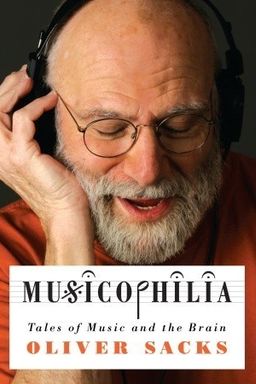
Musicophilia cover

Musicophilia

by Oliver Sacks

In Musicophilia, Oliver Sacks explores the astonishing effects music has on the human brain. Through captivating case studies, he reveals how music can heal, provoke, and even transform lives. This book delves into the mysterious connection between music and the mind, uncovering the wonders and challenges it presents.

Music and the Mind

Why does music touch you so deeply, and why does it seem so universal? In Musicophilia, neurologist Oliver Sacks argues that music is not a cultural ornament or a pleasant accident but a fundamental aspect of being human—rooted in the brain, encompassing movement, memory, emotion, and identity. Across the book’s rich clinical and personal stories, Sacks shows that music can survive brain injuries that erase language, can erupt unbidden after lightning strikes, and can reanimate patients who have lost speech or movement. It is both biologically grounded and personally transcendent.

Music as a biological inheritance

Sacks begins with the notion that the musical instinct parallels your instinct for language. Every culture creates music, and infants respond rhythmically before they can speak. The ability to detect tone, harmony, and rhythm engages extensive networks: auditory cortex maps sound features, motor regions synchronize rhythm and anticipation, and limbic areas infuse music with feeling. This complexity makes music robust yet vulnerable—damage to one part can distort perception or unleash new powers elsewhere.

Debates about evolutionary purpose

For centuries thinkers have asked whether music evolved for adaptation or pleasure. Darwin viewed it as a precursor to language and courtship behavior, while others like Pinker have dismissed it as “auditory cheesecake”—a byproduct of linguistic and emotional systems. Sacks resists such reductions, suggesting that music’s grip on the brain is too deep to be mere decoration. It provides structure to emotion, organizes time, and builds community—functions that never lost their evolutionary utility.

Music’s therapeutic and diagnostic power

Because musical processing depends on distributed neural circuits, it can be selectively impaired or astonishingly preserved in neurological disease. People who cannot speak may still sing fluently, those immobilized by Parkinson’s can walk to music, and those with dementia may reconnect to loved ones through song. For Sacks, these examples make music not just diagnostic of brain function but restorative—a means of rekindling agency and emotion when other channels fail.

The meaning of music in human life

From Nietzsche’s claim that “we listen with our muscles” to Schopenhauer’s view of music as the purest form of emotion, Sacks merges philosophical insight with neurological evidence. Music unifies body and mind: its beat can mobilize motion; its melody can stabilize feeling; its presence can maintain identity in those who hover between worlds. By the book’s end, you understand music as an evolutionary endowment that binds your senses, memories, and social connections into an art form that is at once ancient and neurologically modern.

(Note: throughout the chapters, you’ll encounter vivid case studies—patients, savants, and ordinary people—who become living experiments in how music animates the mind. Their stories, woven with Sacks’s lucid science, make the book both a neurological map and a human testament to music’s power.)


When Music Appears

In some people, music arrives suddenly—as if a switch in the brain has flipped. Sacks collects astonishing accounts of sudden acquired musicophilia: people who develop intense musical craving and creativity after brain injury, seizures, or near-death experiences. Lightning-struck orthopedic surgeon Tony Cicoria, tumor patient Salimah M., and others illustrate how altered temporal-limbic connections can evoke passion, hallucination, or talent previously dormant.

Lightning and the musical awakening

Cicoria’s transformation anchors this theme. After being struck by lightning, he experienced visions, survived, and soon felt compelled to play Chopin and compose his own rhapsody. This was not random mania—it was an organized artistic drive emerging from reconfigured temporal circuits. His right temporal lobe, likely affected by the electrical injury, appears to have strengthened its ties to emotional systems, producing a sense of transcendence and creative purpose.

Seizures, medication, and musical obsession

In other cases, temporal-lobe seizures or the alterations that follow their treatment generate musical fixation. A woman indifferent to music became an avid listener after seizure control with lamotrigine; her emotional centers, now freed from epileptic suppression, latched onto melody and rhythm. This supports the view that the musical self can lie latent within neural circuits awaiting release or reconnection.

Music’s paradoxical double edge

The same regions that can awaken music can also distort it. Musicogenic epilepsy turns melody into a seizure trigger: certain songs provoke convulsions, while in others the music is part of the aura itself. From Critchley’s cases in the 1930s to modern imaging, these phenomena emphasize the remarkable specificity of musical networks—how a single motif can ignite an entire neuroelectric storm.

Together, such stories show that music may not need external teaching to emerge. Under certain neural conditions, it reveals itself as a deep biological current—sometimes healing, sometimes consuming—that can rewrite a person’s identity overnight.


Imaginary Music and Earworms

Even in silence you can hear music. Sacks explores the phenomenon of internal sound—voluntary and involuntary imagery, earworms, and hallucinations—that demonstrates how deeply music is wired into your brain’s predictive machinery. The boundary between imagination and perception proves surprisingly thin.

The neural reality of imagined sound

Functional imaging by researchers like Robert Zatorre shows that imagining music activates the same auditory cortex used for listening. When you mentally practice or replay a tune, motor and auditory circuits communicate much like they would during performance. That’s why athletes and musicians can rehearse effectively in silence—mental practice reshapes real cortical maps (as Alvaro Pascual-Leone demonstrated in piano-learning studies).

Earworms and the looping brain

Earworms—short motifs that loop uncontrollably—represent spontaneous release of those same predictive networks. Modern exposure to repetitive media saturates auditory circuits, making them prone to replay. In mild form earworms are harmless entertainment; in extreme cases, as in post-encephalitic patients or those with Tourette’s, they verge on pathological repetition, echoing the cyclical firing of motor loops in the basal ganglia (Rodolfo Llinás’s noise-generator theory explains why snippets slip into consciousness).

When silence sings back

For people with hearing loss, internal sound can intensify into genuine hallucination. Deprived of input, auditory cortex begins to generate its own symphonies—a release phenomenon observed in patients like Mrs. C., who heard phantom carols after deafness. Neuroimaging confirms these are not illusions but measurable activations of auditory and emotional networks.

Sacks’s message: the musical mind abhors a vacuum. Whether you imagine melodies, combat earworms, or adapt to silence, your brain continually composes a private soundtrack to existence.


When Music Breaks

Because musical capacity spans perception, emotion, and movement, it can fracture in many ways when the brain is injured. Sacks charts the terrain of amusia, dystimbria, and pitch disorder—conditions that reveal how music is built from specialized yet interlocking functions.

Losses of melody and rhythm

In congenital amusia (studied by Isabelle Peretz), people like D.L. cannot follow a tune or recognize melody though speech remains normal. Acquired forms arise after stroke or trauma, selectively impairing pitch, timbre, or rhythm. These selective losses demonstrate modularity: melody relies heavily on right temporal cortex and pitch-mapping networks, while rhythm recruits bilateral motor and cerebellar systems.

Distortion and disintegration

Other disorders warp rather than erase perception. Rachael Y., a composer, experienced each voice of a quartet as isolated strands—dysharmonia—after her accident, losing the power to integrate harmony. Jacob L., with cochlear damage, perceived pitches bent and unstable, demonstrating how peripheral deficits can ripple into cortical remapping of sound. Such cases show that your auditory world is actively constructed by feedback between ear and brain.

Hope through plasticity

Despite these losses, Sacks emphasizes recovery. Because cortical maps are plastic, targeted practice or imagery can re-differentiate them. Musicians learn to adapt—composing in new registers, developing heightened internal hearing, or discovering alternative creative paths. The variety of disordered responses affirms that musicality is not a single skill but a mosaic of distinct yet cooperative abilities, each capable of regeneration.

Music’s fragility, ironically, reveals its depth: when one element fails, you glimpse the finely tuned architecture that normally operates effortlessly whenever you hum or tap your foot.


Extraordinary Minds and Musical Gifts

At the opposite extreme of loss lie enhancements—people whose brains manifest unusual or extreme musical traits. Sacks describes savants, the blind, and the synesthetic, whose neural wiring produces intensified perception or creativity. These cases outline the brain’s adaptive diversity, hinting that musicality is not singular but multidimensional.

Savants and paradoxical brilliance

Martin, who lost much of his intellect after meningitis, memorized thousands of operas, transposed at will, and improvised fluently. Neuroscientist Allan Snyder suggests such abilities may stem from reduced left-hemisphere inhibition, freeing raw perceptual detail usually filtered out. Transcranial magnetic experiments show that temporary disruption of frontal control can unleash latent pattern-recognition and artistic fluency in typical subjects—a scientific echo of savant gifts.

Blindness and cross-modal expansion

Blind musicians—like those studied by Ockelford and Pascual-Leone—often show exceptional pitch and auditory imagery. When sight is lost early, visual cortex is repurposed for sound and touch, expanding the auditory world. Jacques Lusseyran’s accounts of blindness evoke this vividly: music brought him glowing landscapes and color-like experiences, confirming neuroplastic reallocation of sensory cortex.

Synesthesia: when sound becomes color

In musical synesthesia, tones evoke colors or textures automatically. Composer Michael Torke sees D major as blue; others experience literal shapes or movements. Imaging studies show simultaneous activation of color and auditory areas, consistent with cross-wiring that persists from childhood. This “leakage” of perception highlights early developmental connectivity that for most people is pruned away.

Sacks’s broader message is affirmative: neurological difference often brings compensations and creative forms of adaptation, revealing the richness of patterns the normal brain conceals.


Music, Memory, and the Self

For Oliver Sacks, few stories match the poignancy of Clive Wearing, the conductor rendered almost totally amnesic by encephalitis. His life captures how music can preserve identity when all else is lost. This chapter anchors Sacks’s conviction that music and memory are intertwined more intimately than reason or language.

The living present of performance

Clive can retain consciousness for only seconds, recording “I am awake” repeatedly in his diary. Yet when playing piano or conducting, he becomes fully himself—phrasing, interpreting, and shaping sound as before his illness. Music suspends his amnesia by immersing him in a continuous temporal flow, what Victor Zuckerkandl called “hearing, having heard, and being about to hear” simultaneously.

Procedural versus episodic memory

Neurologically, Clive demonstrates that procedural and emotional memories can endure without factual recall. His motor skills, sense of harmony, and love for his wife persist because these engage circuits distinct from the hippocampus—basal ganglia, cerebellum, and limbic regions. Music thus offers a route into residual networks untouched by amnesia.

Therapeutic resonance

For caregivers, Clive’s case illustrates concrete strategies: use familiar pieces to ground patients, accept music as an expressive channel when speech fails, and recognize that moments of musical clarity constitute genuine presence. Emotional memory may anchor a self even when narrative memory does not. (Deborah Wearing’s memoir Forever Today expands on this deeply humane dimension.)

Through Clive you witness music’s power to restore personhood and emotion, making the case that our musical memory—the body’s rhythm and melody—is the most enduring thread of human continuity.


Healing Through Melody and Rhythm

From therapy rooms to concert halls, Sacks shows music as medicine in motion. Speechless patients recover language through song, parkinsonian limbs regain rhythm, and individuals with Tourette’s channel tics into drumming or performance. Music becomes both therapy and prosthesis—a bridge between damaged circuits and living movement.

Melodic intonation and language recovery

In melodic intonation therapy (MIT), tone and rhythm guide patients with nonfluent aphasia to rebuild speech. Samuel S., mute after stroke, regained spoken words by singing familiar tunes with therapist Connie Tomaino. Neuroimaging by Gottfried Schlaug shows that right-hemisphere networks and interhemispheric connections strengthen during such training, supporting new linguistic flow.

Rhythm as external timing

Rhythm can reorganize motion. After injury, Sacks himself relearned to walk by internally hearing Mendelssohn; Parkinson’s patients stride fluidly when synchronized with a beat. Research by Aniruddh Patel and others suggests humans uniquely couple auditory and motor systems, allowing external rhythm to recalibrate motor timing. The beat becomes an external pacemaker when the inner one falters.

Channeling impulsivity and social connection

For individuals with Tourette’s, music can suppress or redirect tics. Pianist Nick van Bloss and composer Tobias Picker experience near-complete tranquility while performing; group drumming sessions enable collective entrainment that replaces chaos with cooperation. Here, therapy merges with artistry and community, reaffirming that rhythm and rapport co-regulate the nervous system.

In each instance, Sacks redefines treatment not as suppression but as transformation—using the brain’s innate musicality to awaken movement, speech, and connection long thought lost.


Transformation and Musical Identity

Late in Musicophilia, Sacks explores how neurological change—through degeneration, trauma, or adaptation—can paradoxically yield creativity or new identity. In frontotemporal dementia, limbs turned phantom, or genetic syndromes like Williams, music remains a sign of living spirit, revealing how damage can spark difference rather than emptiness.

Creativity released by degeneration

In frontotemporal dementia, patients like Vera B. and Louis F. develop newfound musical drive even as language and reason fade. Bruce Miller’s research interprets this as release of right-hemisphere networks previously inhibited by frontal control. These emergent talents may not restore cognition but illuminate the persistence of artistry even in decline.

Phantoms, prostheses, and persistence

After amputation, phantom limbs maintain sensory maps, enabling musicians like Paul Wittgenstein—the one‑armed pianist—to visualize and even feel their lost hand while playing left‑hand repertoire. Modern prosthetic design now decodes these phantom signals, transforming imagination into motion. The phantom, once a ghostly remnant, becomes a channel of agency.

Genetic architectures of musicality

Williams syndrome, caused by microdeletion on chromosome 7, pairs cognitive impairment with exuberant sociability and musical enthusiasm. Individuals like Gloria Lenhoff demonstrate intense melodic memory and emotional responsiveness, linked to enlarged temporal structures. Music, for them, is more than pastime—it’s the medium of social life and learning.

Across all these variations, Sacks celebrates the same truth: the musical brain is resilient, inventive, and deeply human. When structure fails, rhythm, melody, or feeling finds a way to speak again.

Dig Deeper

Get personalized prompts to apply these lessons to your life and deepen your understanding.

Go Deeper

Get the Full Experience

Download Insight Books for AI-powered reflections, quizzes, and more.