
Idea 1
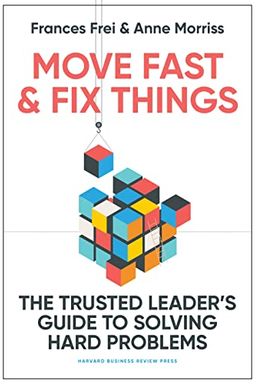
Move Fast and Fix Things: Leadership That Combines Speed and Trust
How can you change things quickly without leaving chaos in your wake? This is the central question Frances Frei and Anne Morriss ask in their bold leadership guide, Move Fast and Fix Things. Drawing on their work with companies like Uber, Airbnb, and Harvard Business School, they argue that true organizational progress doesn’t come from choosing between speed and care—it comes from balancing both. Their central claim is simple but revolutionary: great leaders should move fast and fix things.
For decades, “move fast and break things” was Silicon Valley’s call to arms. But as Frei and Morriss make clear, breaking things—trust, cultures, relationships—creates long-term drag that undermines even the most brilliant innovations. The more sustainable path is learning to build speed on a foundation of trust. Speed drives momentum and progress; trust ensures people want to come along for the ride.
The False Trade-Off Between Speed and Care
In their introduction, the authors dissect the myth that you can either move fast or take care of people. Having worked with companies cleaning up after reckless disruption, they say this belief is not just wrong—it’s costly. Organizations that fail to see how trust fuels speed end up in one of three dysfunctional states: Responsible Stewardship (safe but slow), Reckless Disruption (fast but careless), or Inevitable Decline (slow and broken). The aim is to reach the top-right quadrant they call Accelerating Excellence—the space where trust and pace amplify each other.
To help readers find that quadrant, they introduce the FIX Map—short for “fast, iterative excellence.” This framework asks every leader to analyze how their organization balances speed and trust. If speed reveals your destination, trust is what gets everyone to board the plane.
The Five-Day Playbook for Change
To make their philosophy practical, Frei and Morriss structure the book as a five-day journey—a metaphorical week that guides leaders from diagnosis to action. Each day represents a principle of effective leadership:
- Monday: Identify your real problem. Instead of reacting to symptoms, dig deep to uncover the true barrier blocking progress.
- Tuesday: Solve for trust. Every organizational wobble—lack of authenticity, empathy, or logic—can be fixed by designing trust-building experiments.
- Wednesday: Make new friends. Inclusion isn’t a moral afterthought; it’s the engine that drives innovation, speed, and better decisions.
- Thursday: Tell a good story. People move faster when they believe in a shared narrative that honors the past and lights the path forward.
- Friday: Go as fast as you can. Empower others, cut unnecessary friction, and build a culture of urgency without burning trust.
Each step builds toward momentum: identify truth, build trust, gather difference, inspire belief, and empower speed.
Why These Ideas Matter Now
The authors wrote during an era when change fatigue and corporate cynicism are rampant. Many leaders confuse patience with prudence and confusion with caution. Frei and Morriss challenge that paralysis with optimism: most problems are fixable if you move fast enough to matter. Their method pulls leaders out of “Responsible Stewardship”—the polite limbo of meetings and task forces—and helps them rediscover the joy and creativity that only action can bring.
The premise also reflects a deep ethical stance: leadership isn't about your heroic performance; it’s about empowering others to thrive. By blending pragmatism and empathy, Frei and Morriss show how leaders can restore energy and humanity to business. If their previous book Unleashed introduced empowerment as the heart of leadership, Move Fast and Fix Things makes it operational—showing how you can apply empowerment to solve hard problems quickly, without breaking what matters most.
“Your mission isn’t to fix everything—it’s to convince yourself and everyone around you that everything is fixable.”
Frei and Morriss ultimately offer a hopeful playbook for modern organizations. In a world obsessed with optimization, they remind us of something simpler and more powerful: trust is the ultimate accelerator. When people believe in each other, progress stops being a grind and starts to feel exhilarating. Their message is clear—you don’t have to choose between moving fast or doing good work. You can, and must, do both.