
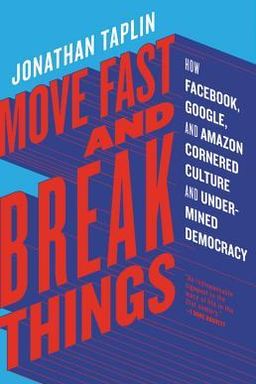
Move Fast and Break Things cover

Move Fast and Break Things

by Jonathan Taplin

In ''Move Fast and Break Things,'' Jonathan Taplin reveals how tech giants like Facebook, Google, and Amazon undermine democracy and culture. Delving into tax evasion, privacy invasion, and monopolistic practices, Taplin offers insights into reclaiming control and fostering a fairer digital landscape.

How Digital Monopolies Hijacked Culture and Democracy

How did the promise of the open Internet turn into a threat against creativity, democracy, and equality? In Move Fast and Break Things, Jonathan Taplin—a longtime music and film producer turned digital media scholar—argues that the libertarian ideology driving Silicon Valley has produced not an innovation renaissance but a monopolized digital economy that erodes art, journalism, and civic life.

Taplin contends that the mantra of “move fast and break things”—Mark Zuckerberg’s famous slogan—captures not just Facebook’s culture but the whole ethos of Big Tech: disrupt industries, ignore regulations, and treat all culture as data. He traces how this creed turned a web designed to decentralize power into one dominated by a handful of corporations: Google, Facebook, Amazon, and Apple. These companies have built empires that siphon money and control away from creators and toward platform owners. The result, Taplin warns, is a new form of monopoly capitalism as insidious as Standard Oil once was.

The Creative Collapse

Taplin illustrates the decline using his own career in music and film. Once, artists like Bob Dylan and The Band could make a comfortable living. Now, musicians, journalists, and filmmakers find themselves competing in a digital world where their work is streamed for fractions of a cent—or pirated entirely. Platforms pocket the profits while creators receive little. Digital abundance, Taplin writes, hasn’t democratized creativity; it has concentrated attention and revenue around the top 1% of artists and creators, leaving the rest struggling in economic shadow.

At the same time, the digital monopolies have perfected a surveillance business model that extracts data from every citizen. Facebook and Google sell this information to advertisers and politicians who use it to manipulate attention and opinion. As Taplin shows, the 2016 U.S. election demonstrated how this machinery could destabilize democracy—helping Donald Trump weaponize social media algorithms to bypass traditional accountability and flood public discourse with misinformation.

The Ideology Behind the Machine

Behind the technology lies a political philosophy: the libertarian gospel of Ayn Rand and Milton Friedman. Taplin documents how tech luminaries like Peter Thiel and Jeff Bezos believe government interference corrupts “freedom” and that monopolies are proof of genius rather than greed. Thiel’s infamous claim that “competition is for losers” summarizes the mindset—an unapologetic pursuit of dominance under the guise of efficiency and innovation. Their ideology turns capitalism into an oligarchy, favoring billionaires who see themselves as philosopher-kings rather than citizens accountable to the public.

Taplin connects this worldview to broader political movements. The Koch brothers’ libertarian empire, for instance, underwrites the deregulation agenda that allowed Big Tech to escape antitrust scrutiny. Silicon Valley’s “politics of disruption” thus becomes a moral project—a belief that breaking systems, governments, and industries is a form of progress, even if the cultural and human costs are staggering.

Breaking Things—and People

Taplin shows that the casualties of this ideology are everywhere: independent musicians like Levon Helm forced to tour in their seventies to pay medical bills; exploited Amazon warehouse workers tracked like machines; journalists replaced by clickbait algorithms; and citizens seduced into surrendering privacy for convenience. He urges readers to recognize that the erosion of creative livelihoods foreshadows a broader societal vulnerability—eventually, every profession becomes subject to the same digital strip-mining that devoured art.

He argues that the Internet’s founders, from Doug Engelbart to Tim Berners-Lee, envisioned a decentralized and humanistic network—a place to share knowledge freely, not to harvest personal data or destroy democratic infrastructure. Recovering that vision, Taplin insists, means resisting the dogma of disruption, restoring meaningful antitrust enforcement, and creating new models like artist-owned cooperatives and public-interest media initiatives.

Why These Ideas Matter

For Taplin, this isn’t just technological analysis—it’s a moral call. Without intervention, he warns, we face a future of digital feudalism where creative and civic power rest in the hands of a few eternal oligarchs. His book blends history, economic critique, and personal witness to confront the uncomfortable truth of the Internet age: the revolution meant to empower individuals has evolved into a system that surveils, manipulates, and impoverishes them. The antidote, Taplin proposes, lies in rediscovering community, culture, and cooperation—the foundations of humanity the tech elite have devalued.

Through powerful stories and sharp analysis, Taplin asks you to question not just how technology works but whom it serves. He challenges you to imagine a digital renaissance—a return to the creative spirit that first made the Internet worth building. In his view, we must move fast not to break things, but to rebuild them.


The Countercultural Origins of the Internet

Taplin reminds us that the Internet’s original dream was spiritual, communal, and profoundly human. Long before Facebook and Google turned the Web into an advertising marketplace, pioneers like Doug Engelbart and Stewart Brand came from the 1960s counterculture, where LSD experiments and the Whole Earth Catalog inspired visions of shared consciousness and decentralized creativity.

From Psychedelics to Silicon

Stewart Brand—a bridge between hippies and hackers—believed technology could help humanity achieve personal empowerment and harmony. His Whole Earth Catalog promised “access to tools,” blending self-reliance and community. Engelbart, meanwhile, invented the computer mouse and demonstrated networked collaboration at the legendary 1968 “Mother of All Demos.” His dream was that computing would enhance human intellect, not replace it. This ethos, Taplin notes, was an extension of the 1960s spirit of cooperation and civil rights that Martin Luther King Jr. anticipated when he warned that technology without morality leads to “guided missiles and misguided men.”

DARPA and the Paradox of Freedom

The Internet was born out of government funding, not private enterprise. ARPANET, financed by the Defense Advanced Research Projects Agency (DARPA), aimed to create resilient networks after the shock of Sputnik. Taplin emphasizes the irony: libertarian entrepreneurs now glorify the free market while ignoring that the Web itself was a public-sector creation. Every core protocol—TCP/IP, HTML—was released royalty-free. This public generosity seeded global connection, but it also allowed corporations to privatize the commons once the government retreated from oversight.

The Hippie Dream Eclipsed

By the 1980s, Silicon Valley culture had shifted from Engelbart’s collectivism to Ayn Rand’s individualism. What began as a network for empowerment morphed into a playground for libertarian technocrats. Taplin points to the moment when Peter Thiel and his “PayPal Mafia” replaced the counterculture’s call for collaboration with a creed of monopoly and disruption. As Fred Turner (author of From Counterculture to Cyberculture) observed, the ideals of community were “hijacked” by right-wing radicals who viewed democracy as an obstacle to capitalism.

What We Lost—and Could Regain

Taplin invites you to imagine returning to the Internet’s humanistic roots. He compares the original vision to Buckminster Fuller’s comprehensive design ideals—creating tools that uplift the species. Reclaiming Engelbart’s question—“What will you do for the people?”—means redesigning technology for empathy and cooperation. In this contrast between psychedelic idealism and monopolistic realism lies Taplin’s moral hinge: the Web was conceived to connect minds, not markets, and rediscovering that purpose is the first step toward a digital renaissance.


The Libertarian Counterinsurgency

At the heart of Taplin’s analysis is the ideological revolution that fueled today’s tech empire. He traces how libertarian economics—rooted in the writings of Milton Friedman and Ayn Rand—turned into Silicon Valley’s moral code. This philosophy prizes profit over democracy, efficiency over ethics, and autonomy over social responsibility.

From Friedman to Thiel: The Rise of Tech Libertarians

Friedman argued that a corporation’s only duty was to maximize shareholder profit. Ayn Rand’s heroes, exemplified by the defiant architect Howard Roark in The Fountainhead, glorified individual will against collective constraint. Taplin shows how these ideas captivated Peter Thiel—a Stanford graduate and founder of PayPal—who declared that “freedom and democracy are incompatible.” Thiel’s worldview, shared with venture capitalists like Marc Andreessen and Elon Musk, sees government as inefficiency incarnate and monopoly as virtue.

Thiel encouraged his investors to “build monopolies” and praised seasteading—floating libertarian city-states free from tax or regulation. In doing so, Taplin argues, Thiel and his peers transformed Silicon Valley into a political laboratory for radical deregulation. The ideology rejects both cooperation and civic obligation in favor of the rule of the brilliant few.

Jeff Bezos and the Monopsony Model

Amazon’s founder Jeff Bezos embodies libertarian capitalism in practice. Taplin recounts how Bezos exploited a Supreme Court tax loophole to undercut local bookstores, leading to thousands of closures. Through aggressive pricing and political lobbying—including the Internet Tax Freedom Act—Bezos turned Amazon into a monopsony, a buyer so powerful it dictates terms to sellers. His warehouses, where workers are tracked by GPS and punished for hitching a second too slow, reveal the human cost of efficiency worship. His philosophy—that liberty means the right to pursue happiness but not its guarantee—justifies ruthless labor exploitation as personal freedom.

Crony Capitalism and the New Elite

Taplin exposes the hypocrisy of self-proclaimed libertarian meritocrats who depend on government welfare while denouncing the state. Thiel’s data-mining firm Palantir—funded by the CIA’s venture arm—profits directly from public contracts. Thus, the very people who preach “freedom from regulation” quietly rely on state patronage. Taplin likens this to what George Gilder and the Koch brothers achieved: a coalition of tech and oil money redefining freedom as impunity for billionaires.

The Moral Cost of Radical Autonomy

For Taplin, libertarianism’s allure lies in its promise of personal control—but its danger lies in moral abdication. By equating autonomy with virtue, its adherents erode empathy, equality, and shared purpose. In the digital world, this creed yields monopolies that see users as data, not citizens. Taplin’s critique echoes Joseph Stiglitz’s warning that “markets based on exploitation destroy their own rationale.” The revolution Silicon Valley calls freedom, he argues, is really a rebellion against democracy.


Digital Destruction and the Fall of Creative Industry

Taplin’s most visceral chapters chronicle what he calls “digital destruction”—a global creative collapse engineered by piracy, monopolies, and algorithmic exploitation. Starting with Napster, the file-sharing service founded by Sean Parker and Shawn Fanning, Taplin shows how a generation of technologists treated art as disposable code. The consequences reshaped the livelihoods of millions of artists.

Napster and the Theft Revolution

Napster’s creators celebrated themselves as rebels fighting corporate greed, but Taplin reveals their deeper damage. By popularizing free music downloads, they slashed the global music industry’s revenues by two-thirds within a decade. Parker admitted Napster’s users were “infringing copyright,” yet rationalized the theft as innovation. The site’s 70 million users were proof of disruption’s morality: if everyone steals, theft becomes progress.

The YouTube Paradox

When Google acquired YouTube, Parker’s renegade ethos fused with corporate scale. YouTube allows professional content to be uploaded and monetized only after users post pirated versions—making artists chase their own work through takedown notices. Taplin cites YouTube’s internal emails showing founders deliberately courting illegal videos because piracy drove traffic. The “safe harbor” loophole of the Digital Millennium Copyright Act (DMCA) shielded YouTube from liability, even though pirated material was its backbone. A new economy emerged where creators did the labor, consumers provided the data, and platforms reaped the profit.

Facebook and the Attention Harvest

Taplin extends the analysis to Facebook, illustrating how it perfected surveillance marketing. By turning human relationships into advertising targets, Facebook monetized self-expression itself. Each post becomes unpaid labor. Taplin calls this “the greatest work-for-hire scheme in history”—billions of people generating free content every day to feed Mark Zuckerberg’s data engine. The platform doesn’t sell connection; it sells prediction: the ability to anticipate what you’ll click, buy, or believe.

Culture as Commodity

What unites Napster, YouTube, and Facebook is their treatment of culture as raw material. Taplin’s critique recalls Jaron Lanier’s Who Owns the Future?: when creativity becomes free, the ecosystem collapses. Musicians like Levon Helm went from earning hundreds of thousands yearly to nothing; filmmakers saw revenues vanish; journalists lost ads to Google News. The “long tail” promised democracy of ideas but delivered concentration of wealth. As Taplin writes, the Internet didn’t liberate artists—it replaced them with algorithms trained to mimic art at scale.


Monopoly Capitalism in the Digital Age

Why are Big Tech’s profits soaring while wages stagnate? Taplin argues that the answer lies in monopoly capitalism—an economic system redesigned by Robert Bork’s “consumer welfare” doctrine and perfected by Silicon Valley. Antitrust laws meant to protect competition were neutered to favor efficiency and low prices, allowing Google, Amazon, and Facebook to dominate every market they entered.

The Legacy of Robert Bork

Bork’s theory reframed monopoly as benign if prices stayed low. Reagan-era deregulation adopted this philosophy, gutting antitrust enforcement. Taplin recalls being taught mergers and acquisitions at Merrill Lynch during the 1980s when questions of antitrust “never came up.” This laissez-faire mindset produced conglomerates across airlines, health care, and beef production—and now digital monopolies with unmatched political clout. Under Bork’s logic, Amazon could control 70% of the book market or Google 88% of search without consequence, because consumers still “benefited” from free services or cheap prices.

Rent-Seeking and Inequality

Taplin draws on economists Peter Orszag and Jason Furman, who call these firms “rent seekers”: corporations earning super-normal profits by exploiting scarcity rather than creating value. Google extracts monopoly rents from advertisers forced to pay inflated rates for digital reach. Amazon exploits monopsony power, driving down author and publisher incomes. Facebook monetizes users’ identities with no compensation. Taplin connects this concentration of wealth to America’s rise in inequality and wage stagnation on par with the Gilded Age.

Democracy on Sale

In politics, monopoly power transforms liberty into oligarchy. Taplin cites research by Princeton’s Martin Gilens showing that wealthy corporations, not citizens, drive legislative outcomes. Google and Facebook deploy armies of lobbyists and foster “regulatory capture”—a revolving door where former government officials join tech giants and vice versa. Eric Schmidt’s frequent White House visits exemplify how digital monopolies maintain immunity through influence.

The Frozen Future

Monopolies don’t innovate—they entrench. Taplin cites MIT research showing startup formation shrinking under Big Tech dominance. Firms once motivated to compete now “exit” instead—selling to Google or Facebook before growth. This cozy landscape mirrors the stagnation Robert Gordon described in The Rise and Fall of American Growth: technology generates wealth but little productivity or creativity for ordinary people. The price of digital convenience, Taplin concludes, is a slow death of dynamism.


What It Means to Be Human in a Digital World

Beyond economics, Taplin explores the psychological toll of living inside the machines we built. Our devices, he warns, are designed not for liberation but addiction. Tech companies have mastered behavioral conditioning—a modern Skinner box that trains you to seek dopamine hits from likes, notifications, and digital rewards.

The Hooked Economy

Citing entrepreneur Nir Eyal’s Hooked, Taplin explains how variability—a mix of random reward and anticipation—programs users just like lab rats pressing levers. Every ping of a notification reinforces compulsive checking. He recounts tragedies like Joshua Burwell, a man who fell to his death while staring at his phone, as symbols of our distracted age. Social media monetizes attention by turning human vulnerability into profit—the longer you scroll, the richer the algorithm becomes.

Surveillance and Identity

Our online selves become commodities. Taplin references Julia Angwin’s Dragnet Nation to show how platforms like Facebook sell not only your data but your emotions, using experiments that manipulate mood through algorithmic tweaks. Zuckerberg’s doctrine of “radical transparency”—where privacy erodes for progress—reduces intimacy to content. In one chilling story, he recounts a young woman involuntarily outed to her father by an automatic Facebook update, illustrating how algorithmic openness can destroy personal safety.

The Erosion of Empathy

Taplin connects digital isolation to social decay—anonymity enabling cruelty, misogyny, and political tribalism. Gamergate’s harassment of female developers like Zoe Quinn exemplifies how online platforms foster mob aggression shielded by invisibility. He invokes Plato’s “Ring of Gyges” to explain why anonymity breeds moral collapse. When we can act without consequence, we lose empathy—the foundation of what it means to be human.

Rediscovering Humanity

Taplin closes by describing his retreat to Big Sur’s New Camaldoli Hermitage, where silence reminded him that presence—not connectivity—defines real community. He contrasts Silicon Valley’s cult of efficiency with Benedictine values: work, prayer, hospitality, study, renewal. These practices, he writes, ground us in purpose the digital world dissolves. Art, empathy, and contemplation are the antidotes to algorithmic addiction. To remain human, Taplin insists, we must disconnect from manipulation and reconnect with meaning.


Toward a Digital Renaissance

Taplin concludes with optimism: the digital age can still be redeemed. He envisions a “Digital Renaissance” grounded in decentralization, fairness, and human creativity. To achieve it, society must confront monopoly power, rebuild democratic oversight, and design cooperative systems that align technology with cultural survival.

Repairing the Broken Web

Taplin echoes Tim Berners-Lee’s call for “re-decentralization.” The Internet, he proposes, should function like its original architecture—a network of equals, not overlords. He imagines reforms to outdated laws like the DMCA, replacing “safe harbor” exploitation with “take down, stay down” accountability. Creators must be paid fairly through micropayment systems or artist cooperatives modeled after Sunkist or Magnum Photos—nonprofit collectives where producers control their own distribution and profits.

Reimagining Public Media and Antitrust

Taplin calls for revitalized public broadcasting—a fusion of NPR, PBS, and digital platforms funded through small spectrum taxes—to create advertising-free zones for authentic culture. He also urges a return to strong antitrust enforcement: treating Google and Facebook like utilities, forcing them to license technologies just as AT&T’s Bell Labs once shared its patents to fuel innovation. By reclassifying them as public infrastructure, we could restrain monopoly while unlocking new creativity.

Civic Responsibility in the Tech Era

Taplin’s renaissance depends as much on values as regulation. He argues for subsidiarity—the idea that communities, not corporations, should solve problems locally. His example of Chattanooga’s municipally owned broadband network demonstrates how local initiatives can outcompete giant incumbents and restore communal control. Technology, used responsibly, could become the engine for democracy rather than its digitized demise.

Reclaiming Art as Cultural Resistance

In his afterword, Taplin quotes Toni Morrison: “Artists are the ones that sing the truth.” This, he insists, is our task—protecting creators as society’s conscience against Silicon Valley’s plutocracy. The Digital Renaissance will require courage, cooperation, and conviction: a collective reclamation of the Internet as a human space. Move fast, Taplin says—but this time, break the monopolies, not the music.

Dig Deeper

Get personalized prompts to apply these lessons to your life and deepen your understanding.

Go Deeper

Get the Full Experience

Download Insight Books for AI-powered reflections, quizzes, and more.