
Idea 1
Mostly What God Does Is Love You
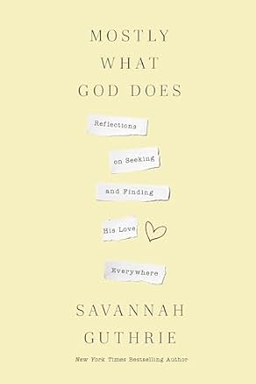
What if the central truth of spirituality—of all belief—could fit into one simple sentence? In Mostly What God Does: Reflections on Seeking and Finding His Love Everywhere, acclaimed journalist Savannah Guthrie explores that very notion. She contends that, beneath doctrines and dogmas, life with God is rooted in an astonishingly simple revelation: Mostly what God does is love you.
That phrase, borrowed from Eugene Peterson’s The Message translation of Ephesians 5:1–2, becomes the heartbeat of Guthrie’s entire book. Through personal stories, meditations, and theological reflection, she examines what divine love looks like—and how learning to receive and reflect that love can transform daily life. Drawing from her own experiences of loss, motherhood, doubt, and joy, she invites readers into a journey of rediscovering faith, not as fearful obedience but as a steady relationship with a loving God actively present in every human moment.
A Journalist’s Leap into Faith
For Guthrie—best known as co-anchor of NBC’s TODAY show—writing about faith was both audacious and intimidating. This was no investigative report or public interview; it was an public act of vulnerability. In the foreword, she admits her apprehension: Everything has been said about faith, she muses, but I have not said it. With characteristic candor and humor, she positions herself not as an expert but as a fellow traveler—curious, imperfect, and wide-eyed.
She organizes the book into “six not-so-easy pieces”—Love, Presence, Praise, Grace, Hope, and Purpose—her own version of the “essentials of faith.” Each part is a conversation between her personal experiences and Scripture, structured as short reflections meant to be savored slowly. Guthrie even invites readers to linger with blank pages between essays—a playful call for quiet and soul-stillness, mirroring how she and her children share thirty seconds of silence before bedtime. That simplicity—pause, presence, love—is exactly what she believes God asks of us.
Love as the Foundation and Framework
The book’s thesis—that God’s main activity is love—flows from Guthrie’s personal faith evolution. Raised in a devout Baptist home, she once imagined God as an exacting authority waiting for mistakes. Over the years, through heartbreak, divorce, disappointment, and rediscovered faith, that severe image softened into Someone who loves radically, unconditionally, and continually—even when unacknowledged. This recognition, she suggests, is the essence of spiritual maturity: believing past pain and uncertainty that God’s intentions toward us are good.
Her writing captures the gravity and humor of that discovery. She jokes about getting her first tattoo—her late father’s handwritten words All My Love—as an everyday mantra. The phrase, she explains, is not just a sentimental inscription but a theological affirmation. Imagine, she says, God writing to you those same words: “All my love.” What if that were not metaphor but fact?
The Six Movements of a Loved Life
Guthrie structures her reflections around six progressive movements that trace the soul’s journey within divine love:
- Love: the awareness that God’s first, last, and constant action is love, not judgment.
- Presence: learning to sense God’s companionship in each moment and silence.
- Praise: moving from fear into gratitude—discovering that worship heals the soul as much as it honors God.
- Grace: confronting sin and failure not through shame but through mercy and renewal.
- Hope: practicing faith amid suffering, insisting on goodness when the world seems irredeemable.
- Purpose: recognizing that the evidence of divine love is not perfection but participation—sharing God’s love outwardly, in work and relationships.
Each section amplifies a central truth: God’s love is not an abstract doctrine but a lived reality. Her stories—such as struggling to pray through grief, finding God’s “voice” during motherhood, or rediscovering Psalm 23 as her lifelong companion—offer real-world theology in motion. Her reflections are iterative, each piece looping back to the same refrain: love starts, sustains, and perfects all things.
A Modern Faith Memoir
Part memoir, part devotional, part spiritual manifesto, Mostly What God Does is reminiscent of works such as Anne Lamott’s Traveling Mercies or Shauna Niequist’s Present Over Perfect. Like those authors, Guthrie blends personal imperfection and humor with sincere theology. What distinguishes her, however, is her journalist’s sensibility: evidence matters, language matters, questions matter. She treats faith as investigation—not toward proof but toward intimacy.
She also resists tidy conclusions. Instead, she points to what she calls “holy curiosity”: the freedom to question God and to expect God to respond. If belief is giving God the benefit of the doubt in a cynical world, then curiosity is what keeps that belief alive. Each chapter models this curiosity, showing how ordinary moments—a hymn with her children, a painful failure, a prayer said with impatience—can become sites of revelation.
Why This Message Matters Now
In a culture often burned by toxic religiosity or spiritual exhaustion, Guthrie’s gentle theology of love is both balm and correction. She writes for the faith-full and faith-wounded alike, offering a God who delights rather than demands. Her portrait of divine affection stands as a counterweight to judgmentalism, consumer cynicism, and despair—modern maladies she sees in news, politics, and even within herself.
Ultimately, Mostly What God Does returns us to the place where faith begins: wonder that love itself could be the universe’s engine. Faith, she suggests, is not blind optimism but a hard-won decision to see life through love’s lens—again and again. And if we can manage that, even briefly, perhaps we will understand what she means when she writes: “Mostly what God does is love you. Keep company with him and learn a life of love.”