
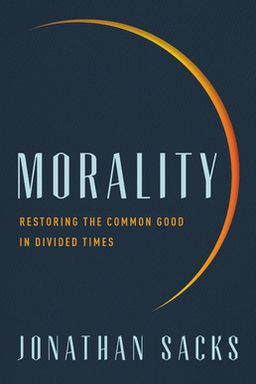
Morality cover

Morality

by Jonathan Sacks

In ''Morality: Restoring the Common Good in Divided Times,'' Jonathan Sacks delves into the collapse of traditional values in our divided world. He offers a roadmap to rebuild societal trust by prioritizing shared moral codes and fostering community over individualism.

Rebuilding the Moral Ecology of the West

How do free societies hold together when shared moral language collapses? In his sweeping analysis, Jonathan Sacks argues that the modern West is undergoing a form of cultural climate change—a long transition from a world organized around the collective “We” to one centered on the autonomous “I.” This shift in moral gravity underlies contemporary crises of loneliness, political polarization, consumerism, and institutional decay. Sacks contends that while individual freedom has brought unprecedented creativity and choice, the thinning of communal bonds has left people atomized and democracies fragile.

You see this transformation in every sphere. Families fragment; work and markets become detached from moral responsibility; technology amplifies self-display; and politics fractures into warring identities. Sacks calls this not only a social but a moral emergency: without institutions that teach the habits of trust, restraint, and reciprocity, free societies cannot sustain themselves for long.

From covenant to contract

Sacks traces the decline of shared responsibility to intellectual and cultural currents stretching back five centuries. The Reformation emphasized individual conscience; the Enlightenment exalted reason and autonomy; Romanticism and existentialism crowned personal authenticity. Together they made the self, rather than the community, the core of moral life. This philosophical lineage, reinforced by market deregulation and digital networks, eroded the institutions—families, congregations, civic associations—that once embodied covenantal ties. The result is a society of contracts and transactions but few covenants of belonging.

In Sacks’s terms, a contract is about interests—what you get. A covenant is about identity—who you are with others. When contracts replace covenants, communities turn into marketplaces and citizens into consumers. (Note: This echoes Robert Bellah’s Habits of the Heart, which observed a similar moral atomism in American life.)

The symptoms of the “I” age

Empirical evidence reinforces his diagnosis. Robert Putnam’s Bowling Alone documented collapsing civic participation; Jean Twenge’s iGen traced the mental-health crisis among digitally immersed youth; surveys show a steep rise in loneliness and distrust across the U.S. and Europe. The internet and consumer capitalism, Sacks argues, reward attention-getting rather than relation-building. They create constant stimulation but little presence. The irony is that societies obsessed with connection produce epidemics of isolation.

Public life fares no better. In politics, the retreat from shared narratives yields polarization, populism, and identity wars. In economics, moral deregulation culminates in bubbles and scandals—from Enron to the 2008 financial crisis—revealing that markets depend on virtues they do not themselves create. Even universities, once citadels of open inquiry, now struggle between protection and intellectual risk, fearful of controversy. In every case, institutions that once formed citizens into moral beings give way to systems that instrumentalize them.

The covenantal alternative

Yet Sacks is not a pessimist. His central claim is constructive: free societies can renew themselves by reviving the moral grammar of covenant—shared responsibility grounded in dignity and faith. You need to repair small moral ecologies: families, neighborhoods, congregations, clubs, and voluntary groups that rebuild trust through daily practice. This is what Tocqueville called the “schools of self-government,” where people learn to balance freedom with responsibility.

Across economics, politics, and culture, Sacks urges a rebalancing. Markets must serve the common good; technology must respect human presence; rights must be joined with duties. Communities must provide the moral literacy that politics alone cannot impose. The Sabbath, he suggests, is a small but powerful rehearsal of this covenantal order—a weekly practice that gathers families, halts the tyranny of consumption, and restores gratitude and relational joy.

Core insight

Cultural renewal begins not with policy but with practice—with human beings who rediscover covenant in family, friendship, and community, and who learn once again that the question is not “What can I gain?” but “What do we owe each other?”

This is Sacks’s guiding theme: that to survive the modern age, you must rebuild the habits and institutions that turn “I” into “We.” Every chapter of his argument explores where the “I” has overreached—in family, economy, technology, or politics—and how the logic of covenant can restore balance. The book is not nostalgia; it is an ethical blueprint for rebuilding moral ecology in a time of fragmentation.


Loneliness and the Search for Belonging

Loneliness is not simply a private sadness; it is a symptom of social disintegration. Sacks opens with this human dimension to show you how the collapse of the “We” has measurable mental and physical costs. He presents loneliness as the hidden epidemic of affluent societies—a crisis comparable in health impact to obesity and smoking.

Social evidence and consequences

Studies in the UK and U.S. show roughly half of adults sometimes feel alone. Younger generations, paradoxically the most digitally connected, report the highest isolation. Loneliness increases cardiovascular disease, accelerates cognitive decline, and raises mortality risk by over 25%. The “epidemic” cuts across class and age, intensified by the decline of religious participation, village life, and extended families.

Sacks weaves data with moral argument: isolation corrodes empathy and moral will. Without face-to-face community, moral learning withers. Virtues like trust, generosity, and patience are not taught by code but by contact. Digital connectivity cannot replace embodied presence.

Models of communal resilience

There are still counterexamples that can inspire you. Susan Pinker’s “village effect” research in Sardinia shows how intergenerational life produces both wellbeing and extraordinary longevity. Similarly, religious congregations—measured by Putnam—generate dense social capital through rituals, mutual care, and moral education. For Sacks, Jewish community life historically modeled this resilience: the synagogue, charity funds, and sabbath meals all convert private existence into shared meaning.

These examples show that lived communities, not merely mental health services, are the heart of the cure. You can design policies for parks or local clubs, but real healing arises when people assume responsibility for one another’s presence.

Sacks’s moral diagnosis

When the “We” collapses, not only the individual but society itself becomes sick. Rebuilding connection is a moral act, not just therapeutic care.

The practical takeaway is simple but urgent: cultivate local relationships, invest time in family meals, volunteer, or join civic associations. These habits restore both meaning and health. Sacks’s language of covenant begins here—with the decision to be present to others, turning loneliness into belonging.


Technology, Attention, and Moral Presence

Technology has rewired how you attend to the world, and with it how you grow morally. Sacks examines the paradox of social media: tools built to connect people often erode empathy and sustained focus.

The attention economy

Platforms like Facebook, YouTube, and TikTok thrive on engagement loops that exploit cognitive vulnerabilities. Netflix competes with sleep; YouTube auto-plays; endless scrolling displaces deep conversation. The moral cost is visible among youth: Jean Twenge’s iGen charts falling happiness and rising depression since smartphones became universal around 2012.

How attention shapes moral life

Drawing on anthropology, Sacks reminds you that conversation, not messaging, is the crucible of moral formation. Malinowski called it “phatic communion”—speech that sustains relationship—while Robin Dunbar linked language to social grooming. Screens disembody that encounter, replacing mutual presence with performance. Seeking “likes,” users curate selves rather than cultivate character. Empathy contracts into exhibitionism.

Sacks’s challenge

You cannot build moral character without the discipline of attention. To learn empathy and self-restraint, you must spend time face to face, not screen to screen.

For Sacks, the answer lies in restoring boundaries—screen-free meals, family rituals, sabbath rest, and education that prizes dialogue over display. Even tech leaders restrict devices at home, an implicit admission that presence matters. The practice of conversation becomes both ethical and countercultural: to listen patiently is to resist fragmentation.

You need not reject technology, but you must govern it by moral purpose. Attention, like time, is a covenantal resource. How you spend it determines who you become.


Markets, Morality, and Trust

Sacks neither demonizes nor glorifies markets: he argues they are moral systems that depend on trust. When that moral infrastructure erodes, the market corrodes itself. Scandals like Enron, Carillion, and the 2008 crash dramatize what happens when greed substitutes for governance.

Moral foundations of capitalism

Adam Smith’s The Theory of Moral Sentiments preceded his Wealth of Nations; empathy and conscience were always prerequisites for the invisible hand. Sacks revives that insight: the linguistic root of “credit” is “to believe.” Without belief in one another’s honesty, markets collapse. Behavioral economics confirms this—people punish unfairness even at personal cost, which sustains cooperation. Markets presuppose virtues they cannot create.

Repairing economic character

Today, CEO-to-worker pay ratios exceed 300:1, signaling a cultural disconnect between success and service. Sacks urges reforms: fiduciary responsibility for leaders, incentive alignment to share risk, and public honor for ethical enterprise. He cites his Jewish Association of Business Ethics as one model of moral renewal through professional culture, echoing older guild traditions that bound profit to principle.

Key lesson

Markets create wealth, but only moral communities create the trust that makes that wealth sustainable.

Rebuilding the moral ecology of capitalism means rewarding integrity as much as innovation and restoring the sense that enterprise serves a social covenant, not just shareholder return. Only then can prosperity coexist with justice.


Family, Covenant, and Continuity

The family, Sacks argues, is where moral life begins. It is the first covenantal institution, binding people through loyalty and trust beyond calculation. When marriage and parenting lose their sacred dimension, society loses its moral apprenticeship.

Covenant vs contract in private life

Marriage as contract is transactional; marriage as covenant creates identity. A contract lasts as long as interest; a covenant endures through faithfulness. Sacks shows how the cultural revolutions of the 1960s—through secularization and sexual liberation—dissolved marriage’s covenantal meaning. The result: growing numbers of single-parent homes, declining birth rates, and intergenerational inequality documented by Charles Murray and Robert Putnam. Family breakdown reinforces class divides because stable two-parent households transmit trust, discipline, and hope.

Renewing the family”s role

Sacks’s remedy is cultural, not coercive: honor fidelity, create rituals that sustain bonds (e.g., the Sabbath meal), and design social policies that make commitment economically viable. Family time must be guarded from market pressures; community networks must mentor young parents. The goal is not nostalgia for patriarchy but recovery of mutual responsibility as a source of human strength.

Moral insight

Where families fail, no government can fully compensate; where they flourish, even fragile communities endure.

The family thus becomes the prototype of covenant itself: the school of love where the lessons of loyalty and self-restraint are learned for life.


Truth, Freedom, and the Public Square

Modern democracy depends on shared truth, but Sacks warns that post-truth politics is corroding that foundation. When opinion replaces fact and emotion eclipses evidence, public trust collapses—leaving societies easily manipulated.

The making of post-truth

From Marx, Nietzsche, and Freud’s “hermeneutics of suspicion” to postmodern relativism, modern thought has doubted the very notion of objective truth. Combine that with algorithms that amplify outrage, and lies spread faster than corrections. Fake-news examples like the phantom “Holocaust ban” email show how emotion outpaces verification. Sacks calls this a moral crisis: if people lose the expectation of honesty, cooperation becomes impossible.

Reclaiming shared reality

You need institutions that guard truth—responsible journalism, civic education, transparent platforms, and a public ethos that prizes integrity over tribal advantage. Defending truth is not merely epistemic; it is communal. A society bound by covenant values honesty because it values trust. Without trust, even freedom becomes a power struggle.

Sacks’s warning

Without shared truth, you cannot have shared trust; without trust, you cannot have a shared society.

This crisis extends to speech culture: campuses silencing controversial speakers, and social media mobs replacing debate with denunciation. The cure is freedom linked to civility—the courage to argue constructively and the humility to hear others as partners in truth.


Identity, Victimhood, and Moral Agency

Sacks explores the politics of identity and its dark twin, victimhood. Both arise when the “We” of shared citizenship fragments. Identity movements, meant to affirm dignity, risk degenerating into zero-sum competition for recognition. Likewise, trauma can become moral capital, trapping people in grievance instead of growth.

Identity politics and democracy

Historically, identity has both united and divided: Herder’s nationalism, Marx’s class struggle, and civil rights activism all show its ambivalence. Today’s versions—whether ethnic nationalism or intersectional resentment—replace civic patriotism with mutually exclusive tribal loyalties. Sacks prefers George Orwell’s distinction: patriotism as love, nationalism as power. Without a broader “We,” democracy decays into factional grievance.

Victimhood culture

Drawing on Edith Eger’s and Viktor Frankl’s lessons from surviving Auschwitz, Sacks shows that life after trauma depends on reclaiming agency. “Suffering is universal; victimhood is optional.” Therapeutic culture, by confusing emotion with moral claim, risks disabling responsibility. True compassion empowers others to act, not to remain defined by hurt.

Sacks’s ethic

Victimization is what happens to you; victimhood is the identity you choose to carry. Choosing responsibility is the beginning of renewal.

The practical outcome is a politics that honors memory without idolizing grievance, and a civic identity large enough to unite differences. Responsibility, not resentment, is the path from “I” to “We.”


Civility, Argument, and Freedom

Democracy lives on its conversation. Sacks shows how the death of civility—amplified by social media, academic intolerance, and outrage culture—threatens liberty itself. Civility is not politeness; it is restraint in the service of coexistence.

Arguing for the sake of truth

Judaism’s tradition distinguishes arguments “for the sake of heaven” from those for self-vindication. The sages Hillel and Shammai disagreed respectfully, seeking growth through dialogue. Korach’s populist revolt, by contrast, mirrored modern demagogues—the “we alone” dynamic of populism that silences dissent. Sacks’s moral test is simple: if an argument enlarges understanding, it is righteous; if it diminishes community, it is corrupt.

Restoring civic discourse

Universities and online networks now struggle with this distinction. Overprotection and cancel culture attempt virtue by silencing disagreement, but genuine intellectual safety arises from resilience, not avoidance. Greg Lukianoff and Jonathan Haidt’s Coddling of the American Mind illustrates how cognitive fragility undermines learning. Civility is a collective discipline: you choose words that preserve the space for argument itself.

Sacks’s civic vision

If you win an argument but lose relationships, you’ve lost something essential to truth itself.

Relearning how to disagree honorably may be the most urgent civic reform of all. Free speech without moral virtue becomes noise; civility turns noise back into knowledge.


Time, Consequence, and the Future

At the deepest level, Sacks urges you to recover moral time—the ability to think beyond the immediate. Modern culture rewards short-term gains and policies; yet civilizations perish when they consume the moral capital meant for their descendants. The theme unites personal restraint, environmental stewardship, and humility before complex systems.

The ethics of foresight

Through the Hart–Devlin debate on law and morality, Sacks shows how permissive choices can yield corrosive long-term effects (e.g., drug culture leading to opioid crises). Chaos theory teaches caution: in complex societies, small shocks can cascade. Hayek warned against the “fatal conceit” of believing planners can foresee social outcomes. The moral lesson: respect tradition’s accumulated wisdom—it encodes survival-tested norms.

Acting for posterity

Climate change epitomizes short-termism: markets and elections operate on cycles far shorter than ecological time. Sacks frames this as a covenantal responsibility between generations—being guardians, not owners. Like Attenborough, he invokes the abolition of slavery as precedent for moral leaps that transcend immediate benefit. Long-term stewardship requires laws, institutions, and culture aligned with patience.

Final moral injunction

To build a future worth inheriting, you must learn to say no to immediate desires in the name of those not yet born.

Sacks closes with hope: wherever people act with responsibility, gratitude, and foresight, the moral ecosystem begins to heal. Covenantal thinking is thus not a relic but a roadmap—for thriving individuals, responsible economies, and enduring societies.

Dig Deeper

Get personalized prompts to apply these lessons to your life and deepen your understanding.

Go Deeper

Get the Full Experience

Download Insight Books for AI-powered reflections, quizzes, and more.