
Idea 1
Building the Silicon World
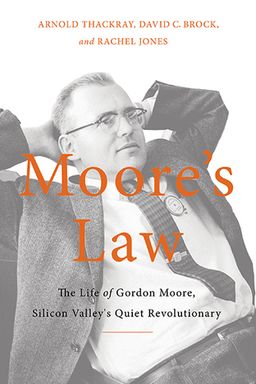
How does a boy from rural California end up defining the rhythm of global technology? The book tells the intertwined story of Gordon Moore—chemist, entrepreneur, and quiet strategist—and the revolution that crystallized around his name: Moore’s Law. Rather than a single prediction, what unfolds is a social-technological epic, where chemistry, collaboration, and disciplined manufacturing transform a backwater lab culture into what you now call Silicon Valley.
The central argument is that technology’s exponential progress is not a miracle of physics but a construction of people, institutions, and culture. Moore’s Law—transistor counts doubling at regular intervals—became a collective promise sustained by cooperative engineering and industrial coordination. Behind it lie the values Moore absorbed in Pescadero: self-reliance, thrift, and experimental craft. His early chemistry experiments and Caltech training gave him the mindset to turn glassblowing and diffusion furnaces into billion-dollar production strategies.
Roots and Character
You meet Moore as a cautious, methodical experimenter—the antithesis of a flamboyant founder. His rural upbringing and early marriage to Betty Whitaker instill endurance and partnership. Betty’s role is decisive: she manages logistics and family life, acting as the household engine that makes Moore’s relentless lab hours and start-up risks possible. The domestic sphere is not a footnote—it’s part of the industrial narrative.
From Cold War Labs to Shockley’s Frictions
The backdrop is Cold War electronics: vacuum tubes dominate, then transistors appear, militarized by defense contracts. Silicon replaces germanium under demands for heat resistance, and Beckman Instruments funds William Shockley to pioneer silicon diffusion. But Shockley’s erratic management collapses under its own weight. His failure incubates the seed of rebellion—the Traitorous Eight—Moore among them. Their departure from Shockley Semiconductor in 1957 inaugurates the entrepreneurial template that will define the Valley: expert engineers joining forces, finding sympathetic capital, and building disciplined new firms.
The Chemistry and Craft of the Microchip
At Fairchild Semiconductor, Moore’s chemical mastery finds its industrial outlet. You watch diffusion furnaces and oxide masking methods evolve into batch-processing miracles. Silicon wafers, purified and patterned, replace hand-wired circuits. The planar process—Jean Hoerni’s insight to leave oxide intact—offers reliability and mass scalability. Coupled with Bob Noyce’s realization that metal interconnects could be printed cross-wafer, this unlocks the integrated circuit. Moore’s hands-on furnace building and metallization innovations turn chemistry into manufacturing economics.
From Economic Theory to Collective Rhythm
Moore’s 1965 Electronics paper reframes the industry: every investment in process improvement moves the cost minimum toward higher complexity. Thus, denser chips become cheaper per transistor. His forecast spurs an industrial pact—roadmaps, investments, and competitive cadence—that synchronizes global fabrication. Moore’s Law becomes a self-fulfilling coordination device, not a natural constant. It is equal parts engineering, economics, and social contract.
A pivotal insight
Moore’s Law works because people believe it should. The promise of regular doubling mobilizes resources, aligns competitors, and turns semiconductor production into a global metronome of progress.
Entrepreneurship and Industrial Growth
Fairchild’s spin-offs multiply across Santa Clara Valley. Engineers defect, form new firms, and seed venture networks. Defection capital—talent mobility combined with venture backing—becomes the Valley’s core economic mechanism. Out of this ferment, Moore and Noyce build Intel in 1968, applying lessons of cooperative focus, manufacturing rigor, and incentive structures. Intel’s Goldilocks strategy in semiconductor memory, its manufacturing-first culture, and the eventual pivot to microprocessors exemplify Moore’s disciplined experimentalism.
Social Costs and Legacy
Behind success lie unseen consequences: solvent pollution, gendered labor, and superfund sites—reminders that speed and chemistry carry environmental costs. Later, Moore channels engineering logic into philanthropic ventures. The Gordon and Betty Moore Foundation applies his measurement ethos to conservation, science, and healthcare, though Moore learns that social systems resist quantitative control. His final legacy is double: exponential technological progress and the humbling recognition that metrics alone cannot engineer human welfare.
If you step back from the transistor counts and yields, the book gives you a panorama of invention as a collective craft. From Pescadero’s rural self-reliance to clean-room global factories, Moore’s life and law reveal how careful chemistry and cooperative imagination can scale human ingenuity to infinity—or at least until physics says stop.