
Idea 1
The Art and Science of Remembering
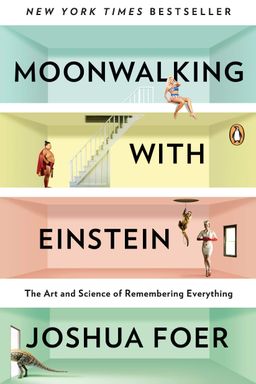
How can an ordinary person train their memory to perform extraordinary feats? In Moonwalking with Einstein, journalist Joshua Foer embarks on a year-long experiment to answer that question. He begins as a curious observer at the U.S. Memory Championship and ends as a champion himself, proving that memory is a trainable skill, not an innate gift. The book blends personal narrative, cognitive science, and cultural history to explore how humans remember, why we forget, and what memory reveals about our minds and identities.
Foer’s journey ties together two central claims. First, memory is not fixed—it can be expanded by deliberate practice and by learning how the mind encodes and retrieves information. Second, the way societies externalize memory—through writing, books, and now digital lifelogs—reshapes what it means to know and to be human. As he trains with world-class mnemonists such as Ed Cooke and Ben Pridmore, and learns from scientists like K. Anders Ericsson, Foer uncovers a universal truth: the limits of your memory are often the limits of your attention and technique, not your biology.
Memory as Trainable Skill
Foer’s first revelation is that “memory champions are made, not born.” Studies by Ericsson and others show that ordinary people, given structured methods, can rival natural prodigies. The story of the undergraduate S.F.—whose digit span grew from seven to nearly eighty through two years of practice—demonstrates that mental capacity expands with chunking and meaningful encoding. Using domain-specific associations (like running times), S.F. restructured raw numbers into meaningful patterns. Foer learns to do the same through spatial and visual systems like the memory palace, linking data to familiar places in the mind.
Ancient Techniques, Modern Science
At the heart of Foer’s training is the method of loci—an ancient Greek invention that transforms memory into architecture. By placing bizarre and vivid images along a mental path (his childhood home, for instance), Foer engages the hippocampus, the brain’s spatial-navigation engine. Neuroscientist Eleanor Maguire’s fMRI scans confirm that expert memorizers recruit these same spatial circuits when remembering numbers or cards. In Ed Cooke’s playful lessons—imagine Claudia Schiffer swimming in cottage cheese or jars of garlic blocking the driveway—Foer learns that the brain remembers through emotion, exaggeration, and image.
From Skill to Sport
Foer’s narrative shifts from psychology to performance as he enters the competitive world of memory sport. The World Memory Championship is a mental decathlon featuring poetry, numbers, and faces, where discipline meets creativity. Competitors use mnemonic architectures like the Major System and PAO (Person–Action–Object) method to compress data into imagery that can be walked through mental palaces. By training under pressure with metronomes and spreadsheets, Foer applies Ericsson’s principle of deliberate practice: push beyond comfort, track errors, and correct them systematically. This process propels him from journalist to U.S. champion in less than a year.
Memory’s Broader Meanings
Beyond competition, the book reflects on memory’s cultural and moral meaning. Foer contrasts ancient orators—who saw memory as a civic art—with our digital age, where we outsource remembering to devices and networks. He revisits inventions from the alphabet to the index to the Internet, showing how each externalization changed intelligence itself. This leads to contemporary thought experiments: Microsoft’s Gordon Bell records his entire life in data, raising questions about whether external archives become part of who we are. Foer warns that offloading memory can erode inner reflection and the continuity that gives life coherence.
Forgetting and Identity
At its most poignant, the book explores the edge cases of memory—amnesiacs like EP, who live in an eternal present, and hypermnestics like Luria’s “S.”, who drown in unwanted details. These figures illustrate that memory’s purpose is not just storage but the construction of autobiographical continuity. Forgetting is not merely loss—it is the mental process that allows you to think abstractly, to forgive, and to live unburdened by an exhaustive past. The art of memory, Foer concludes, is about balance: improving what matters, accepting what must fade.
Core message
To practice remembering is to expand how fully you experience time and life. Memory is not a static ability; it’s a craft shaped by technique, culture, and attention. The more intentionally you remember, the more meaning you draw from living.