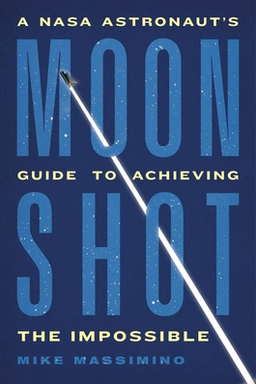
Moonshot cover

Moonshot

by Mike Massimino

Moonshot is a motivational guide from NASA astronaut Mike Massimino, blending humor with heartfelt storytelling. It reveals the power of persistence, teamwork, and adaptability in achieving ambitious goals, inspiring readers to embrace challenges and redefine success.

Achieving the Impossible: Your Personal Moonshot

Have you ever looked at a dream in your life and thought, “That’s impossible”? Maybe it’s starting your own business, writing a book, or even running a marathon. In Moonshot: A NASA Astronaut’s Guide to Achieving the Impossible, Mike Massimino—former NASA astronaut and two-time space traveler—asks you to reconsider that belief. He argues that any goal, no matter how far-fetched, can be achieved through persistence, teamwork, trust, and adaptability. Drawing from his remarkable journey from a nearsighted, height-fearing kid on Long Island to a spacewalking astronaut repairing the Hubble Space Telescope, Massimino shows that life’s


One in a Million Is Not Zero

Massimino begins his journey with a powerful mindset shift: one in a million is not zero. This principle captures a mathematical and philosophical truth—that difficult doesn’t mean impossible. When Mike calculated the odds of becoming an astronaut, he realized that while one in a million is daunting, it’s still not zero. There’s always a chance, but only if you try.

Pursue the Dream Relentlessly

Facing rejection after rejection from NASA—three times in total—Massimino refused to let failure define him. His bad eyesight led to medical disqualification, but instead of surrendering, he engineered his own solution. Through months of vision training, and sheer grit, he improved his eyesight enough to pass NASA’s rigorous exam and earn his place as part of the 1996 astronaut class. The lesson: when obstacles appear permanent, adapt and persist until they move.

Turning Fear into Action

Massimino’s fear of heights and multiple failures might have easily stopped him—but he reframed those fears as motivators. “The only way to make something impossible is to stop trying,” he writes. Even a one-in-a-million dream can succeed if effort never ceases. This is not naïve optimism; it’s a call for pragmatic hope grounded in relentless action and critical thinking.

Core Lesson

When you face what looks like impossible odds, remind yourself: one in a million is not zero. Your effort, however small, keeps the chance alive. Giving up guarantees failure; persistence keeps hope breathing.


No One Leaves the Pool Until Everyone Passes

In NASA’s world, teamwork isn’t optional—it’s survival. The chapter No One Leaves the Pool Until Everyone Passes the Test delivers one of Massimino’s most enduring lessons: success is collective. When he arrived at NASA, poor swimming skills nearly disqualified him from water survival training, essential to astronaut readiness. Yet instead of mocking or excluding him, his team rallied around him. Strong swimmers spent their weekend teaching the weak ones until all forty-four members of the “Sardine” class passed. This nurturing, collaborative culture built the core of NASA’s success.

From Individualism to Team Spirit

In most workplaces, individual recognition dominates: outperform your colleagues to win. At NASA, it’s reversed—you succeed or fail as a unit. For the astronaut corps, one person’s failure can jeopardize lives. The culture prioritizes cooperation, transparency, and collective responsibility. Massimino learned that the weakest member of the team deserves the same respect and support as the best performer.

Shared Success and Shared Failure

During his missions to Hubble, Massimino witnessed teams standing together even when things went wrong—like a damaged piece of equipment on orbit. Instead of blaming the individual, the entire crew accepted responsibility, learned collectively, and came back stronger. “When you fail, fail as a team,” he says. “Never throw anyone under the bus.” This mindset keeps morale high and builds long-term resilience.

Core Lesson

In life and work, bring everyone along. Supporting your teammates through their struggles ensures collective victory—and creates trust strong enough to endure crisis.


Speak Up and Listen Well

Communication, Massimino insists, can save lives—or end them. “Speak Up” recounts harrowing near misses and teachable moments from the cockpit. Early in training, his silence nearly led to a midair collision when he failed to correct a pilot’s heading. The hard lesson: even when you’re new or inexperienced, your perspective matters. Silence kills; participation saves.

The Power of Honest Voice

NASA culture demands openness. Every astronaut must confess errors publicly at Monday meetings—known as “close calls.” These meetings function not to shame but to teach. Only hiding a mistake is unforgivable. This transparency builds safety systems and humility across the organization. (In leadership research, this mirrors Amy Edmondson’s concept of “psychological safety”—the condition where team members feel safe admitting mistakes.)

Listening Is Half of Speaking

The Speak Up rule extends beyond voice—it demands listening. When rookie astronaut Drew Feustel proposed a new “Pick Stick” tool for Hubble repairs, veterans listened instead of dismissing him. The device revolutionized delicate telescope procedures. Encouraging new voices generates innovation and prevents blind spots.

Core Lesson

Always speak when something feels off—and as a leader, thank people for doing so. Courageous communication and receptive listening transform teams into high-performing, trust-driven units.


Trust the Training, Gear, Team, and Yourself

Launching into space is terrifying, and Massimino admits he was scared. The antidote? Trust. His mantra—Trust Your Training, Trust Your Gear, and Trust Your Team—applies far beyond rockets. It’s about cultivating confidence in the systems and people that support you, especially under pressure.

Trust Your Training

NASA’s rigorous preparation ensures readiness. “Spaceflight is an open-book test,” mentor Steve Smith told him. You don’t have to remember everything, but you must trust that you’ve been taught well. Self-doubt corrodes performance; belief in accumulated experience sustains it.

Trust Your Gear

Astronauts rely entirely on technology—the shuttle, space suits, and mission systems. When Massimino watched technicians meticulously apply epoxy to a rocket joint, he saw how care builds reliability. His trust in the craft was faith in thousands of unseen workers. (In business parallels, this reflects Simon Sinek’s principle of “trusting the process”—confidence in well-built systems.)

Trust Your Team and Yourself

After the Columbia disaster, NASA’s recovery embodied shared trust: transparent communication, systemic overhaul, and moral courage. “Trust, but follow up,” Massimino writes—trust doesn’t mean blind faith but continuous collaboration. Ultimately, he adds one more layer: trust yourself. If you’re nervous, it’s proof you care. Nervous energy fuels preparation and focus.

Core Lesson

Whether launching into orbit or facing a career challenge, confidence comes from trust—earned through work, shared through teams, and reinforced through self-belief.

You Can Always Make It Worse

Astronaut Robert “Hoot” Gibson’s law was simple: “No matter how bad things seem, you can always make it worse.” Massimino learned it the hard way after tangling his space tether like a spaghetti knot. Every hasty move made it worse. Panic and speed compound errors; calm and teamwork solve them.

Slow Down to Speed Up

When emergencies strike, slowing down is counterintuitive but life-saving. NASA’s “Two-Person Rule” demands at least two minds for every critical decision—one acting, one confirming. Massimino’s later crisis, a leaking space suit mid-mission, proved the rule’s worth. By meticulously cross-checking every step, his crew avoided fatal mistakes and finished their work safely.

Go Slow Like Joe LoPiccolo

Drawing inspiration from a family handyman known for deliberate precision, Massimino’s crew adopted “Go slow like Joe LoPiccolo” as its mission motto. Slowness isn’t inefficiency—it’s precision under pressure. The STS-109 team’s careful approach extended Hubble’s life and led to Nobel Prize–winning discoveries from its instruments.

Core Lesson

In crises, restraint is power. Pause, breathe, and get help before acting. Fast action without forethought doesn’t fix trouble—it multiplies it.


The First Rule of Leadership

Great leadership, Massimino emphasizes, begins not with authority but empathy. His defining leadership lesson came from Apollo astronaut Alan Bean, who taught him “The First Rule of Leadership: admire and care for everyone on your team.” True leaders respect even the difficult or overlooked members—and by doing so, build loyalty that endures.

Learning from Alan Bean

Bean’s mentor Pete Conrad once rebuked him for dismissing a teammate: “Maybe you’re the one who should be taken off the team.” That shock transformed Bean’s leadership philosophy. He later commanded Skylab with remarkable success because he cultivated respect for everyone—from rookie engineers to flight directors.

Admiration Builds Cohesion

Massimino put this rule to use when managing complex engineering teams during Hubble repairs. Listening to an often-ignored engineer named Sam—whose unconventional ideas solved critical problems—showed him the power of inclusion. Recognizing hidden genius strengthens collaboration and morale.

The Bank of Good Thoughts

To deal with team friction, Massimino created a “Bank of Good Thoughts.” Before confronting someone, recall something admirable about them. Positive framing reduces defensiveness and makes problem-solving collaborative. (In psychology, similar methods appear in appreciative inquiry and compassionate leadership practices.)

Core Lesson

Leadership means caring first, commanding second. Respect every contributor, and admiration will transform performance, unity, and trust.


Houston, We Have a Problem: Reach Out

After his spaceflights, Massimino served as a CAPCOM—the communicator between astronauts and Mission Control. This role taught him one profound truth: every human being needs mission control, someone to reach out to when stranded in uncertainty.

Mission Control as Lifeline

When Shuttle Columbia exploded in 2003, three astronauts orbiting in the International Space Station were suddenly stranded. Massimino became their CAPCOM, offering constant updates and emotional support until their safe return. His empathy extended to their families, visiting them, and even taking children to watch their parent’s spacecraft overhead—small acts of human connection that rebuilt hope.

Everyone Needs a CAPCOM

During Hubble repairs, Massimino’s own CAPCOM, Dan Burbank, guided him through crisis when he stripped a screw. Calm, encouraging communication helped him regain composure. “Dan was my lifeline,” he recalls. It’s a reminder: we all need people who can keep us calm, direct our thinking, and remind us we’re not alone.

Core Lesson

When overwhelmed, reach out—say “Houston, I have a problem.” And when others reach out to you, be their mission control: present, empathetic, and resourceful.


The Thirty-Second Rule

Mistakes are inevitable, even in space, but dwelling on them is optional. In “The Thirty-Second Rule,” Massimino explains how astronauts manage error and regret under high pressure. Instead of denial, they allow thirty seconds to feel bad—then refocus.

From Dwelling to Discipline

Massimino used to spiral into self-blame after every mistake until fellow astronaut Rick Sturckow taught him: give yourself thirty seconds of remorse. Self-pity longer than a minute helps no one. It’s a disciplined emotional reset—a psychological airlock that moves you from guilt to action.

Applying the Rule in Space and Life

When he stripped that infamous Hubble handrail screw, he looked down at Earth and took thirty seconds to vent mentally: “You idiot!” Then he let it go, asked for help, and collaboratively found a solution. The repair succeeded. Regret, when contained, becomes energy to move forward.

Core Lesson

Don’t suppress frustration; manage it. Take thirty seconds to feel regret fully—then release it and return your focus to progress.


Be Amazed and Keep Perspective

After countless hours in space, Massimino discovered his final truth: ordinary moments are extraordinary. The Earth viewed from orbit—a delicate blue sphere with fragile atmosphere—renewed his sense of awe and humility. “If you were in heaven, this is what you would see,” he thought. Then he realized: maybe Earth is heaven.

Choosing Amazement

Awe, Massimino says, is a choice. We can cultivate wonder in the everyday: city architecture, blooming flowers, laughter. During brutal cold-weather training, he reframed misery into gratitude after seeing the star-filled Canadian sky. Challenges become bearable when viewed with amazement rather than complaint.

Embracing the Big Picture

From space, he saw how small yet vital human existence is. Life’s big picture—our shared home—makes mundane hardship meaningful. In his teaching at Columbia University, he encourages students: find purpose large enough to justify your effort. Like the Hubble’s “Omega Centauri” star cluster imagery, remembering the vastness of existence keeps your problems in perspective.

Core Lesson

Look around with wonder. Awe renews motivation, reframes challenges, and reminds you that your small steps contribute to something cosmic.


Know When to Pivot

Change, Massimino concludes, is inevitable—even in dreams. When the Space Shuttle Program ended, he faced a decision: continue toward long-duration spaceflight or reinvent himself. He chose to pivot—from astronaut to educator, communicator, and storyteller.

Embracing Change with Purpose

Turning down an International Space Station assignment felt heartbreaking, but he recognized his priorities: family, teaching, and connecting people with the wonder of space. Through television appearances like The Big Bang Theory and a professorship at Columbia, he discovered that sharing knowledge was his new frontier.

Advice from Alan Bean

His mentor Alan Bean—Apollo 12 moonwalker turned painter—encouraged him to see career transitions as new missions, not endings. “Don’t feel entitled,” Bean warned. “Do what you love again, from scratch.” With this mindset, Massimino found joy in teaching and inspiring future explorers.

Core Lesson

You may outgrow chapters of your life, even dreams. But pivoting isn’t failure—it’s evolution. The next leap may feel uncertain, but it could be your greatest yet.

Dig Deeper

Get personalized prompts to apply these lessons to your life and deepen your understanding.

Go Deeper

Get the Full Experience

Download Insight Books for AI-powered reflections, quizzes, and more.