
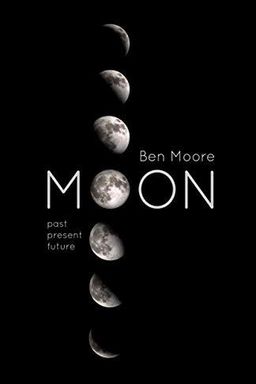
Moon cover

Moon

by Ben Moore

Moon: Past, Present and Future offers a captivating exploration of humanity''s evolving relationship with the moon, from ancient myths to the Apollo missions and beyond. Discover the moon''s role in shaping cultures and scientific pursuits, and ponder the exciting possibilities of future lunar exploration.

Rebellion, Identity, and the Power of the Human Soul

What does it mean to be human when governments can manufacture people without souls? In Broken Moon, Sarah Beth Moore turns that haunting question into an unforgettable dystopian odyssey about humanity’s fragile spirit and its capacity to endure under oppression. The novel imagines a future scarred by two centuries of war, where an authoritarian Party rules metal cities perched above scorched earth. Citizens are tracked, controlled, and tithed—their children taken from them to serve the elite below. And through all this, one young woman’s secret heritage becomes the last defense of human freedom.

At its core, Broken Moon is about resistance in three dimensions: against tyranny, against despair, and against the erasure of humanity itself. Moore argues that real power isn’t technological or political—it’s spiritual. It’s found in the will to imagine something better, and in the invisible bond between souls. Her protagonist, Naiya Legerdemain, embodies this claim through her transformation from orphaned scavenger to a supernatural warrior with the ability to bend energy and defy death. Her evolution mirrors the book’s argument: that every human carries a divine spark, and that saving the world is as much about rediscovering that spark as it is about fighting monsters.

An Oppressive World Built on Fear

Moore’s world-building sketches an Earth rebuilt after apocalyptic wars—crumbling and rebuilt vertically into gigantic metal pyramids called Cities. Inside, citizens live under constant surveillance, their movements monitored through trackers embedded in their necks. Religion and books are banned, blamed for the wars that nearly ended humanity. When Naiya defies the Party’s rules to collect forbidden artifacts, she begins to uncover secrets buried for centuries: the decline in births, the creation of soulless clones, and the terrifying truth that scientists have been trying to recreate human life in a lab. The result isn’t salvation—it’s horror.

The Party’s experiments produce hollow copies—duplicates of real people who look and speak the same but have no consciousness. These creatures, called the Hollow, symbolize the ultimate moral failure: humans sacrificing humanity for utility. (Comparable dystopian critiques appear in Aldous Huxley’s Brave New World and Kazuo Ishiguro’s Never Let Me Go.) Moore places this technological hubris against Naiya’s awakening spiritual power, creating a sharp contrast between soulless fabrication and transcendent life.

The Search for Identity and Purpose

Soon Naiya learns that her family is far from ordinary. Her adoptive father Papa Bear Elijah is part of an underground resistance, hiding knowledge of a mystical intermediary realm called Terminus—a space where souls rest between lives. This discovery finally explains the world’s infertility and decay: the souls in Terminus are dying, severed from the cycle of reincarnation. Humanity can’t reproduce because its spirit is dying. That revelation shifts the book’s focus from simple rebellion to cosmic restoration. Naiya becomes humanity’s last hope, inheriting her mother’s mission to reconnect Earth with its lost spiritual essence.

Throughout the story, Moore weaves questions of identity—who Naiya truly is, whether her life belongs to the Party or to purpose, and what it means to be called Legerdemain, a name tied to a lineage of soul-protectors. Her journey from ignorance to conviction represents every person’s struggle to define themselves against external control. (In tone and theme, it recalls Suzanne Collins’ Mockingjay and Lois Lowry’s The Giver, but with a more metaphysical urgency.)

Why This Story Matters Now

Moore wrote Broken Moon not merely as science fiction but as an allegory about modern humanity’s disconnection from meaning. In a time when technology threatens to replace empathy and data dominates culture, the book urges readers to remember what sets us apart from machines: the soul, imagination, and compassion. Through Naiya’s final choice—to fight not for victory but for love—Moore affirms that survival depends on moral integrity as much as on power. The Broken Moon looming overhead is more than scenery; it’s symbol and warning, showing what happens when civilizations trade wonder for conquest.

As you read, you’ll encounter forbidden science, familial sacrifice, and spiritual rebellion. You’ll face betrayals by loved ones who aren’t what they seem, and revelations that turn enemies into teachers. You’ll see the fall of false gods—the Party, the Home Guard, even the scientists—and the rise of something older and truer: the belief that what we cannot replicate is what makes us human. That belief, Moore suggests, is our only salvation.

Core Message

In a world broken by war and technology’s arrogance, humanity’s redemption lies not in conquest or replication, but in rediscovering the divine spark within every soul. Broken Moon teaches you that courage and compassion—our invisible, unmeasurable qualities—are the only true forces strong enough to heal a shattered world.


Living Under a Totalitarian Sky

Moore’s oppressive setting gives you a visceral sense of confinement. Imagine living inside a steel pyramid where walls watch, freedom is suspect, and even love must obey laws. That’s Naiya’s City—an iron labyrinth ruled by the Party’s motto: Everything for everyone, and nothing for ourselves. It’s an ideology that demands universal sacrifice, replacing personal responsibility with collective control. Here, even family is a transaction: the firstborn child of every worker belongs to the state. Moore uses this chilling rule—called the tithe—to show how systemic cruelty masquerades as fairness.

The Architecture of Control

Cities are built vertically, not horizontally, each level segregating classes: poor laborers at the top, elites near the ground where sunlight is a privilege. Every person carries a tracking chip fused to the brainstem, impossible to remove without killing them. The Home Guard—the Party’s enforcers—embody the state’s monstrous ideal: humans modified into predators with red eyes and sharpened teeth. When Naiya sees them, she sees what happens when a government literally rewrites biology to sustain obedience. (George Orwell’s 1984 imagined similar thought control; here, Moore escalates it to genetic control.)

Rebellion of Small Acts

What stands against this oppression? Ordinary grace. Naiya’s role as a Collector—someone who hunts forbidden artifacts like books and relics—turns simple curiosity into rebellion. Her rescue of forbidden literature beneath burned temples parallels the way resistance starts within the imagination. When she uncovers texts that question the Party’s doctrine, Moore reminds you that ideas, not weapons, start revolutions. Even reading is an act of freedom. The contrast between the City’s technological sterility and Naiya’s wonder at a worn circuit board or leather-bound book illustrates what authoritarianism fears most: people who can still dream.

The Cost of Obedience

Around Naiya, citizens justify atrocities as civic duty. Women console themselves when their babies are taken, men chant Party slogans to suppress grief. Through them, Moore shows how survival under tyranny requires spiritual mutilation. Even love must submit to systemic logic: Amy loses her child to the tithe, then herself to grief and disappearance. The Party doesn’t ban love outright—it desecrates it by rationalizing cruelty as necessary for order. That transformation of heartache into policy makes you question: how much of yourself would you give up just to stay safe? Moore makes you feel that tension in every scene.

Freedom, Moore argues, doesn’t vanish in one grand explosion; it erodes through a thousand compromises. When compassion becomes contraband, even survival becomes a crime of conscience.


The Mystery of Terminus and the Death of Souls

Terminus is the metaphysical heart of Broken Moon. It isn’t a place on Earth but a cosmic waiting room—a realm between death and rebirth where souls rest before returning to the human world. Moore transforms this spiritual conceit into science fiction, blending theology and technology to explain the world’s crisis: Terminus is dying. The souls waiting there are fading, unable to reincarnate. Without souls, humans stop being born. Life literalizes faith—when belief dies, creation dies with it.

Discovering the Secret

Naiya and her companions—Enoch, Tate, and the child Pip—discover clues through a hidden journal written by an ancient mayor, preserved in the ruins of the Painter’s Palace. Its entries reveal that after a second civil war, the Home Guard seized control, silencing truth about the spiritual dimension. The Party’s scientists blamed religion for the apocalypse and tried to replace God with their own creation. But their interference ruptured the boundary between life and death, trapping humanity’s spirit in limbo. Through the mayor’s words, Naiya realizes her journey isn’t rebellion—it’s restoration.

Science Versus Spirit

Where other dystopias pit reason against emotion, Moore expands the conflict: science versus soul. The Home Guard’s experiments mimic resurrection without understanding it, creating hollow soldiers who can live without spirit. Their creators believe this proves victory over mortality; Naiya’s powers prove the opposite. Her ability to channel energy, heal, and kill with elemental light shows that spirit is real, measurable, and divine. Through this power she reconnects to Terminus itself, becoming conduit rather than experiment. (Moore’s fusion of mysticism and futurism recalls C.S. Lewis’s Space Trilogy and Madeleine L’Engle’s A Wrinkle in Time.)

The Moral of the Dying Souls

The moral insight Moore offers is profound. Humanity’s problem isn’t scientific—it’s moral exhaustion. When people stop believing in meaning, their world collapses. Souls stranded in Terminus mirror humans stranded in despair. Only Naiya’s compassion rekindles the connection between realms. Her gift makes literal the idea that love resurrects. Terminus therefore becomes allegory for spiritual ecology: if we abuse our moral environment, even heaven dies. The battle for souls is also the battle for empathy.

What Moore shows through Terminus is that eternity isn’t elsewhere—it’s inside every act of kindness. When society forgets that, the end begins.


Love as Rebellion: The Bonds That Save

In a world where intimacy is a threat, love itself becomes revolutionary. Moore uses family and friendship not as adornments to the plot but as the very weapons of freedom. Naiya’s relationships with her adoptive family—Papa Bear, Enoch, Amy, and Pip—shape both her survival and her awakening. Each love requires sacrifice, yet each gives her the strength to fight. Moore’s message is clear: regimes can break bodies but never break the connections that make us human.

Papa Bear’s Wisdom

Papa Bear trains Naiya and Enoch as Collectors, teaching them both combat and compassion. His mottoes—like “Mercy is a mistake” and “Preoccupation is death”—prepare them for a brutal world, yet his heart guides her beyond survival. His secret knowledge of her legacy as a Legerdemain sets her destiny in motion. When he dies publicly at the Party’s hands, his execution serves as moral mirror: cruelty cannot destroy love, only prove its resilience. Moore uses his sacrifice as the emotional hinge for Naiya’s transformation from dependent child to spiritual inheritor.

Enoch’s Conflicted Loyalty

Enoch, Naiya’s adoptive brother, embodies divided loyalty—trained to protect her but struggling with forbidden love. His courage balances her mysticism, showing that rebellion needs both heart and hand. Even his broken finger becomes a symbol: wounds that don’t heal easily teach endurance rather than despair. Their partnership mirrors shared destinies like Katniss and Peeta’s in The Hunger Games, but without romance’s simplicity. Moore layers affection with ethical tension, asking whether loving someone can remain pure when the world weaponizes vulnerability.

Amy and Pip: Lost and Found

Amy’s tragedy drives home Moore’s most unsettling theme: the replication of love. When Naiya discovers that her sister has been replaced by a duplicate with Amy’s face but not her soul, she confronts the horror of synthetic emotion. This revelation turns the Party’s technology into moral mockery—love faked is worse than lost. Pip, Amy’s younger brother turned soldier through Marking, represents innocence corrupted but not extinguished. Even Marked, he helps Naiya fight and protect her. Through him Moore reminds you that no experiment can completely rewrite the human spirit. His brief survival and rescue give Naiya her reason to keep going.

Moore’s radical claim is that love itself has metaphysical power. Compassion isn’t softness—it’s the only force that consistently defies tyranny. In Broken Moon, every act of tenderness becomes an act of rebellion.


The Hollow and the Ethics of Creation

One of Moore’s most disturbing ideas is the concept of the Hollow: cloned, empty replicas created by scientists under Party orders. These beings are attempts to solve population decline by bypassing spirit itself. The Hollow are both achievement and atrocity—proof that humanity’s intellect can outpace its morality. Through their creation, the book asks whether technological success without conscience deserves to be called progress at all.

From Innovation to Desecration

The Hollow project begins with hope for saving a dying world, but quickly devolves into torture and experimentation. Amy’s disappearance, and her later revelation as a replacement, personalizes this horror. Scientists like Doctor Catherine Vaughn describe the process: bodies grown artificially, souls suppressed through pain and death to prevent reincarnation. Moore makes you feel the ethical inversion—science achieving control by annihilating wonder. The Party’s slogan of equality becomes grotesque when applied to the creation of soulless slaves. (In literature, this echoes Mary Shelley’s Frankenstein and the moral dilemmas of modern cloning ethics.)

The Mark and the Mutation of Morality

The Home Guard’s Mark—a rune burned into their hands—reveals another tier of desecration. It twists their souls into obedience, turning children like Pip into soldiers stripped of empathy. By comparing the Marked to the Hollow, Moore makes a subtle argument: dehumanization through culture is as effective as through science. Both destroy the conscience. It’s a chilling reminder that moral extinction doesn’t require machines; it requires surrender.

The Consequence and the Warning

Moore’s warning feels prophetically modern. Our real-world pursuit of artificial intelligence and genetic engineering raises similar questions. What happens when humans believe they can manufacture consciousness? Moore’s answer: they can make life mimic thought, but never meaning. The Hollow are shadows of humanity—living proof that the soul cannot be coded. When Naiya faces the Hollow version of Amy, she learns that empathy is not programmable. Even a perfect copy can’t love.

For Moore, creation without compassion is destruction disguised as science. The Hollow remind you that progress without purpose is the fastest road to oblivion.


Faith, Power, and the Making of a Savior

As the story progresses, Naiya evolves from frightened Collector into messiah figure. Her transformation hinges on discovering that she’s a Legerdemain—a hereditary protector of the boundary between life and death. This revelation redefines her world’s politics as spiritual warfare. The Party’s battle is not against rebels but against creation itself. Naiya’s struggle now becomes mythic, echoing archetypes from Joan of Arc to Luke Skywalker: ordinary youth realizing she carries divine power that terrifies corrupt regimes.

From Collector to Conduit

Her powers first manifest as electrical energy—light bursting from her palms, healing her wounds, deflecting bullets. These miracles frighten both allies and enemies. When she finally faces the Mayor’s gun and reverses its bullet midair, killing him, Moore confirms Naiya’s shift from reactive heroine to divine agent. Importantly, Naiya never seeks this power; it seeks her. Her humility contrasts sharply with the Party’s hubris, proving that the worthiest leaders are those who never ask to rule.

Faith Versus Manipulation

Doctor Black and the Mayor both exploit belief for control. One hides behind science, the other behind politics, yet both manipulate faith as currency. When they try to enlist Naiya—first by torture, then by persuasion—they reveal their ignorance: spiritual power cannot be owned. Moore’s confrontation scenes turn theological; the real battle is over interpretation. Is creation chaos or design? Is resurrection theft or grace? Naiya’s refusal to join either man positions her as humanity’s conscience, the one person who won’t barter the divine for dominion.

The Ethics of Divinity

Moore avoids sentimental savior tropes by keeping Naiya grounded in guilt, doubt, and grief. Her victories come at immense personal cost—the loss of Papa, the betrayal of Amy, and the death of countless companions. Her power never glorifies her; it condemns her to endless responsibility. That realism makes her triumph human. Instead of divine perfection, Moore gives divinity as burden: saving others demands suffering. In the end, Naiya’s light is not holiness; it’s empathy made radiant.

You don’t need miracles to be sacred—you need decency when the world tells you to be cruel. Moore’s savior is less a goddess than a reminder that goodness itself is divine.


The End and the Promise of Renewal

The closing chapters of Broken Moon feel like both catastrophe and genesis. After the climactic battle and Naiya’s collapse, the survivors flee the City toward Athens—a rumored sanctuary where rebellion thrives in freedom. Achilles guides her there, revealing the wider network of resistance across the planet. Beyond their decaying Nation, other cities still fight for truth. Humanity, Moore says, is not extinct—it’s evolving.

Leaving the Old World

The exodus from the City reimagines the biblical escape from Egypt. Naiya’s followers are a ragged mix of clones, rebels, and children, united not by blood but by choice. As they walk under the broken sky, she carries her father’s letter—a moral compass reminding her that faith and compassion are technologies of their own. The message echoes through her: that innocence isn’t weakness and love isn’t luxury. The moon above, once a symbol of fracture, now becomes promise—a broken thing still luminous.

Rebuilding What Was Lost

In the book’s final pages, Moore leaves humanity poised between ruin and renewal. The Bible, recently discovered to be a signal blocker, doubles as metaphor: ancient spirituality shielding modern rebellion. Papa’s letter functions as benediction and burden, passing the torch to Naiya and, by extension, to the reader. The world may be broken, but the lineage of hope continues. It’s a truth that applies beyond fiction—survival depends on preserving wonder even amid despair.

The Unfinished War

Though Naiya escapes, Moore makes clear that war between science and spirit is far from over. Doctor Black now rules as Mayor, proof that evil survives by adapting. But the story ends not with defeat but with renewal of purpose: Naiya’s vow to find other Legerdemains and reignite the soul cycle. Her journey outward mirrors ours inward—the continual task of keeping empathy alive despite systems that deaden it. (This open-ended ending aligns with classics like Margaret Atwood’s The Handmaid’s Tale and Veronica Roth’s Allegiant.)

The broken moon isn’t Earth’s tombstone—it’s its memory. What’s shattered doesn’t cease to shine. Moore ends by convincing you that endurance itself is sacred, and that rebuilding the world begins wherever someone refuses to give up hope.

Dig Deeper

Get personalized prompts to apply these lessons to your life and deepen your understanding.

Go Deeper

Get the Full Experience

Download Insight Books for AI-powered reflections, quizzes, and more.