
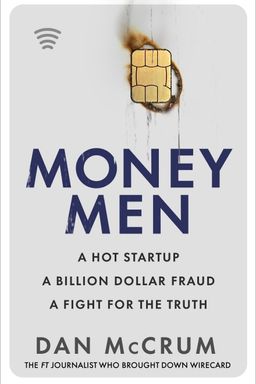
Money Men cover

Money Men

by Dan McCrum

Money Men is a thrilling expose of Wirecard''s dramatic rise and catastrophic fall. Follow journalist Dan McCrum and a brave group of whistleblowers as they uncover the massive fraud behind Europe’s former fintech darling, revealing crucial lessons about corporate deception and the resilience needed to pursue truth.

The Anatomy of Wirecard's Rise and Fall

How does a company that promises to be Europe’s next tech champion end up as one of its greatest financial scandals? The Wirecard story shows you not just the anatomy of a fraud, but the structures, incentives, and human behaviors that let it grow unchecked. It mixes tech ambition, opaque banking systems, and intelligence-style secrecy in a way that deceives investors, auditors, and regulators alike.

From niche payments to global power

Wirecard begins in the early 2000s serving high-risk sectors—porn and gambling—processing payments others won’t touch. Buying a tiny bank (XCOM) transforms it: that licence gives Wirecard control of settlement rails between Visa, Mastercard, and merchants. It can issue cards, move client funds, and blur legitimate flows with opaque accounting entries. This combination of tech flare and financial privilege becomes its superpower—and its shield against scrutiny.

The growth illusion

By acquiring small firms and booking huge processing volumes, Wirecard crafts an illusion of scale. Revenues show rapid growth, but much of it comes from supposed Third‑Party Acquirers (TPAs)—external partners in places like Dubai, Manila, and Singapore. These partners contribute most of the company’s reported profits, yet physical checks by journalists reveal empty offices, fake invoices, and trustee bank statements with no real balances. KPMG’s later audit confirms that almost half of Wirecard’s revenue and most of its EBITDA stemmed from unverifiable TPA commissions.

Marsalek, Braun, and the culture of control

Two figures dominate: CEO Markus Braun, who embodies visionary tech optimism, and Jan Marsalek, the COO whose networks stretch across shadowy third-party deals and even alleged intelligence circles. Their partnership blends charisma with secrecy. Marsalek works through shell companies like Sunsont, local fixers, and encrypted channels to conceal high-risk businesses. Braun, meanwhile, builds a narrative of exponential fintech growth, urging investors to trust visionary numbers rather than small inconsistencies.

Journalists, short sellers, and whistleblowers

As suspicions mount, short sellers and journalists start investigating. The anonymous Zatarra report in 2016 accuses Wirecard of money‑laundering and round‑tripping. The Financial Times takes up the case, but legal threats, intimidation, and hacking attempts make reporting dangerous. Pav Gill’s whistleblowing within the Singapore office leads to Project Tiger—a legal investigation by Rajah & Tann—and later Project Ring led by EY. Internal evidence shows forged invoices and circular transfers. These revelations, combined with forensic reporting, break the wall of secrecy.

Regulators and auditors in disarray

German regulator BaFin protects Wirecard from criticism, even banning short sales to stabilize the market. Ernst & Young continues signing off accounts despite warning signs, while KPMG’s special audit exposes the missing evidence behind Third‑Party revenues. This clash between regulatory loyalty and investigative skepticism allows the fraud to persist far longer than it should.

Collapse and consequences

In June 2020, the story implodes. Trustee accounts in the Philippines are proven fake—the €1.9 billion in supposed bank cash never existed. Markus Braun resigns, Marsalek flees via Vienna in a private jet, and Wirecard files for insolvency. The scandal brings criminal charges, parliamentary inquiries, and an enduring question: how did regulators, auditors, and markets all fail together?

Core insight

Wirecard’s downfall proves that when financial control systems mix with technological opacity and charismatic leadership, oversight collapses. Transparent data trails—not headlines, audits, or reputation—are the only reliable defense against systemic deception.

Understanding this story means grasping the interplay between ambition and opacity. It isn’t just about financial fraud; it’s a lesson in how modern institutions—legal, journalistic and regulatory—can be outmaneuvered when narrative power outweighs evidence.


The Shadow Network Behind Wirecard

Jan Marsalek’s ascent from basement coder to globe‑trotting operator explains how Wirecard’s hidden empire functioned. He constructs a network of fixers, shell firms, and covert partners that stretches from Prague to Mauritius to Manila. This network becomes the infrastructure for laundering transactions, staging acquisitions, and exporting Wirecard’s risk far away from auditors.

Shell deals and covert operations

Marsalek’s playbook is simple but powerful: when a deal is too risky or too dirty for the main company ledger, outsource it to an offshore partner. Examples include Hermes and Bijlipay in India, routed through O’Sullivan’s Mauritius fund, and Sunsont for untraceable card processing. In each case, Wirecard’s internal documents show artificial markups, forged signatures, and fake websites prepared in Munich to present a semblance of legitimacy.

From payments to politics

Marsalek links Wirecard’s commercial expansion to intelligence and geopolitical ventures. He proposes rebuilding Libyan infrastructure and setting up a border force, flashes classified documents about Novichok, and cultivates Russian counterparts. These connections blur corporate and state boundaries, demonstrating how financial secrecy can intersect with global intrigue.

Key pattern

Marsalek turns ambiguity into a management tool: if a line of business could expose Wirecard, he relocates it beyond regulators’ reach through proxies and encrypted communication.

The escape and aftermath

When Wirecard collapses, Marsalek vanishes from Munich, flying to Minsk and reportedly continuing under protection networks linked to Russia. His flight symbolizes the system’s failure: when one executive can use confidential networks to disappear, it proves how deep the opacity ran inside the company’s leadership. For you as a reader, his story is a window into how globalized fraud combines high‑tech commerce with espionage‑style evasion.

(Note: Marsalek’s trajectory mirrors historical examples like Enron’s financial architects or Theranos’s operational secrecy—but with an added layer of geopolitical intrigue that turns a corporate default into a diplomatic mystery.)


The Mechanics of Fraud and Illusion

You can’t grasp Wirecard without tracing its accounting manipulations. Beneath the glossy growth figures lay fake sales, circular transfers, and money routed through third parties to create the illusion of profit. Internal investigators and short sellers uncover patterns showing how fraudulent revenue became balance‑sheet assets and how those assets justified even larger acquisitions.

Round‑tripping and acquisitions

Wirecard fabricated profits by booking nonexistent sales, then used those entries to buy thin or opaque companies—such as Hermes in India—at inflated prices. These purchases absorbed fake profits into tangible assets, giving auditors comfort while preserving the deception. Inside documentation shows Mauritius funds flipping assets to Wirecard for hundreds of millions, with proceeds partially routed back to insiders through consulting invoices and finders’ fees.

Transaction laundering

At the transaction level, the company manipulated merchant category codes (MCCs) to disguise gambling and nutraceutical payments. Declined transactions under category 7995 (gambling) were re‑submitted under innocuous codes. Prepaid cards and white‑label wallets masked true volumes, making it difficult for banks and regulators to identify high‑risk merchants. This systematic obfuscation inflated volumes while concealing chargeback losses and customer complaints.

Trustees and missing cash

Crucially, Wirecard claimed that billions were held in “trustee accounts” to cover risk reserves. In reality, these funds were either nonexistent or inaccessible. Auditors often received envelopes from cooperating trustees—containing forged bank statements—that masked the missing money. When those confirmations unraveled, the entire structure collapsed.

Follow the cash

Every illusion in Wirecard’s accounts depended on one failure: auditors and investors looking only at reported revenues instead of verifying bank flows. The truth resides in real liquidity, not paper profits.

(When viewed alongside other accounting scandals, Wirecard’s techniques echo patterns in Sino‑Forest and Parmalat: complex offshore round‑trips paired with unwarranted trust in third‑party statements.)


Whistleblowers, Investigators, and the FT Battle

The exposure of Wirecard owes as much to human courage as to forensic accounting. From the Singapore whistleblower Pav Gill to Financial Times reporters Dan McCrum and Stefania Palma, the book shows how disciplined investigative tradecraft defeats corporate concealment and intimidation.

Securing sources under fire

Gill’s discovery of forged invoices and circular transfers forced him to choose between compliance and conscience. He preserved mirrored email boxes, copied 70GB of evidence, and eventually fled Wirecard after retaliation. Journalists communicated through codenames (“Harry,” “Panjiri”), used wiped devices and air‑gapped laptops, and printed documents with gloves to avoid microdot tracing. These rituals—often seen as paranoia—proved vital as hacking attempts and surveillance intensified.

Legal and psychological warfare

Wirecard’s reaction is ferocious: lawsuits by Schillings, covert photos by private investigators, and digital forgeries aimed at discrediting reporters. The FT’s editors—Lionel Barber and Nigel Hanson—balance libel risk against the public interest, sometimes delaying publication to avoid injunctions. These delays illustrate how the law can itself be weaponized against truth.

Tradecraft lesson

Serious corporate investigations depend on the same rigor as intelligence work: secure communication, compartmentalized data, legal foresight, and psychological resilience. Without those, exposure stalls under pressure.

The payoff

Despite intimidation, the FT persists. Each report peels back the layers of Wirecard’s fake empire until regulators and KPMG can no longer ignore the discrepancies. The endurance of whistleblowers and reporters transforms a private fraud into a public reckoning. (Compare Gill’s role to Sherron Watkins at Enron—both face isolation, smear, and eventual vindication.)

You finish this part realizing that investigative journalism’s triumph is never inevitable: it requires security, collaboration, and moral clarity stronger than corporate might.


Regulators, Auditors, and Systemic Blindness

The Wirecard collapse highlights systemic blind spots in financial oversight. Institutions meant to enforce truth—auditors, regulators, courts—become participants in delay and confusion. You see how corporate power manipulates frameworks designed to limit it.

BaFin’s misplaced loyalty

Germany’s financial regulator treats Wirecard more as a national champion than a suspect. When short sellers attack, BaFin bans short‑selling and investigates journalists for market manipulation. This defensive nationalism buys Wirecard legitimacy at the cost of accountability, showing how regulatory protectionism can blind oversight.

KPMG vs EY

A clash between forensic and conventional auditing shapes the timeline. KPMG’s independent audit discovers missing contracts, phantom partners, and untraceable revenue; EY continues approving annual accounts based on trustee letters instead of bank confirmations. The result is institutional inertia—trust in management outweighs forensic skepticism, extending Wirecard’s survival for years.

Law and litigation

Wirecard’s use of German civil procedure—brief-based, low-disclosure lawsuits—lets the company control narrative and suppress evidence. Journalists face high litigation costs and tight time limits. When combined with PR offensives and SoftBank’s market endorsement, this legal architecture transforms fraud defense into credibility theater.

Systemic insight

Audit and regulatory institutions fail not just through incompetence but through cultural deference to success. When a company becomes a national icon, skepticism loses its social license.

Wirecard reminds you that oversight must be adversarial, not promotional. Regulators should demand proof, not faith; auditors must follow data, not reputation.


Collapse, Lessons, and Legacy

Wirecard’s demise in 2020 marks the moment when illusion collides with reality. KPMG’s findings—no verifiable profit flows, missing documentation—lead auditors to demand bank confirmations from the Philippines. When those turn out forged, the €1.9 billion gap destroys the corporation overnight.

The final unraveling

Braun resigns, Marsalek escapes, and German prosecutors act. EY’s reputation is damaged, BaFin’s head resigns, and investors lose billions. Parliamentary inquiries expose a pattern of national pride shielding misconduct. Institutional confidence erodes globally, reminding markets that even “tech banks” can still fabricate cash.

Aftershock and reflection

The aftermath isn’t just punishment—it’s reform. Germany reexamines BaFin’s structure, presses audit reforms, and strengthens whistleblower protection. But the enduring insight is psychological: people believed in Wirecard because they wanted a European success story to exist.

Final lesson

Fraud thrives where narrative outweighs verification. You prevent future Wirecards not by more belief, but by rigorous transparency—following the money, protecting whistleblowers, and questioning stories that sound too perfect.

This ending turns a financial scandal into an educational resource: a case study in modern risk, resilience, and the fragile boundary between innovation and deception.

Dig Deeper

Get personalized prompts to apply these lessons to your life and deepen your understanding.

Go Deeper

Get the Full Experience

Download Insight Books for AI-powered reflections, quizzes, and more.