
Idea 1
Winning the Wealth Game
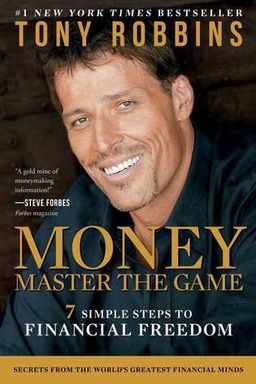
How can you design a life of lasting financial freedom instead of chasing market noise? In Money: Master the Game, Tony Robbins argues that wealth creation is not a mystery—it’s a structured, learnable game built on psychology, disciplined saving, and modeling from world-class investors. The core claim: you can win if you understand the rules and adopt the mindset used by Ray Dalio, Jack Bogle, David Swensen, Warren Buffett, and others who consistently produce results.
Robbins builds a seven-step blueprint that integrates behavior, finance, and motivation. You start by shifting from fear to understanding—seeing money as a tool and the financial system as a jungle whose predators you can outsmart. Then you construct a plan anchored on automatic saving, low-cost investing, asset allocation, emotion-proof decision making, and lifetime income. It’s a game you can master if you follow the sequence and stay consistent.
Mindset: Think Like a Player, Not a Pawn
Robbins insists wealth starts in your head, not your wallet. Most people are reactive—they fear downturns, chase fads, and let emotions hijack rational plans. Winners, by contrast, operate with anticipation. They model successful strategies and automate good behavior. The metaphor of the chessboard runs throughout: stop being a piece moved by others and start making moves yourself. Mindset transformation means defining what financial freedom looks like for you—because clarity drives action.
The Seven-Step Framework
The framework combines psychology and mechanics:
- Decide what you really want and commit to a Freedom Fund—your automatic savings engine.
- Learn the rules and traps: fees, brokers vs. fiduciaries, and industry incentives.
- Create a lifetime plan with diversified asset allocation and downside protection.
- Convert your nest egg into lifetime income—your paycheck for life.
- Embrace the breakthroughs: story, state, and strategy—your psychological engine for action.
The Book’s Architecture
Each part advances a theme. Part One builds mindset and savings discipline. Part Two dismantles industry illusions—showing how fees, taxes, and emotional mistakes erode returns. Part Three shares models from investment masters and advanced strategies like Ray Dalio’s All Seasons portfolio, Private Placement Life Insurance (the “rich man’s Roth”), and income-guaranteeing annuities. The final chapters explore exponential technologies and giving—defining wealth beyond money.
Core Promise
“If you follow the seven steps, you will win this game,” Robbins declares—because success comes from modeling patterns, not guessing the future.
Key People and Practices
Robbins anchors his system in real-world examples. Ray Dalio contributes the All Weather allocation—a portfolio resilient in any economy. Jack Bogle teaches low-cost indexing and fee awareness. David Swensen offers endowment-style diversification. Warren Buffett underscores simplicity. Together they form a practical curriculum for ordinary savers to behave like institutional pros. (Note: Robbins’s synthesis echoes Benjamin Franklin’s and Jim Rohn’s philosophies—freedom through disciplined habits.)
Psychology and Execution
Information without execution is worthless. Robbins closes Part One by weaving mindset and mechanics: your story determines your strategy, and your physiological state determines whether you follow through. He teaches “story–state–strategy” as a triad for breakthroughs. Reframe “I can’t” into “I automate.” Use rituals—set automatic transfers, precommit to saving raises, run fee audits annually—to make the right choice default.
In short, Money: Master the Game reframes wealth as a system you can engineer. By learning from the masters, aligning your behavior with proven rules, and using psychological design to stay consistent, you replace luck with certainty. Financial freedom becomes not a dream, but a strategy executed daily.