
Idea 1
Designing Conversations That Change Everything
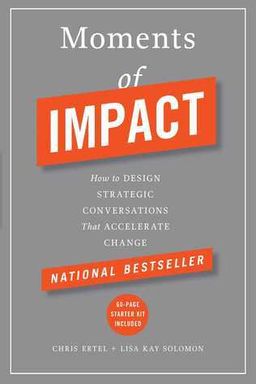
Have you ever walked out of a high-stakes meeting thinking, “Well, that could have been an email”? In Moments of Impact, authors Chris Ertel and Lisa Kay Solomon argue that the problem isn’t meetings—it’s how we design them. They contend that most leaders treat every critical gathering as just another meeting, instead of what it should be: a strategic conversation—an intentionally designed, emotionally engaging experience that helps people see and solve the most pressing adaptive challenges of their time.
The authors’ central claim is simple but transformative: strategic conversations are the key leadership skill almost no one is taught but everyone desperately needs. When executed well, these conversations spark insight, create shared understanding, and propel meaningful change. Done poorly, they drain energy, confuse teams, and stall innovation. The book offers a complete guide to designing strategic conversations—combining the logic of strategy, the empathy of design, and the collaboration of great dialogue.
Why Strategic Conversations Matter
Ertel and Solomon ground their framework in the realities of what they call VUCA World: an environment defined by volatility, uncertainty, complexity, and ambiguity. In this context, traditional approaches—five-year plans, rigid hierarchies, and endless PowerPoint decks—fail to make sense of change. Adaptive challenges can’t be solved by analysis alone; they demand creativity, empathy, and collaboration. Strategic conversations are where this happens: leaders and teams come together to understand challenges, explore uncharted possibilities, and commit to action.
The Core Argument: Designing for Impact
The book asserts that designing conversations requires rethinking not just what is discussed but how people engage. Strategic conversations are not about reporting or defending plans; they are about discovery, co-creation, and emotional connection. The authors insist these events are designed experiences—complete with a purpose, rhythm, emotional arc, and physical environment that mirrors the creative challenges being tackled.
To achieve those moments of impact—when insight shifts perception—leaders must embrace design thinking. That means empathizing with participants’ perspectives, creating experiences that engage the whole person, and using storytelling, visuals, and structure to shape how people think and feel about complex issues.
VUCA and the Need for Adaptive Leadership
Building on Ronald Heifetz’s concept of adaptive leadership, the authors differentiate between technical challenges (which have known solutions) and adaptive challenges (which require learning and collaboration). Most organizations mistakenly treat the latter as simple problems solvable by expertise. Ertel and Solomon call for a mindset shift: rather than offering all the answers, leaders must create conditions for groups to explore new possibilities together. That’s the role of a strategic conversation.
Five Core Principles for Designing Strategic Conversations
The authors outline five design principles, each with specific practices that transform ordinary meetings into experiences of insight and action:
- Define Your Purpose: Every conversation serves one of three purposes—Building Understanding, Shaping Choices, or Making Decisions. Pick one and design accordingly.
- Engage Multiple Perspectives: Diverse voices challenge groupthink and bring the organization’s full intelligence into the room.
- Frame the Issues: Use clear questions, metaphors, and visuals to focus the dialogue and surface hidden assumptions.
- Set the Scene: The environment shapes behavior—so design the space, visuals, and flow to encourage collaboration and creativity.
- Make It an Experience: Go beyond the agenda to create a narrative journey that engages minds, hearts, and guts.
Stories That Illustrate Transformation
Each principle is brought to life through powerful examples. When Kaaren Hanson at Intuit used a mobile scavenger hunt to help executives feel the future of mobile technology firsthand, the exercise catalyzed real strategic alignment—and led to a multimillion-dollar shift in company focus. Similarly, when the De La Salle Christian Brothers in Australia faced declining membership, a film and simulation exercise helped them face uncomfortable truths and redesign their mission for the future. In both cases, the experience—not a presentation—changed minds and spurred collective action.
When Things Go Wrong
But even powerful tools can fail. The authors warn about the “Yabbuts”—organizational forces that derail progress: politics (who wins or loses power), near-termism (the obsession with immediate results), and the karaoke curse (overconfidence without real skill). Navigating these traps requires courage, empathy, and deliberate design. When handled well, leaders replace the destructive “doom loop” of denial and inaction with a “hope loop,” where shared experiences create momentum and belief in change.
A Leadership Blueprint for the Future
Ultimately, Moments of Impact teaches that designing strategic conversations is not just a facilitation skill—it’s a leadership imperative. In an era when no one person can know all the answers, the leader’s job is to design the conversations that discover them. By combining logic, empathy, and creativity, you can create the conditions where insight happens—and those moments of impact will shape the future of your organization.