
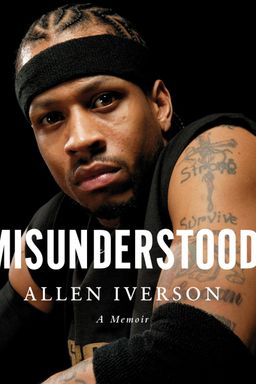
Misunderstood cover

Misunderstood

by Allen Iverson,Ray Beauchamp

The N.B.A. All-Star details his childhood, professional career and ways he impacted our culture.

Context, Identity, and Owning Your Story

How do you turn raw talent, public scrutiny, and personal loss into a life that changes a sport and a culture? This book argues that Allen Iverson’s journey shows you three truths: context changes meaning, mentorship can be rescue, and authenticity—when disciplined—can remake institutions. What looks like rebellious individualism is actually a hard-won synthesis of roots, rules, risk, and responsibility.

The engine: family, faith, and a code

Iverson’s center of gravity is family. Nana (Ethel Mitchell) runs a tight, God-fearing two-bedroom house on Jordan Drive, where a dozen relatives sometimes squeeze in. His mother, Ann, is fifteen when he’s born, hustling multiple jobs—Avon warehouse, supermarket cashier, Langley Air Force Base, shipyard—while telling him from the start he’s destined for pro sports. That mix—stern limits plus radical belief—becomes the stabilizing code he carries into chaos. He learns toughness early (a bus wheel rolls over his foot; he gets up and climbs aboard anyway), and he learns why boundaries matter (Nana’s lone spanking after he disobeys and goes to the creek).

Environment as crucible, not destiny

Stuart Gardens and nearby Glen Gardens offer belonging and danger—crabbing with chicken wings, cutting hair for cash, stealing candy, and sliding toward the drug economy’s $100-stash model. The lure is concrete: weekend windfalls that buy shoes and freedom; the cost is terrifying: a handgun pressed to his head in a dark hallway, being dragged by a car. He insists he never uses drugs (to protect his athletic future), yet he can’t entirely escape the ecosystem. You see how quickly a kid toggles between petty mischief and mortal risk. (Note: This mirrors many athlete memoirs, but Iverson’s account is unvarnished about both the pull and price.)

Craft, exposure, and gatekeeping

Talent blooms when structure meets exposure. Football with the Aberdeen Raiders (coach Gary “Mo” Moore) forges his competitive code—“If it’s between you and me, it’s me.” Basketball becomes the vehicle after a reluctant rec tryout, van rides with Coach Bob Barefield, and nonstop Aberdeen playground runs. The Summer of 1992 AAU breakout—37, 26, 36 in Winston-Salem, MVP over older stars—vaults him from local legend to national prospect. But opportunity hinges on paperwork: after the 1993 bowling-alley case, Governor Douglas Wilder’s clemency (Dec. 30, 1993) and Milburn credits in U.S. Government and Psychology, verified by Georgetown’s Mary Fenlon, become the hinge on which his future swings. Ms. Sue Lambiotte even stages a tiny graduation—“valedictorian of one”—to mark eligibility. (Lesson: applause doesn’t unlock doors; transcripts do.)

A mentor who saves a life

At Georgetown, Coach John Thompson builds a protective cone: no freshman press, strict dress, controlled access. He balances rules off-court with freedom on-court—“He needs to fly.” He wraps an arm around Iverson in practice, runs onto the floor after a rough exhibition foul yelling, “Don’t hurt my boy!”, and makes him return a loaned Mercedes to keep lines clean. Thompson’s mentorship gives Iverson time to mature, finish credits, and develop a defensive identity that wins him Big East Defensive Player of the Year. Meanwhile, humiliation in practice (walk-on Dean Berry crossing him repeatedly) becomes a private apprenticeship that evolves into Iverson’s era-defining crossover.

Race, media, and narrative warfare

The bowling-alley ordeal—charges of “maiming by mob” under a law originally aimed at lynch mobs, a bench conviction by Judge Overton, time at City Farm—exposes how law, race, and fame collide. The Court of Appeals later reverses; the DA drops the case. Still, crowds chant “Jailbird” and taunt with O.J.-themed signs. Even a broadcaster’s “tough monkey” line triggers national parsing. Years later, the May 7, 2002 “practice” press conference is consumed as a meme, not a moment of a grieving man (his best friend Rahsaan Langford’s murder trial was ongoing) trying to reassure a city.

Becoming himself—then fitting a system

Reebok’s “The Question” campaign bets on authenticity—cornrows, black ankle sleeves, baggy shorts, chains—and turns Iverson into a style catalyst. The NBA sometimes pushes back (a memo nitpicks his crossover as a carry; later, a dress code aims to domesticate street aesthetics), but fans decide the culture. Under Larry Brown, friction yields a new system: off-ball “Iverson” cuts, Eric Snow and Aaron McKie stabilizing guard play, and Dikembe Mutombo’s rim protection. The 2000–01 run—10–0 start, scoring title, All-Star MVP in D.C., plus the iconic step-over Ty Lue in the Finals—cements how individual fire can power collective success.

The book’s core claim lands like this: if you want to thrive under pressure, you must learn to supply your own context, find mentors who set boundaries and grant freedom, respect the bureaucracy that gates opportunity, and refuse to dim who you are. Iverson’s story shows you that the headline is never the whole story—and that the work behind the headline is what lasts. (Compare to The Last Dance: Jordan controls narrative through domination and media savvy; Iverson contests it through authenticity and cultural redefinition.)


Roots, Rules, and Survival

To understand Iverson’s edge, you start in cramped rooms and crowded cars. Nana’s two-bedroom house on Jordan Drive is command central—early curfews, no loud music, church on Sunday—and Ann’s relentless belief sets a horizon line he can see. He’s “Bubbachuck” at home, the kid Nana once scolded after he tumbled onto the interstate from her burgundy car. Those stories don’t just add color; they show you why guardrails keep a gifted kid alive long enough to get lucky.

The house that held a village

Ten to twelve people sometimes share the space. You learn how proximity shapes character: when privacy is scarce, respect becomes a daily practice, and toughness is not a performance—it’s a coping strategy. Nana spanks him once for sneaking to the creek, then bakes discipline back into the routine. Ann’s roster of jobs—Avon forklift, Langley typist, cash register, shipyard—teaches him the grind, while her mantra (“You’re going to play pro sports”) instills a future-facing identity that competes with the urgency of now.

Stuart Gardens as classroom

The neighborhood is both playground and curriculum. He learns to crab with chicken wings, cut hair for a few dollars, and, yes, steal—first candy and bloodworms, then car doors. Wearing gloves to hide fingerprints feels clever until it isn’t. The point isn’t to glamorize; it’s to show how skill, nerve, and poor decision-making brew together when cash is short and the future is abstract. (Note: Many athlete narratives skip the petty to focus on the profound; Iverson ties them, showing how the petty can become profound under pressure.)

The hustle’s seductive math

Older hustlers model a business plan: take a $100 stash, pay back $70, keep the spread. By Monday, a teenager can feel rich enough to buy the shoes that signal status. The lessons are stark. The upside is immediate, the downside irreversible: a gun at his head in Glen Gardens, getting dragged by a car, understanding the moral toll of fueling addiction in your own zip code. He says he never uses drugs—fear for his athletic future acts like armor—but the environment still brands him with the risk calculus you later see on courts: fast reads, hard choices, living with outcomes.

Friends as mirrors and magnets

The peer group—Ra (Rahsaan Langford), Thrilla (Michael Jackson), and Eric—function like a rotating conscience. They celebrate wins, warn against reckless moves, and pull him between two futures: sports legitimacy or street gravity. When Ra is murdered years later, the grief detonates during the 2002 “practice” presser; you see how friendships seeded in Stuart Gardens keep shaping moments long after the projects. The past is not a chapter you close; it’s a language you keep speaking.

Toughness you can’t fake

The fourth-grade bus incident—his foot run over, yet he insists on getting on first—reads like bravado until you set it next to his later choices. He’s showing you a pattern: pain becomes fuel; lines you cross become claims to space. That mental model migrates to sports: take hits, keep going, finish at the rim through contact, return kicks after getting flattened. You don’t teach this in clinics; you absorb it in hallways and parking lots.

What you take forward

When you evaluate origin stories, don’t flatten them into “bad neighborhood, great escape.” Stuart Gardens gives Iverson community, improvisation skills, and early leadership; it also tempts him with a cash economy that punishes hesitation. Your takeaway is double-edged. First, find your Nana and Ann—people who give you limits and belief. Second, audit your environment’s lessons: keep the initiative and resilience; ditch the shortcuts that cost tomorrow. The genius of Iverson’s early life is not innocence—it’s discernment learned the hard way.

(Compare to Andre Agassi’s Open, where parental drive borders on coercion; here, Nana and Ann enforce tough love without erasing autonomy. The result is a young competitor who owns his choices—and their consequences.)


Football Code, Basketball Breakout

Iverson’s competitive identity is born in pads, then weaponized with a ball in his hands. Football with the Aberdeen Raiders, organized by Butch Harper and coached by Gary “Mo” Moore, teaches him a simple creed: “If it’s between you and me, it’s me.” That sentence becomes software he runs for decades—on kick returns, in Big East lanes, and in NBA fourth quarters.

Mo’s truck and number 33

Mo ferries him across city lines so he can practice. He argues to give the undersized kid Tony Dorsett’s 33; Jermaine Marshall yields it after seeing Iverson’s tears. Playing up in age groups, Iverson grabs a quarterback by the jersey and slams him to the ground at eight. The message—take your space or someone else will—becomes muscle memory. Peer bonds with Ra, Thrilla, and E grow here too, fusing sports discipline with street loyalty.

From reluctant hooper to visual learner

He doesn’t love basketball at first. Ann drags him to a rec tryout. He sits, watches, then copies. His learning style is visual and immediate—see it, do it. Coach Bob Barefield gives him structure (comb your hair before he lets you out of the van); the Aberdeen playground gives him edge (finish through contact under streetlight crowds). That hybrid—the disciplined ride and the ruthless run—makes him dangerous.

Summer of 1992: talent meets a stage

Boo Williams’s AAU pipeline and Coach Bill Tose place him on a national platform. In Winston-Salem he drops 37, 26, and 36 against older stars like Jerry Stackhouse and Jeff McInnis, and wins MVP. Nike invites him to a national camp; Bob Gibbons’s rankings rocket him to No. 1 among rising juniors. One July flips the map: he’s no longer just a Hampton phenomenon—he’s a national problem for defenders. (Note: This is the early-’90s AAU accelerator in action; exposure could compress timelines overnight.)

Crossover by apprenticeship

The signature move isn’t born on a mixtape; it’s forged in humiliation. Dean Berry, a freshman walk-on from Brooklyn, keeps crossing him in practice. Iverson stays late, studies the mechanics, and adds it to his toolkit. The recipe is simple and ruthless: make the defender fear your first step, cradle the ball high and away to freeze him, then puncture the gap with a violent change of direction. The Seton Hall play—left-to-right on Danny Hurley, replayed twice on the jumbotron—turns practice into spectacle.

Defense as amplifier

What makes the offense suffocating is the defense. Iverson wins Big East Defensive Player of the Year, averages over three steals, and sets Georgetown’s steals record. Defense births offense; turnovers become runway. Add finishing—his favorite college dunk is over UConn’s Rudy Johnson—and you have a two-way compactor who can swing games in two possessions.

How you use this playbook

If you want to level up, copy the sequence. First, adopt a competing creed (“If it’s between you and me, it’s me”) that licenses courage. Second, pair formal structure with chaotic reps—van rides and blacktop nights. Third, find a nemesis at a sub-skill, then apprentice yourself until their edge becomes yours. Talent isn’t enough; you need a stage (AAU), a tutor (Dean Berry), and a feedback loop (Seton Hall’s roar). That’s how a move becomes a language and a player becomes a problem.

(In Peak, Anders Ericsson argues deliberate practice separates the elite; Iverson’s crossover journey is a visceral case study—stripped of lab coats and conducted at speed.)


Paperwork, Clemency, and Protection

Iverson’s ascent almost ends in a courtroom. The February 13, 1993 bowling-alley brawl at Circle Lanes leads to charges of “maiming by mob,” a bench conviction by Judge Overton, and time at Newport News City Farm. Four teens—Iverson, Michael Simmons, Melvin Stephens, Samuel Wynn—become defendants under a statute crafted to stop lynch mobs, now turned against Black youths. The dissonance is the point: the same society that loves highlight reels can criminalize the kid who makes them.

Mercy as policy and lifeline

On December 30, 1993, Governor Douglas Wilder grants clemency. It’s not an acquittal; it’s a conditional release—curfew, counseling, and school. Critics call it political; Iverson calls it life. He hugs Nana and Ann that day. The legal story continues: the Virginia Court of Appeals later reverses the conviction; the DA drops the case. But public memory sticks to simple labels, a lesson Iverson never forgets: legal vindication doesn’t guarantee reputational repair.

Eligibility is a maze, not a form

Freedom demands paperwork. Ms. Sue Lambiotte tutors him through U.S. Government and Psychology credits at Milburn. Georgetown’s academic advisor Mary Fenlon verifies progress. When a Nike travel reimbursement exceeds NCAA limits, Georgetown must prove repayment before he practices again. These small rules are friction that keeps the plane from skidding on landing. Lambiotte stages a micro-graduation—cap, gown, Nana smiling. He’s valedictorian of one, but the symbolism is for a crowd: he is now officially eligible to become the person he already is on the court.

Coach Thompson’s “cone of silence”

When Iverson arrives, the noise is deafening. Thompson builds quiet by design: no freshman interviews, strict dress, PR escorts through back doors. He mixes tenderness with lines you don’t cross—he hugs Iverson through storms and makes him return a loaned Mercedes to avoid impropriety. At the same time, he protects the artist: “He needs to fly.” Off-court structure, on-court freedom. That paradox gives Iverson the room to become himself without being consumed by his circumstances.

Kenner League and rebirth

Under furlough permissions, Iverson sneaks into a stage that reintroduces him to the basketball world: the Kenner Summer League at McDonough Hall. First touch, he pulls a three. The PA voice—“Allen Iverson”—lands like a consecration. Shortly after, he tattoos a new identity on his arm: “The Answer.” It’s marketing, sure, but it’s also theology: he believes he can be the solution after being branded a problem.

What saves a life in your world

If you’re navigating high-stakes environments, borrow this triad. First, fight for mercy—judges, governors, bosses—people who can commute a sentence or extend a deadline. Second, respect the maze—eligibility, compliance, reimbursements—because a missed form can trap you again. Third, build a cone of silence—mentors who limit exposure so you can focus. Institutions often punish loudly and help quietly; you need advocates like Thompson and Lambiotte who do both with care and paperwork.

(Note: Where some programs showcase athletes for recruitment optics, Thompson chooses protection as method; it’s a clinic in developmental leadership.)


Race, Media, and Narrative Wars

Once you’re public, every play arrives with a headline. Iverson learns that crowds and cameras compress complexity into slogans—“Jailbird,” “CONVICT U,” O.J.-themed signs. The press toggles him between martyr and menace, redemption arc and cautionary tale. He answers with playmaking and, when necessary, silence—Coach Thompson’s early rule. This section shows you how legal realities and public narratives often live on separate planets.

From bench conviction to crowd conviction

Judge Overton’s bench verdict (five years on each count, bond denied) fractures a community. Polls show sharp racial divides in how Hampton Roads residents read the case. Even after the Virginia Court of Appeals reverses and prosecutors drop it, the label refuses to leave. That’s how narratives harden: the first story to stick often outruns the correction. (Compare to media coverage of the Duke lacrosse case; exonerations trail headlines.)

Words that weigh more on air

During a game, Billy Packer calls Iverson a “tough monkey” on national TV. The phrase detonates. Thompson publicly defuses the feud—calling Packer a good man—and Iverson says he isn’t offended. But the episode becomes a Rorschach: some hear racism, others hear a colloquialism. The lesson isn’t to police every word; it’s to recognize that public language carries historical freight, and people hear it through different pasts.

Managing the mismatch

In arenas like Pitt and Villanova, taunts become routine. Iverson often smiles. He keeps playing. Later, brands like Reebok read the moment differently: where gatekeepers hear deviance, they hear authenticity. “The Question” campaign leans into who he is. Street culture chooses; institutions adjust later. It’s a reminder that public opinion is not one audience—it’s a contested marketplace of meanings.

The “practice” parable

On May 7, 2002, Iverson plans to calm a city after a private meeting with Coach Larry Brown and GM Billy King ends in unity—“You’re not going anywhere.” The first media question: practice. He says, “We’re talking about practice. Not a game!” The clip loops for years. Missing context: his best friend Rahsaan Langford’s murder trial is underway; a familiar Virginia prosecutor from Iverson’s past hovers over the proceedings; the 2001–02 season stung. Grief and pressure shape tone; TV reduces it to a meme. This is the book’s thesis in miniature: if you clip a life to a line, you lose the person inside it.

Your playbook for public storms

If you work in public, build a counter-narrative machine. Control the controllables—conduct, message, craft. Use mentors as buffers (Thompson’s cone). Accept that corrections rarely chase the headline; design for endurance, not immediate vindication. And when you watch viral moments, train yourself to ask, “What else was happening?” Context is not an excuse; it’s oxygen for understanding.

(Note: Media literacy is a recurring sports-literature theme; here it’s sharpened by race and class, where identical behaviors are read differently depending on who performs them.)


Culture, Coaching, and a Finals Run

In the NBA, Iverson becomes both lightning rod and lighthouse. Reebok asks what he wants; he says, “to be myself.” Cornrows, baggy shorts, black ankle sleeves, chains—the look becomes a global signal that the kid from Hampton won’t dim to fit a suit. “The Question” launches with a credo—“I play every game like it’s my last”—and fans crown it. The league pushes back in small ways (a memo flags his crossover as a potential carry; a future dress code aims to domesticate street aesthetics). But culture travels bottom-up; once Biggie asks for your shoes, the runway is set.

A rookie year of friction and fireworks

He drops 30 in his first start, strings five straight 40-point games (a rookie feat only Wilt had matched), and sells out sneakers. Simultaneously, he faces scrutiny—an arrest and probation that force lifestyle changes (he quits smoking to pass tests) and media narratives that reduce wins and losses to morality tales. The contrast is jarring: criminalized youth meets cultural icon. His answer is consistent—compete harder, keep playing.

Larry Brown’s hard classroom

Enter Larry Brown, a teacher who worships details. Iverson hates drills, loves scrimmage; clashes erupt—missed shootarounds, suspensions, trade rumors. But both adapt. Brown reimagines Iverson off the ball with “Iverson” cuts; Eric Snow and Aaron McKie steady the point; later, Dikembe Mutombo protects the rim. Iverson apologizes, recommits, and channels his fire into the system. It’s a negotiation many teams need: a visionary talent plus a disciplinarian architect.

The 2000–01 near-summit

They start 10–0. Iverson wins the scoring title and the All-Star MVP in D.C., then detonates in the playoffs with 50-point nights that bend series. Game 1 of the Finals becomes canon: overtime dagger, the step-over Ty Lue—audacity you can frame. Injuries sap depth—George Lynch’s broken foot and Eric Snow’s ankle issues weigh on rotations—while Shaq and Kobe loom like a wall. The Sixers fall in five, but the run etches a truth: harnessed authenticity can carry a franchise to the edge of a parade.

Why he left school, why it made sense

Rewind to the draft decision to see the ethics of urgency. He’s nineteen. Plumbing fails at home, his daughter Tiaura needs support, his sister Iiesha has seizures, his father is back in prison, and Nana has just died. Advisors (David Falk) counsel patience; Coach Thompson cautions but blesses him. Isiah Thomas raises one finger—No. 1 pick. A $50 million Reebok deal lands. The calculus shifts: duty to family now outweighs incremental development later. Sometimes right timing is not optimal timing; it’s moral timing.

What you can copy

If you lead teams, design for friction: build systems that honor a star’s individuality while insisting on habits that scale. If you build a brand, bet on lived truth; fans sense marketing versus message. If you face an early leap decision, map both timelines—the one where you ripen and the one where people you love can’t wait. Iverson’s career shows that culture is moved by the fearless, refined by good coaches, and remembered in moments that fuse preparation with personality.

(Compare to Tim Duncan’s Spurs—system first, personality quiet; Iverson’s Sixers invert the equation, then meet in the middle under Brown. Both paths can work when trust meets accountability.)

Dig Deeper

Get personalized prompts to apply these lessons to your life and deepen your understanding.

Go Deeper

Get the Full Experience

Download Insight Books for AI-powered reflections, quizzes, and more.