
Idea 1
Rethinking Capitalism Through Mission-Oriented Innovation
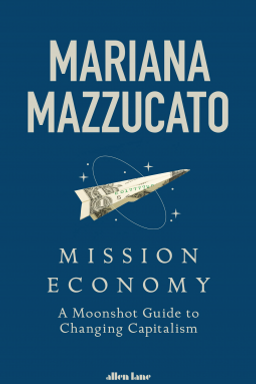
What if we could rebuild capitalism to tackle the climate crisis, inequality, and pandemics with the audacity of the moon landing? In Mission Economy: A Moonshot Guide to Changing Capitalism, economist Mariana Mazzucato invites you to imagine exactly that. She argues that the same kind of visionary leadership and risk-taking that landed a man on the moon must now be applied to solving our planet’s deepest social and environmental challenges.
Mazzucato contends that capitalism has lost its sense of purpose. Businesses chase short-term gains and shareholders’ dividends, while governments—paralyzed by decades of neoliberal ideology—confine themselves to fixing market failures, outsourcing core functions, and avoiding risk. In this model, public institutions have been hollowed out, stripped of capability, and denied the creative confidence that once made them engines of innovation. As COVID-19 made clear, this leaves societies unable to respond effectively to crises that require coordination, direction, and ambition.
What’s Gone Wrong with Capitalism
Before proposing solutions, Mazzucato paints a sobering picture of capitalism in crisis. Finance largely funds itself—pouring money into real estate and speculation rather than productive innovation. Companies are obsessed with quarterly shareholder returns, spending billions on stock buybacks instead of research or worker training. Governments have been reduced to timid fixers and outsourcers, their muscle withered by decades of anti-government rhetoric and privatization. The planet, meanwhile, is burning—subsidies still flow to fossil fuels even as climate change accelerates. These systemic flaws, Mazzucato warns, are not inevitable; they are products of explicit choices and false economic beliefs.
Rediscovering the Moonshot Mindset
To find a way forward, Mazzucato revisits the moon landing—the archetypal example of coordinated risk-taking between government, business, and science. In 1962, John F. Kennedy announced one of history’s most audacious goals: to send a man to the moon and return him safely to Earth before the decade’s end. The resulting Apollo program harnessed over 400,000 workers, multiple industries, and a commitment to experimentation, improvisation, and learning from failure. NASA didn’t just fix problems; it shaped markets, drove innovation, and created entire new industries—including software, miniaturized electronics, and materials science. That mission was not about efficiency or return on investment; it was rooted in vision, faith, and curiosity.
Mazzucato challenges you to imagine applying that same “moonshot” ethos to today's “wicked” problems—reducing carbon emissions, curing diseases, narrowing the digital divide, or reforming capitalism itself. A true mission-oriented approach, she explains, is not just about setting big goals but transforming how governments and businesses work together: sharing risks and rewards, experimenting dynamically, and rebuilding public capabilities that foster creativity and purpose.
From Market Fixing to Market Shaping
Central to Mazzucato’s thesis is a rejection of “market failure theory” — the idea that markets naturally self-correct and government should intervene only when things go wrong. Instead, she calls for “market shaping”: proactive creation of new markets around societal goals, like clean energy or universal healthcare. In her view, public institutions should act as bold investors of first resort, not cautious lenders of last resort. They should define ambitious missions—such as a carbon-neutral economy—and mobilize resources across sectors to achieve them. Every stage of policy, from taxation to procurement, should be designed to serve public purpose, not private profits.
Why This Matters to You
Mazzucato’s argument isn’t an abstract theory—it’s a call to action for citizens, businesses, and policymakers. It asks you to reconsider what you expect from government: not just efficiency or minimal interference, but visionary leadership that invests in people and ideas. It urges companies to embrace purpose beyond shareholder returns and to contribute meaningfully to common missions. And it challenges you, as a citizen, to participate in shaping these missions—from the streets where you live to the global stage where climate and inequality are contested.
What You’ll Learn in This Summary
Across the coming key ideas, you’ll explore how the Apollo program offers lessons for government leadership and collaboration; why capitalism’s short-term financialization undermines innovation; and how mission-oriented policies—from the Green New Deal to digital inclusion—can reshape economies around public purpose. You’ll discover Mazzucato’s seven principles for a new political economy, emphasizing collective value creation, dynamic organizations, outcomes-based finance, fair distribution, and participatory governance. Above all, you’ll see that changing capitalism is not about tinkering—it’s about reimagining its purpose so that prosperity, justice, and sustainability become the shared missions of our time.