
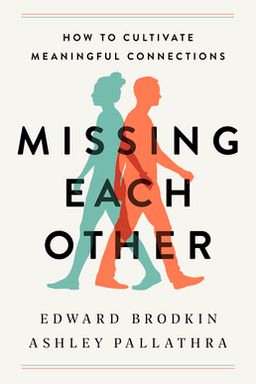
Missing Each Other cover

Missing Each Other

by Edward Brodkin and Ashley Pallathra

In ''Missing Each Other,'' Edward Brodkin and Ashley Pallathra explore the science of human connection. Learn how attunement, empathy, and active listening can foster meaningful relationships in a fast-paced, technology-driven world. Discover practical techniques to overcome loneliness and create deeper bonds.

Cultivating Genuine Human Connection Through Attunement

How often do you find yourself talking with someone—your partner, your colleague, your child—yet feel you just missed each other? In Missing Each Other, psychiatrists Edward S. Brodkin and Ashley Pallathra make the case that in our hyperconnected world, we are paradoxically disconnected. Despite living in the age of smartphones and instant messages, many conversations feel rushed, distracted, and hollow. The authors argue that the ability to truly tune in to another person, what they call attunement, has become a lost art—and reviving it could transform not only our relationships but the fabric of society itself.

At its heart, the book asks: what does it take to feel genuinely understood? The answer lies in developing attunement—defined as the ability to be aware of your own inner state while simultaneously connecting to another person’s emotions, body language, and rhythm. This isn’t passive empathy; it’s an active, dance-like interplay that balances awareness, responsiveness, and understanding. Brodkin and Pallathra emphasize that attunement is both a mental and physical process, a skill that can be taught, strengthened, and practiced over time, much like mindfulness or playing an instrument.

The Crisis of Disconnection

The authors begin by examining a cultural paradox: we now have endless ways to connect digitally, yet real connection feels harder than ever. They cite research showing that loneliness and social isolation have reached epidemic levels, linked to rising anxiety, depression, and even shorter lifespans. Part of this stems from the way modern communication—split across apps, screens, and fragmented attention—encourages shallow exchanges instead of deep engagement. Many conversations turn into parallel monologues; people talk past each other rather than with each other. (This mirrors Sherry Turkle’s argument in Reclaiming Conversation, which similarly laments technology’s erosion of authentic dialogue.)

Brodkin and Pallathra trace their fascination with attunement to their work at the University of Pennsylvania, where they studied social communication in adults on the autism spectrum. They discovered that difficulties in connection are not unique to autism—they’re nearly universal. Many neurotypical adults also struggle with attunement, finding themselves awkward or disconnected in everyday interaction. This realization inspired the authors to build a practical framework anyone could use to strengthen connection—from autistic adults to executives, parents, artists, and couples.

The Four Components of Attunement

The book’s central framework distills attunement into four interdependent components: Relaxed Awareness, Listening, Understanding, and Mutual Responsiveness. Think of these as the four movements of a symphony:

  • Relaxed Awareness: A calm yet alert state of body and mind that enables presence without tension.
  • Listening: Paying deep attention—not just to words but to tone, gesture, and emotion—while staying aware of your own reactions.
  • Understanding: Integrating perception and reflection to grasp another person’s perspective while keeping your own.
  • Mutual Responsiveness: The dynamic back-and-forth that allows two people to stay in sync, adjust in real time, and co-create the flow of interaction.

Each stage builds upon the previous one. Relaxed awareness is the foundation; without it, stress and reactivity block clear perception. Listening then becomes the art of tuning outward while maintaining inner composure. Understanding transforms raw perception into insight. And mutual responsiveness—the ability to dance with another person’s rhythm—is the summit, where attunement fully blooms.

Why It Matters

The authors argue that cultivating attunement can ripple outward far beyond individual relationships. It improves communication within families and workplaces, enhances emotional regulation, reduces conflict, and even supports leadership. They propose that widespread development of attunement could help society navigate polarization and mistrust—since many political and cultural divisions are amplified by poor listening and misunderstanding. In this sense, attunement is not just therapeutic; it’s civic. (Brodkin and Pallathra connect this to philosopher E. M. Forster’s plea from Howards End: “Only connect!”)

Throughout the book, they blend science and art, drawing insights from neuroscience, psychotherapy, Tai Chi, music, and improvisation. Using vivid examples—from the Dalai Lama’s legendary focus in conversation to Michael Jordan’s serene performance under pressure—they show that attunement is a skill shared by great communicators, athletes, and artists alike. The result is a practical manual for emotional presence that feels both spiritual and scientific.

Building a Habit of Connection

The authors don’t simply describe attunement—they teach it. Each chapter includes progressive exercises inspired by mindfulness and Tai Chi: breathing, posture awareness, slow movement, and partner-based activities. These practices train you to find balance between tension and relaxation—alert yet fluid, grounded yet open. Like any art, attunement requires repetition; over time, these habits become second nature. “Think of attunement like a muscle,” they write. “It grows stronger with consistent practice.”

Ultimately, Missing Each Other reveals that connection isn’t just about communication techniques—it’s about learning to inhabit presence. When you relax, listen deeply, understand fully, and respond authentically, you create the conditions for human resonance. Attunement, Brodkin and Pallathra suggest, might be the quiet miracle of everyday life—the power to truly see and be seen.


Relaxed Awareness: Calm in the Midst of Chaos

Brodkin and Pallathra start with the foundation of attunement—Relaxed Awareness. They define it as the simultaneous ability to be aware of yourself, others, and your surroundings while remaining calm and grounded. This balance may sound simple, but it’s rare. Most people associate awareness with tension and vigilance, and relaxation with disengagement. The authors insist that the magic lies in holding both—a calm, alert state of mind that enables presence without panic or passivity.

The Power of Stillness in Action

To illustrate what relaxed awareness looks like, Brodkin and Pallathra draw parallels between spiritual masters and elite athletes. The Dalai Lama demonstrates this quality when he gives his complete, undistracted attention to each person he meets. Similarly, basketball legend Michael Jordan exemplified “serenity in the midst of a storm,” maintaining composure and fluid agility even under insane pressure. Olympic swimmers Michael Phelps and Katie Ledecky, as well as marathoner Eliud Kipchoge, also operate in this “zone”—deeply focused but loose, relaxed even while pushing physical limits. (Psychologist Mihály Csíkszentmihályi’s concept of flow echoes this state: total immersion combined with effortless control.)

The Science of Regulation

Relaxed awareness isn’t mystical—it’s physiological. The authors explain how our autonomic nervous system manages stress through two opposing networks: the sympathetic (fight or flight) and parasympathetic (rest and digest) systems. Most of us live tilted toward the sympathetic side, constantly anxious and overstimulated. Relaxed awareness arises when the parasympathetic system, especially through the vagus nerve, restores calm. Research by neuroscientist Stephen Porges shows this same vagal system fosters social engagement; when we feel safe and relaxed, we’re more empathetic, expressive, and connected.

Hormones also play a role. The authors note that oxytocin—the “bonding chemical”—enhances relaxation and increases emotional attunement, while chronic stress and cortisol erode both. Thus, cultivating relaxed awareness is not only psychological; it changes how the body experiences connection.

Training the Muscle of Calm

How do you develop this capacity? Brodkin and Pallathra offer practical exercises inspired by Tai Chi and mindfulness. These include:

  • Stretching to release tension in the neck, shoulders, and spine.
  • Sitting Meditation to align posture, slow breathing, and maintain open awareness.
  • Standing Meditation for grounding balance between stillness and alertness.
  • Walking Meditation to bring this balance into motion.
  • Silk Reeling exercises from Tai Chi to sustain fluid relaxed focus during movement.

Each practice teaches that relaxation doesn’t mean avoidance—it means staying open while fully engaged. Over time, regulating the body trains the mind to remain clear even in turbulence, a skill essential for connecting amid stress or conflict.

“Attunement thrives on calm alertness,” the authors remind us. “If we can be aware of ourselves while regulating tension, we can stay connected—even through chaos.”

In daily life, relaxed awareness turns ordinary conversations into opportunities for connection. When you sense stress rising in a meeting, or tension brewing with a partner, the ability to pause, breathe, and remain steady can reset the entire interaction. It’s the still point around which meaningful attunement begins.


Listening: Hearing Beyond Words

Listening is not merely a passive activity; it’s the beating heart of attunement. Brodkin and Pallathra draw a sharp line between hearing and listening. Hearing captures sound. Listening captures meaning, emotion, and intention. It requires sustained presence, genuine curiosity, and an openness to be influenced by another person’s experience.

The Three Dimensions of Listening

The authors describe three intertwined elements that make up deep listening:

  • Focused Attention: Directing full awareness to what the other person is expressing—through words, tone, expression, and body language.
  • Synchrony: Mirroring emotional and physical rhythms. Conversations are dances; our posture, gestures, and even neural patterns tend to sync when rapport forms.
  • Emotional Empathy: Feeling what the other feels while knowing it stems from them. This balancing act prevents compassion fatigue while deepening resonance.

When listening well, the boundary between people softens but doesn’t disappear. As one author says, “Attunement isn’t merging—it’s harmony.” Specialists call this reciprocal resonance, where the brain’s mirror neuron system fires as if we were performing the same action or feeling the same emotion as the person we’re observing.

The Neuroscience of Connection

Neuroscience confirms that true listening physically synchronizes two brains. Using EEG and fMRI, researchers have found that when people communicate deeply, their brain waves align—a rhythm dance known as neural resonance. This shared pattern resembles the coordination seen among musicians improvising or dancers moving in sync. It’s the invisible language of empathy that bridges subjective worlds. (Neuroscientist Vittorio Gallese’s mirror neuron research underpins this finding.)

Listening to Yourself

But listening isn’t only outward. It also involves internal awareness—reading your own body and emotional signals while engaging others. Many people struggle with this “interoception,” the ability to feel what’s happening within. Those who can’t identify their emotions often struggle to recognize others’ as well. Balancing external attention with internal awareness lets you stay grounded instead of swept away by another’s feelings.

The authors use therapy examples to show this principle: a clinician noticing their tension and breath while listening to a client can regulate themselves enough to stay present and empathetic. Without this self-check, empathy can morph into emotional overload or misunderstanding.

Listening in Practice

Practical exercises like relaxed awareness while listening and synchronized walking train attention to stay steady amid interaction. In one exercise, you listen silently to another person’s story for several minutes while maintaining posture and slow breathing. The goal: sense your body and emotions without losing focus on them. Later, you swap roles. Another partner exercise teaches rhythm by walking side-by-side, matching pace without words—a tangible way to “listen” through movement.

When we listen fully, we offer the greatest gift we can give—presence.

In a culture where multitasking is prized, the authors gently remind us that listening demands simplicity. Put down the phone. Slow your breath. Resist the urge to rehearse your response. When two people truly attend to each other, they co-create a moment of harmony—proof that attention itself is a form of love.


Understanding: Seeing Through Another’s Eyes

Once you’ve learned to listen, the next step is Understanding—the ability to interpret what you perceive. Brodkin and Pallathra define understanding as grasping another person’s emotional and cognitive world while distinguishing it from your own. It’s empathy elevated into insight, merging feeling with reflection.

The Social Brain at Work

Our brains are wired for social cognition, the ability to make sense of others’ actions, intentions, and emotions. Through the mirror neuron system, the amygdala, and prefrontal regions, we constantly analyze and predict how others feel or think. Yet misunderstanding remains endemic—because our judgments are filtered by stress, bias, and quick internal attribution (“She’s rude” instead of “She’s tired”). The authors warn against these shortcuts, showing how even small misreadings can fracture rapport.

Emotional vs. Cognitive Empathy

The book separates empathy into two modes: emotional empathy (feeling what another feels) and cognitive empathy (understanding how another thinks). Emotional empathy is instinctive; cognitive empathy requires stepping into another’s frame of reference. These modes can operate independently—some people feel deeply but fail to understand, while others reason accurately but remain detached. Effective attunement blends both.

The authors draw on developmental psychology to show how “theory of mind,” the skill of perspective-taking, starts around age five when children realize that others have different beliefs and intentions. Adults, however, often regress when emotions run high. Recognizing that your partner’s reaction may come from their perspective—not a flaw in yours—is a hallmark of mature understanding.

From Reactivity to Reflection

Humans are reactive by default. The book uses real therapy examples—couples caught in loops of blame—to demonstrate how reflexive response blocks comprehension. One patient imagines his wife’s criticism as attack, missing her plea for help. Through mindfulness, he learns to pause between “stimulus and reaction,” noticing his tension before replying. Buddhist teacher Noah Rasheta calls this the ability to “mind the gap”—that brief pause that turns reaction into thoughtful choice.

Understanding thus becomes an act of compassion: suspending judgment long enough to see the full context of another’s motives. Exercises like Understanding in Conversation and Push Hands (a Tai Chi partner movement) train this skill physically—responding to others’ pressure or motion without resistance or collapse. The body learns flexibility that mirrors emotional insight.

Balancing Self and Other

Deep understanding requires holding two truths: the validity of your own perspective and the legitimacy of another’s. Cultures navigate this balance differently. The authors contrast Western individualism—which often overemphasizes autonomy—with Eastern collectivism, exemplified by Korea’s concept of nunchi, the social intelligence to “read the room.” Both extremes—self-absorption or self-erasure—disrupt attunement. Harmony lives in the space between.

“Understanding does not require agreement,” Brodkin and Pallathra write. “It requires awareness—of yourself, of others, and of the bridge between.”

By practicing curiosity and reflection, you expand your capacity to perceive nuance. Conversations become opportunities to uncover motives and meaning rather than to defend yourself. In that light, understanding turns everyday communication into mutual discovery—the essence of what it means to be known.


Mutual Responsiveness: The Dance of Connection

After awareness, listening, and understanding comes the culmination of attunement—Mutual Responsiveness. If relaxed awareness grounds you and understanding enlightens you, mutual responsiveness moves you. It’s the dynamic, improvisational exchange where two people’s actions and words intertwine seamlessly, like dancers responding to each other’s rhythm.

Meeting People Where They Are

Mutual responsiveness begins with the ability to “meet others where they are.” In the book, Brodkin and Pallathra use vivid examples, such as the police officer in the film Falling Down, who defuses tension by noticing and admiring a frightened woman’s glass collection rather than interrogating her. By aligning with her emotional world, he builds trust that opens communication. This principle applies everywhere—from leadership to parenting. Chobani CEO Hamdi Ulukaya and basketball coach Phil Jackson both built empathic organizations by listening to employees and players before acting—placing ego aside and engaging from the other’s reality rather than authority.

The Flow of Contingent Response

Once connection is established, attuned partners engage in what psychologists call contingent responsivity—each response builds logically on the other’s previous action. Conversation becomes co-created rather than mechanical. Comedians Tina Fey and Rachel Dratch exemplify this skill in improvisation; Fey calls it “serving your partner.” Every line is a gift offered and received, keeping both participants in the flow. Research shows this reciprocity binds people far more deeply than mere mirroring—it proves that each person is truly listening and thinking dynamically.

Exercises such as Reciprocal Conversation and Push Hands train this interplay physically and verbally. In Tai Chi’s push hands, partners alternate leading and following, responding to each other’s pressure with just the right intensity—not too forceful, not too passive. This mirrors emotional balance: assertive yet respectful, guiding yet receptive.

Staying in the Flow

“Go with the flow” is common advice—but the authors refine it: don’t drift, stay in the flow. Awareness must remain active, flexible, and present. Medical student and former violist Megan describes learning to stay in flow during patient interviews—just as musicians sync intuitively while improvising. Attunement requires responding to reality, not to pre-scripted expectations. This adaptability transforms awkward silences and unpredictability into opportunities for discovery.

Repairing Breaks in Connection

Even skilled communicators drop the rhythm sometimes. Small missteps, pauses, or misunderstandings are inevitable. What matters is the ability to notice, reset, and begin again. Exercises that teach mindful breathing and reflection help you catch attention lapses—whether in a meeting or a relationship—and gracefully re-enter attunement without defensiveness.

“Perfect attunement is impossible,” the authors remind us. “But beginning again is always possible.”

Mutual responsiveness is the living pulse of connection—a rhythm that engages, adjusts, and renews itself. Like dancers, musicians, or friends sharing laughter, every movement and word becomes a signal that says: I see you, I’m with you, and together we create harmony.


Artificial Attunement and the Future of Connection

In the book’s later chapters, Brodkin and Pallathra take a surprising turn—from human attunement to its technological mimicry. They call this emerging phenomenon Artificial Attunement (AA)—machines capable of simulating empathy, responsiveness, and human connection. It’s both fascinating and disturbing, as it blurs the boundaries between authentic human relationships and algorithmic coaxing.

The Rise of Synthetic Empathy

Computers can now mimic signs of emotional understanding. Artificial intelligence systems detect facial expressions, voice tone, and even physiological signals to infer moods. Companies like Microsoft, Google, and Amazon have developed programs that identify emotions and tailor responses accordingly. Personal assistants such as Alexa or Siri already “listen” and reply with friendly intonation, yet lack true awareness. The authors caution that such simulation can deceive us into believing machines care.

When Machines Pretend to Feel

AI may reproduce the outward mechanics of attunement—listening, responding, and personalizing—but not its essence. It has no self-awareness, no vulnerability. Emotional reciprocity demands consciousness. Without it, machines offer a facsimile of empathy that can subtly distort our expectations of conversation. Philosopher Sherry Turkle warns similarly in her work on “artificial intimacy,” arguing that companion robots and therapy chatbots risk replacing human warmth with convenience. The authors share her concern: as we normalize synthetic “care,” we may forget what authentic connection feels like.

Between Promise and Peril

Not all AA is harmful. Brodkin and Pallathra acknowledge constructive uses—robots or virtual reality tools can help autistic children read facial expressions, or assist paralyzed patients in communication. Yet unchecked adoption without ethical safeguards could lead to surveillance and manipulation. Facial-recognition and emotion-tracking software already analyze millions of faces for commercial and governmental use. Paired with brain-machine interfaces (like Elon Musk’s Neuralink), technology could eventually read emotions directly from neural activity—a leap with staggering ethical consequences.

The authors urge regulation grounded in neuroethics, echoing the guidelines proposed by scientists such as Rafael Yuste: preserve privacy, autonomy, and identity. Attunement must remain human, they argue, because real empathy arises from shared vulnerability and imperfection—something no AI can replicate.

“Technology can listen,” they conclude, “but it cannot care. The miracle of attunement still belongs to us.”

By contrasting artificial and authentic attunement, the authors remind us what’s at stake. Machines may imitate connection, but only humans can inhabit it. In a century of increasing digital mediation, reclaiming our ability to attune—to look, listen, breathe, and truly meet each other—is both a personal revolution and a cultural survival skill.

Dig Deeper

Get personalized prompts to apply these lessons to your life and deepen your understanding.

Go Deeper

Get the Full Experience

Download Insight Books for AI-powered reflections, quizzes, and more.