
Idea 1
How Recent History Gets Rewritten
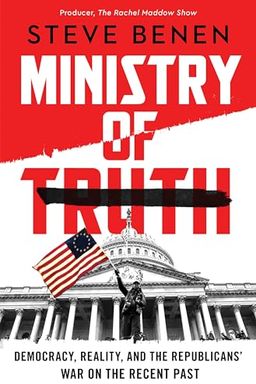
Have you ever watched someone insist you didn’t just see what you definitely saw? In Ministry of Truth, Steve Benen argues that today’s Republican Party has built a full-spectrum campaign to do exactly that: to overwrite your memory of recent events with tidy narratives that better serve its political needs. He contends that what looks like ordinary spin is actually something more corrosive—an organized war on the recent past—executed with a propagandist’s discipline and an authoritarian’s indifference to evidence.
The Core Argument
Benen’s central claim is straightforward and unsettling: Republicans aren’t merely putting favorable gloss on messy episodes; they are replacing what happened with new stories, then reinforcing those stories until they stick. The method rests on four pillars he documents across chapters: a studied indifference to reality, the absence of shame, a powerful network of partisan allies (notably Fox News and a sprawling right-wing media ecosystem), and relentless repetition (a point propaganda scholars such as A. J. Mackenzie highlighted as far back as 1938). Together, these pillars allow leaders to steamroll facts—even ones you personally witnessed—and install alternate versions as the new common sense.
This is not history as harmless nostalgia. Benen shows how, in case after case—from the Russia scandal to the 2020 election, from the January 6 attack to Trump’s Ukraine extortion, from the border wall to Covid and the economy—rewrites were used to block accountability, distort policy, and normalize behavior that would have once ended political careers. The result, he argues, has been a degraded public square where shared reality collapses and democracy itself grows brittle (a warning echoed by historians like Timothy Snyder and political theorists like Hannah Arendt).
Why This Matters Now
As you approach elections or assess leaders, you rely on a simple civic toolset: facts, records, memory, and the lessons of lived experience. Benen’s contention is that these are precisely the tools under attack. The party’s edits to the recent past make governance worse in the present. He shows how the bogus IRS “scandal” (debunked by multiple investigations) was later used to block routine tax enforcement in an infrastructure deal, and how the Big Lie about 2020 seeded new law-enforcement “voter fraud” units that found virtually no systemic problems but did intimidate voters (as AP later reported). Misinformation isn’t just rhetorical; it produces real-world costs and policies.
What You’ll See in This Summary
You’ll start by learning the GOP’s playbook for altering memory, then revisit what actually happened in the cases most aggressively rewritten: the Russia probe (and the Barr and Durham after-stories), the prewritten and then post-written Big Lie about the 2020 election, and the conversion of a violent insurrection into a tale of “tourists” and “political prisoners.” You’ll see how Trump’s “perfect phone call” to Ukraine was documented, corroborated, and even deemed unlawful by the Government Accountability Office—and then treated as a partisan mirage the party now seeks to “expunge.” We’ll walk the border wall fantasy (promises, physics, and financing) alongside the mythologized Covid response and the endlessly repeated “greatest economy in history” claim, measured against the data.
The Editing Suite: From Reality TV to Real Politics
Benen closes with a parable from Trump’s reality show, The Apprentice. When Trump fired the “wrong” contestant, producers would comb footage to assemble an after-the-fact justification—what one called an “artificial version of history.” He argues the GOP now applies that same retroactive narrative construction to politics: pick the ending that helps, then backfill the story. You saw it when Attorney General Bill Barr front-ran the Mueller findings with a misleading summary; when Tucker Carlson handpicked quiet clips from Capitol CCTV to call rioters “sightseers”; and when Republican leaders now move to literally erase impeachments from the record. Trump himself summarized the tactic in a social post: “With time, people forget!”
Essential Command
“The party told you to reject the evidence of your eyes and ears. It was their final, most essential command.” (George Orwell, 1984—quoted by Benen to frame the book’s stakes.)
How to Use This
As you read, test your own memory against the rewrites. You watched the inauguration crowd, the rallies, the briefings, the videos on January 6. Benen isn’t asking you to accept his partisan framing; he’s pointing you back to documentary record, Republican-led investigations (like the Senate Intelligence Committee on Russia), audio of Trump’s own words (to Bob Woodward about Covid; on the White House lawn urging Ukraine and China to probe the Bidens), and formal findings (like GAO ruling the Ukraine hold unlawful). The value for you is practical: once you recognize the moves—indifference to reality, shamelessness, allied megaphones, rote repetition—you can stop them from hijacking your memory and your vote.