
Idea 1
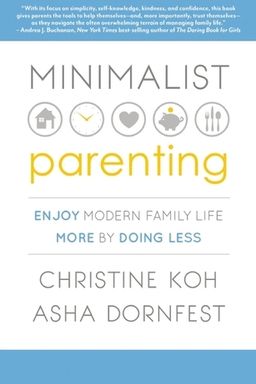
Minimalist Parenting: Enjoying Family Life by Doing Less
Why does modern family life—despite all its comforts—leave so many parents feeling exhausted, overscheduled, and vaguely inadequate? In Minimalist Parenting, Christine Koh and Asha Dornfest argue that the problem isn’t a lack of love, skill, or commitment—it’s too much of everything: too many choices, too many expectations, too much guilt, and way too much clutter, both physical and emotional. Their central claim is that happiness in family life comes not from doing more, but from doing less—the right less.
Koh and Dornfest contend that most parents today have confused abundance for advantage, equating busyness and overinvestment with good parenting. In contrast, they propose a new formula for thriving families: edit ruthlessly, trust yourself, and make space for joy. At heart, minimalist parenting invites you to reframe what it means to have it all—not by scaling down your love or ambition, but by intentionally freeing yourself from the noise so you can focus on what truly matters.
Parenting in an Age of Abundance
The authors open by capturing the paradox of modern parenthood: you may have security, comfort, and opportunities your parents never imagined, yet you feel constantly behind. Koh and Dornfest call this affliction ‘wrestling with abundance.’ The problem isn’t scarcity—it’s surplus. From baby gear aisles to endless extracurricular options, parents are overwhelmed by so many “right” ways to raise a child that they lose confidence in their own instincts. Minimalist Parenting is their prescription for this new cultural illness.
They remind you that you already have everything you need to build a meaningful family life: love, time, and enough expertise to raise confident, happy kids. But to use these strengths well, you must declutter your schedule, possessions, and expectations. This isn’t about spartan living or anti-consumerism—it’s about curation rather than accumulation. Like a good editor, a minimalist parent keeps what adds joy and connection, and lets go of the rest.
Redefining Success and Sanity
Minimalist Parenting challenges the cultural scripts that equate being a ‘good’ parent with being perpetually busy and self-sacrificing. Koh and Dornfest acknowledge that guilt and comparison are woven into the fabric of contemporary parenting—the “Pinterest perfection” trap—yet they argue that trusting your inner compass is the real hallmark of responsible parenthood. They call this inner guide your “bus driver”—the intuitive voice that knows what feels right for your family, despite the static of social pressure.
Living minimally doesn’t mean settling for mediocrity—it means investing deeply in the things that matter most. The authors share that when you align your decisions with your values, daily life begins to ‘zing’ with clarity. Instead of competing in the invisible Olympics of parenting, you can finally breathe and enjoy the messy, funny, fleeting moments that make family life remarkable.
A Blueprint for Doing Less, Better
The book’s structure reflects its promise: practical strategies for simplifying the major “containers” of family life—time, possessions, money, education, play, food, and celebrations. In the early chapters, you learn how to reclaim your schedule by identifying what’s truly meaningful and cutting the rest. Later, they tackle actionable techniques like managing clutter (‘from clutter to curation’), making financial choices based on values rather than fear, and simplifying routines around meals, school, and activities.
The concept of “editing” runs through every chapter. Whether you’re sorting through toys, weeding out commitments, or recalibrating your goals, Koh and Dornfest guide you to keep what sparks joy and belonging, not guilt. Unlike prescriptive parenting manuals, Minimalist Parenting doesn’t prescribe a single right way—it empowers you to define your own operating system.
Parenthood as Personal Growth
Both authors share candid stories of their own messy, imperfect lives—Christine juggling academic work and motherhood, pumping milk in an MIT bathroom; Asha navigating her son’s anxiety and homeschooling him when the traditional path stopped working. These stories are not Instagram-polished; they ground the philosophy in real, relatable chaos. By showing how they stumbled their way toward simplicity, they invite you to see minimalism as an evolving practice, not a destination.
The closing message is radical in its tenderness: your own well-being is not optional. The last chapters focus on self-care and the idea that parents who thrive create thriving families. Koh and Dornfest reclaim self-nourishment as a form of love, not selfishness. They invite readers to refocus their energy—away from “expert” parenting and toward building trust, connection, and joy.
The authors write that parenting, like life, is best approached as an act of courageous editing: a continual process of deciding what to keep, what to release, and how to make room for the remarkable.
Through its humor, compassion, and practical wisdom, Minimalist Parenting reframes the modern parenting conversation—from one of relentless effort to one of mindful abundance. By learning to do less, you create more space for laughter, love, and meaning—the things that were never missing, only buried.