
Idea 1
Living a Meaningful Life through Minimalism
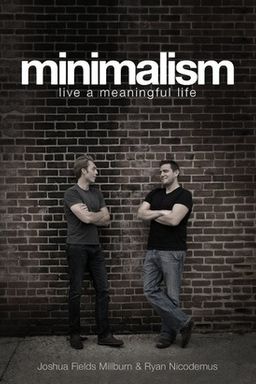
What would it really take for you to feel fulfilled—not just successful or comfortable, but deeply content and alive? In Live a Meaningful Life, Joshua Fields Millburn and Ryan Nicodemus—known collectively as The Minimalists—argue that meaning isn’t found in the next promotion, the bigger house, or the overflowing closet. It’s found in living intentionally, simplifying your life, and focusing your energy on what truly matters. The authors contend that by stripping away life’s excess, you make room for health, relationships, passion, growth, and contribution—the five dimensions they identify as the pillars of a meaningful existence.
The book unfolds as a friendly yet candid guide: part memoir, part manual for recalibration. Millburn and Nicodemus draw from their own transformation—from stressed-out corporate climbers to purposeful minimalists—to show that the relentless pursuit of possessions and status leaves most people unfulfilled. Their central message is simple but radical: you can reorder your priorities and build a life rich in purpose instead of cluttered with stuff.
The Trap of Modern Conformity
The authors open with a cutting observation about modern culture: conformity is a drug. We buy to numb dissatisfaction, chase normality because it’s safer than authenticity, and compare ourselves to others until our self-worth corrodes. They argue that this collective treadmill has created a population of anxious, overworked, debt-ridden achievers who confuse busyness with meaning. The pressure, they insist, is not entirely external—it’s internalized expectation run amok. By recognizing this, you can release yourself from the burden of constantly measuring up.
Millburn and Nicodemus discovered this insight not in theory but in crisis. In their late twenties, each seemed to have everything: six-figure salaries, large homes, shiny cars, and constant validation. Yet both felt hollow. A series of personal upheavals—death, divorce, burnout—cracked open the illusion. They realized success, as society defines it, doesn’t guarantee contentment. So they began paring down. Literally. One of their first experiments, the now-famous “Packing Party,” involved packing up every belonging and only unpacking what was actually needed. The results were revelatory: 80% of what they owned served no real purpose. That excess, they discovered, was weighing them down emotionally as well as physically.
Minimalism as a Tool, Not a Dogma
Crucially, the authors stress that minimalism isn’t about deprivation or arbitrary rules. You don’t need to live with 100 items or give up your house. Minimalism is a tool that helps you focus on what’s essential and remove anything that distracts you from meaning. Whether you have children, own a car, or live in suburbia, you can practice minimalism by evaluating each possession, commitment, and obligation through one question: does this add value to my life? If not, it’s an anchor keeping you from moving forward.
Minimalism, in this sense, acts like a magnifying glass for purpose—it brings into focus the relationships, work, habits, and contributions that align with your values. By removing clutter, it sharpens attention and frees resources. It’s a mindset as much as a method, much like Buddhist concepts of non-attachment or Leo Babauta’s Zen Habits philosophy, which the authors credit as an influence. Both point toward a truth that’s surprisingly countercultural: life’s joy is not in accumulation, but in awareness and simplicity.
The Five Dimensions of Meaning
By clearing their lives of clutter, Millburn and Nicodemus discovered five key dimensions that anchor fulfillment: Health, Relationships, Passions, Growth, and Contribution. Each dimension represents a way to reimagine success: physical vitality instead of appearance, connection instead of status, creativity instead of consumption, improvement instead of comfort, and service instead of self-interest. Every chapter in the book explores one of these dimensions through personal stories and actionable advice, showing that meaning is built through daily decisions rather than sweeping gestures.
For instance, “Health” reframes fitness as an act of self-respect rather than vanity. “Relationships” teaches you to nurture connections that are supportive and reciprocal. “Passions” urges you to replace your numbing job or routine with purposeful work that excites you. “Growth” demonstrates how small, consistent actions compound into transformation. And “Contribution” crowns them all, highlighting that true fulfillment comes from living beyond yourself. (Tony Robbins and Viktor Frankl express similar views—service to others transforms pain into purpose.)
Relevance in a Consumer Age
Why do these ideas matter? Because you’re surrounded by noise urging you to do the opposite. Modern advertising equates value with possessions. Corporate culture exalts busyness. Social media rewards comparison. Millburn and Nicodemus’s framework offers a rebellion—a conscious decision to live deliberately. Their version of minimalism isn’t an aesthetic; it’s ethical and existential. It’s about aligning your life with your principles so you can experience genuine happiness instead of fleeting pleasure.
Ultimately, this book challenges you to redefine success on your own terms: to declutter your space, streamline your commitments, and fill the cleared ground with what matters most. The promise is profound in its simplicity: if you live intentionally within these five dimensions, you can build a life not merely well-decorated, but deeply fulfilling. Minimalism: Live a Meaningful Life isn’t about less for its own sake—it’s about less for the sake of more meaning.