
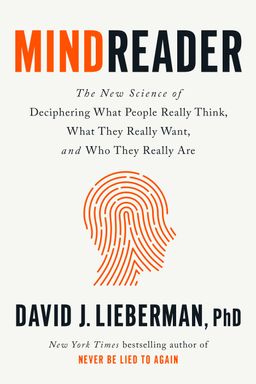
Mindreader cover

Mindreader

by David J Lieberman

Mindreader by David J. Lieberman offers readers the tools to decipher human behavior, unlocking the secrets behind what people truly think and feel. With insights from an FBI instructor, learn to read subtle cues, manage anxiety, and strengthen emotional resilience for better relationships and communication.

Reading Minds Through Language and Psychology

Have you ever wondered what people really mean—not just what they say? In Mindreader, Dr. David J. Lieberman argues that human beings constantly reveal the truth of their thoughts, feelings, and intentions through their words, gestures, and the smallest details of communication. The book draws on cutting-edge research in psycholinguistics, cognitive science, and behavioral psychology to show that you can decipher what’s really going on beneath the surface of any interaction—whether it’s a casual chat, a negotiation, or a life-changing confrontation.

Lieberman contends that language is the window to the subconscious. While our words may seem deliberate, our patterns of speech—everything from pronouns and tone to pacing and syntax—reveal how we truly think and feel. By learning to interpret these cues, you can uncover deception, identify emotional states, assess integrity, and even predict how someone will behave next. But Lieberman insists this isn’t about manipulation—it’s about awareness, empathy, and self-protection.

From Cold Reading to Scientific Profiling

Traditional ideas about body language—crossed arms indicating defensiveness, eye contact marking honesty—are too unreliable, Lieberman argues. Instead, the author proposes a more sophisticated discipline: reading the subconscious mind through linguistic structure and psychological theory. He bases his methods on the same tools he teaches to elite FBI profilers, CIA interrogators, and military analysts, demonstrating how anyone can apply them in daily life.

Each conversation, Lieberman says, is a data stream waiting to be decoded. An omission, a change of subject, or an oddly specific adjective can all transmit the speaker’s hidden self. For instance, omitting personal pronouns may suggest emotional detachment or deceit; swapping the active for the passive voice often indicates guilt or avoidance (“Mistakes were made” instead of “I made a mistake”).

Why Psycholinguistics Matters Now

Lieberman explains that modern life demands this kind of psychological literacy. In a world shaped by screens, remote work, and masked expressions, we rely more than ever on what people say and write. Psycholinguistic profiling allows you to evaluate others’ integrity without seeing them—an essential advantage in text messages, emails, and virtual meetings. A single grammatical pattern can reveal more about a person’s sincerity and mental state than a dozen gestures ever could.

The Four Dimensions of Mindreading

The book unfolds in four main parts, each building on the last to create a complete system of psychological insight:

  • Part I: Subconscious Reveals — how language exposes hidden emotions, social bonds, and power structures.
  • Part II: The Human Lie Detector — the linguistic and behavioral patterns that differentiate truth from deception.
  • Part III: Taking a Psychological Snapshot — identifying personality, mental health, and resilience through communication style.
  • Part IV: Building a Psychological Profile — linking all these observations into a coherent, predictive understanding of another person.

Knowledge as Responsibility

Crucially, Lieberman warns that this power must be used ethically. To label someone as dishonest or unstable on the basis of a single phrase is reckless. The methods must be applied to patterns over time, not isolated remarks. The purpose is not judgment but clarity—understanding others more deeply and handling relationships more intelligently.

Ultimately, Mindreader argues that understanding others begins with understanding yourself. Every insight into human speech and behavior becomes a mirror that reflects your own subconscious patterns. As Lieberman reminds readers, self-awareness is the truest form of emotional intelligence. Once you can hear what people are really saying—including yourself—you gain an edge not just in conversation but in life itself.


Linguistic Clues: The Grammar of Truth

Lieberman begins his practical exploration with language itself—the verbs, pronouns, and sentence structures that disclose a speaker’s psychological state. He explains that sincerity is not in what people say but in how they say it. This insight sets the foundation for reading unspoken intentions even in an emailed sentence or a voicemail.

Pronouns and Ownership

Personal pronouns reveal how much ownership someone takes of their words. When a person avoids “I” and “my,” they subtly distance themselves from responsibility. A heartfelt compliment sounds like, “I really loved your presentation.” Compare that to “Nice presentation”—a generic statement without personal engagement. The omission may not always mean deceit, but it often indicates emotional withdrawal.

In law enforcement, this principle exposes false reports. People falsely claiming a stolen vehicle tend to say “the car” instead of “my car.” The absence of ownership hints that they’re trying to separate themselves from the incident.

Active vs. Passive Voice

Another tell of sincerity lies in verb construction. The active voice signals confidence and responsibility (“I broke the window”), whereas the passive voice dilutes accountability (“The window got broken”). Politicians love phrases like “Mistakes were made,” which convey regret without culpability. In contrast, a person who says, “I made a mistake,” demonstrates integrity and self-respect.

Euphemisms and Detachment

Lieberman notes that euphemisms—softened or sanitized language—often conceal unease or guilt. When a company says it’s “rightsizing” instead of “firing,” or when someone claims they were “being economical with the truth,” it’s a sign of discomfort. In daily life, you’ll hear it in phrases like “letting someone go” or “a fender bender.” The speaker wants to dull the emotional impact, betraying that they’re uneasy with the truth they’re delivering.

Spatial and Emotional Proximity

Even small words like “this” or “that,” “here” or “there,” indicate psychological distance. “This problem” is personal and close; “that problem” is remote. If someone calls an idea “that one,” they’re likely disowning it subconsciously. In therapy, avoiding “I” or “we” often means the patient is shielding themselves from intimacy or emotional pain. Recognizing such distancing syntax can tell you far more than direct confession ever could.

“The subconscious effort to distance oneself from words reveals the uneasy truth the conscious mind wishes to hide.”

By decoding sentence structure, pronoun choice, and verbal distance together, Lieberman teaches that every spoken line becomes a small psychological fingerprint. Whether someone is lying, nervous, or honest, their language architecture gives them away every time.


How Words Reveal Relationships and Emotions

Relationships, Lieberman argues, are linguistic ecosystems. How someone refers to others—through pronouns, order, or even what they avoid mentioning—maps the emotional terrain of their connections. You can tell who feels close to whom, who holds grudges, and who has emotional distance, long before they admit it.

The Power of “We”

Couples that speak with more “we,” “us,” and “our” language display stronger bonds and better conflict resolution. “Where did we park?” feels intimate; “Where did you park?” signals separation. Studies of thousands of marital conversations confirm that pronoun patterns predict divorce risk better than therapy questionnaires. Similarly, in teams or companies, those referring to “our goals” have higher unity and morale than those saying “the company.”

Order and Omission

Even the order in which people mention others reveals subconscious priorities. Lieberman shares the biblical story of King Solomon’s judgment to show this rule: the true mother said “My son is alive; hers is dead,” while the impostor said “Her son is dead; mine is alive.” The first mother’s focus was her living child, showing genuine attachment. The principle holds in modern life: someone who lists their dog, their friends, and then their spouse might unwittingly reveal emotional displacement.

Objects as Symbols

The things we touch and cherish reveal how we feel about people tied to them. This is the principle of symbolic representation. The tenderness of a mother folding a baby’s clothes shows affection; a child’s treatment of a former stepfather’s gift reflects hidden resentment or longing. Observing how someone handles objects related to others gives you insight into their emotional world without needing direct words.

By combining these linguistic and symbolic cues, Lieberman teaches you to sense emotional proximity—who is in someone’s inner circle, who’s slipping away, and who lives rent-free in their mind. You begin to see relationships not for what people claim but for how they unconsciously express them.


Power Dynamics Hidden in Politeness

From boardrooms to dinner tables, hierarchy leaks through language. Lieberman shows how subtle phrasing, politeness levels, and even silence measure confidence, control, and emotional health. A single “please,” “perhaps,” or pause reveals who feels empowered and who doesn’t.

Status in Speech

High-status speakers use direct, sparse language; lower-status individuals buffer their words with qualifiers. “Close the door” becomes “Could you maybe close the door, please?” Multiple softeners in one sentence—“I’m so sorry to bother you, but could I possibly ask…”—signal deference or insecurity. Conversely, refusal to soften requests, especially when unnecessary, may show arrogance or poor empathy.

Focus and Authority

Surprisingly, the powerful use “I” and “me” less frequently. Because they focus outward, not inward, their language centers on others or objectives (“You’ll see results” rather than “I think you’ll see results”). In texts or emails, phrases like “Forgive the delay” instead of “I’m so sorry for my delay” convey authority; the speaker requests rather than admits. By contrast, “Excuse me” subtly commands the listener to grant pardon—signaling higher confidence—while “I’m sorry” assumes responsibility and lower status.

Nonverbal Power

Power also manifests in silence and gesture. The person who can compel action with minimal language—a lifted hand, a look, a single word—wields genuine control. Parents, teachers, and officers who resort to lengthy explanations have already ceded ground. Lieberman calls this “economy of authority”: the less pressure needed to command, the greater the power.

Noticing how people phrase favors, give thanks, or offer apologies lets you gauge their self-esteem and situational dominance. True confidence speaks quietly; insecurity hides behind excess words.


The Language of Emotion: Anxiety and Anger

Emotions, too, have linguistic fingerprints. Lieberman devotes detailed chapters to decoding anxiety and anger—the twin pillars of emotional leakage. Both reveal themselves in pronouns, qualifiers, and tone long before any outburst occurs.

Anxiety: The Inner Tilt

An anxious person focuses inward, using more personal pronouns (“I,” “me,” “my”) and tentative phrases (“I guess,” “I think,” “I might”). They hesitate, over-explain, and fill speech with qualifiers and retractors (“but,” “although”) that undermine confidence. The anxious mind overmonitors itself, mirroring how nervous people carefully watch their own movements—like watching your hand lift a coffee cup you’ve held a thousand times.

Physical signs—rapid breathing, throat clearing, voice tremors—often accompany these verbal tics. Lieberman reminds readers that anxiety isn’t weakness but a symptom of fear: the fear of being wrong, rejected, or exposed.

Anger: The Outward Explosion

Anger, conversely, ejects focus outward. The angry speaker abandons “I,” favoring “you” and “they.” They drop qualifiers altogether and lean on absolutes and commands: “You always,” “You never,” “That idiot ruined everything.” Angry language is clean, blunt, and certain—reflecting a need for control after fear’s loss of control. Anger, Lieberman writes, is fear wearing armor. It lets the ego distract itself from vulnerability by projecting power.

He notes, however, that suppressed or “polite” anger leaks through passive tone, cliché, or sarcastic nicety—the “lips-only smile” masking contempt. Detecting these linguistic distortions helps you identify emotional undercurrents before they erupt.

Together, anxiety and anger illustrate Lieberman’s central thesis: every emotional storm changes the temperature of our language. Listen long enough, and you can forecast inner weather with startling accuracy.


Deception, Bluffing, and Manipulation

Few sections are as riveting as Lieberman’s manual on deceit. He explores the tactics of liars, bluffers, and con artists—from guilty spouses to poker sharks to corporate fraudsters—and teaches you to separate truth from illusion in conversation.

The Anatomy of a Lie

Liars, Lieberman shows, need mental shortcuts. Because deception is cognitively taxing, they rely on repetition (“as I said before”), vague generalities, or clichés to save brainpower. Expect moralizing (“Kids these days have no respect”) or philosophical detours (“In this world, people are unfair”)—smokescreens to sound righteous rather than factual. They avoid direct denials; “I’d never do that” feels safer than “I didn’t do that.”

The Bluff as Theater

A bluff, Lieberman reminds us, isn’t just lying—it’s performing authenticity. Like Shakespeare’s stage queen who “protests too much,” bluffers try too hard to appear relaxed. They overdo eye contact, exude fake casualness, or insist “I’m absolutely certain.” Their error mirrors Apple’s early “shuffle” algorithm, which had to make randomness appear random. The result: rehearsed imperfection that feels scripted.

The genuine person shows congruence—emotion, language, and behavior align naturally. Bluffs collapse under overcompensation. A truly confident negotiator or card player doesn’t need to convince anyone else.

The Con Artist’s Playbook

Professional manipulators exploit human psychology: obedience to authority, susceptibility to flattery, and craving for belonging. Citing social psychologist Robert Cialdini’s findings, Lieberman shows how scammers build false trust through imitation (“You’re like me”) and premature intimacy (“I feel I can tell you this”). We drop our guard when someone mirrors our interests or vulnerability.

“Confidence,” Lieberman warns, “is the con in con artist.” Their power depends on our emotional needs. Learning to spot overemphasis, rushed decisions, or unearned familiarity helps you protect not only your wallet but your mind.


Personality, Values, and Emotional Health

Beyond lie detection, Mindreader helps you recognize personality types, mental health states, and even levels of self-esteem. Lieberman integrates clinical psychiatry with everyday observation to reveal how ordinary conversations expose the extraordinary structures of the psyche.

Dominant vs. Submissive Personalities

A dominant person externalizes stress: “The window is stuck.” A submissive person internalizes it: “I can’t open the window.” Both may be normal, but consistently blaming or resigning oneself hints at pathology. In distress, each extreme warps into disorder: dominance toward aggression (personality disorders) and submission toward depression (affective disorders). Emotional health, Lieberman argues, lies in balanced responsibility.

The Meaning of Values

What people praise or criticize reveals their self-concept. We admire in others what we value in ourselves—and despise traits that threaten our ego. Someone obsessed with punctuality or appearance is projecting the standards by which they judge their own worth. By identifying others’ habitual themes—money, loyalty, humility—you glimpse their inner hierarchy of meaning.

Self-Esteem and the Ego Trap

Lieberman clarifies a common myth: narcissists don’t love themselves; they fear they are unlovable. The loud ego compensates for deep inferiority. True self-esteem manifests as humility—the quiet confidence that needs no validation. Those with inflated egos seek control instead of connection; those with stable self-worth can freely give and receive.

Emotional wellness depends on self-control and perspective—the ability to delay gratification, accept reality, and find meaning. Happiness arises not from escaping discomfort but from using it to grow. As Viktor Frankl observed, fulfillment is found in purpose, not pleasure.


Spotting Pathology and Danger

The final chapters of Mindreader turn dark but vital: recognizing mental breakdown, personality disorders, and warning signs of violence or suicide. Lieberman aims not to alarm but to equip readers with psychological radar that can save relationships—and lives.

Sociopaths in Disguise

Sociopaths, Lieberman warns, wear “the mask of sanity.” They mimic empathy and charm but feel no remorse. Their speech is polished yet hollow, filled with clichés of goodness and exaggerated eye contact designed to appear trustworthy. When their control slips—through contradiction, fake vulnerability, or incongruent laughter—the mask cracks. Recognizing overperformed humility or overrehearsed calm can expose the predator beneath.

Boundaries and Respect

Emotionally healthy people respect boundaries; the disturbed do not. Boundary violators—those who touch inappropriately, ignore refusals, or overshare personal details—reveal disordered empathy. Their need to dominate or fuse with others betrays fragile self-esteem. Observing how someone treats waiters, colleagues, or subordinates tells you everything about their inner stability.

Red-Flag Language

Absolutist and violent phrasing (“Everyone’s out to get me,” “They should all burn”) signals psychological rigidity and potential volatility. Detachment phrases (“It did this to me”) show avoidance of responsibility. Combined with stressors—job loss, rejection, or humiliation—these patterns foreshadow breakdown or aggression. Lieberman references criminologist Stanton Samenow’s reminder: people don’t “snap”; they escalate through consistent thinking errors.

Lieberman ends with a moral plea: use insight not as a weapon but as protection. Awareness allows compassion and caution. When you can read the signs of instability—whether in a stranger, a colleague, or yourself—you’re no longer blind to danger, but neither are you powerless before it.

Dig Deeper

Get personalized prompts to apply these lessons to your life and deepen your understanding.

Go Deeper

Get the Full Experience

Download Insight Books for AI-powered reflections, quizzes, and more.