
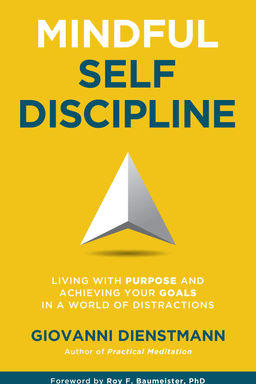
Mindful Self-Discipline cover

Mindful Self-Discipline

by Giovanni Dienstmann

Mindful Self-Discipline redefines self-discipline as a potent tool for personal empowerment. Giovanni Dienstmann guides readers on a journey to integrate self-discipline into everyday life, helping them overcome distractions, achieve higher goals, and craft a life that reflects their deepest values and dreams.

Mindful Self-Discipline as Power and Harmony

How can you live in alignment with your highest values despite distraction, doubt, and desire? In Mindful Self-Discipline, Giovanni Dienstmann answers with a synthesis of Eastern mindfulness and Western behavioral science. He defines self-discipline not as repression, but as the art of harmonious self-governance: staying true to what matters and acting from purpose, moment after moment.

Self-discipline, in this view, is both power and harmony. Power when you assert authority over impulses; harmony when all parts of you—reason, emotion, and instinct—play in tune. Dienstmann compares it to a wise ruler governing the inner kingdom or a maestro conducting an orchestra. The goal is not suppression but integration.

The Essence of Mindful Self-Discipline

Dienstmann’s central argument is that lasting discipline arises when Aspiration, Awareness, and Action operate as one, forming what he calls the Three Pillars Framework. Aspiration gives you purpose; Awareness lets you recognize impulses and pause; Action turns intention into habit. Together they form a cycle of intentional living. Fragmentation, forgetfulness, or futility—his “three F’s of chaos”—appear when one pillar is weak.

Underneath these pillars lies a unifying principle: mindfulness fuels mastery. Awareness trains you to pause before reacting; reflection reveals patterns; meditation strengthens the prefrontal cortex—the brain’s control center. (In neuroscience terms, the prefrontal cortex must lead the limbic and reptilian regions.) Discipline becomes not a battle against yourself but a skill of conscious alignment.

From Willpower to Habit

The book distinguishes three building blocks of behavior: willpower, habits, and environment. Willpower is the moment-to-moment energy to act with awareness. Self-discipline sustains willpower over time. Habits, once built, reduce reliance on willpower by automating right action. Environmental design—removing temptations, adding friction—makes good behaviors easier and bad ones harder. But Dienstmann stresses: dependence on external scaffolds alone breeds fragility. You must train the inner muscle of will.

The idea of limited willpower (ego depletion) is reinterpreted through Carol Dweck’s growth-mindset lens. Treat willpower like a muscle: exercise it daily through small acts of deliberate friction—cold showers, short fasts, or micro-challenges—to grow your reserve capacity. (This echoes James Clear’s Atomic Habits and Kelly McGonigal’s The Willpower Instinct, but Dienstmann adds a mindfulness core.)

Training the Inner Conductor

Your job as a mindful self-disciplined person is to coordinate the inner orchestra: thoughts, emotions, habits, and external conditions. Each element contributes differently—focus chooses what matters, willpower performs even when uninspired, and integrity keeps you consistent. The metaphor extends to rhythm: routines and circadian patterns bring beauty and predictability to life’s melody.

Dienstmann’s own practices—waking at 2:30 a.m., meditating for hours, one meal per day—function as examples of conscious design, not punishment. They focus energy on growth, family, and legacy. The lesson isn’t to copy his schedule, but to find your own rhythm of sacred routines that express purpose through consistency.

The Book’s Journey

The book begins with redefining discipline and willpower, then deepens into the Three Pillars Framework—Aspiration, Awareness, and Action. Subsequent chapters offer hands-on methods: the PAW Method (Pause–Awareness–Willpower) for responding wisely to impulses; Shift Your Focus, Shift Your Perception, and Embrace Pain to train emotional intelligence; and a mastery of habit-cycle design (Cue–Action–Reward). Later sections cover practical obstacles—distraction, procrastination, doubt, and failure—and advanced tools such as Never Zero commitment, contingency planning, and virtue cultivation.

Ultimately, Mindful Self-Discipline blends spirituality and strategy. It invites you to live deliberately—anchoring every action in a meaningful “why,” guided by awareness, supported by habits, and expressed through aligned action. Dienstmann reminds readers that when you keep promises to yourself, you reclaim your personal power. Life becomes less a battle of impulses and more a harmonious composition directed by purpose.

"Discipline is not suppression—it is alignment with what truly matters."

Dienstmann’s fundamental message is that self-control without self-awareness is coercion; awareness without aspiration is drift; aspiration without action is fantasy. True freedom lies in uniting all three.

This combination of purpose, awareness, and method makes discipline not something you force, but something you become. When all three pillars support each other, your life gains a quiet power—focused, reliable, and deeply aligned.


Aspiration and the Power of Purpose

Self-discipline collapses without meaning. That’s why Dienstmann begins with Aspiration—your “why.” This is the emotional engine that makes persistence joyful instead of painful. As Nietzsche said, “He who has a why can bear almost any how.” Purpose transforms effort from duty into devotion.

Finding Your Why

Dienstmann’s exercises combine rational reflection and intuitive discovery: list your core values, practice the “Five Whys” to uncover deeper motives, identify role models, and meditate on your deepest longing. These tools uncover what truly moves you. If your goal doesn’t emotionally resonate, you’ll abandon it under stress. Example: when Giovanni’s wife suggested skincare, he dropped the habit because it lacked meaning. When a behavior links to deeper identity—health, legacy, love—it endures.

Translating Vision into Goals

Once you clarify your aspiration, you anchor it in SMART goals (Specific, Measurable, Achievable, Relevant, Time-bound). Dienstmann advises picking three priorities only, then making a Triple Commitment of time, money, and energy. These material commitments convert vague desire into structure. (This parallels Stephen Covey’s scheduling “big rocks first.”)

Facing Resistance and Making an Offering

Inner resistance is inevitable. The Red-Pill Test exposes hidden sabotage: if you hesitate to accept a magic pill granting success, secondary gains—identity comfort, fear of change—are holding you back. Dienstmann’s remedy is conscious sacrifice: make an offering by giving up what blocks your growth, balancing fiery dedication (tapas) with “water” practices—joy, rest, gratitude—to avoid burnout. Purpose without sacrifice is fantasy; sacrifice without joy is punishment.

By grounding goals in aspiration, aligning them with values, and clarifying what you will give in return, you gain fuel for endurance. Purpose turns “I must” into “I choose.”


Awareness: The Pause That Changes Everything

Awareness is the bridge between intention and execution. Dienstmann calls it the mother of discipline because it inserts choice between impulse and reaction. Without awareness, you live by default—ruled by habits, emotional inertia, and dopamine cues.

Building Awareness Through Practice

Three daily disciplines cultivate awareness: meditation (to strengthen the pause), reflection (to analyze behavior), and integration (to apply mindfulness in real moments). Meditation rewires your brain for self-control; journaling builds accountability by showing black-and-white data; integration makes awareness portable.

The PAW Method

Dienstmann’s flagship tool for real-life use is the PAW Method—Pause, Awareness, Willpower. When an urge arises, you Pause (three deep breaths), create Awareness (label options as +1 or –1 to your aspiration), and then apply Willpower (use a technique to act wisely). This turns mindfulness into a behavioral algorithm.

To execute the Willpower step, he provides three strategies: Shift Your Focus (zoom out and reconnect with aspiration), Shift Your Perception (reframe temptation’s meaning), and Embrace Pain (practice acceptance using the ROAR method—Recognize, Observe, Accept, Release). These tools make emotions allies rather than enemies.

“Pause is essential: there is no awareness without pause.”

The pause is where freedom begins—the gap in which you choose alignment over impulse.

Awareness therefore converts knowledge into power. Combined with aspiration, it ensures discipline is not blind exertion but conscious, adaptive leadership over your inner world.


Action: Turning Intention into Structure

Action is where aspiration meets the ground. Dienstmann teaches that disciplined action depends on design—breaking goals into milestones, habits, and rewards that create self-sustaining momentum. Without structure, even a noble goal dissolves into chaos.

Designing Your Path

Start from your aspiration and set one SMART goal that advances it. Then carve that goal into milestones with start and end dates. These prevent procrastination by creating progress markers. Within each milestone, name the habit that realizes it: Action Habits (direct), Replacement Habits (swap negatives), or Project Habits (scheduled work blocks). Define a Minimum Action—your daily non-negotiable—and an Ideal Action for normal days. The former secures consistency; the latter drives growth.

Habit Mechanics and Rewards

Habits run through Cue → Action → Reward. Choose reliable cues—time, place, or previous routine—and make them specific: “When the alarm rings at 7 a.m., I will write 200 words.” Design your environment to ease good cues and block bad ones. Then reinforce behavior with immediate rewards. Dienstmann distinguishes intrinsic rewards (joy in the process), extrinsic incentives (bundling or sequencing pleasures), and negative consequences (stakes or financial loss). Aim to progress from external to internal motivation over time.

Never Zero and Keystone Habits

His “Never Zero” rule means you do your minimum action every day—no exceptions for the set period. This 100% clarity eliminates decision fatigue and builds self-trust. Start with one keystone habit (like daily meditation or morning planning) that triggers ripple benefits. Once stabilized, build new habits upon it. Accountability partners, groups, or coaches can multiply adherence, but Dienstmann cautions against oversharing goals publicly (Derek Sivers’ research) since it can reduce motivation.

Planning, habits, and rewards transform lofty aspiration into reliable behavior. Discipline then feels less like “trying harder” and more like moving along a well-built path.


Facing Distraction, Procrastination, and Doubt

Even the best structure falters under emotional challenges—distractions, avoidance, and self-doubt. Dienstmann devotes several chapters to mastering these inner battles through psychological and mindfulness tools.

Taming Dopamine and Distraction

Modern environments exploit dopamine—the seeking chemical that drives craving. Overexposure to “easy dopamine” (social media, sugar, novelty) dulls motivation for deep work. Dienstmann’s antidote: balance pleasure and purpose. Do your meaningful tasks before indulgences (“rocks before sand”), and occasionally reset your reward system through a Monk Week—a period of dopamine detox filled with meditation, physical activity, and silence. Procrastinate temptations by saying “not now, maybe later,” or use commitment devices that constrain future impulses.

Overcoming Procrastination

Procrastination arises from pain avoidance. Dienstmann suggests three levers: decrease the pain of action through baby steps (90-second starts), increase the pain of inaction by visualizing long-term costs, and embrace the pain mindfully (the ROAR method). Choose the lever based on the root cause—overwhelm, indifference, or fear. Over time, small wins accumulate into a bias for action.

Dismantling Doubt

Doubt drains commitment. Dienstmann proposes the Not Now experiment (suspend doubts temporarily to test a path fully), Remove Options (close escape routes to force focus), and Gain Perspective (zooming out to remember the big picture). These address self-doubt, path doubt, and goal doubt respectively. Professor Scott Geller’s “three yeses”—Yes I can, Yes it will work, Yes it is worth it—summarize the mindset shift.

By mastering attention, reduction of avoidance, and reframing uncertainty, you build mental resilience—the hidden engine of consistency.


Fail Gracefully and Grow Stronger

Everyone fails; the disciplined simply recover faster. Dienstmann’s framework for resilience blends prevention and repair through contingency planning and emotional reset.

Plan for the Predictable

Write if/then statements for foreseeable obstacles: “If I travel, I’ll do a 10-minute routine,” “If I work late, I’ll meditate before bed.” Visualize these responses until automatic (POWER method). This mental rehearsal primes follow-through when conditions shift.

Recover with ALFA

When failures occur, use the ALFA process: Acknowledge the slip neutrally, Learn from its cause, Forgive yourself to release shame, and Act immediately with your minimum action. Shame drains energy and feeds relapse; compassionate accountability restores momentum.

“The goal isn’t never to fall—it’s to fall consciously and rise immediately.”

Dienstmann reframes failure as feedback. Every stumble deepens insight if processed with awareness.

By anticipating obstacles and practicing ALFA, you turn setbacks into learning moments instead of proof of weakness. Resilience, not rigidity, sustains long-term growth.


Meditation, Routines, and Virtuous Depth

In the final chapters, Dienstmann lifts discipline from technique to transformation. Meditation and spiritual virtues together give depth and durability to the practice.

Meditation: The Inner Gym

Meditation trains both awareness and willpower. You observe thoughts drift and return to the object—a micro-rehearsal of discipline itself. Dienstmann frames it through three pillars: Habit (show up daily), Technique (choose one that suits you), and Transformation (apply it throughout the day). The “pause” you cultivate expands into every decision via the PAW method.

Time and Routine Mastery

Mindful time management fuses structure with spontaneity: plan priorities, set boundaries, track time, and single-task deeply. A mindful morning routine—fixed start time, tech-free focus, sequential blocks—anchors the day’s tone. Dienstmann’s practical example includes meditation, reading, and exercise blocks before checking messages. Small consistent rituals yield compound effects on attention and mood.

Cultivating Virtues

Virtues are inner programs you can install deliberately. To Kindle a virtue, relive a memory when you embodied it; to Absorb it, visualize a role model and embody their energy. Each virtue—courage, patience, compassion—should be balanced against its shadow to prevent distortion. Over time, virtues turn discipline into character.

Spiritual Perspective

Spiritual context supplies faith, long-term perspective, and purpose beyond ego. Whether through religious devotion or secular transcendence, seeing your actions as part of a larger narrative amplifies resilience. Dienstmann notes that spirituality is optional, but for those inclined, it deepens endurance by connecting daily choices to cosmic or legacy-scale meaning.

When you integrate meditation, time mastery, and virtuous living, discipline becomes not a set of hacks but a way of being—steady, compassionate, and purposeful.

Dig Deeper

Get personalized prompts to apply these lessons to your life and deepen your understanding.

Go Deeper

Get the Full Experience

Download Insight Books for AI-powered reflections, quizzes, and more.