
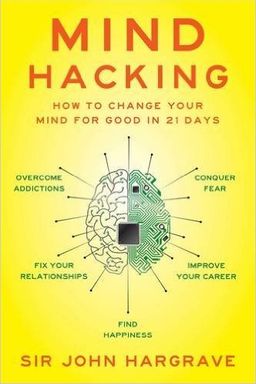
Mind Hacking cover

Mind Hacking

by Sir John Hargrave

Mind Hacking by Sir John Hargrave is a transformative guide to reprogramming your mind in 21 days. Discover techniques to improve concentration, eliminate negative thought patterns, and harness the power of imagination for personal growth. This book empowers you to take control of your mental landscape and achieve lasting change.

Reprogramming Your Mind to Transform Your Reality

Have you ever wished you could rewrite the patterns running your mind — the negative thoughts that loop endlessly, the habits that hold you back? In Mind Hacking, Sir John Hargrave argues that you can. Your mind, he reveals, runs like a computer system filled with outdated and buggy code. The revolutionary promise of this book is simple yet profound: if you learn to analyze, imagine, and reprogram your mental software, you can change your mind — for good.

Hargrave’s core contention is that you are not your mind. In the same way that programmers debug faulty loops of code, you can detach from your habitual mental programming and rewrite it consciously. This idea, rooted in both psychology and computer science, lays the foundation for a practical system of mental mastery. By applying the hacker’s mindset — curiosity, experimentation, iteration — you can learn to track, test, and transform the automatic sequences that shape your thoughts, emotions, and actions.

The Hacker’s Approach to Self-Mastery

Hargrave draws vivid parallels between coding and cognition. Just as early computer hackers like Steve Wozniak learned to bend technology to their will, mind hackers learn to bend consciousness through analysis and deliberate design. We live in two worlds, he explains — the physical world of objects and the mental world of ideas. Yet most people remain trapped inside their own mental operating systems, unaware they have the ability to change the code.

To hack your mind, you start with observation. Recognize the mental movie constantly playing in your head. You play the roles of both actor and observer. Once you realize that you can step outside your thoughts and watch them objectively, you can begin to manipulate them — not as supernatural magic, but as scientific self-experimentation. As Hargrave reminds readers, “you are the observer behind the mind; therefore, you have the power to reprogram it.”

Analyzing, Imagining, and Reprogramming

The book is structured around three progressive stages borrowed from hacker culture: Analyzing your mental loops, Imagining new possibilities, and Reprogramming your thoughts through consistent practice. Each step is supported by research in neuroscience, psychology, and cognitive science. For instance, Hargrave cites meditation studies showing that mindfulness strengthens cognitive control (similar to developing ‘superuser’ privileges in your own mental operating system).

In Analyzing, you debug your mental code by spotting negative loops linked to pain or frustration — like the habits that cause anxiety, procrastination, or addiction. Imagining teaches you to reconstruct those thoughts with creative, positive imagery, the mental blueprint for your ideal future. And in Reprogramming, you translate that blueprint into daily practices of writing, repetition, visualization, collaboration, and small, attainable actions.

Why It Matters

Hargrave’s framework matters because it turns self-improvement from vague motivation into analytic discipline. It reframes inner growth as a system you can hack, test, and master. This approach builds freedom through understanding: once you recognize your thoughts as code, they lose their power to control you. You begin to consciously choose which programs to run.

This hacker-inspired philosophy fits the modern age. In an era of digital distraction, social media loops, and mental overload, learning to control your attention and debug your negative loops isn’t just self-help — it’s survival. Hargrave channels the ethos of classic hackers, open-source collaboration (à la Richard Stallman), and iterative design to create a blueprint for hacking not machines but the mind itself.

By the end of the book, you understand not only that your mind can be hacked — but that you are the hacker. With awareness and deliberate practice, you can rewrite your inner codebase and craft a life of clarity, creativity, and peace. It’s a geek manifesto for transformation, written with humor and rigor, showing that changing your mind really can change your world.


You Are Not Your Mind

The first step to hacking your mind is realizing you are not your mind. This concept, drawn from both Buddhist philosophy and modern cognitive science, is the cornerstone of Hargrave’s system. By understanding that your thoughts are not reality but programs running on the mental screen, you gain the viewpoint of a programmer — not a passive user.

The Mind Movie and the Superuser

Hargrave compares your inner experience to watching a movie. Most people, he says, “get lost in the movie,” forgetting that they are also the observer sitting in the theater. The thoughts, emotions, and narrative playing continuously are not who you are; you are the consciousness behind the projector. Like NASA’s engineer controlling the Mars rover, you input commands within this mental simulation — but you are not the machine itself.

To act as a mind hacker, you must switch roles from an ordinary ‘user’ of your thoughts to the system’s ‘superuser.’ Hackers access root privileges in computer systems to change underlying code; you do the same in your brain when you watch your thoughts instead of reacting to them. Meditation, mindfulness, and reflection are the access keys to this mode.

The Power of Conscious Observation

This step is deceptively simple but transformative. Hargrave cites examples like mathematician John Nash, who overcame schizophrenia by maintaining awareness of his mind’s distortions — observing his thoughts as hypotheses rather than truths. You develop similar awareness by asking, “What was my mind just thinking?” This question, repeated throughout your day, trains the meta-awareness necessary to debug faulty loops.

By adopting this viewpoint, you detach from automatic emotions and instead recognize patterns: anger, fear, regret, or judgment become programs you can modify. As Hargrave puts it, “the act of noticing your mind wandering is progress.” The mind remains a powerful tool — but only when you remember it is your tool, not your master.


Debugging Your Mental Loops

In computer programming, debugging means finding errors in code that make a program malfunction. Your mental loops — recurring thoughts or emotional cycles — work the same way. Negative loops lead to pain and self-sabotage. Hargrave teaches you to identify and fix these loops through systematic analysis using three methods: the Five Whys, Worst-Case Scenario, and Third-Person Perspective.

The Five Whys

Adapted from Sakichi Toyoda, founder of Toyota, this technique asks “why?” repeatedly to trace problems to their root causes. If you feel anxious about failure, keep asking why until you uncover the hidden belief — perhaps “I am not good enough.” Once visible, that faulty mental line of code can be rewritten.

Worst-Case Scenario and Third-Person Perspective

The Worst-Case Scenario approach exaggerates fears to reveal irrational patterns (“if I fail, I’ll end up destitute”). By seeing the absurdity of these projections, you disarm them. The Third-Person Perspective technique flips roles — what advice would you give a friend with this problem? This external viewpoint uncovers clarity and compassion you often deny yourself.

Uncovering the METAL Loop

Hargrave summarizes these insights with the formula METAL: My Emotion–Thought–Action Loop. Each emotion triggers thoughts, which trigger actions, reinforcing the loop. To debug, you identify the emotional starting point — such as anxiety or anger — then follow its causal chain. Writing these loops down, he stresses, transforms abstract feelings into explicit scripts you can refactor.

As a programmer improves software through iterations, you improve your mind through introspection. Debugging is not about self-blame; it’s about curiosity. You’re diagnosing faulty code that was often installed by past conditioning, culture, or family patterns. Once you find the bug, you can rewrite the loop toward joy, confidence, and creativity.


Imagining a New Reality

After analysis comes imagination — the creative act of designing new mental loops to replace the old. Hargrave argues that imagination is more than daydreaming; it’s mental engineering. By vividly picturing what you want instead of what you fear, you seed a future version of yourself.

The Power of Imagination

Drawing examples from thinkers like Albert Einstein and Steve Jobs, Hargrave shows how imagination precedes innovation. Einstein’s “thought experiments” and Jobs’s “reality distortion field” both began as mental blueprints that reshaped reality. Your mind, he emphasizes, is a creative workspace — the blueprint before the building.

Tools for Visionary Thinking

Hargrave teaches five imagination exercises — Feel (the Mood Chip), Do (the $50 Million Inheritance), Have (the Genie in the Lamp), Give (Your Evolution Contribution), and Be (The Funeral Speech). Each one helps you script your ideal feelings, actions, possessions, contributions, and identity. Writing down one word per category clarifies your desired program outputs.

Instead of defining yourself by problems (“I don’t want to be anxious”), you construct positive realities (“I am peaceful and confident”). Imagination aligns emotional energy with future potential, turning intention into probability through visualization and belief.

Hargrave reminds you that all great change begins with mind-based prototypes. Like engineers building the World Wide Web or artists sketching inventions, you first build the mental version, then the external one. To become that future person, imagine it vividly enough today to make it inevitable tomorrow.


Writing and Repetition as Mental Code

Once your new mental loops are designed, you embed them through writing and repetition. Hargrave equates writing with compiling code — translating mental ideas into physical form. “Until it’s on paper, it’s vapor,” he writes. This section draws lessons from Thomas Edison’s invention process, Dr. Richard Peabody’s recovery method, and modern entrepreneurs like Michael Gerber and Allen Downey.

The Power of Writing

Edison wrote down every idea before building it, bridging imagination to reality. Peabody asked recovering alcoholics to record their daily schedules to form positive feedback loops. Gerber taught business owners to document systems for replication, turning one-location stores into franchises — a metaphor for replicating improved mental habits.

The Discipline of Repetition

Scott Adams’s success with Dilbert, Jim Carrey’s $10 million check, and Jerry Seinfeld’s “Don’t Break the Chain” method all prove the emotional power of repeating goals daily. Writing loops fifteen times a day, posting reminders, or tracking progress builds deep mental grooves. The act of focused repetition transforms positive statements into automatic thought patterns — much like neural pathways strengthening through practice.

By combining writing (creating code) with repetition (running code), you move ideas from conscious effort to habit. Hargrave calls this process mind judo — redirecting negative momentum toward positive loops automatically, until optimism becomes the default operating system.


Simulation and Collaboration

Mental simulation is the advanced rehearsal that makes mindset actionable. Inspired by Nikola Tesla’s visual thinking, Hargrave teaches you to run “mind movies” of success, using imagination to model reality step-by-step. He urges practicing in three modes: forward simulation, block-and-tackle (working through difficulties), and self-simulation (viewing yourself from a third-person perspective).

Learning from Tesla and the Seahawks

Tesla imagined every invention in vivid mental simulations before building prototypes. Similarly, Seattle Seahawks coach Pete Carroll and psychologist Michael Gervais trained football players through visualization: by rehearsing peak performance and fear scenarios, they increased calm, confidence, and resilience under pressure. Athletes and professionals alike benefit from mental “functions” that automatically activate during stress.

Collaborative Mind Hacking

Hargrave expands simulation into collaboration — connecting minds like computers to a cloud. He references Jimmy Wales’s creation of Wikipedia and Steve Jobs’s collaborative design at Pixar to illustrate how shared mental energy multiplies creativity. Collaboration, he argues, is the social version of mind simulation: by speaking goals aloud and engaging with others who support or challenge them, ideas evolve from personal fantasies into collective momentum.

Through teamwork and empathy, your mind learns faster and executes better. Radical collaboration — whether through meetups, mentorship, or shared creative projects — amplifies feedback loops across minds. The best mental simulations happen not alone, but together.


Acting with LASER Focus and Tiny Goals

After analyzing, imagining, writing, and simulating, the final stage is acting — turning mental code into real-world change. Hargrave adapts lessons from innovators like Tim Berners-Lee to show that big dreams require small, disciplined actions. His acronym LASER guides this process: Limited, Achievable, Specific, Evaluated, and Repeatable goals.

The Power of Tiny Goals

David Blaine’s endurance feats and Tim Berners-Lee’s invention of the web both demonstrate incremental mastery. To achieve audacious outcomes, you start small — write a proposal, take one jog, make one step. Each limited task compounds momentum, turning effort into resonance. Hargrave compares this to “pushing a swing”: small, well-timed pushes exponentially increase motion.

Gamifying Life and Building Willpower

Hargrave encourages treating goals like video game levels — assign points, rewards, and achievements to keep motivation fun. He cites Jane McGonigal’s recovery from brain injury through gamified healing, showing how playful persistence turns pain into progress. Tiny repeated wins recharge willpower like batteries; one keystone habit (such as daily concentration practice) triggers cascades of improvement throughout life.

Ultimately, acting turns mind hacking into world hacking. Each focused micro-action writes new reality. You begin by eating the elephant one bite at a time — until you find yourself leading not just your mind but your entire world toward brilliance and peace.

Dig Deeper

Get personalized prompts to apply these lessons to your life and deepen your understanding.

Go Deeper

Get the Full Experience

Download Insight Books for AI-powered reflections, quizzes, and more.