
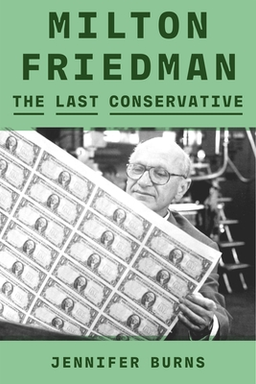
Milton Friedman cover

Milton Friedman

by Jennifer Burns

Jennifer Burns''s biography of Milton Friedman offers an in-depth look at the economist whose radical ideas on free markets transformed modern economic thought. Discover Friedman''s journey from his early influences to his lasting legacy in shaping policies that still ignite debate today.

Building an Intellectual Revolution

How does one economist rewire both the field of economics and the grammar of global politics? Milton Friedman’s life and work form a case study in how ideas migrate—from classrooms to policy blueprints, and from equations to moral arguments about the state and individual freedom. His core claim is consistent throughout: by understanding incentives, prices, and money, you can diagnose almost any social problem. But to see how his system works, you must move from his formative training in Rahway and Chicago to his methodological battles, political controversies, and policy influence across decades.

Friedman’s enduring thesis rests on a deceptively simple rule: markets coordinate activity better than planners if prices are free to move and money is managed predictably. He distrusted discretion—whether by central bankers, bureaucrats, or politicians—and favored clear, rule-based institutions that preserve freedom from arbitrary power. From his early exposure to immigration vulnerability and small-town enterprise, he built a lifelong suspicion of coercion and an admiration for individual agency.

From Rahway to Room Seven: Shaping the Toolkit

Friedman’s intellectual journey began at Rutgers and matured at the University of Chicago’s Room Seven, where he absorbed price theory—the idea that human behavior can be read through incentives and trade-offs. Guided by mentors like Arthur Burns, Frank Knight, and Henry Simons, Friedman learned to combine empirical rigor with philosophical skepticism. Knight’s moral earnestness, Simons’s institutional boldness, and Burns’s data discipline shaped his hybrid method: theory tested against evidence, guided by moral intuition about freedom. In the 1930s, when Keynesian macroeconomics dominated, this mix of theory and empiricism positioned Friedman as an insurgent who would later rebuild economics on monetary and micro foundations.

Monetary Rules and the Empirical Turn

Early Chicago debates about the quantity theory of money convinced Friedman that money drives macroeconomic outcomes. In wartime Washington he honed statistical skills, turning punch-card data from the Treasury and the Study of Consumer Purchases into insights about spending behavior. Those experiences produced his later permanent-income hypothesis and prepared him for the massive historical project with Anna Schwartz, *A Monetary History of the United States*. By blending archival work and theory, Friedman demonstrated that the Great Depression stemmed not from inherent capitalist instability but from central-bank mismanagement.

That argument reoriented postwar economic thought. It gave monetarism empirical muscle, showing that changes in the money stock predicted price and output movements across history. Equally important, it turned monetary policy into a rule-governed science: predict inflation by managing money supply growth, not by chasing unemployment or political demands. (Note: Friedman’s project deliberately countered Keynesian fiscal activism that had dominated policy in the 1940s and 1950s.)

Methodology and Conflict: Theory Versus Econometrics

Postwar debates with the Cowles Commission revealed Friedman’s contrarian streak. He rejected elaborate structural models that “fit” historical data but failed to predict new events. His famous essay, *The Methodology of Positive Economics* (1953), argued that predictive accuracy—not realism of assumptions—determines a theory’s value. Chicago became a rival temple to Cowles’s Yale fortress, turning economics toward testable, simplified models. This predictive ethos later influenced rational-expectations theorists like Lucas and Sargent, who extended Friedman’s insistence on empirical validation into formal expectations theory.

From Workshops to the World: Policy Influence

By the 1950s and 1960s, Chicago’s “money and banking workshop” institutionalized the Friedman-Schwartz method: history as a testing ground for theory. Their *Monetary History* reframed the Fed’s failures; *Studies in the Quantity Theory of Money* provided cross-national evidence. These works brought technical economics into public debate, giving Friedman authority to challenge Keynesian orthodoxy. In his 1967 AEA address, he introduced the “natural rate of unemployment,” undermining the idea of a stable Phillips curve trade-off. Policy-makers could not permanently buy lower unemployment by accepting higher inflation. Expectations would adapt, producing accelerating inflation—a conclusion vindicated in the 1970s stagflation.

Ideas in Politics and Society

Friedman’s academic confidence spilled into politics through *Capitalism and Freedom* (1962) and later *Free to Choose*. Co-authored and edited by Rose Friedman, these books translated price theory into policy: fixed growth rates for money, school vouchers, and negative income tax to replace welfare bureaucracies. They gave intellectual coherence to free-market conservatism, influencing Goldwater, Thatcher, and Reagan. Yet they also exposed tensions—his voucher proposal, meant to democratize education, intersected with Southern resistance to school desegregation, showing how ideas can be repurposed beyond their author’s control.

Global Reach and Moral Controversy

Friedman’s ideas traveled worldwide. His advocacy for floating exchange rates anticipated the collapse of Bretton Woods in 1971; his advice inspired Chicago-trained “Chicago Boys” in Chile, where free-market reforms under the Pinochet regime sparked lasting ethical debate. Friedman saw economic liberalization as a path to political freedom; critics charged complicity with dictatorship. The Chilean case embodies his intellectual paradox: ideas crafted to limit coercion could legitimize authoritarian reform when transferred into different contexts.

Monetarism’s Triumph and Transformation

The 1970s inflation validated his warnings about discretionary policy. Yet the Volcker experiment to control monetary aggregates in the early 1980s exposed practical limits: financial innovation blurred definitions of money, and targeting M1 proved unstable. Even so, the moral of Friedman’s project endured. Central banks worldwide adopted inflation targeting, transparent communication, and independence—principles drawn from his insistence on predictable rules. In crises from 2008 to 2020, officials invoked Friedman and Schwartz to justify aggressive liquidity support, blending rule-based respect for long-run stability with flexible commitment in emergencies.

Legacy and Lessons

Milton Friedman’s story is less about a single doctrine than a durable method: integrate theory and data, distrust discretion, measure what matters, and design institutions to preserve freedom. His influence extends from the negative income tax to the Earned Income Tax Credit, from Chicago’s workshops to IMF blueprints, from inflation targeting to educational choice. But his career also warns you about the political life of ideas. Every economic framework becomes a political instrument once it leaves the seminar. The Friedmanian revolution gave markets moral prestige—and forced every generation since to debate how freedom, fairness, and evidence should coexist within modern capitalism.


Price Theory and Chicago Foundations

At the core of Chicago economics is the principle that prices communicate information and coordinate behavior. Friedman learned this during his formative years in Room Seven at the University of Chicago, surrounded by intellectual titans like Frank Knight, Henry Simons, Jacob Viner, and Aaron Director. Together they redefined price theory as a practical, all-purpose investigative tool—a way to parse choices in any domain, from market competition to law and politics.

A Practical Science of Conduct

Chicago’s distinctiveness lay in its refusal to treat economics as purely mathematical abstraction. Knight called economics “the science of conduct,” implying that price and incentive logic could analyze nearly all social behavior. Friedman internalized this creed. Instead of grand moral appeals or statistical description, he looked for how individuals respond to marginal costs and benefits. This approach shaped his later views on taxation, regulation, and public choice by emphasizing how rules alter signals and thus alter conduct.

Simons’s Rules and Friedman’s Adaptation

Henry Simons provided the bridge between moral reasoning and institutional design. His pamphlet *A Positive Program for Laissez Faire* (1934) argued that to sustain competition you must sometimes reform institutions—break monopolies, enforce fiscal discipline, and regulate banks. Friedman evolved this paradoxical stance: favor markets but discipline their plumbing. He later applied this logic to monetary policy through rules for stable money growth, proving that consistency, not laissez-faire drift, preserves markets’ legitimacy.

Room Seven: Culture of Critique

The informal but combative community in Room Seven forged habits that defined Chicago’s intellectual culture. Students challenged professors directly, evidence was demanded, and economics was treated as a living argument. Friedman’s sharp debating style, honed there, became legendary. From this environment emerged the analytical frame that he would export into law, policy, and global reform: a belief that clear incentives and disciplined prices outperform bureaucratic design. For you, Chicago price theory remains less a doctrine than a durable habit of analysis—one grounded in skepticism, empirical testing, and respect for human agency.


Money, Data, and the Empirical Turn

Friedman’s genius was technical as well as theoretical. During his years in Washington, at the National Resources Committee and Treasury, he learned that large datasets could serve as laboratories for theory. His projects—such as the Study of Consumer Purchases and his innovations in rank correlation—show how empirical puzzles can reshape theory itself. Rather than treating statistics as confirmation, Friedman used data to question orthodoxy.

From Consumer Data to Consumption Theory

Working with Dorothy Brady, Rose Friedman, and Margaret Reid, he moved from consumption surveys to a lifetime theory of spending. Standard Keynesian models assumed that consumption tracks current income. Friedman’s work argued the opposite: people base spending on expected long-run (“permanent”) income. The result—the Permanent Income Hypothesis—explained why fiscal windfalls often failed to stimulate demand. It also transformed welfare debates by shifting attention from temporary to structural policy effects.

Data Meets Moral Vision

In Treasury service, Friedman also developed the practical mechanics of modern taxation. He helped implement income withholding during World War II and designed policies linking tax withdrawal to anti-inflationary goals. This experience taught him how fiscal instruments manipulate the money supply. The merger of empirical method and moral suspicion of power made him rare: both technician and philosopher. (Note: This duality anticipates later economists who bridge econometrics and political economy.)

Permanent Collaborators, Hidden Credits

Women like Anna Schwartz, Dorothy Brady, and Rose Friedman were central yet under-credited. Schwartz assembled monetary data series and forced methodological rigor that made *A Monetary History* possible. Brady and Rose Friedman’s empirical savings research directly seeded the permanent-income model. Recognizing these collaborations reveals that Friedman’s empirical turn was also collective—sustained by statistical craftsmanship that embodied his maxim: theory, facts, and history illuminate one another.


Rethinking Money and the Great Depression

The collaboration with Anna Schwartz produced the intellectual masterpiece that cemented Friedman’s influence: *A Monetary History of the United States* (1963). The book argued that changes in the money supply—not structural flaws in capitalism—caused major economic cycles. Its narrative of the Great Depression reversed decades of Keynesian interpretation and gave monetarism historical legitimacy.

The Great Contraction as Policy Failure

Friedman and Schwartz meticulously traced a 33 percent collapse in the money supply from 1929 to 1933. They demonstrated that the Federal Reserve’s inaction—particularly after the death of New York Fed leader Benjamin Strong—turned an ordinary downturn into a catastrophe. Their moral: bureaucratic hesitation, not market chaos, crushed output and employment. This finding empowered later policymakers such as Ben Bernanke, who cited it during the 2008 crisis to justify aggressive monetary intervention.

Methodological Influence

The work’s methodological impact was equally profound. Rather than abstract equations, it offered narrative history with quantitative rigor. The style encouraged economists to rediscover institutional storytelling—how leadership, culture, and decisions affect macro outcomes. By combining careful data reconstruction with theoretical clarity, Friedman and Schwartz helped revive monetary history as a core research area and gave macroeconomics a tangible evidentiary base.

From Rule of Thumb to Rules of Policy

Friedman’s broader conclusion was institutional: to prevent future crises, central banks should commit to simple, rule-like behavior (for instance, a fixed money growth rate). He saw discretion as the breeding ground of instability. Later, though strict money targeting proved impractical, the rule-based ethos survived in inflation targeting, central-bank independence, and the transparency norms now standard worldwide. The *Monetary History* thus remains both an intellectual landmark and a policy manual for stabilizing modern capitalism.


Monetarism’s Rise and Fall

The 1960s through the 1980s marked monetarism’s ascent—and its limits. Friedman’s debates with Keynesians culminated in the famous Friedman–Phelps “natural rate” hypothesis, which shattered belief in a permanent inflation–unemployment trade-off. Yet as central banks attempted to operationalize monetarist prescriptions under Volcker, institutional reality constrained theory.

Winning the Phillips Curve Fight

In his 1967 AEA address, Friedman predicted that attempts to exploit the Phillips Curve would fail once expectations adapted. His claim proved prophetic when 1970s stagflation erupted. The result was a shift away from fiscal fine-tuning toward monetary restraint. Policymakers accepted that stable inflation expectations underpin employment, not vice versa. This intellectual revolution made money and expectations central to macro policy design.

The Volcker Shock

Under Fed Chair Paul Volcker, the U.S. tried to defeat inflation by targeting monetary aggregates. Initially, inflation fell but unemployment soared, and innovations like deregulated deposits undermined aggregate control. By 1982 Volcker shifted back to interest-rate guidance. The experiment exposed monetarism’s practical fragility: measuring and controlling “money” proved technically complex in modern finance. Nonetheless, the moral of disciplined, credible policy endured, anchoring later inflation-target regimes.

Transformation, Not Abandonment

After the 1980s, monetarism morphed into a broader framework emphasizing rules, credibility, and transparency. Rational expectations and the Taylor rule carried its DNA. Friedman’s insistence on predictable, nonpolitical central banking became orthodoxy, even as strict money supply targeting faded. In essence, monetarism lost its instrument but won the institution.


Markets, Politics, and Moral Paradox

Friedman’s move from academic economics to political advocacy reshaped public discourse. *Capitalism and Freedom* (1962), edited heavily by Rose Friedman, distilled his philosophy: political freedom depends on economic freedom. Markets, he argued, decentralize power, disperse knowledge, and foster innovation—whereas government intervention easily slips into coercion. Yet the political afterlife of his ideas proved unpredictable.

Ideas into Movements

The book energized postwar conservatism and the neoliberal turn. It furnished ideological ammunition for Goldwater, Thatcher, and Reagan. Friedman argued for school vouchers, a negative income tax, and a fixed monetary rule—practical reforms aligned with market choice and personal responsibility. The clearer his logic, the more politicians adapted it to divergent aims: from welfare reform to privatization.

Contested Implementation

His ideas on school vouchers and welfare highlight his moral paradox. Designed to increase opportunity, vouchers were sometimes used to preserve segregation; the negative income tax inspired bipartisan reforms like the Earned Income Tax Credit but also debates about redistribution limits. Friedman prized simplicity and incentive compatibility, but ignored how politics could warp those designs. (Note: The book’s success also reflected Rose Friedman’s editorial and organizational genius, which lent it clarity rare in academic prose.)

Engagement and Backlash

Friedman’s engagement in public debates—through columns, television, and direct policy exchanges—broadened economics’ audience. But it also attached his name to controversial regimes like Chile’s Pinochet government. Supporters credited him with advising only on stabilization; critics saw moral blindness. The global export of his ideas (in the Washington Consensus and privatization programs) multiplied both growth stories and inequality critiques. You learn that once ideas enter politics, economists relinquish control—their concepts gain power but also problematic heirs.


From Global Markets to Modern Central Banks

By the late twentieth century, Friedman’s influence had recast both domestic and international monetary systems. His call for floating exchange rates in the 1960s anticipated the end of Bretton Woods, and his critique of discretionary central banking shaped new frameworks that dominate policy today. Although the strict quantity rule faded, its institutional offspring—transparency, accountability, and independence—flourished.

Bretton Woods and Floating Rates

Friedman viewed fixed parities as artificial. Currencies, he argued, should adjust just like prices in a market. His debate with figures like Robert Triffin and Paul Samuelson foreshadowed the 1971 “Nixon shock,” which suspended convertibility and opened the age of floating rates. The pragmatic “dirty float” that followed vindicated Friedman’s thesis: flexibility, though messy, prevents repeated crisis. This shift globalized his Chicago intuitions: liberalization through market pricing of currencies.

Institutional Legacies

Central banking’s modern toolkit—explicit inflation targets, rule-like behavior, and forward guidance—reflects his ethos. He taught policymakers to anchor expectations and communicate openly. Subsequent evolution, from the Taylor rule to inflation targeting, translated his principles into operational heuristics. Even when unconventional measures like quantitative easing (QE) emerged, Fed chairs such as Ben Bernanke explicitly cited Friedman and Schwartz as justification for preventing money collapse after 2008.

Continuing Relevance

The post-2008 and pandemic-era monetary experiments revealed the tension between theory and implementation. While QE expanded the Fed’s balance sheet far beyond Friedman’s imagination, his central point endured: controlling expectations and money supply growth ultimately determines inflation’s path. When inflation returned after 2020, monetarist reasoning resurfaced as a reminder that even modern instruments must obey the basic discipline that Friedman delineated—manage the price of money, or it will manage you.


Freedom, Reform, and the Moral Ledger

Friedman’s final legacy lies in the tension between his moral ideal—freedom—and the real-world consequences of market reform. His collaborations, policy designs, and controversies reveal a thinker determined to free individuals from coercion but repeatedly tested by the political systems that adopt his tools. You see his philosophy most vividly in his advocacy for charitable capitalism: negative income taxes, school choice, and open opportunity.

Markets as Moral Instruments

Friedman saw markets not merely as efficient mechanisms but as ethical devices that protect liberty by dispersing power. He accepted that outcomes may be unequal, yet valued the voluntary nature of trade over enforced equality. For him, government’s role should be to enforce rules, not deliver outcomes. This conviction became the backbone of the neoliberal era—admired for restoring discipline, criticized for widening divides. (Note: His stance resembles Hayek’s moral defense of liberty but is more operationally focused on policy levers.)

Enduring Debates

As his ideas spread globally, outcomes diverged. Britain’s privatizations boosted efficiency but fostered inequality; Chile’s reforms spurred growth but under dictatorship; U.S. deregulation invigorated finance but also sowed fragility. Each case reveals both the power and cost of his assumptions. Friedman argued that freedom and responsibility must come together; critics countered that structural inequalities distort choice itself. The question remains: can market freedom ensure fairness without political correction?

Lasting Reflection

“Ideas have political lives you do not control.” Friedman’s career embodies both triumph and warning. His revolution institutionalized evidence-based economics and rule-based policymaking but also demonstrated how economic doctrines, once unleashed, acquire unintended moral and political consequences.

When you reflect on Friedman’s arc—from Rahway’s immigrant small-town struggles to global economic transformation—you learn a final lesson: freedom demands not only faith in markets but humility about how ideas act in the world. His intellectual revolution endures because it invites every generation to remeasure the balance between efficiency and justice, rule and compassion, evidence and ethics.

Dig Deeper

Get personalized prompts to apply these lessons to your life and deepen your understanding.

Go Deeper

Get the Full Experience

Download Insight Books for AI-powered reflections, quizzes, and more.