
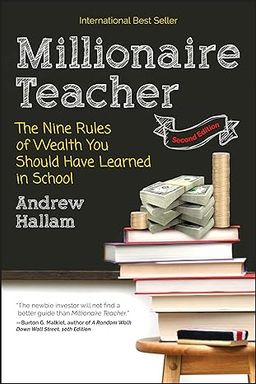
Millionaire Teacher cover

Millionaire Teacher

by Andrew Hallam

Millionaire Teacher reveals how ordinary earners can achieve extraordinary wealth through disciplined money management. Learn to cut expenses, invest wisely, and grow your savings effortlessly. With simple strategies and timeless advice, this book is your guide to financial freedom.

The Millionaire Teacher Philosophy: Wisdom for Ordinary Earners

What if you could become financially independent—even wealthy—while earning a humble middle-class salary? In Millionaire Teacher, educator and investor Andrew Hallam argues that true wealth isn't reserved for high salaries or financial insiders. Instead, it grows from financial literacy, disciplined spending, and the transformative power of compound interest. Hallam’s mission is to show that you don’t need Wall Street connections or complex investment strategies to build real financial freedom—you just need to think differently than the crowd.

Hallam—a high school English teacher who became a millionaire before 40—uses humor, stories, and relatable examples to prove that ordinary people can master money more effectively than highly paid professionals. His core argument: Wealth comes from habits, not income. Learning how to spend consciously, invest intelligently, and avoid emotional traps can turn almost any income level into a path toward prosperity.

Rethinking Wealth: Appearance vs. Reality

Most people confuse looking rich with being rich. Hallam shares an early lesson from tutoring a family in Singapore who lived in luxury—a Jaguar, Rolex watches, and a mansion—but regularly bounced checks for his tutoring fees. They earned big but lived in debt. This story underscores his first rule: “Spend like you want to grow rich, not like you want to look rich.”

He introduces the concept of the Hippocratic Rule of Wealth: just as doctors first commit to “do no harm,” aspiring investors should commit to avoid self-sabotage. Overspending harms your future as surely as overmedication harms your health. Real wealth comes from owning productive assets, not accumulating liabilities.

Financial Education We Missed in School

Hallam laments that schools teach algebraic formulas and pig dissections but not managing credit or investments. He sets out to fill that gap by teaching nine timeless financial rules as if they were part of a global ‘Money Curriculum.’ Each principle—from how to spend and save to how to invest—connects practical stories with proven research.

His book reads like a classroom conversation: approachable, vivid, and filled with examples that make complex theory simple. Whether it’s NBA players going broke despite multimillion-dollar paychecks or millionaires driving Toyotas instead of Ferraris, Hallam grounds every idea in reality. He teaches readers how to resist cultural pressure, differentiate between wants and needs, and understand what real wealth looks like—freedom from needing a paycheck, not ownership of luxury items.

The Core Argument: Anyone Can Beat Wall Street

The book challenges one of finance’s biggest myths: that professional brokers and advisors consistently outperform ordinary investors. Hallam provides overwhelming evidence—from Nobel Prize–winning economists to Wall Street studies—that most professionals underperform simple, low-cost index funds. You don’t need stock tips, newsletters, or hedge funds. You just need patience, low fees, and the discipline to keep investing when markets fall.

He calls this the “average fifth grader advantage”—a well-trained child could beat Wall Street professionals simply by using index funds and avoiding emotional mistakes. Quotes from Warren Buffett, Paul Samuelson, and William Sharpe support this principle. Even billionaires and Nobel laureates invest passively. The magic comes from compound interest working quietly in your favor, not from adrenaline-filled market timing.

A Teacher’s Approach to Money Mastery

Hallam structures the book like a practical syllabus of wealth-building. He starts with spending discipline, teaches the mathematics of compounding, then shows how to invest using diversified index funds. Each rule builds on the last: avoiding seduction by scams and emotional decisions, knowing how to rebalance intelligently, and resisting the persuasive rhetoric of financial advisers who profit more from selling products than guiding clients.

He weaves in personal stories—his frugal “cheapskate confession,” biking 70 miles daily to save on fuel; a self-taught millionaire mechanic who never lost money on cars; and how he paid off student loans while living on clams and potatoes. These illustrate that frugality isn’t deprivation—it’s freedom. His toughest years became lessons in control and peace of mind.

Why This Matters Today

Hallam’s message couldn’t be timelier. In an age of consumer debt, financial anxiety, and “get rich quick” schemes, Millionaire Teacher is a manifesto for balance and independence. It tells you that building wealth on an ordinary income isn’t about luck—it’s about understanding human psychology, the mathematics of compounding, and the importance of simplicity.

Ultimately, this book is about empowerment. It gives readers not only the technical tools to invest wisely but also the mindset to resist the cultural seductions of wealth illusion. Hallam teaches that financial literacy is moral literacy—the decision to take responsibility for your future. By the end, you’ll learn how to “spend like you want to grow rich,” invest like a scientist, and live like someone who truly understands value.


Spend Like You Want to Grow Rich

Hallam begins his financial journey with a startling observation: the people who look wealthy often aren’t. He tells of an American family in Singapore who drove a $250,000 Jaguar and wore Rolex watches but regularly bounced $150 checks for their child's tutoring. Their glamorous lifestyle masked financial fragility—a lesson Hallam calls his ‘Jaguar revelation.’

The Hippocratic Rule of Wealth

Hallam proposes a simple oath for money management: “Above all, do no harm.” Just as doctors commit to preserving health, you should commit to preserving financial well-being. Debt and overconsumption are self-inflicted wounds. The antidote? Spend far less than you earn and invest the difference intelligently. The cure lies in self-control, not complex financial products.

Defining True Wealth

Hallam distinguishes between two types of wealth: pretense and reality. Real wealth means having enough to quit work anytime and living from investments that generate income—ideally twice the median household income of your country. A person with a multimillion-dollar house and leased Ferrari but high debt isn’t rich; someone with a modest lifestyle and strong investments is free.

In one example, he contrasts an NBA player’s paycheck with a teacher’s savings discipline. Sixty percent of retired basketball players go broke within five years, despite salaries in the millions. Meanwhile, disciplined savers with ordinary earnings accumulate genuine wealth because they understand one simple truth: it’s not how much you make; it’s what you keep.

Perception and Satisfaction

Your perception drives your spending habits. Hallam explains how his father’s old Datsun—with a hole in the floor—taught him gratitude. Owning an outdated car made him appreciate having transportation rather than envying luxury vehicles. Satisfaction diminishes temptation. As Buddhists say, wanting leads to suffering; financial peace comes from appreciating what you have.

Frugality as Empowerment

Through stories of buying used cars and carefully managing housing decisions, Hallam reframes frugality as clever strategy, not sacrifice. He learned from Russ Perry, a bus mechanic who became a millionaire, that cars are liabilities, not assets. Perry’s rule: never buy new, purchase reliable used vehicles that retain value, and sell them for what you paid. This isn’t stinginess—it’s financial leverage.

The chapter ends with Hallam’s confession of extreme frugality—living on 30% of his salary, biking 70 miles daily, and eating clams for months to pay off debt. The lesson: debt is enslavement. Once he became debt-free, his investment accounts blossomed. This rule, simple yet powerful, forms the foundation of his nine-step system—if you master your desires, you master your finances.


Use the Greatest Investment Ally: Compound Interest

Hallam calls compound interest the most powerful force in finance—and one that schools fail to teach properly. He opens with humor, calling quadratic equations ‘as useful to most people as ingrown toenails,’ but celebrating that one mathematical idea actually changes lives: compounding.

Starting Early Is Magical

Using the example of Warren Buffett buying his first stock at age eleven, Hallam shows how starting young creates exponential results. Money invested early has more time to snowball; waiting even a decade can cost you hundreds of thousands of dollars. He dramatizes this with Noah’s Ark imagery—those who procrastinate, like Noah’s disbelieving friends, drown financially as the flood of time rises.

The Bohemian Millionaire Story

One of Hallam’s most charming teaching examples features a fictional child named Star. Her mother invests a small daily sum—about $1.45 from recycled bottles—from age five onward. By adulthood, Star’s total savings of $32,400 grow to over $1 million thanks to compounding. Meanwhile, her high-earning friend Lucy starts saving much later, invests eight times more, but ends up with less. Their story proves that time outranks income.

Gifting vs. Teaching

Parents often think giving children money helps them financially. Hallam cites research from Thomas Stanley’s The Millionaire Next Door showing that handouts reduce independence. Teaching earning and saving habits fosters empowerment. Wealth built from effort lasts; inheritance alone breeds negligence. The best ‘gift’ you can give anyone is financial responsibility.

Debt Before Investing

Before compounding can work for you, you must stop it from working against you. High-interest debt is negative compounding—credit-card interest grows like a malignant mirror of investment growth. Paying off cards yielding 18% interest is equivalent to earning a risk-free 18% return. Hallam stresses: never invest while in debt.

How Money Actually Grows

To demystify markets, Hallam tells the story of Willy Wonka’s chocolate factory, translating stock ownership into simple business logic. Investors own businesses, not lottery tickets. When companies earn profits, pay dividends, and reinvest, their owners grow richer. Understanding this transforms investing from gambling into partnership. Hallam concludes: if you start early, invest steadily, and keep faith in compounding, even a modest salary can build a fortune larger than most people’s dreams.


Small Percentages Pack Big Punches: Index Investing

In a world obsessed with market timing and stock tips, Hallam champions simplicity. He argues that low-cost index funds—which track the performance of entire markets—consistently outperform most actively managed mutual funds. This section blends humor, quotes from Nobel laureates, and brutal data to dismantle the myth of professional superiority.

Evidence vs. Emotion

Hallam cites experts like Warren Buffett (“The best way to own common stocks is through an index fund”) and economists such as Paul Samuelson and William Sharpe, who mathematically proved active management fails on average once fees are deducted. Index funds offer one clear advantage that compounding magnifies over decades: cost efficiency. High fees don’t seem harmful in percentages—1% or 2%—but over a lifetime, they drain hundreds of thousands from your retirement fund.

The Challenge to Professionals

Hallam frames a metaphorical contest: an average fifth grader using index funds could beat most professional fund managers. Why? Because index investing removes human bias and emotional error. Active managers trade excessively, chase trends, and incur taxes and hidden commissions. Studies show over 90% of active funds underperform their benchmarks after 15 years. Survivorship bias inflates this further—the worst funds simply disappear.

Fees and Hidden Costs

He breaks down the five silent killers of active mutual funds: expense ratios, marketing fees, trading costs, sales commissions, and taxes. Together, they turn professional management into a stealth drain on your wealth. Hallam humorously compares these hidden charges to “a swimmer towing a carpet through water.” Even a fund performing well before fees can lose ground after taxes and costs.

Behavioral Simplicity

Instead of choosing funds based on historical returns—Morningstar’s five-star ratings or glossy brochures—Hallam teaches that such backward-looking selection guarantees disappointment. Past winners revert to mediocrity because markets are random, not predictable. Burton Malkiel’s A Random Walk Down Wall Street mirrors his view: even professionals can’t foresee future outperformers.

The punchline? The surest way to succeed is to be average—mathematically average, not behaviorally average. Buy indexes, keep fees low, hold for decades, and avoid chasing headlines. Over time, this modest strategy produces extraordinary results—without insider access or Wall Street theatrics.


Conquer the Enemy in the Mirror: Psychology of Investing

If index funds are simple, why do so few investors use them effectively? Hallam exposes the real obstacle: emotion. Fear and greed sabotage sound decisions, leading many to buy high and sell low. He explains that average investors earn less than their own funds’ historical returns because they invest reactively—chasing excitement and fleeing discomfort.

The Investor Behavior Gap

Between 1980 and 2005, mutual funds averaged 10% returns, yet investors earned only 7.3%. This 2.7% loss per year—caused by emotional timing—cuts lifetime wealth almost in half. Hallam likens this self-destructive pattern to a psychological disorder cured only by discipline. Dollar-cost averaging (investing equal sums regularly regardless of market mood) neutralizes these impulses and turns volatility into opportunity.

Dogs on Leashes: How Markets Work

One of Hallam’s most memorable metaphors compares the stock market to a leashed dog running ahead of its owner. The dog (stock prices) races and stumbles, but always returns to the owner (business earnings). When markets become euphoric and prices soar beyond profits, reality eventually tugs them back. Understanding this leash metaphor helps you see crashes as corrections, not catastrophes.

Embracing Market Chaos

Hallam shows that every generation experiences a financial bubble—1929, the 1990s dot-com craze, or the housing frenzy of 2008. Each time, investors say, “This time it’s different.” It never is. He recounts his own folly buying Nortel Networks during tech mania, losing half his money despite knowing better. His lesson: resisting herd mentality requires humility.

Be Greedy When Others Are Fearful

Quoting Warren Buffett’s famous advice, Hallam urges readers to treat market crashes like supermarket sales: stocks on sale. After crises like 9/11 and the 2008 meltdown, he eagerly bought discounted index funds while others panicked. He illustrates how transferring money from bonds to stocks during downturns multiplies returns when markets recover. Fear is the enemy in the mirror; courage and patience are your allies.


Build Mountains of Money: Balanced Portfolios

Hallam’s fifth rule shifts from psychology to structure. If stock markets are emotional roller coasters, bonds are the seatbelts. Combining both creates stability—a principle institutional investors have long relied on. He calls bonds ‘the parachute that softens the crash’ and teaches how ordinary people can build responsible portfolios using simple allocations.

Understanding Bonds

A bond is essentially a loan. When you buy government or corporate bonds, you lend money and receive interest. Shorter-term government bonds are safest, while high-yield corporate bonds (dubbed ‘junk’) carry higher risk. Hallam explains that buying short-term bond indexes avoids inflation traps while providing reliable diversification.

The Age Rule

A simple rule of thumb: allocate a percentage to bonds equal to your age. If you’re 30, keep 30% bonds and 70% stocks; if you’re 60, reverse those proportions. Bonds reduce volatility, allowing you to rebalance easily during market declines. Hallam’s own portfolio shifted this way—selling bonds during downturns to buy cheap stocks, then selling stocks later to replenish bonds.

The Couch Potato Portfolio

Inspired by columnist Scott Burns, Hallam introduces the ‘Couch Potato’ method: split your money 50–50 between a total stock market index and a bond index, rebalance once a year, and ignore the noise. This lazy strategy beat over 80% of professional managers even during turbulent years. Simplicity becomes a superpower—it minimizes mistakes and maximizes patience.

Global Diversification

He suggests adding international indexes to capture global growth. A mix of domestic, international, and bond funds forms the world-class triad of investing: stability, exposure, and resilience. By combining discipline with simplicity, you can ‘build mountains of money’ quietly while others chase short-term thrills. It’s the financial equivalent of strength training—you grow steadily by sticking to the routine.


Peek Inside a Pilferer’s Playbook: The Advisor’s Trap

Hallam reveals a darker side of finance: how many financial advisers manipulate investors into buying costly products that erode long-term wealth. He calls this system ‘legalized pickpocketing,’ where charm replaces expertise. Understanding their tactics protects you from exploitation.

Sales Rhetoric vs. Reality

When clients question high fees or mention index funds, advisers often claim, “Indexes are dangerous when markets fall,” or “We can handpick better funds.” Hallam dismantles these myths using hard data: even in market crashes like 2008, actively managed funds lost more than indexes. Managers couldn’t time exits successfully, proving their claims hollow.

Conflicts of Interest

Most advisers earn commissions from selling specific mutual funds. Their livelihood depends on fees, not client success. Hallam recounts conversations with bank representatives who admitted they push expensive ‘funds of funds’ first, indexes last. Some agents complete only a two-week certification yet advise clients on life savings—a recipe for trouble.

Professional vs. Practical Wisdom

To illustrate the hierarchy of finance, Hallam compares advisers with top-tier pension fund managers. Even after fees and taxes, fewer than 30% of professional pension funds beat simple indexed portfolios. If billion-dollar institutions struggle to outperform, your local broker certainly won’t. His call: find fee-only planners—advisers paid for guidance, not commission sales.

Education as Defense

Hallam celebrates how companies like Google preempted financial predators by educating employees through lectures from William Sharpe, Burton Malkiel, and John Bogle—all champions of indexing. Knowledge, he insists, is your best shield. Once you understand how advisers profit, you’ll reclaim control over your financial future—and never pay hidden fees again.


Avoid Seduction: Scams, Illusions, and False Promises

Hallam dedicates one of his most cautionary chapters to financial seduction—the allure of easy money. He admits his own mistakes, describing how he lost thousands to a scam called Insta-Cash Loans promising 54% annual returns. His confession humanizes the lesson: greed can blind even seasoned investors.

The Anatomy of a Scam

Insta-Cash Loans operated like a Ponzi scheme, paying investors with new deposits rather than profits. Hallam’s friend convinced him after years of apparent success, but the company eventually collapsed—just like Bernie Madoff’s empire. The moral: if returns sound unreal, they are. The average market yields about 8–10%; anything promising multiples of that invites disaster.

Investment Newsletters and Junk Bonds

Hallam criticizes glossy newsletters boasting “300% returns” and corporate bonds offering unusually high yields. Research shows over 90% of investment newsletters fail within a decade. High-yield bonds are aptly nicknamed ‘junk’—they lure investors with interest but often go unpaid. Real investing isn’t about excitement; it’s about mathematical patience.

Gold, Hedge Funds, and Media Mirage

Hallam demolishes three popular illusions. First, gold’s allure: adjusting for inflation since 1801, $1 of gold now equals only $73, while $1 in U.S. stocks grew to over $10 million. Second, financial magazines profit more from advertiser fear than truth—they sell headlines, not wisdom. Third, hedge funds—marketed to the rich—have 75% mortality rates; survivorship bias falsely inflates their reported success.

Rejecting the “Best” for the “Good”

Quoting Voltaire—“The best is the enemy of good”—Hallam concludes the chapter by warning against chasing perfection. Investors who abandon sound strategies for seductive shortcuts rarely recover. The safest path to steady wealth isn’t sexy, but it works: stick with balanced index funds, avoid emotional temptations, and remember that consistency beats charisma.

Dig Deeper

Get personalized prompts to apply these lessons to your life and deepen your understanding.

Go Deeper

Get the Full Experience

Download Insight Books for AI-powered reflections, quizzes, and more.