
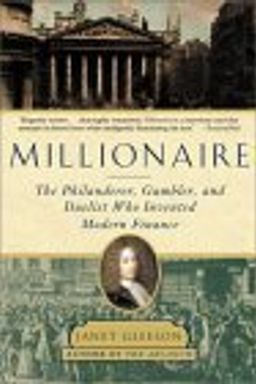
Millionaire cover

Millionaire

by Janet Gleeson

Millionaire by Janet Gleeson reveals the life of John Law, the audacious financier whose ventures in the 18th century pioneered the use of paper money. His story is a blend of ambition, innovation, and cautionary tales of financial speculation that have shaped the economic landscape we know today.

John Law and the Birth of Modern Finance

What if the modern economy—based on credit, paper money, and trust—was born not in a banker’s boardroom but at the gaming table of a charming, controversial Scotsman? In Millionaire: The Philanderer, Gambler, and Duelist Who Invented Modern Finance, historian Janet Gleeson invites you into the dazzling and cautionary story of John Law, a man who transformed the financial systems of Europe long before Wall Street existed. Law’s grand experiment with paper money in early 18th-century France triggered the world’s first stock-market boom and bust and gave birth to a new word: millionaire.

Gleeson argues that Law was both a visionary and a tragic hero. He grasped an idea centuries ahead of its time—that wealth could be created not from gold or silver dug from the earth but from confidence and credit. He believed that paper, underpinned by trust and circulation, could fuel an economy far more effectively than precious metals ever could. Yet his idealism collided with human greed, political intrigue, and the limits of rational control. The resulting saga, the rise and spectacular fall of the Mississippi Company, remains one of history’s most monumental financial dramas.

A Man Ahead of His Time

Born in Edinburgh in 1671, John Law grew up among goldsmith bankers and absorbed their understanding of money as both a medium of exchange and an expression of human trust. Trained in mathematics and probability, his genius emerged at the gambling tables of Europe. Law’s belief in the science of odds reflected a deeper conviction: chance could be tamed by calculation, and wealth could be multiplied through intelligent design. When his schemes brought him to Paris after years of exile—for killing a man in a duel—he found a nation crippled by war debts and starved of coin. France, he believed, needed not more gold but more belief—a system built on circulation, credit, and confidence. The 18th century was awakening to the power of ideas, and Law proposed a financial enlightenment to match.

Paper over Gold: Law’s Vision

Law’s central insight was revolutionary: money was not limited by metal but by imagination. He contended that a modern economy should be fluid, responsive, and capable of growth beyond the size of royal treasuries. His establishment of the Banque Générale in 1716 introduced a startling innovation—banknotes exchangeable for coin at fixed value. These notes, backed by trust rather than bullion, circulated rapidly and fueled trade. When the French Regent Philippe d’Orléans made Law’s bank royal, France experienced a surge in commerce that seemed miraculous. Shops flourished, fortunes multiplied, and Paris buzzed with optimism. For a moment, Law’s paper seemed like philosopher’s gold—an alchemy that had turned credit into prosperity.

The Mississippi Mirage

But the alchemy could not hold. Law’s second creation, the Mississippi Company, designed to unite France’s colonial ventures under one colossal enterprise, became the first financial bubble in history. Investors, lured by dreams of New World gold, poured into the narrow rue Quincampoix, bidding company shares up twentyfold. Out of this frenzy emerged a new class of French nouveaux riches—the world’s first “millionaires.” Yet the wealth was an illusion, sustained by speculation and the endless printing of paper money. When confidence faltered, the system collapsed in 1720 with breathtaking speed. Fortunes evaporated, mobs rioted, and Law fled Paris, hated as the greatest swindler who ever lived.

The Man and the Myth

In Gleeson’s account, Law’s life reads like a modern morality play. A mathematician and gambler, he treated money as a living organism, circulating through society like blood through a body. When circulation stopped, disease—stagnation—would follow. But just as his theory needed trust to survive, it was undone by fear and human weakness. His duel in London, the scandal of his love affair, his daring escape from prison, and his eventual fall from grace mirror his financial rise and fall—style, brilliance, and tragedy in equal measure.

Gleeson reminds readers that our own world, dominated by credit cards, electronic money, and speculative markets, still lives within Law’s idea of a financial system built on confidence. His story remains a timeless lesson: the health of any economy depends less on gold in the vaults than on trust in the air. Law’s dream of infinite prosperity became the world’s first financial nightmare—but from its wreckage, modern finance was born.


From Goldsmith’s Son to Gambler

Janet Gleeson roots John Law’s extraordinary rise in his Scottish upbringing among goldsmith bankers of Edinburgh. Law’s father, William, was a respected goldsmith and assayer whose dealings blurred the line between craftsmanship and credit. In an age when coins were scarce and trust was currency, goldsmiths stored others’ wealth and issued notes against it—the earliest form of modern banking. Growing up in this world, young Law learned that money was not merely metal but a promise backed by reputation.

Law’s early life, however, also reflected the contradictions that would define him: intellectual mastery married to reckless appetite. He mastered mathematics and fencing, both symbols of precision and control, yet reveled in gaming, fashion, and seduction. Edinburgh could not contain him, and by twenty-one he set out for London—a city teeming with trade, theater, and risk. There, amid the gambling dens and coffeehouses, Law honed a philosophy that probability and calculation could outwit chance itself.

The Birth of a Risk Theorist

Long before modern economists like Keynes or Kahneman, Law treated chance as a science. He studied games of dice and cards to uncover their underlying mathematics. Inspired by Pascal and Bernoulli, he believed uncertainty could be quantified and exploited. This “mathematical gambler” became a star of London’s high-stakes salons, admired for his charm and uncanny success. As Gleeson puts it, he was “a man who never cheated yet never lost,” a living embodiment of rational risk-taking.

At the same time, Law’s keen observation of England’s postwar economy—its chronic shortage of coin, the rise of merchant credit, and the founding of the Bank of England—provided fertile ground for his theories. He saw money as a social contract: its value derived from mutual belief, not intrinsic metal. To him, economic expansion required freeing money from its metallic chains.

The Fatal Duel

Yet ambition met tragedy in 1694. After a romantic rivalry with Edward “Beau” Wilson, Law fought a duel in Bloomsbury Square and killed his opponent. Condemned to death for murder, he escaped from Newgate Prison and fled England, beginning a long exile that would carry him across Europe’s gaming tables. The duel became his lifelong curse and metaphor: a single stroke of overconfidence that turned triumph into peril—a pattern repeated in his later financial ventures.

In exile, Law perfected both his charm and his theories. In Paris, Venice, and Amsterdam he dazzled aristocrats as a gambler who played with mathematical precision. But beneath the silk and wine, he refined a deeper ambition: to reform how nations conceived money itself. His exile became an education in global commerce—and the prologue to his improbable rise as France’s financial savior.


The Alchemy of Paper Money

When Law returned to Paris in 1716, France was financially exhausted. Years of Louis XIV’s wars had emptied the treasury, silver and gold were scarce, and trade had ground to a halt. To Law, this was not merely a fiscal crisis but a mechanical failure—commerce had lost its circulatory pulse. His remedy: replace metal with motion. In essence, he argued, money should be a living instrument that circulates credit and sustains national prosperity.

Creating the Banque Générale

Law proposed a private bank that would issue paper notes redeemable in coin. With the Regent Philippe d’Orléans’s blessing, the Banque Générale was born. Investors could buy shares partly with depreciated government bonds—a clever stroke that converted debt into capital. At first parisian merchants scoffed at the idea of “scraps of paper masquerading as gold.” But when the Regent publicly deposited a million livres in the bank, confidence soared.

The notes were beautifully engraved and carried Law’s promise to pay the bearer on demand. Crucially, they didn’t fluctuate with the frequent coin revaluations that plagued France. For the first time, ordinary Parisians experienced a stable, reliable currency. Markets revived, trade flourished, and optimism returned. As the Gazette de la Régence observed, “Money flows like the Seine.”

Public Confidence and Private Fear

But the system’s stability depended on confidence—something Law knew from cards was as fickle as fortune. Rivals in the finance ministry and the Parlement muttered that a Scots Protestant should not control France’s money. So he cultivated allies: the Regent’s confidant Saint-Simon, influential nobles, and wealthy foreigners. His charisma and logic subdued many skeptics, but whispers persisted that the miracle rested on illusion. Law himself warned, “Commerce thrives on credit, and credit thrives on confidence—but confidence is easily lost.”

By 1718 the Regent nationalized the bank, transforming it into the Banque Royale. Law, now effectively France’s banker, had achieved his dream—but at a perilous cost. What had begun as a controlled experiment in paper credit was now the machinery of the state. His alchemy had turned paper into gold—but as history would show, the transformation could be reversed just as easily.


The Mississippi Dream

Having mastered banking, Law next turned to trade. His audacious plan: merge France’s overseas companies into a giant monopoly called the Mississippi Company to exploit Louisiana’s rumored riches. By swapping company shares for government debt, he promised to cleanse France’s finances while opening a new world of prosperity. It was both a visionary consolidation and a speculative trap.

Boom on the Rue Quincampoix

Parisians went mad for shares. The narrow Rue Quincampoix became a frenzied open-air stock exchange. Nobles, clergymen, servants, and foreign speculators jostled shoulder to shoulder to buy Mississippi stock. Shares soared from 500 livres to 10,000 within months. “Millionaire” entered the French language to describe the new rich. The Duchess of Orléans lamented that “the god Mammon reigns in Paris.”

Law’s company absorbed more ventures—the East India trade, tobacco monopoly, even tax collection—until it became a global conglomerate backed by the Banque Royale’s endless issue of notes. For a season, France seemed reborn. Luxury markets boomed, and merchants complained of too much demand. Watteau’s paintings captured this gilded delirium: elegant couples floating through gardens of plenty.

The Anatomy of a Bubble

But speculation fed on itself. Investors borrowed paper money to buy more shares; the bank printed notes to sustain them. Credit ballooned, real profits lagged, and the system detached from reality. Some farsighted financiers, like Richard Cantillon, quietly sold out and left France with immense gains. Others doubled down, convinced the paper miracle would never end. Law’s own words—“money is only a belief”—became a prophecy of collapse.

By late 1719, the confidence that had built France’s fortune began to tremble. The Mississippi colony yielded no gold, only fever and hardship. When investors sought to convert notes back into coin, there was none left. The first modern financial bubble was about to burst.


Collapse and Chaos

In 1720, greed turned to panic. As Law devalued coinage and restricted withdrawals, mobs filled the Paris streets. Investors who once praised him now cursed his name. In a few months, shares that had minted millionaires became worthless paper. Riots erupted outside the Banque Royale; people crushed against its doors, some dying in the frenzy to redeem their notes.

The Price of Paper Faith

Law’s reforms were trapped in a paradox: he had freed money from metal, but the public still believed only in gold and silver. When coinage was outlawed and trust collapsed, the entire system imploded. The Regent, fearful for his throne, distanced himself from his former protégée. Paris was gripped by famine, fraud, and plague. Satirists mocked Law as an alchemist turned fool, and his enemies called for his hanging. Even as chaos spread, Law still believed the theory was sound—only ruined by “disorder and fear.”

This first boom and bust cycle anticipated every speculative mania to come—from the South Sea Bubble in London to the crashes of 1929 and 2008. The same human pattern replayed: innovation, speculation, euphoria, and collapse. As economist J.K. Galbraith later observed, “The world was first taught by Law the folly of believing prosperity can be printed.”

Exile and Reflection

Law fled Paris under guard, his house besieged by mobs. Once hailed as France’s financial messiah, he became Europe’s scapegoat. In exile he wandered from Brussels to Venice, still writing treatises on credit and appealing to rulers to try his ideas. “Had I gone more slowly,” he confessed, “I would have made no mistakes.” Yet he refused to admit defeat: the system had failed, he insisted, not because it was wrong but because men lacked faith.

By the time he died in 1729, penniless in Venice, Law was a ghost of his former glory. But his intellectual legacy—the concept of circulating credit and national banks—had reshaped finance forever.


A Legacy of Paper and Trust

John Law’s story did not end with his flight. In fact, his ideas quietly survived him. Eighty years later, revolutionary France introduced assignats—land-backed paper notes inspired by Law’s theories. The modern central bank, the rise of corporate equities, and even the global credit system trace their roots to his vision of money as an instrument of national energy rather than static treasure.

From Scandal to System

For decades, Law was reviled as a charlatan. Enlightenment thinkers like Adam Smith condemned his “extravagant project of banking and stock-jobbing,” while later writers such as Charles Mackay and Karl Marx turned him into a symbol of capitalist folly. Yet twentieth-century economists, from J.K. Galbraith to Antoin Murphy, have reappraised him as a prophetic innovator who first grasped the dynamics of credit expansion and confidence cycles. In essence, Law invented the psychology of modern finance: the recognition that markets run on belief.

Gleeson reminds us that every credit card swipe, every digital transaction, still relies on Law’s revelation that value is collective faith, not metal. The very dangers he exposed—overconfidence, greed, and panic—are as real today as in 1720. The bubbles of dot-com stocks or subprime mortgages echo the same rhythms of euphoria and collapse that swirled around the Rue Quincampoix.

The Human Element

Ultimately, Law’s tragedy lies not in mathematics but in human nature. He could calculate risk but not desire; model credit but not trust. His utopia of circulation assumed rational actors, yet greed and fear drowned reason. Gleeson closes by suggesting that in every modern financial crisis—from the Asian meltdown to Wall Street’s implosions—Law’s spirit flickers. The alchemy of paper endures, and with it, the old temptation to believe that prosperity can defy gravity.

Law’s life, as Gleeson tells it, is both cautionary tale and origin myth: the gambler who bet everything on belief, lost it all, and still changed the world. In his failure, he proved an enduring truth—that money, at its heart, is nothing more or less than a story we agree to believe.

Dig Deeper

Get personalized prompts to apply these lessons to your life and deepen your understanding.

Go Deeper

Get the Full Experience

Download Insight Books for AI-powered reflections, quizzes, and more.