
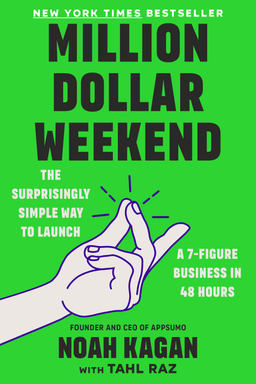
Million Dollar Weekend cover

Million Dollar Weekend

by Noah Kagan

Million Dollar Weekend reveals how to convert entrepreneurial dreams into thriving businesses. With insights on overcoming fear, leveraging rejection, and embracing strategic experimentation, Noah Kagan guides readers to achieve exponential growth and lasting impact in the business world.

Turning a Weekend into a Million-Dollar Mindset

Have you ever wondered what’s actually stopping you from starting that dream business idea you keep thinking about? In Million Dollar Weekend: The Surprisingly Simple Way to Launch a 7-Figure Business in 48 Hours, Noah Kagan argues that the real barrier isn’t money, time, or talent—it’s fear. Specifically, the fear of starting and the fear of asking. Kagan, best known as the founder of AppSumo and an early Facebook and Mint.com employee, insists that ordinary people can build extraordinary wealth quickly if they overcome these twin fears and start experimenting.

He calls his approach the Million Dollar Weekend (MDW) Process, a three-phase system that teaches you to find a problem people will pay to solve, validate the solution by collecting real sales, and then scale it with smart growth habits. Rather than bogging readers down with theory or corporate jargon, Kagan focuses on small, fast wins—teaching you to make your first dollar in days, not your first million in decades.

Why this matters now

In a world obsessed with planning, preparing, and perfecting, Kagan’s core message is radical: action beats analysis. He contrasts wantrepreneurs—people with endless ideas and zero progress—with experimenters who test early and often. Drawing from his own failures (like getting fired from Facebook and losing potential billions in stock options), he demonstrates how failure can free you from fear and turn into your greatest teacher.

Kagan shows that every successful company—from Apple to Airbnb—began as a small weekend experiment. His idea is that you don’t need venture capital, coding skills, or corporate backing; you just need a willingness to test ideas quickly, accept rejection, and learn what people will actually pay for. That mindset shift—from overthinking to experimenting—is the book’s central promise.

The MDW process at a glance

The Million Dollar Weekend is structured into three core stages:

  • Start It: Build your courage through practical challenges that help you face rejection and act immediately. This section includes Kagan’s popular exercises like the Dollar Challenge and Coffee Challenge to strengthen your “Ask muscle.”
  • Build It: Use the MDW method to brainstorm, test, and validate business ideas with zero upfront investment. You’ll learn to identify real problems, model business viability in a single minute, and secure paying customers before building the full product.
  • Grow It: Once validated, Kagan introduces modern marketing tools—like YouTube, newsletters, and email automation—to help you turn your tiny side hustle into an automated machine that earns while you sleep.

Through relatable stories of everyday people—like a teacher who earned $20,000 annually baking cookies and a postal worker who built a $4,000-per-month climbing business—Kagan transforms entrepreneurship from an intimidating dream into an exciting, learnable game.

Core themes you'll learn

Creator’s Courage: Everyone is born with creative bravery, but fear of failure stifles it. Rediscovering that playful, fearless experimenting from childhood is key to progress.

The NOW, Not How mindset: Acting immediately, even imperfectly, builds momentum and confidence faster than endless planning (similar to James Clear’s concepts in Atomic Habits about action-based identity building).

Customer-First Validation: Stop building before confirming the market’s need. By getting three paying customers within 48 hours, you prove viability—what Kagan calls the test to “go from zero to one dollar.”

Experimentation as Learning: Treat your business ideas as experiments, not make-or-break endeavors. When an idea fails, you’ve still gained data and skills to apply to the next one.

By the end, Kagan reframes business building not as a path to billionaire wealth but to personal freedom. His goal is to help readers determine their Freedom Number—the monthly income it takes to live independently on their terms (for him, it was $3,000 per month). That number replaces abstract dreams of riches with a tangible goal within reach.

“Successful people just start.”

This mantra, Kagan’s rallying cry, encapsulates his belief that entrepreneurial success—and even happiness—comes from the courage to take your first small step.

In short, Million Dollar Weekend is part business toolkit, part motivational manifesto. It’s a reminder that almost everything can change for you in a single weekend if you commit to starting, asking, and experimenting. Whether your dream is $500 a month or $1 million a year, the process and the mindset that Kagan teaches can turn fear into fun and turn ideas into money.


Start Before You Feel Ready

Kagan begins with a universal truth: no one ever feels ready to start. In his first chapter, provocatively titled “Just Fu**ing Start,” he recounts how being fired from Facebook became the accidental spark that turned him into a serial entrepreneur. That setback could have defined him—but instead, it liberated him from the fear of failure and led him to experiment relentlessly until he found success with ventures like AppSumo and Sumo.com.

Now, Not How: The antidote to overthinking

When faced with a goal, most people immediately think “How?” How will I find customers? How will I make it perfect? That’s a trap. Kagan urges us to shift to Now, Not How—do the first small thing immediately. Text one friend. Post one offer. Ask one question. The speed of action, not the depth of planning, is what separates doers from dreamers.

He demonstrates this through micro challenges: sending a message right now to ask friends for a business idea, or requesting a $1 “investment” from someone to spark your commitment. Both are symbolic—but their power lies in moving you from intention to execution in minutes.

Freedom Number: Redefining success

Unlike traditional startup goals that fixate on millions, Kagan grounds entrepreneurship in what he calls your Freedom Number—the monthly income needed to cover your ideal lifestyle. For him, that was $3,000. For you, it might be $800 or $8,000. Once you hit it, you’ve bought your independence, the true currency of freedom.

This reframing reduces anxiety and creates clear focus. You’re not chasing a fantasy of a billion-dollar exit—you’re targeting the simple number that buys back your time. As he puts it, “Your Freedom Number is the story of why and how you succeed, distilled into one clarifying goal.”

Failure becomes a training ground

Kagan’s own path underscores the value of starting messy and learning fast. After Facebook and Microsoft both rejected him, he ran a string of small, quirky businesses—a personal CRM, a student discount card, a series of startup events—each of which taught him a key lesson. That experimentation mindset is what eventually birthed the MDW process.

“Experiments are supposed to fail.”

By treating every idea as an experiment, you detach your identity from the outcome and keep learning. This mirrors Eric Ries’s Lean Startup philosophy, but Kagan simplifies it for solopreneurs—test tiny, learn fast.

Ultimately, starting before you feel ready is both a mindset and a skill. Every time you choose NOW over HOW, you’re wiring your brain for courage. Starting small—sending that first text, making that first ask, setting your first modest financial goal—creates the unstoppable momentum your future success will ride on.


Embrace Rejection as Your Superpower

In Chapter 2, Kagan shares his father’s favorite sales advice: “Love rejections! Collect them like treasure!” This principle shaped his life because it transformed rejection from punishment into progress. The fear of rejection—or what he calls Ask Avoidance—is the number-one factor keeping would-be entrepreneurs broke and timid. Building your “Ask muscle” through repeated exposure therapy is the only way to win.

The Rejection Goal principle

Instead of aiming for yeses, Kagan suggests setting weekly rejection targets—say, 25 no’s. The paradox is that by seeking rejection, you neutralize its power. The more often you ask, the more “yeses” will inevitably sneak in. It’s behavioral psychology in action, similar to exposure therapy for fear (paralleling Jia Jiang’s famous 100 Days of Rejection challenge).

The Coffee Challenge experiment

Kagan’s signature exercise, the Coffee Challenge, asks you to request 10% off your next coffee—without justification. It’s awkward, embarrassing, and transformative. Most people crumble from discomfort, but those who push through report an almost euphoric feeling of self-liberation. It’s not about saving money; it’s about proving you can survive the word “no.”

For Kagan, this playful approach mirrors how true entrepreneurs build resilience. Every successful deal, partnership, or customer began with an uncomfortable ask—be it pitching investors, requesting feedback, or selling your product directly to someone’s face.

Persistence, Follow-ups, and Framing

Kagan turns selling into helping: “If you believe your product improves people’s lives, it’s your moral obligation to sell it.” This reframes sales from manipulation to service. He also emphasizes persistence—most yeses come after multiple follow-ups, citing data that follow-up requests are twice as likely to succeed. This echoes insights from Dale Carnegie’s How to Win Friends and Influence People, updated for the digital age.

When you embrace rejection as a game, you remove its sting and make fear your ally. By developing your Ask muscle—through daily, deliberate asks—you create opportunities that would never appear otherwise. Whether negotiating, selling, or collaborating, your “Ask energy” becomes a growth engine in business and life.


Find Problems, Not Just Ideas

Most aspiring entrepreneurs obsess over finding the perfect idea. Kagan flips this thinking: ideas are cheap; solutions are valuable. In Chapter 3, he introduces the Customer First Approach—a simple but revolutionary method to uncover real business opportunities by focusing on people’s pain points rather than your own imagination.

Start with the customer’s experience

Drawing inspiration from Jeff Bezos and Steve Jobs, Kagan insists that all innovation begins with empathy. Instead of asking, “What should I create?”, ask, “Who am I helping, and what’s making their lives harder?” This reframing leads to insights grounded in reality, not wishful thinking.

His own success with AppSumo began because he personally felt frustrated by the lack of affordable software deals. When he realized thousands of entrepreneurs shared that problem, he built AppSumo as “Groupon for Geeks” in a single weekend—spending $50 and four hours coding a PayPal button. That quick experiment led to $65 million in annual revenue years later.

Simple problem-finding tools

  • Solve your own frustrations: Your daily annoyances—whether finding a reliable cleaner or better breakfast—are hidden markets.
  • Study existing marketplaces: Scroll Craigslist or Etsy to see what people are already begging to pay for.
  • Search queries and Reddit posts: What are people repeatedly Googling or requesting on forums? Those questions point to unmet demand.
  • Zone of Influence: Start with people and groups you already understand and have access to. Your immediate circle is your best test market.

Kagan also includes “idea generators,” such as looking at Amazon’s top sellers (and imagining upgrades or accessories) or translating success from one niche to another. This systematic creativity turns problem-spotting into a repeatable science.

“Customers don’t want your idea—they want their problem solved.”

Kagan’s insight places customer empathy at the heart of business validation, echoing principles from Clayton Christensen’s Jobs to Be Done framework.

By hunting for problems in communities you belong to, you’ll stop chasing “unicorn ideas” and start building real solutions. That mindset shift—from inventor to problem-solver—is often the difference between another failed side hustle and your first million-dollar win.


Validate Fast with the One-Minute Model

Once you’ve spotted a strong problem worth solving, Kagan teaches you to stress-test it quickly with the One-Minute Business Model. Instead of lengthy plans or investor decks, it’s about crunching five key numbers to see if your business idea could realistically hit $1 million in sales.

The Million-Dollar Filter

To simplify market research, Kagan advises checking only two factors: (1) Is the market growing? and (2) Are there enough customers who will pay for the solution? By using free tools like Google Trends and Facebook Ads audience data, you can estimate demand within minutes.

He demonstrates the process with examples like beard oil. Millions search for beard products monthly, prices are around $50, and even if you sold to a fraction of them, you’d surpass seven figures. The model rejects perfectionism in favor of quick, data-informed clarity: chase opportunities where there’s already a “wave” of attention and spending.

Revenue Dials—your variables for success

The One-Minute Model reduces business viability to a simple equation: Revenue – Cost = Profit. Then, tweak what Kagan calls your six Revenue Dials: average order value, frequency, price, customer type, product line, and add-on services. Each dial adjusts potential profit, allowing rapid pivoting without overhauling your idea.

His “Sumo Jerky” challenge shows this brilliantly. When his original one-off jerky sales couldn’t hit $1,000 profit in 24 hours, he pivoted to selling subscriptions to offices—instantly turning it into a repeatable, scalable model. That shift took him from 200 required sales to just 33. Small tweak, massive impact.

Fail Fast, Pivot Fast

The core takeaway: treat your model like a dashboard. If one metric looks impossible, adjust another. A gourmet cookie baker might not reach volume through retail, but could pivot to gift boxes or corporate orders. Testing assumptions quickly prevents you from wasting time on doomed ideas.

“If your first model fails, congratulations—you’ve saved yourself six months and $10,000.”

The One-Minute Business Model isn’t just a shortcut—it’s a discipline in ruthless simplicity. Instead of trying to predict the future, you let quick math, not emotion, tell you if an idea is worth pursuing. It’s lean, logical, and proven to separate hobby projects from million-dollar possibilities in minutes.


The 48-Hour Money Challenge

The centerpiece of Kagan’s system is the 48-Hour Money Challenge—the process of validating your idea by collecting three real payments within two days. It’s the ultimate reality check for entrepreneurs who want to know whether their ideas have true market demand.

The Golden Rule of Validation

Kagan’s rule is simple: “Find three paying customers in forty-eight hours.” These must be real transactions, not empty promises or surveys. The goal isn’t building a business—it’s confirming whether strangers (not just your mom) will hand over money for your idea.

He accomplished this with his Sumo Jerky experiment, preselling $4,040 of jerky subscriptions in a day, despite having no inventory. Once he had the cash, sourcing product was easy—a reversal of how most people waste months building before selling.

Three Fast Validation Methods

  • Direct preselling: Message or call your Dream Ten potential customers, describe the product, and ask for money now. This captures both interest and willingness to buy.
  • Marketplaces: Test demand by posting mock offers on Craigslist, Facebook Marketplace, or Reddit. You’ll see instantly if buyers exist before investing anything.
  • Landing pages: Build a quick sign-up or PayPal link page (using tools like SendFox or Unbounce) and drive small ad traffic to see if anyone converts.

Kagan’s advice echoes Tim Ferriss’s 4-Hour Workweek: sell the offer before you build it. Each “no” gives feedback; each small “yes” gives proof. Unlike vanity metrics (likes or followers), money is binary—people either pay or they don’t, and that clarity is everything.

Celebrate rejection, refine offers

Even if your validation test fails, the experiment succeeds if you learn why. Kagan provides a follow-up script to turn rejections into insights (“Why not?”, “What would make it a no-brainer for you?”). This iterative feedback makes every “no” part of your product redesign process.

Validation, not theory, separates dreamers from earners. Achieving three quick sales proves your idea works and builds confidence to grow. Even if you fail, you’ve failed cheaply, quickly, and learned what to test next weekend.


Build an Audience that Buys

In Part 3, Kagan explains how to scale your validated business through authentic audience building. His core belief: Social Media is for Growth; Email is for Profit. It’s a symbiotic duo that converts fans into lifetime customers.

100 True Fans Beat 10,000 Followers

Drawing on Kevin Kelly’s “1,000 True Fans” idea, Kagan shows that even 100 genuine supporters can sustain your business. Quality trumps quantity: these are people who buy your offers, reply to your newsletters, and spread your content. For him, his online community helped raise $30,000 for charity in days—proof that deep relationships outperform viral fame.

Find your unique angle and platform

Before posting anything, define what makes you different. Kagan calls this your special sauce. Ask yourself: “Who am I? Why should people trust me? What am I passionate about? What do I offer others?” Whether you’re a writer, coach, or designer, your authenticity is your algorithm.

Then, choose the platform that best fits your strengths. Photographers thrive on Instagram, consultants on LinkedIn, and educators or storytellers on YouTube—Kagan’s personal favorite for its longevity and monetization potential. Start with one platform; consistency beats complexity.

Be a guide, not a guru

People don’t want lectures—they want companions. Instead of positioning yourself as a flawless expert, share your journey in real time. Post about what you’re learning, failing, and testing. Like Ali Abdaal documenting his med school productivity hacks, your transparency attracts trust and human connection.

When you consistently help a small circle of fans solve problems, you create an ecosystem of mutual value. They’ll not only buy from you but also champion your brand, amplifying your growth organically—because people follow people, not corporations.


Turn Emails into an ATM

Once you’ve built an audience, Kagan shifts focus to converting that attention into income through email marketing. He recounts how one funny, story-driven email featuring Steve Jobs and fonts turned a typical $100 campaign into $10,000 in a day. The lesson: personality sells better than polish.

Why email beats all social media

While algorithms change, email subscribers are an owned audience—a business asset independent of tech platforms. Kagan would trade his hundreds of thousands of social followers for his 100,000 engaged email readers any day. They open, read, and buy consistently. As he puts it, “Email is your personal ATM.”

Build your list with irresistible leads

Start with a simple landing page offering a Lead Magnet—a free, immediately useful resource related to your niche. Examples include templates, guides, or checklists. Use Kagan’s 0–100 framework: get 10 friends from your network first, expand to 50 through social bios, then 100 via posts or referrals.

Automate your relationship

Use autoresponders (like his own tool SendFox) to welcome new subscribers warmly, share your best work, and invite connection across platforms. Early engagement is crucial: “The moment they join is the moment they care most.” A good three-email intro sequence—welcome, connect, value—builds loyalty fast.

The Law of 100

To reach mastery, commit to 100 reps before quitting—100 emails, 100 posts, 100 sales attempts. Just as a photographer improves by shooting often, repetition creates refinement. Kagan’s abandoned podcast proved that consistency, not instant success, is the real differentiator between amateurs and pros.

Email marketing, done Kagan-style, is personal, funny, and relentlessly human. When readers look forward to each message, sales happen naturally—and your inbox becomes both a classroom and a cashflow system.


Create a Growth Machine and a Freedom Life

In the final chapters, Kagan shows how to systemize both your business and your life. Unlike startup culture that glorifies endless hustle, his goal is freedom-driven productivity—building machines that scale without stealing your joy.

The Five Questions for Sustainable Growth

Successful marketing, he says, boils down to answering five questions: What’s your one goal? Who exactly is your customer? What marketing tactic works best? How can you delight existing customers? And if you had to double your results in 30 days with zero money, what would you do? These filters simplify strategy and focus resources on what actually grows your business.

Kagan illustrates these principles through the story of Daniel Bliss, a Canadian postal worker turned entrepreneur. By testing different marketing methods—wholesales, giveaways, ads, marketplaces—Daniel discovered which channels brought 90% of his sales. The lesson: experiments are the only path to clarity.

Designing Your Dream Year

Beyond profits, Kagan challenges you to define what a joyful, meaningful year looks like. He breaks vision-setting into four domains—work, health, personal, and travel—and urges readers to literally schedule them using a color-coded calendar. This ensures your week reflects what truly matters, not what screams for attention.

He also emphasizes social capital. Entrepreneurship is never solo—it’s “team-made, not self-made.” Building an accountability partner system, connecting with mentors, and targeting “prefluencers” (up-and-coming talents before they’re famous) ensures longevity and opportunity.

For Kagan, the millionaire mindset isn’t about endless work but aligned work. It’s about building routines and relationships that keep your experiments alive and your life enjoyable. When systems, not willpower, drive your progress, your business doesn’t just make money—it sustains meaning.

Dig Deeper

Get personalized prompts to apply these lessons to your life and deepen your understanding.

Go Deeper

Get the Full Experience

Download Insight Books for AI-powered reflections, quizzes, and more.