
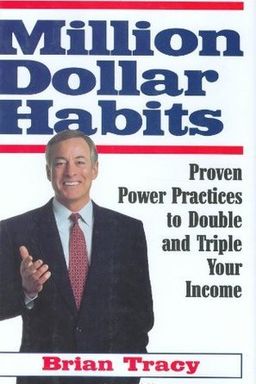
Million Dollar Habits cover

Million Dollar Habits

by Brian Tracy

Million Dollar Habits reveals the transformative power of habits in achieving success. Brian Tracy guides readers through reprogramming their minds and adopting practices that unlock potential, boost self-esteem, and ensure financial independence. Discover how to live life on your terms.

Transforming Your Life Through Habit

Have you ever wondered why some people seem to move effortlessly toward success while others, though equally intelligent, struggle to stay afloat? In Million Dollar Habits, Brian Tracy delivers a powerful answer: success is not luck, DNA, or circumstance—it’s habit. Your daily routines, automatic behaviors, and patterns of thought create the architecture of your life. Change those habits, Tracy argues, and you literally change your destiny.

Tracy contends that 95 percent of everything you do is driven by habit. These habits—mental and physical—govern how you think, act, feel, and respond to the world. Successful people have developed deliberate habits that make achievement seem natural. Unsuccessful people have fallen prey to habits of procrastination, reactivity, and fear. The good news, he insists, is that all habits are learned—and therefore all can be unlearned and replaced with better ones through consistent practice.

The Foundation: You Are What You Repeatedly Do

Tracy opens with an idea as ancient as Aristotle and as relevant as neuroscience today: excellence is not an act, but a habit. Every repeated thought builds neural pathways; every repeated action strengthens your emotional conditioning. He recounts stories of George Washington and Benjamin Franklin, both of whom consciously designed habits to build character. Washington practiced civility every day until he embodied dignity itself. Franklin chose thirteen virtues—including temperance and humility—and focused on one per week. With repetition, those virtues became instinctive behaviors that shaped his life and legacy.

You, too, he says, can become the person you most want to be by deliberately engineering your habits. Success is predictable: it follows from the daily disciplines that align your thoughts and actions with your goals. It isn’t reserved for the fortunate few; it’s built from the ground up, through awareness and practice.

The Psychology Behind Success and Failure

Tracy builds his case through a series of universal laws—mental patterns that govern achievement regardless of profession or background. These include:

  • The Law of Cause and Effect: Everything that happens has an identifiable cause. Do what successful people do—think their thoughts, take their actions—and you will inevitably get similar results.
  • The Law of Control: Happiness comes from feeling in control of your life. Victims blame circumstances; achievers take responsibility for their choices and habits.
  • The Law of Belief: Whatever you believe with conviction becomes your reality. Your self-limiting beliefs are invisible barriers that you can remove by reprogramming your mind.
  • The Law of Attraction: You are a living magnet, always attracting people and situations that match your dominant thoughts and emotions.
  • The Law of Correspondence: Your outer world always mirrors your inner world; change begins from within.

These laws combine into one guiding truth: You become what you think about most of the time. Tracy frames them not as mystical principles but as practical psychology. Your mind and emotions are programmable, much like software. If you upgrade the inner “operating system,” the external results follow naturally.

Why Habits Matter More Than Goals

Tracy distinguishes between goals and habits. Goals give direction, but habits deliver results. You can want success, health, or happiness—but unless your daily actions consistently reinforce that desire, nothing changes. Habits are the bridge between hopes and outcomes. The habit of goal setting, positive self-talk, saving money, learning continuously, and treating people kindly—those repeating actions create exponential results over time.

He encourages readers to turn temporary discipline into automatic behavior. For example, instead of forcing yourself to be optimistic, practice gratitude each morning until it becomes your natural default. Instead of forcing productivity through willpower, structure your environment so it supports focus—a technique echoed by Charles Duhigg in The Power of Habit and James Clear in Atomic Habits.

The Promise of Mastery and Freedom

Ultimately, Million Dollar Habits is not just about wealth. It’s about mastery—over your thoughts, your time, your relationships, and your destiny. Tracy’s optimism is infectious: your potential, he insists, is virtually unlimited once you align your habits with your highest goals. The book offers not only insight but tools—step-by-step practices to replace destructive routines with empowering ones. You’ll learn how to develop unwavering self-control, how to stay motivated even after setbacks, and how to turn personal excellence into a lifelong practice.

Tracy’s Central Message

“We first make our habits,” Tracy writes, “and then our habits make us.” Behind every success story is a set of invisible disciplines that compound over time. By consciously selecting, practicing, and reinforcing the right behaviors, you literally become unstoppable.

In essence, Tracy’s work is a manual for self-directed transformation. Through his blend of psychology, practical wisdom, and timeless philosophy, he reminds you that your habits are not just small routines—they are your character in motion. Every successful person you admire—Washington, Franklin, or even contemporary entrepreneurs—has followed the same path: build the habits first, and success inevitably follows.


The Laws That Shape Success

Brian Tracy’s approach to habit formation rests on several foundational “laws” governing human behavior and achievement. These laws act like psychological physics: they’re universal, impartial, and always in motion. Understanding them transforms vague motivation into predictable progress.

The Law of Cause and Effect

Tracy calls this the cornerstone of success. Everything happens for a reason; nothing is random. If you consistently emulate the thoughts and behaviors of successful people, you produce similar outcomes. He tells how his own transformation—from broke laborer to millionaire consultant—began when he asked the top salesperson in his company for advice, followed it exactly, and watched sales skyrocket. Success, he realized, is an effect produced by repeatable causes.

The Law of Control

You feel happy to the degree that you feel in control. Most unhappiness stems from surrendering that control—blaming bosses, parents, or luck. Unsuccessful people see life as happening “to” them; successful people see it happening “through” them. Martin Seligman’s concept of “learned helplessness” parallels Tracy’s point: once you perceive external forces controlling your life, motivation collapses. The antidote is radical responsibility—acknowledging that your habits, not circumstances, dictate your outcomes.

The Law of Belief

Whatever you believe, with conviction, becomes reality. Beliefs are mental filters: they determine what you perceive and how you act. Tracy argues that self-limiting beliefs—"I’m not good with money," "I’m not confident"—are not truths but verbal habits. Because beliefs are learned, they can be reprogrammed. When Franklin redefined himself as a model of virtue, he changed his mental script first, then his actions followed. (Carol Dweck’s Mindset expands on a similar idea: shifting belief from fixed ability to growth potential changes everything.)

The Law of Expectations

What you expect confidently becomes your self‑fulfilling prophecy. Tracy advises beginning each day by affirming, “Something wonderful is going to happen to me today.” This anticipation alters your tone, posture, and attitude, inviting positive responses. He sees expectations as emotional magnets—attracting the experiences you rehearse mentally. Negative expectations work just as reliably, creating cycles of disappointment. By cultivating faith in success, you direct your subconscious toward opportunity rather than fear.

The Law of Attraction

You are a magnet, constantly drawing circumstances that match your dominant thoughts. Tracy demystifies this idea—popularized later in The Secret—by grounding it in psychology. Positive attention and emotional focus attract allies and conditions conducive to progress, while cynicism and anger repel them. Thoughts charged by emotion become energetic signals that shape your reality.

The Law of Correspondence

Your outer world is a mirror of your inner world. Tracy invites you to examine recurring problems not as external misfortunes but as reflections of internal patterns. If relationships struggle, perhaps your self‑talk is critical; if finances stagnate, perhaps your mindset is scarcity‑based. By upgrading inner habits, outer conditions shift automatically. The rule is simple: change inside, and reality must follow suit.

Key Takeaway

Together, these laws reveal that success is engineered, not accidental. Your mind is both architect and construction crew—designing each experience through belief, expectation, and repetition. Master these principles, and habit becomes destiny.


Building Million-Dollar Habits

Tracy emphasizes that wealth, health, and happiness stem from a specific kind of habit—what he calls “million‑dollar habits.” These aren’t just about making money; they’re patterns of thinking and discipline that compound into extraordinary results over time.

Turning Discipline into Automation

Every new habit begins painfully, sustained by conscious effort. Tracy reminds you that motivation fades, but automation lasts. To form a habit, practice the behavior daily for 21 to 30 days. The repetition rewires your neural circuits, converting effort into instinct. Like Benjamin Franklin’s focus on virtues or Washington’s civility drills, you build excellence by micro‑discipline: small actions repeated until they become identity.

Seven Steps to Replace Old Patterns

  • Decide exactly what habit you want to create.
  • Commit to a daily practice—no exceptions.
  • Visualize yourself performing the behavior easily.
  • Affirm your progress aloud to reinforce identity.
  • Track consistency; the brain rewards completion.
  • Avoid environments that trigger the old habit.
  • Reward yourself for success—celebration cements growth.

By following these steps, temporary behaviors crystallize into lasting habits. Tracy notes that self‑discipline—the ability to make yourself do what’s right whether you feel like it or not—is the master habit behind all others. It’s the lever that moves every other area of life.

Common Habits of Successful People

According to Tracy, achievers worldwide share several predictable habits: daily goal setting, time management, positive expectation, lifelong learning, financial prudence, and integrity. They think about their goals constantly, act disciplined every morning, and focus on service instead of transaction. He cites Franklin's methodical tracking of virtues and Washington’s deliberate refinement of behavior—proof that conscious repetition yields greatness.

He encourages readers to copy success, not envy it. Observe what the best performers in your field do differently—then model their routines. Tracy’s own experience selling cars, managing sales teams, and later consulting for corporations demonstrates that habits of excellence are transferable. (This mirrors Napoleon Hill’s approach in Think and Grow Rich: imitate principles, not personalities.)

Why Small Habits Create Big Leverage

The cumulative power of habit is exponential. Saving even 10 percent of your income or reading 30 minutes daily doesn’t feel monumental—but over years, they generate wealth and wisdom that appear miraculous to outsiders. Tracy calls this “wedge theory”: small wedges of improvement expand into massive results over time. It’s the compounding principle of success—tiny steps repeated daily create geometric growth.

Practical Insight

Habits are not moral imperatives—they’re design choices. You can architect a future that feels inevitable by stacking positive behaviors until momentum takes over. As Tracy summarizes: “Good habits are hard to form but easy to live with. Bad habits are easy to form but hard to live with.” Choose wisely.


Mastering Beliefs and Self-Image

Tracy dedicates major focus to your inner identity—the beliefs and self‑image that determine what habits take root. You don’t rise above your self‑concept, he insists; you fall to it. To build success habits, you must first believe you deserve success.

Rewriting the Internal Script

Every person lives according to an unconscious mental program formed in childhood by parents, schools, and culture. Tracy calls this your “master program.” If you were told you were careless, you may unconsciously sabotage organization; if labeled an underachiever, you might avoid risks that could prove that prediction wrong. The key, he says, is recognizing that these are scripts, not truths. Through visualization and affirmations (“I am disciplined, I finish what I start”), you can overwrite the old programming with new directives that support your goals.

Self-Limiting Beliefs

Tracy identifies negative self‑beliefs as the greatest barrier to achievement. “I can’t learn sales,” “I’m not confident”—these are not facts but habits of thinking. Replace them with empowering language that affirms potential. For instance, instead of saying, “I’m terrible with money,” adopt “I’m learning to manage my finances intelligently.” This shift activates what psychologists call the “reticular activating system,” filtering your environment for solutions aligned with your new self‑concept.

Visualization and Mental Rehearsal

Visual images sharpen belief faster than logic. Tracy recommends rehearsing the future you desire as if it already exists. Olympic athletes, he notes, mentally run through perfect performances repeatedly before competition; success in business follows the same neural patterns. See yourself taking confident action, imagine applause for a presentation, and your mind begins to operate as though those outcomes are certain.

Acting 'As If' Until It’s True

Tracy challenges readers to behave like the person they wish to become before believing they are that person. Confidence is not prerequisite—it’s consequence. Start dressing, speaking, and working as the successful version of yourself. Over time, reality catches up to identity. This mirrors William James’s principle: “Act as if what you do makes a difference. It does.”

Core Message

Before you can create new habits, you must see yourself as the kind of person who embodies them. Identity drives behavior; beliefs build habit. Once your self‑image shifts, excellence becomes automatic.


Habits That Build Wealth and Success

In Tracy’s framework, financial success follows the same logic as personal development. Getting rich is not primarily about income; it’s about habitually creating value and saving intelligently. He describes practical behaviors that differentiate genuine wealth builders from perpetual strugglers.

Think Like a Wealth Creator

Millionaires, Tracy observes, share mental habits before financial ones. They focus on opportunity rather than obstacle, abundance rather than scarcity. They see money as a by‑product of service. He explains that rich people habitually ask: “How can I help more people, more effectively?” This focus on contribution, not accumulation, aligns with what Napoleon Hill defined as “definite major purpose.”

Saving and Compound Discipline

Tracy urges saving at least 10 percent of income before anything else. The habit matters more than the amount—it teaches delayed gratification and self‑control. Over decades, compound interest transforms little acts of discipline into financial freedom. He recounts how most self‑made millionaires start modestly but build steadily through consistent saving and investing habits, not windfalls.

Wedge Theory

His “wedge theory” illustrates how incremental improvement multiplies wealth. If you improve just one percent per week—earning slightly more, spending slightly less—you create an expanding wedge of income versus expense. Over time, the widening gap produces independence. Mediocre workers stagnate because their habits flatten; achievers grow by small gains repeated relentlessly.

Look Rich or Be Rich

Tracy contrasts the illusion of wealth with its reality. Many people waste money trying to appear successful instead of becoming it. True affluence stems from competence, credibility, and continuous learning. Drive modest cars, wear clean but simple clothes, and invest first in skills, then assets. As he puts it, “Fake wealth advertises; real wealth invests.”

Key Takeaway

Rich habits are not defined by earnings but by discipline and vision. Save systematically, learn continuously, serve generously—and wealth becomes inevitable rather than accidental.


Success Through Work and Leadership Habits

Tracy argues that career acceleration and leadership depend on habits of initiative, integrity, and service—the daily behaviors that make you indispensable. Promotions and pay raises, he writes, are symptoms of value creation, not favors of luck.

The Power of Initiative

He recalls starting with nothing, taking sales jobs where payment depended entirely on commission. Those early years taught him that life rewards action. Waiting for permission is career paralysis. Successful professionals habitually take charge, anticipate problems, and volunteer solutions. “The world,” Tracy insists, “belongs to those who do things before they are asked.”

Serve and Add Value

In business, money is the echo of value. Tracy encourages cultivating the habit of asking, “How can I serve more people more effectively?” This service mindset replaces transactional thinking. When you make your company more profitable, efficient, or respected, your own rewards follow naturally. He compares this to sowing and reaping—every act of genuine contribution plants seeds for future success.

Leadership Through Character

Leaders, Tracy observes, are made by habits, not charisma. They practice punctuality, preparation, and persistence until reliability becomes part of their aura. Such trust multiplies influence. He traces Washington’s and Franklin’s leadership to deliberate cultivation of virtue. Similarly, modern executives rise because they model consistency, empathy, and excellence, inspiring others to replicate those standards.

Lifelong Learning

Another cornerstone habit is continuous learning. Tracy himself read hundreds of books and asked hundreds of questions to climb from laborer to entrepreneur. He encourages reading at least one hour daily in your field, attending seminars, and aligning with mentors. Each small learning habit compounds into mastery. (Peter Drucker similarly maintained that management is a life of constant education.)

Essential Lesson

Great careers and influence stem not from talent but from disciplined service, learning, and reliability. When excellence becomes your habit, leadership follows naturally.


Developing Habits for Happiness and Health

Tracy broadens the notion of success beyond money and work, connecting habitual well‑being with all forms of achievement. A strong mind and body fuel creativity, optimism, and productivity. Happiness, he insists, is a habit of thought reinforced by healthful living.

Choosing Health Consciously

Good health is not luck but design. Eat nutritious foods, exercise regularly, and rest sufficiently—these are disciplines, not accidents. Tracy recommends viewing fitness as an investment that multiplies your capacity for work and joy. Small habits—like walking daily or drinking more water—produce massive cumulative benefits.

Optimism as Daily Practice

He defines optimism as “a mental virus of possibility.” Train yourself to expect positive outcomes. Like gratitude journaling or affirmations, optimism resets emotional chemistry toward creativity and resilience. When setbacks occur, treat them as lessons—feedback from the law of cause and effect, not punishment.

Balance and Moderation

Tracy’s holistic view of success recognizes equilibrium. Overwork erodes progress; moderation restores it. He recommends guarding solitude and scheduling peace of mind as a daily objective—echoing Stoic and Buddhist traditions. Happiness grows from consistency: regular sleep, patience with others, and daily moments of reflection.

Key Reminder

Habits sculpt not just your career but your chemistry. By practicing health, gratitude, and serenity each day, you train both body and brain toward happiness that lasts.


Character: The Ultimate Habit

For Tracy, character is the summit of all habits—the integrated expression of values practiced until they become identity. Wealth and power mean little without moral strength. He ends his book with a call to build character deliberately, as Washington and Franklin did before you.

Integrity as Foundation

Tell the truth. Keep your promises. Fulfill obligations whether anyone is watching or not. Integrity is the reputation of your habits. Small honesty compounds like interest; lies consume trust like debt. When your actions align with your values, internal peace follows—Tracy calls this “peace of mind, your most precious possession.”

Responsibility and Perseverance

You are responsible for everything you experience. Accepting this truth eliminates blame and expands freedom. Perseverance—the habit of never quitting—ensures that temporary defeat becomes practice, not failure. Together, responsibility and persistence make character resilient.

Gratitude and Loyalty

Tracy concludes that gratitude is the highest emotional habit. Thankfulness dissolves envy and fear, energizing kindness and joy. Loyalty—to people, principles, and purpose—builds long‑term trust, turning momentary success into legacy. Like Franklin’s loyalty to civic service, these habits create respect that outlives wealth.

Final Thought

Character is habit matured by conscience. Tracy’s message is timeless: Success achieved without integrity is failure disguised. Build virtues first, and your success will sustain itself.

Dig Deeper

Get personalized prompts to apply these lessons to your life and deepen your understanding.

Go Deeper

Get the Full Experience

Download Insight Books for AI-powered reflections, quizzes, and more.