
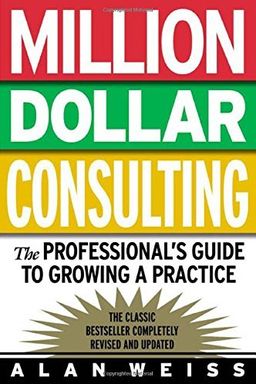
Million Dollar Consulting cover

Million Dollar Consulting

by Alan Weiss

Million Dollar Consulting, a timeless guide by Alan Weiss, empowers consultants to elevate their practice with proven strategies for client acquisition, value-based pricing, and relationship-building. Discover how to transform your consulting business into a million-dollar powerhouse while maintaining a healthy work-life balance.

Consulting as a Path to Wealth and Freedom

How can you transform your expertise into a business that not only earns millions but also grants you unparalleled freedom? In Million Dollar Consulting, Alan Weiss argues that consulting is not simply about providing advice—it’s about creating immense value while living an extraordinary life. Weiss contends that any professional, whether independent or leading a small boutique firm, can build a million-dollar practice by replacing the outdated notion of trading time for money with a philosophy centered on value, equity, and mindset.

According to Weiss, the traditional consulting model—charging by the hour or day—is both unethical and limiting. Consultants deserve compensation that reflects outcomes, not effort. Throughout the book, he demonstrates that wealth is not measured in money alone but in discretionary time—the ability to do what you want, when you want, with whom you want. This mindset, he insists, is the foundation of both personal liberty and financial abundance.

A Philosophy Built on Value

Weiss’s central argument hinges on one deceptively simple idea: your fees should reflect your value, not your time. He calls hourly billing “unethical” because it incentivizes inefficiency—the longer a consultant works, the more they earn, even if that delays the client’s results. Instead, he proposes value-based fees, calculated from the measurable impact of the consultant’s contribution. This model places the consultant and client on equal footing as partners invested in achieving meaningful outcomes.

Imagine helping a client increase profits by $2 million or save $500,000 through streamlined operations. Instead of billing $150 per hour, Weiss teaches you to price that impact—perhaps $200,000 for a result worth ten times more. It’s a shift from survival thinking to wealth creation, from being a technician to a transformer of businesses.

From Expertise to Influence

Early chapters invite readers to evolve from mere specialists to visionary experts. Weiss distinguishes between content expertise (knowledge of subject matter, like insurance or software engineering) and process expertise (understanding how decisions, strategy, and behavior drive performance). Consultants who master processes become industry-agnostic—they can help any organization succeed, regardless of sector. The goal, Weiss explains, is to move along a continuum from consultant to expert to thought leader to icon, ultimately becoming the name clients request by reputation alone.

Weiss’s own examples—working with Mercedes, Hewlett-Packard, and the Federal Reserve—illustrate that transformational consultants think in frameworks, not formulas. They redefine what clients truly need. When asked for a “two-day leadership retreat,” a great consultant asks “Why?” uncovering deeper strategic needs such as culture or accountability.

Marketing as Leadership

Weiss famously declares, “Selling is dead.” In his universe, marketing is not manipulation but magnetism. Consultants don’t chase clients—they attract them through credibility, generosity, and presence. He calls it “marketing gravity,” a concept akin to St. Paul’s viral evangelism: by consistently publishing valuable insights, speaking, and cultivating strong brands, consultants pull ideal clients toward them. Reputation precedes outreach, and peers drive referrals through trust and admiration.

The book guides readers to shift focus from pitching to enabling buyers to buy. Weiss teaches that decisions in consulting, especially at the executive level, are made through peer referral, not social media noise. A strong network, authentic generosity, and expertly defined value proposition form the consultant’s gravitational field.

Execution with Integrity

The later sections pivot from philosophy to practice: how to write proposals that close every time, deliver value flawlessly, and set boundaries with clients. Weiss’s “conceptual agreement” model—built on clear objectives, metrics, and value—ensures mutual understanding before a contract begins. He includes detailed templates for proposals, advisory retainers, subcontractor agreements, and crisis consulting approaches adaptable for pandemics or economic upheaval.

Underpinning all his methods is an uncompromising ethical stance. Time-based billing is immoral; confidentiality and honesty are nonnegotiable; and pro bono work should serve genuine causes, not self-promotion. Consulting, at its best, is “about improving the client’s condition”—and that moral clarity, Weiss insists, separates million-dollar practitioners from mere freelancers.

A Career and a Calling

Ultimately, Weiss’s philosophy transcends business—it’s about crafting a life of significance. The final chapters discuss legacy: how meaning is created daily through contribution and growth, not through chasing perfection or external validation. He reminds readers that there is always “a bigger boat”—but the goal isn’t owning it. It’s living with purpose, abundance, and autonomy.

Alanism Insight

“You can always make another dollar, but you will never be able to make another minute.”

Through humor, candor, and sharp pragmatism, Weiss positions consulting as a profound act of creation. To him, million-dollar consulting is not about money—it’s about mindset, mastery, and meaning. This book teaches you not just how to earn spectacular fees, but how to build a career—and life—that scale far beyond convention.


The Value-Based Mindset

Weiss’s core principle is that consultants are paid for outcomes, not time. Billing by the hour, he argues, rewards inefficiency and punishes success. Instead of measuring effort, measure impact: how much the client benefits from your expertise. This mindset changes the consultant-client relationship from a transaction into a partnership based on trust and shared success.

Why Time-Based Fees Are Unethical

Weiss calls hourly billing unethical because clients deserve quick resolutions, not prolonged engagements. If a consultant finishes efficiently, hourly billing discourages that excellence. Lawyers and therapists suffer from this same trap—Weiss jokes that even therapy’s 50-minute hour is a business model that keeps people dependent instead of healed. When you’re rewarded for taking longer, the client’s best interests are compromised.

Constructing Value-Based Fees

The process starts with what Weiss calls conceptual agreement: defining objectives, metrics, and value before quoting fees. Objectives identify what will be improved (like sales or retention). Metrics measure success (monthly reports, customer feedback). Value quantifies impact—financial, emotional, and cultural. Weiss advises aiming for a 10:1 ROI, meaning if your fee is $100,000, the client should gain $1 million in measurable or perceived improvements.

This method moves consultants out of commodity pricing. Don’t charge “per day.” Charge for transforming the business. Weiss’s examples include advising the Times Mirror Company and charging not by hours but by the impact on training effectiveness, turning a skeptical client into a long-term partner.

High Fees Signal High Value

Paradoxically, Weiss explains that higher fees often make clients more confident in choosing you. People don’t seek the cheapest heart surgeon—they want the best. Large fees convey excellence and exclusivity, creating a psychological assurance that your results will match your price. Luxury brands, from Bentley and Bulgari to McKinsey, prove this rule repeatedly: people believe they get what they pay for.

Alanism Insight

“Real wealth is discretionary time. Money is simply fuel for your lifestyle and legacy.”

When you charge based on value, you align profit with purpose. Your clients invest confidently because they see tangible and intangible returns—from improved revenue to better culture and peace of mind. In this mindset, both consultant and client thrive ethically and economically.


Marketing Gravity and the Power of Referrals

Weiss redefines marketing as magnetism. You don’t sell; you attract. His concept of marketing gravity describes a field of energy that draws ideal clients toward you through credibility, generosity, and omnipresence. Building this gravitational pull means positioning yourself so that your reputation does the work before you walk into the room.

Peer Referral: The New Currency

Traditional advertising has lost its power. Decisions today, Weiss says, come through peer recommendations. Executives buy consulting services exactly as they choose heart surgeons: by asking trusted peers, not googling the cheapest options. Word of mouth, not websites, drives corporate influence. His story of being contacted by the American Institute of Architects based on another entrepreneur’s referral exemplifies how trust cascades through networks effortlessly and cost-free.

Creating Evangelists

Weiss advises you to cultivate “evangelists”—clients who rave about your work and voluntarily spread the word. These champions can be nurtured through exceptional service, acknowledgment, and inclusion. Invite them to coauthor articles, speak at your events, or participate in case studies. Testimonials and video endorsements multiply your reach and build emotional credibility, far more than traditional advertisements.

The Unified Field Theory of Marketing

Inspired by Einstein’s attempt to unify physics, Weiss proposes his own unified theory of consulting: your value proposition (how you improve client conditions), ideal buyers (those able and willing to pay for it), marketing gravity (your visibility through publishing and speaking), the accelerant curve (how buyers move toward your premium offerings), and the close (trust and conceptual agreement). Everything connects—strong marketing makes selling unnecessary.

The lesson is clear: stop chasing clients. Build gravity through insight, generosity, and results. When you achieve this magnetic presence, clients say not “What can you do for me?” but “Do you have room for me?”


The Ethics of Consulting

Weiss is unapologetically moral about consulting: ethical behavior is inseparable from professional excellence. He uses vivid examples—like falsified insurance signatures, whistleblower cases, and corporate deceit—to argue that consultants must uphold duty and honor above all. The law, he reminds us, is not morality. Consultants should ask not only “Is it legal?” but “Is it right?”

Time-Based Fees as Moral Failure

Charging for time, he writes, is inherently unethical because it rewards longer projects rather than faster solutions. Like lawyers who profit from drawn-out trials, time-based consultants misuse trust. Ethical consultants align their incentives with client success, delivering outcomes swiftly and sharing clear value agreements. Value-based fees become a moral contract.

Integrity Beyond Compliance

Weiss recounts confronting executives who falsified documents and taking decisive action even when it cost him business. Ethics, for him, means protecting clients, stakeholders, and the public—even if it requires walking away. Confidentiality ends where harm begins. Consultants must report misconduct rather than protect wrongdoers under the guise of discretion.

Pro Bono Work and Generosity

Weiss also defines ethical generosity through pro bono consulting: help legitimate nonprofits, never for-profit entities, and always with professionalism. Offer strategy, not charity. Treat pro bono clients with the same rigor as paid ones, because your time represents value regardless of payment. Often, he notes, pro bono engagements yield unforeseen rewards—connections, media exposure, and satisfaction.

Ethics in consulting, therefore, are not philosophical diversions but practical business imperatives. By acting honorably, you safeguard reputation, attract the right clients, and ensure your work contributes positively to society.


Building Leverage and Reducing Labor

For Weiss, true wealth comes not from money but from discretionary time. Creating leverage means earning more while working less. He reveals three primary pathways: alliances, subcontracting, and outsourcing.

Smart Alliances

Weiss’s formula for alliances is “1 + 1 = 150,” meaning partnerships must multiply value, not merely add capacity. Collaborate where both parties’ expertise complements each other. But beware—never make alliances legal entities, and never commingle funds or intellectual property. They should be project-specific and formalized only through written agreements. Weiss recounts his decade-long collaboration with speaker Patricia Fripp, where mutual trust turned ethics into profit.

Subcontracting Without Sacrificing Control

Subcontractors extend a consultant’s reach but bring risk. Weiss insists on ironclad agreements prohibiting subcontractors from marketing themselves to clients or claiming intellectual property ownership. They are paid for delivery, not brand association. He jokes that subcontractors must never read his books—lest they start charging by value too! The best subcontractors, he says, take joy in execution while maintaining loyalty to your leadership.

Outsourcing as Efficiency

Outsourcing nonessential tasks—from bookkeeping to travel coordination—frees consultants to focus on creativity and client relationships. Weiss lists everyday vendors: IT professionals, printers, limousine services, couriers, and designers. He warns never to barter (“the IRS still taxes barter”) and admonishes consultants to pay local providers quickly to maintain goodwill. His mantra: pay people first, especially those who keep your operations smooth.

Leverage, Weiss teaches, isn’t about scaling a team—it’s about expanding value while simplifying your life. The less you labor, the more powerful your consulting becomes—and the more time you gain to live abundantly.


Thriving in Ambiguity and Crisis

Crises test consultants’ adaptability. During the 2020 pandemic and other global shocks, Weiss observed that great consultants didn’t wait for normalcy—they led through uncertainty. His chapter on crisis consulting teaches that thriving in ambiguity requires confidence in the journey, not clarity of the destination.

Leadership Through Chaos

Drawing from his experience after 9/11 and recessions, Weiss explains that clients crave reassurance, not perfection. When disasters strike, consultants must offer hope and direction: “I have the light; follow me.” The key is to act amid incomplete data rather than waiting endlessly for certainty. Weiss’s analogy to Mike Tyson’s quote—“Everyone has a plan until they’re punched in the jaw”—captures the importance of resilience under duress.

Offering Genuine Help

Weiss urges consultants to call clients during crises to offer help, not pitch projects. A sincere message such as “I’ve been thinking of you—I’d like to help” opens doors more effectively than any sales script. He demonstrates how such outreach during crises often leads to long-term engagements once stability returns, referencing his clients in Manhattan who returned to work after 9/11 stronger than before.

Remote Marketing and Delivery

Weiss redefines remote work as opportunity, not obstacle. Conducting workshops and advisory sessions via Zoom or livestream preserves full value, never at discounted rates. He provides detailed practices: keep meetings interactive, limit virtual workshops to three hours, use video effectively, and maintain physical professionalism even online. “Your value isn’t diminished when remote,” he insists; in fact, responsiveness and competence in crisis enhance reputation.

To thrive in ambiguity, Weiss concludes, embrace discomfort. Stop waiting for more data; use wisdom. Great consultants succeed not by predicting stability but by guiding clients confidently through chaos.


Legacy and Meaning in a Consulting Life

At the culmination of Million Dollar Consulting, Weiss turns philosophical. He argues that consulting, like life, should be lived with intention. Your legacy, he writes, is created daily—not at retirement. Every decision, client relationship, and ethical stance contributes to the footprint you leave behind.

Creating Daily Meaning

Weiss defines meaning as awareness of how your actions impact others and the environment, paired with your energy to grow. High awareness but low intent leads to indifference; high intent but low awareness breeds insensitivity. Balance both to avoid becoming a bystander to your own life. His humorous anecdote of accidentally activating a plane seat’s massage controls on a nearby passenger reminds us to ask, “Who’s pushing your buttons?”

Creating Evergreen Intellectual Property

Legacy in consulting comes from producing ideas that endure beyond trends. Weiss’s decades-old frameworks—like distinguishing problem solving from innovation—remain timeless. He cautions against chasing novelty; the goal is usefulness that lasts. “Your legacy isn’t about the constantly new. It’s about the constantly useful.” His own “Million Dollar Consulting” concept, continuously revised since 1992, exemplifies creative longevity.

Defining Who You Want to Be

Ultimately, legacy is about identity. Weiss invites you to ask, “Who do you want to be?” Purpose outweighs perfection. He reminds readers: wealth is discretionary time, and TIAABB—“There Is Always A Bigger Boat.” Chasing size erodes serenity; true wealth is freedom and integrity. Consulting, when done right, nourishes both.

With his closing mantra—“No guilt, no fear, no peer”—Weiss encapsulates the philosophy of fulfilled living. Million-dollar consulting isn’t merely a business strategy; it’s a life design built on courage, contribution, and creative independence.

Dig Deeper

Get personalized prompts to apply these lessons to your life and deepen your understanding.

Go Deeper

Get the Full Experience

Download Insight Books for AI-powered reflections, quizzes, and more.