
Idea 1
Millennial Money: Youth as Your Greatest Investment Advantage
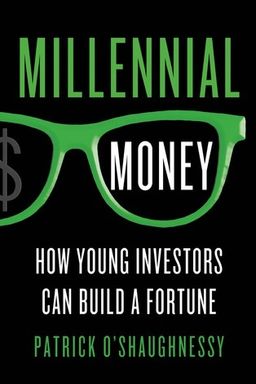
What does financial freedom look like to you in the next 30 or 40 years? A home, a life of travel, or maybe the peace of mind that you’ll never have to worry about money again? In Millennial Money, Patrick O’Shaughnessy argues that the key to achieving that freedom isn’t a lucky break or an inheritance—it’s time. Youth, he insists, is the ultimate edge in investing, and if you learn to use it wisely in the global stock market, your future fortune is virtually guaranteed.
O’Shaughnessy contends that young investors are in a uniquely powerful position. Not only do millennials have decades ahead of them to let their money compound, but they also have unprecedented access to global markets, low-fee investing tools, and information that was once reserved for elites. Yet, paradoxically, we’re the most cautious generation—more conservative in our investing behavior than our grandparents who lived through the Great Depression. That fear, he argues, is the greatest obstacle standing between us and wealth.
The Core Argument: Time and Stocks Beat Everything
O’Shaughnessy begins with a simple truth: the earlier you start investing, the richer you will become. Time, not timing, is the real secret. Through the power of compound interest—the mathematical miracle Albert Einstein allegedly called the eighth wonder of the world—money grows exponentially over decades. Every extra year of investing acts like an additional square on a chessboard doubling your returns. But this compounding only works to its full potential if you begin young and stay invested, especially in equities.
To illustrate his point, he offers two archetypal millennials: Liam and Grace. Both start earning similar incomes, yet their futures diverge sharply. Liam waits until age 40 to invest and sticks to “safe” savings and bonds; Grace begins at 22, investing regularly in global stocks. Fifty years later, Grace lives comfortably, travels often, and supports causes she cares about, while Liam depends on family support in retirement. The difference isn’t luck—it’s early and consistent stock market investment.
Stocks, Not Savings, Are the Path to Wealth
Millennial Money dismantles the illusion that cash and savings accounts are safe. O’Shaughnessy reminds us that since America left the gold standard in the 1970s, the dollar’s value has steadily eroded thanks to inflation and the fiat currency system. A dollar in 1971 is worth only about 17 cents today. Keeping your funds in cash is a guaranteed loss of purchasing power. Even short-term government bonds and savings accounts barely keep pace with inflation—they simply don’t compound the way stocks do.
Stocks, however, are living entities. They represent ownership in companies that evolve, innovate, and expand with the economy. Across more than a century of data, stocks have consistently outperformed every other asset class—not just in America but worldwide. They adapt through what economist Joseph Schumpeter called “creative destruction”: as old companies fade, new ones rise. Owning global stocks means owning humanity’s progress.
The Millennial Opportunity: A Global Generation
For O’Shaughnessy, millennials are the first generation with broad, inexpensive access to global investments. With a click of a button, you can own shares in companies across 45 countries via global index funds or ETFs. This global reach reduces risk, offers exposure to innovation everywhere, and protects against the decline of any single economy or currency. He warns against “portfolio patriotism”—the tendency to invest mostly in domestic stocks simply because they’re familiar. Americans, for example, held 72% of their portfolios in U.S. stocks even though those stocks represent only about 43% of the global market.
To go global isn’t just smart diversification—it’s essential protection. History is littered with cautionary tales of once-dominant markets that collapsed, from Japan’s Nikkei bubble in 1989 to Germany’s postwar losses. A global portfolio sidesteps localized disasters and rides the wave of worldwide creative destruction.
Be Different, Get Out of Your Own Way
After establishing “go global,” O’Shaughnessy turns to “be different” and “get out of your own way,” the other two pillars of smart investing. To beat average returns, don’t simply mirror market indexes. Index funds are valuable for beginners, but they tend to overweight large, already-successful companies with slower future growth. Instead, he advocates using smarter, evidence-based strategies—what he calls “smart indexes”—built around factors like value (buying cheap stocks), shareholder yield, quality, and momentum. In his own Millennial Money Strategy, these five factors combine into a systematic checklist that dramatically outperforms traditional investing over time.
Yet even the best strategy fails if emotions interfere. Behavioral finance research (from Kahneman and Tversky to modern twin studies) shows that fear and greed lead investors to buy high and sell low. Our biology—wired for survival in a dangerous world—works against us in capital markets. We panic at short-term losses and chase euphoria during bubbles. The solution? Automation and discipline. O’Shaughnessy recommends automatic contributions, clear rules, and the courage to stay the course during volatility—a modern version of Buddhist detachment. “Don’t just do something,” he quotes, “sit there.”
Why It Matters
The overarching message is simple but profound: Your youth is your fortune’s foundation, and your choices now will echo decades into the future. The first millennial investors can either fund an aging world burdened by debt or build independent wealth immune to declining government support. Modern technology has democratized global investing, and behavioral science has shown us exactly how not to sabotage our own success. You need only three things—global perspective, disciplined strategy, and emotional mastery—to let time do the rest. As O’Shaughnessy puts it, “Money is just like a seed. Planted, it will grow and prosper; unplanted, it will slowly die.”