
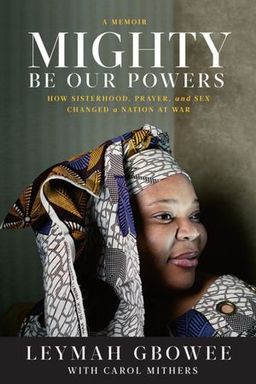
Mighty Be Our Powers cover

Mighty Be Our Powers

by Leymah Gbowee with Carol Mithers

Mighty Be Our Powers reveals the inspiring journey of Leymah Gbowee, whose determination and leadership ended a brutal civil war in Liberia. By uniting women across religious divides, Gbowee transformed despair into hope, demonstrating the formidable power of peace and sisterhood.

How Sisterhood and Faith Changed a Nation

How do ordinary women turn despair into a movement powerful enough to end a war? In Mighty Be Our Powers: How Sisterhood, Prayer, and Sex Changed a Nation at War, Nobel Peace Prize laureate Leymah Gbowee tells the harrowing, triumphant story of how a group of Liberian women—Christian and Muslim alike—refused to stay silent as their country imploded in violence. Through unity, prayer, and courage, they altered the course of history.

Gbowee’s journey, co-written with journalist Carol Mithers, begins with her girlhood optimism, descends into the chaos of civil war, and rises again through resilience, learning, and solidarity. By combining autobiography with political history, the book argues that spiritual conviction and collective action can achieve what political power alone cannot.

A Nation in Shambles—and a Woman in Fragments

Liberia’s fourteen-year civil war (1989–2003) left a quarter of a million dead and millions displaced. Newspapers showed boy soldiers with AK-47s and fanatical leaders like Charles Taylor, but the world mostly ignored the women whose daily courage sustained the country. Gbowee writes from that hidden side: the cooking during shellfire, the protecting of children from soldiers, the silent suffering of rape and hunger. She grew up in Monrovia believing she’d be a doctor but lost everything—to violence, poverty, and an abusive partner. “Pieces of me were being stripped away,” she recalls, “replaced by anger.”

Her trauma, like Liberia’s, carried the seeds of transformation. In her darkest moments, Gbowee met remarkable people who extended compassion—doctors, women in refugee camps, even strangers who told her to keep walking. These fragments of empathy grew into the conviction that healing—personal and collective—could become a revolutionary act.

From Personal Ruin to Public Rebellion

Gbowee’s insight that “the same suffering that breaks us can bind us” shapes every chapter. She experienced domestic abuse and depression, yet refused to surrender. Her recovery started in small acts: helping war refugees as a social worker, telling her story during trauma workshops, and eventually recognizing her ability to lead others. “Before you can help heal a nation,” her mentor told her, “you must heal yourself.”

That healing led to leadership. Gathering women from churches and mosques, she founded the Christian Women’s Peace Initiative and then co-led the Women in Peacebuilding Network (WIPNET). They began with prayer meetings, then protests, then bold sit-ins at Liberia’s peace talks in Ghana. The group’s “Mass Action for Peace” was a landmark: thousands of women in white, sitting under the blazing sun with signs reading “We Want Peace—No More War.” Their determination forced warlords to listen where diplomacy had failed. (Compare this to Gandhi’s salt march or Martin Luther King Jr.’s Montgomery campaign—grassroots defiance wrapped in moral clarity.)

Faith, Femininity, and the Politics of Resistance

The movement’s genius was its moral framing. By claiming motherhood and faith, Liberian women turned patriarchal ideals into weapons of peace. They sang hymns and ululated prayers, using the authority of caregiving to shame politicians and rebels. “Does the bullet know Christian from Muslim?” they asked. Their methods included fasting and even a symbolic sex strike, dramatizing the cost of war to women’s bodies and families. As Gbowee explains, when the women threatened to strip naked to prevent peace negotiators from leaving the table, they invoked a traditional curse so strong that even generals froze in terror. Sisterhood became strategy.

Healing a Nation—and Herself

When peace finally came in 2003 and Charles Taylor fled into exile, the women’s work had just begun. Gbowee realized that “peace is not a moment—it’s a process.” She helped reintegrate child soldiers, challenged international institutions like the UN to take local wisdom seriously, and connected Liberia’s recovery to wider global struggles for women’s leadership. Yet her story remains painfully human: she battles burnout, alcoholism, grief (after the sudden death of her sister Geneva), and the guilt of motherhood divided between activism and family.

Through it all, Gbowee clings to her faith—not as blind piety, but as the fuel for persistence. “When the world goes silent,” she writes, “God’s whisper becomes a roar in your heart.” Her later creation of the Women, Peace and Security Network—Africa (WIPSEN) extends the Liberian lesson across the continent. Her life testifies that when women claim their collective voice, prayer becomes policy and resilience becomes revolution.

This summary explores how Gbowee’s personal rebirth intertwined with Liberia’s healing. You’ll see how she survived domestic violence, turned trauma into activism, founded peace movements, confronted global bureaucracy, and redefined leadership for women everywhere. The power of her story lies not in miracles but in persistence—the insistence that hope itself is a political act.


From Privilege to War’s Ruins

Leymah Gbowee grew up in what she calls “the good life” of Monrovia’s middle class—her father a government official, her mother a pharmacist, and her dreams aimed toward medical school. But Liberia’s complex social fabric was already tearing. Rooted in the divide between the Americo-Liberian elites and indigenous tribes, the nation carried centuries of inequality. When Charles Taylor’s rebels crossed the border in 1989, that quiet tension exploded into the bloodiest civil conflict West Africa had ever seen.

Gbowee was seventeen when the first shells hit. Within weeks, her family’s peaceful home deteriorated into a war zone. Soldiers looted, neighbors vanished, and church sanctuaries filled with corpses. She would later witness the St. Peter’s Lutheran massacre, where hundreds of civilians were murdered in a house of worship. The girl who had once believed in God’s protection now “stopped talking to God,” consumed by disbelief and fury.

The Collapse of Home and Innocence

Gbowee’s journey into adulthood was forged in displacement. Her family fled to Ghana’s Buduburam refugee camp, living in heat and deprivation. Her father, a disciplined man of education and pride, could not save them from dependency. These hardships, combined with the humiliations of poverty, began to erode Leymah’s sense of worth. Like countless war refugees, she struggled between gratitude for survival and resentment at what had been stolen. (Psychologists like Viktor Frankl would later describe similar tensions among survivors of atrocity in Man’s Search for Meaning.)

Entrapment and Domestic Violence

Returning to war-torn Liberia, Gbowee met Daniel—a charismatic older man who offered stability, then turned possessive and violent. Trapped by dependence, social stigma, and two pregnancies, she endured years of beatings and humiliation. “Pieces of me disappeared,” she admits. “I was alive, but hollow.” Her relationship mirrored the structural violence of her country: patriarchal power crushing potential, until only fragments remained. Gbowee’s honesty in narrating abuse without self-pity is both raw and instructive. She understood, even as a trained social worker, that education alone couldn’t free women without economic independence and community support.

When she escaped to Ghana again, destitute with her children, and later returned to find even her nation desolate, her redemption began not through rescue by others but through small acts of kindness—a ship captain offering food, a doctor waiving fees, a stranger telling her, “You can’t give up.” Each mercy became a thread she would later weave into activism: the belief that compassion itself could be structural power.

Seeds of Resistance

Out of surviving loss emerged empathy. Volunteering with the Lutheran Trauma Healing and Reconciliation Program, Gbowee witnessed how communities could recover by sharing stories. Trauma, once voiced, became a shared wound that could also knit people together. This practice—combining confession, dialogue, and dignity—anticipated what peace theorist John Paul Lederach calls “the moral imagination of reconciliation.” Gbowee didn’t yet know it, but those circles of listening and tears would evolve into far larger circles of activism. From personal disempowerment, a movement was already stirring.


Rebuilding from the Rubble Within

The turning point in Gbowee’s story is both quiet and profound. After escaping her abusive partner, sick and impoverished, she faced the despair familiar to survivors who think, “I’m done.” But her mother’s simple question—“What do you want to do with your life?”—reignited the spark. That conversation set her on a path back to education, dignity, and purpose.

Education as Defiance

She enrolled at Mother Patern College of Health Sciences, earning her social work degree while raising four children. Her mentor in the Lutheran program, Rev. Bartholomew Colley, pushed her to read political theory and theology—from Martin Luther King Jr. to the Kenyan pacifist Hizkias Assefa—and to see that peace was never passive. “Every one of us in this country was victimized one way or another,” he taught, “and every one of us has to heal.”

Through fieldwork with war orphans and ex-child soldiers, she learned firsthand what rebuilding meant: listening deeply, forgiving the unforgivable, then transforming guilt into responsibility. One boy who threatened her became the first to call her “General.” That moment encapsulated her core insight—that strength could emerge not from domination, but from the power to acknowledge and nurture broken humanity.

Liberation and Sisterhood

As she trained others in trauma healing, Gbowee recognized women’s silence as a hidden wound of war. Most had been raped, widowed, or impoverished; all carried unspoken pain. So she began creating safe circles where women could speak freely, light a candle, and share shame without fear. These sessions birthed what she called “The Shedding of the Weight”—a ritual of naming suffering to reclaim humanity. They also demonstrated a deeper truth: that emotional liberation is the first step toward political liberation.

By the time she met Nigerian activist Thelma Ekiyor through the West African peace network WANEP, Gbowee was ready to think regionally. The two women shared a vision: to weave these intimate spaces of healing into a continental network for peace. “WIPNET,” Thelma told her, “will be where women speak and act as one.” What had begun in village workshops was about to become a revolution of faith, feminism, and collective imagination.


Women Unite for Peace

In 2002, Gbowee’s prophetic dream—“Gather the women to pray for peace”—sparked a movement that became the beating heart of her life. The Christian Women’s Peace Initiative soon joined with Muslim women to form a force that transcended tribal and religious boundaries. What began as weekly prayers under a tin roof would ignite one of Africa’s most remarkable movements of nonviolent resistance: the Women’s Mass Action for Peace.

Strategy through Faith

For Gbowee, faith was both method and weapon. She used scripture, song, and fasting to unify thousands across Liberia. Instead of militarizing despair, the women hallowed it. They dressed in white, refused food, and sat for hours in blistering heat, chanting “We want peace—no more war.” By invoking motherhood and moral duty, they reframed politics in moral terms. Their slogan, “Does the bullet know Christian from Muslim?” melted divisions that diplomats couldn’t bridge.

Creative Protest

The women’s creative tactics shocked the world and confounded Liberia’s warlords. When President Charles Taylor banned demonstrations, they protested anyway—silently, persistently. When negotiations stalled during the peace talks in Ghana, they physically blocked the delegates inside, threatening to strip naked, invoking a cultural curse stronger than law. The negotiators caved; peace advanced. Gbowee’s leadership blended empathy with fierce practicality, echoing what sociologists call “maternalist politics”—using the cultural authority of motherhood to protect the public good (similar to movements in Argentina’s Mothers of the Plaza de Mayo).

Faith as Political Power

The Mass Action’s genius was moral legitimacy. Soldiers and civilians alike saw in these women the face of the nation’s conscience. By August 2003, as peacekeepers arrived and Taylor fled into exile, it was clear that this grassroots army had achieved what neither the generals nor the UN could. “We’d been labeled nobodies,” Gbowee writes, “but we held the power to save our country.” The story foreshadowed the election of Ellen Johnson Sirleaf as Africa’s first female president only two years later, proving that women’s voices could literally reshape nations.


Peace Is Not the End—It’s the Beginning

After the Accra peace accord of 2003 ended Liberia’s war, the real battle began: rebuilding lives and institutions from nothing. “We had survived,” Gbowee writes, “but we had to remember how to live.” The country’s infrastructure was destroyed, its people traumatized, and trust nonexistent. This stage tested both Liberia’s resilience and Gbowee’s evolving sense of leadership.

Building Beyond Ceasefire

Through WIPNET and allied NGOs, she turned from protest to reconstruction—helping women understand the peace agreement in plain language, working with UNICEF to reintegrate former fighters, and critiquing the UN mission’s paternalism. Her challenge to international experts—“You cannot go to another country and make a plan for it”—remains one of the book’s boldest insights. True peace, she insists, must be locally led and inclusive of women, who “know every corner of the home and community.”

When UN disarmament efforts failed disastrously, resulting in riots, Gbowee’s team stepped in, speaking directly to ex-combatants in their own dialects. Their local knowledge transformed chaos into success. Her critique of global bureaucracy echoes scholars like Amartya Sen and Wangari Maathai, who argue that development divorced from cultural context breeds dependency rather than empowerment.

Expanding the Mission

Gradually, Gbowee became both national symbol and continental voice. She studied at Eastern Mennonite University to formalize her understanding of restorative justice and peacebuilding, fusing theology with practical policy. Her creation of WIPSEN-Africa extended her work across borders—training women to engage security forces, run for office, and mediate local conflicts. Yet she remained grounded in daily realities: feeding her children, mourning her sister’s death, and battling depression and alcoholism. Her honesty about these struggles reminds us that activism’s cost is both spiritual and personal.

Liberia’s eight fragile years of peace restored schools and political rights, yet left most citizens impoverished. Gbowee’s 2011 Nobel Prize acknowledged not only her protest but her perseverance—the harder work of building institutions and hope where only survival had existed before. “Peace,” she writes, “is a very long process, but it begins when women sit down and decide they’ve had enough.”


The Price and Promise of Leadership

Gbowee’s rise as a global activist brought both triumph and turmoil. Her films and awards celebrated her courage, but fame exposed rifts among her peers and pain within her family. In sharing these struggles openly, she reframes heroism—not as perfection, but as endurance through imperfection.

Costs of a Movement

After Pray the Devil Back to Hell won international acclaim, jealousy and accusations fractured former allies in the peace movement. The very sisterhood that had defeated war now faced internal wars of recognition and resentment. “If those women smell fear on you,” her mentor Sugars once told her, “they will use you for the rest of your life.” That truth haunted her anew. Balancing motherhood, mourning, and leadership, Gbowee turned inward, confronting her own exhaustion and relapse into drinking. Yet even in crisis, she refused despair, drawing on the same faith that had once sustained the movement.

Redemption Through Purpose

Her recovery came from re-centering on service. Through her foundation, she trained hundreds of young women in political participation, conflict resolution, and self-esteem. She emphasized that leadership is not charisma but consistency: “We don’t wait for heroes; we become them.” In her later work, she mentored new activists in Congo, Sierra Leone, and Ghana, showing that what broke one generation could empower the next. Her goal is not endless activism but sustainable peace—one rooted in local voices and female leadership from village councils to parliaments.

By the book’s end, Gbowee envisions her return to Liberia as both homecoming and legacy. “I’m going to run for Parliament,” she says. But whether or not she wins office, her life already answers her mother’s long-ago challenge: she chose what to do, and built a movement that turned personal pain into national purpose. Her message to readers, especially women, is simple and prophetic: Don’t ever stop.

Dig Deeper

Get personalized prompts to apply these lessons to your life and deepen your understanding.

Go Deeper

Get the Full Experience

Download Insight Books for AI-powered reflections, quizzes, and more.