
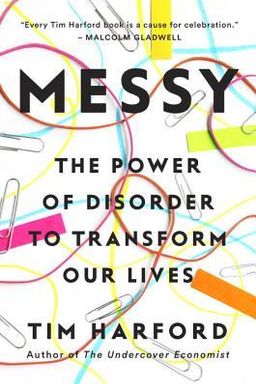
Messy cover

Messy

by Tim Harford

Messy explores why tidiness is overrated and how embracing disorder can boost creativity and success. Tim Harford reveals the hidden benefits of chaos, offering strategies to harness its power in both personal and professional spheres.

The Power of Productive Mess

Why do we crave order even when chaos produces brilliance? The central argument of this book is that mess — in work, thinking, design, and systems — is not a flaw but a feature of creativity, adaptability, and resilience. From musicians improvising on broken instruments to regulators designing smarter oversight, the lesson is constant: tidy perfection often numbs awareness and eliminates the flexibility that innovation demands.

The book challenges your instinct to tidy your desk, streamline teams, automate routines, and codify targets. It reveals, through stories and evidence, that such orderliness hides fragility. True mastery comes from managing controlled disorder—allowing randomness, experimentation, and diversity to reveal what neat systems cannot predict.

Creativity amid imperfection

When jazz pianist Keith Jarrett accepted an unplayable piano in Cologne, he produced one of history’s most transcendent performances. Brian Eno later used this principle deliberately, introducing randomness through his Oblique Strategies cards. Their experiments capture the core theme: constraints and unpredictability force attention. Creativity thrives when circumstances demand adaptation rather than control.

Psychologists like Shelley Carson found that distraction and porous attention correlate with creativity. Messy environments make your brain stay agile—like a simulated annealing process, where random jumps help you find higher creative peaks. The point isn’t chaos but disciplined unpredictability.

Mess across domains

From art studios to war rooms, messy systems outperform tidy ones. MIT’s Building 20—an ugly, temporary structure—incubated radar, Bose speakers, and the Internet, precisely because people could rearrange it freely. Similarly, John Boyd’s OODA loop strategy shows that adaptive speed and disorder can defeat larger, rigid opponents. Bezos’s Amazon and Rommel’s desert campaigns exploited the same principle: act faster than rivals can comprehend, even if it looks chaotic inside.

In science and policy, enforced tidiness through numeric targets and rigid measures can produce perverse results. Hospitals that optimize GP appointment metrics end up restricting real access; banks that follow detailed Basel rules still collapse under their own modeled precision. Messy designs—multiple, simple heuristics combined with surprise checks—actually build robustness (as Andy Haldane and Jeremy Bentham suggested).

Diversity, resilience, and improvisation

Diversity is a productive kind of mess. In teams, networks that mix tight bonds (trust) and weak bridges (novelty) innovate best. Biodiversity and urban heterogeneity teach the same lesson: monocultures—whether in forests, microbiomes, or cities—are fragile. Messy variation cushions shocks and enables evolution. Improvisation, too, translates this principle to human performance. Martin Luther King’s unprepared Montgomery speech and Miles Davis’s first takes prove that letting go of overcontrol can unleash authenticity and connection.

Living with creative disorder

In everyday life, structured mess beats rigid order. Benjamin Franklin constantly failed at “Order,” illustrating that perfect routines crumble under real conditions. Studies show that “filers” waste time managing archives, while “pilers” keep only relevant material near at hand. Workspaces that people design themselves, even if visually disheveled, energize productivity more than clean but imposed environments. Similarly, children need spaces to play messily—to build, burn, and argue safely—so they grow up capable of assessing risks and collaborating beyond scripts.

Even technology inherits this principle. Overreliance on automation can erode human intuition, as in Air France Flight 447, where pilots, deskilled by safety systems, failed to recognize a stall. The book calls for reintroducing practice, feedback, and manual engagement. A bit of cognitive “dirt”—hands-on involvement—keeps the system safe.

The messy mindset

The ultimate theme is that complexity and uncertainty are unavoidable. You cannot eliminate mess; you can only design to thrive within it. When you adopt flexibility—rotating projects like Darwin’s worm studies, mixing teams across boundaries, setting ambiguous targets, or trusting controlled improvisation—you make yourself and your organization stronger. In a world obsessed with efficiency, the author’s final message is liberating: embrace mess not as failure of order but as evidence of life, movement, and resilience.


Randomness and Creative Constraint

Creativity often begins where perfection ends. When Keith Jarrett sat before a faulty piano at the Köln Concert, necessity rewired his art. Musicians and thinkers like Brian Eno institutionalized this insight through tools such as Oblique Strategies—random provocations that disrupted comfortable habits. Randomness, far from distraction, becomes an ally in discovery.

Why disorder stimulates innovation

Computer scientists’ “simulated annealing” explains why randomness helps: occasional chaotic jumps prevent solutions from getting trapped on local peaks. Eno’s Berlin sessions with Bowie worked the same way—provocations like “Emphasize the flaws” forced breakthroughs. Psychologist Shelley Carson found that porous attention correlates with creative thinking; distractibility opens channels for strange connections. Even making class texts harder to read—disfluent fonts—forces deeper learning (Diemand-Yauman’s study).

Inviting productive mess

  • Mix deliberate randomness into routine: shuffle meeting agendas or test opposite assumptions.
  • Alternate focus with exploration: switch between diligent refinement and wild experiments.
  • Allow porous attention: read widely, wander, feed your curiosity.
  • Add friction to learning: make tasks slightly harder to force awareness.

When you welcome controlled randomness, boredom vanishes and attention sharpens. Creativity doesn’t mean chaos—it means tension between structure and surprise, order and accident.


Networks, Projects, and Cross‑Pollination

Creative lives and organizations thrive on variety. Darwin’s simultaneous work on barnacles, earthworms, and evolution or David Bowie’s constant stylistic shifts reveal a shared pattern: pursuing many projects makes ideas collide. Psychologist Howard Gruber called this a “network of enterprises.”

How multiple projects work

Diverse efforts feed one another through cross-fertilization—ideas migrate between domains. They allow subconscious incubation and buffer morale: if one project stalls, others sustain momentum. Twyla Tharp keeps “boxes” of notes for each idea so her mind keeps churning in the background. Erez Aiden’s genomic breakthroughs came from failed physics attempts—a by‑product of messy curiosity.

Empirical proof

Bernice Eiduson’s decades‑long study found that top scientists switched topics dozens of times and remained more productive overall. The pattern isn’t distraction but intelligent rotation—like crop rotation for creativity. Three active projects at a time seem ideal: enough variety to stimulate links, not so many to overload focus.

When you design your work as a portfolio of ventures, some dormant, some growing, you convert mess into momentum. Variety ceases to be inefficiency—it becomes your creative engine.


Team Variety and Cognitive Friction

Teams succeed when they balance tight trust with fresh perspective. Too much bonding breeds echo chambers; too much bridging dissolves coherence. The challenge is to knit them together deliberately.

Bonding strength, bridging stretch

The British Olympic rowing crew exemplified bonding—discipline and loyalty consolidated performance. Meanwhile, mathematician Paul Erdős embodied bridging—collaborating with hundreds across disciplines to spread ideas worldwide. The ideal organization contains “structural folds”: overlapping groups connected by double insiders who translate between worlds (Balázs Vedres’ research).

Why diversity feels uncomfortable

Scott Page and Katherine Phillips showed that cognitively diverse teams solve harder problems even though participants feel less comfortable. Discomfort signals that assumptions are being tested. Dave Brailsford’s cycling team proved that goal harmony—not social harmony—delivers innovation.

If you build teams, reward respectful dissent and overlapping membership. The short‑term tension of difference becomes the long‑term source of insight.


Improvisation and Human Judgment

Improvisation re‑humanizes expertise. Martin Luther King’s spontaneous Montgomery speech erupted from a near‑empty outline yet electrified his listeners. Neuroscience confirms why: when people improvise, brain regions of self‑monitoring quiet down, freeing authentic connection.

Improvised excellence

Miles Davis’s Kind of Blue sessions captured first‑take magic; jazz and comedy show that real‑time responsiveness outperforms perfection. In service industries, Zappos and O2’s social media teams empower staff to go off‑script—answering personally and playfully in crisis. Such moments depend on confidence, listening, and judgment, not algorithmic procedure.

How to cultivate it

  • Train fundamentals so you can forget them when needed.
  • Practice deep listening—hear the audience or context.
  • Encourage judgmental courage: small risks, frequent feedback.

Improvisation isn’t chaos—it’s mastery in motion. You anchor in preparation, then release control to encounter reality, turning uncertainty into art.


Autonomy and Meaningful Disorder

Creative spaces thrive not through architectural beauty but through autonomy. MIT’s Building 20, famously scruffy, birthed radar research and hacker culture precisely because occupants could rewire walls. By contrast, glossy designer offices like Chiat/Day’s Gehry campus drained morale because they removed control.

Control matters more than décor

Haslam and Knight’s experiments compared lean, enriched, empowered, and disempowered offices. Productivity soared when people arranged their own space and sank when experimenters undid their work. The message: empowerment outranks orderliness.

Design for flexibility

  • Let people modify their environment—move furniture, add plants, leave traces.
  • Favor cheap, reconfigurable spaces over fixed showpieces.
  • Avoid imposed fun or mandated aesthetics; autonomy fuels intrinsic motivation.

When ownership replaces imposed order, mess becomes identity, and innovation follows naturally.


Metrics, Automation, and the Illusion of Control

Modern systems mistake measurement for mastery. Policymakers and engineers chase neat dashboards, but any single metric invites gaming, and automation hides fragility. Two domains—performance targets and computerized control—illustrate how apparent precision can backfire.

When targets mislead

Hospital wait‑time goals, ambulance response timers, and Basel banking formulas all produced distortions. Clinics restricted bookings, paramedics reclassified calls, and banks stuffed portfolios with “safe” assets that weren’t. Economist Andy Haldane and Bentham’s century‑old notion of “constructive ambiguity” converge: keep evaluations unpredictable and plural. Surprise audits and rotating metrics nudge genuine performance.

When automation erodes skill

Air France Flight 447 exposed the paradox: as machines grow reliable, human operators lose practice. Earl Wiener warned, “Automation turns small errors into big ones.” Similar cases—from GPS misdirections to over‑trust in databases—show complacent dependence. The remedy: keep humans actively engaged, ensure systems offer visceral feedback, and plan for handovers, not total handoffs.

The common thread is humility. Neither measurements nor machines should replace human judgment; they should provoke it. Complexity demands oversight that is messy, human, and alert.


Heuristics, Diversity, and Resilient Systems

Simple, diverse structures often outperform sophisticated but uniform designs. Whether in nature, finance, or governance, resilience stems from redundancy and variety, not elegance alone.

Why simplicity wins

Psychologist Gerd Gigerenzer’s studies reveal that simple yes/no heuristics—like avalanche or heart‑attack checklists—beat complex models under pressure. In finance, naive diversification (1/N rule) outperforms Markowitz optimization when data are sparse. Andy Haldane’s “indebtedness heuristic” predicted bank fragility better than Basel’s thousands of parameters. The reason: overfitting to tidy data blinds systems to rare shocks.

Diversity as protection

Ecologically, monocultures decay—Germany’s spruce plantations, stripped of variety, eroded soil and resilience. Microbial, urban, and national diversity alike buffers shocks: Jane Jacobs’s mixed neighborhoods thrive, as do cities dense with immigrant innovation (Ottaviano & Peri). Homogeneity may feel efficient but risks collapse under stress.

Messy systems—composed of simple rules and diverse parts—weather uncertainty. Whether designing economies, organizations, or ecosystems, embrace heterogeneity and heuristic thinking as the ultimate anti‑fragile formula.


Messy Lives and Everyday Adaptability

At a personal scale, mess sustains attention, opportunity, and growth. Benjamin Franklin’s lifelong failure to master “Order” reveals how life resists tidy scheduling. Studies show that keeping a small pile of active work, using search instead of endless filing, and planning flexibly by month rather than by day align better with human reality.

Everyday disorder as system

“Pilers” outperform “filers” because visible clutter mirrors priorities. Email folders waste time relative to search. Calendar minimalism—Andreessen’s blank afternoons or Schwarzenegger’s open days—creates space for serendipity. In youth as well, unstructured play teaches risk management and negotiation. Messy playgrounds like The Land or Emdrup show that freedom and risk nourish competence without raising serious injury rates.

Your goal isn’t to drown in chaos but to cultivate adaptive flexibility. A messy desk, a playful hour, or an unplanned conversation might be the small disorder that restores your creative order.


Designing for Serendipity and Surprise

The final lesson of the book unites all others: design systems that force awareness through controlled unpredictability. Whether in city streets, audits, or conversations, safety and creativity emerge when people must think, not when they can drift on autopilot.

Environments that make you notice

Dutch engineer Hans Monderman removed road signs and traffic lights to create shared‑space streets where drivers negotiated eye‑to‑eye. Accidents dropped because attention surged. Similar principles guide inventive workplaces: randomized seating, serendipitous encounters, or unexpected prompts that jolt routine thinking.

Unpredictable oversight

Haldane’s idea of regulatory “SWAT teams” shows the power of surprise. When banks cannot predict which exposures will be tested, they must maintain general competence rather than polish appearances. Randomness thus becomes integrity’s ally.

Serendipity and surprise are not luxuries—they are design principles. A world built entirely for order breeds blindness; one designed for intelligent mess keeps us creative, ethical, and alive.

Dig Deeper

Get personalized prompts to apply these lessons to your life and deepen your understanding.

Go Deeper

Get the Full Experience

Download Insight Books for AI-powered reflections, quizzes, and more.