
Idea 1
Why Messengers Matter More Than Messages
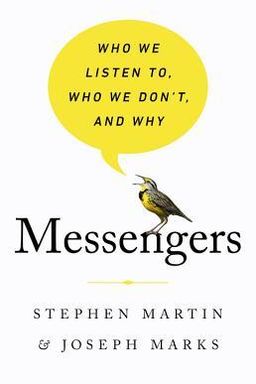
Why do some voices break through while others go unheard, even when their information is accurate? In Messengers: Who We Listen To, Who We Don’t, and Why, Stephen Martin and Joseph Marks argue that the decisive factor isn’t always what is said — it’s who says it. We like to believe good ideas rise on their merits, but research in psychology, social signaling, and behavioral economics consistently shows that the messenger often outweighs the message.
How perception distorts persuasion
Humans are expert pattern-finders but lazy evaluators. Instead of independently assessing every argument, you rely on heuristics — cues about a person’s credibility, warmth, competence, or authority — to decide whether to pay attention. Nalini Ambady’s “thin slices” research shows that people form stable impressions of competence and trust in seconds from micro-behaviors like tone, posture, and face shape. This adaptive shortcut saves energy, but it also means messages are filtered through the audience’s perception of the messenger’s traits rather than through logic alone.
That’s why Cassandra’s fate in classical myth — knowing the truth but never being believed — remains relevant. Modern versions abound: Michael Burry spotted the 2008 crash early, but his eccentricity and low social fluency made others ignore him until later retellings by Michael Lewis spread his insight. Warren Buffett, by contrast, now commands deference because his standing legitimizes any warning he offers. The same logic applies to Twitter, where Barack Obama’s tweet about Charlottesville was shared millions of times while an ordinary citizen’s identical sentiment vanished into obscurity.
Two families of messengers
Martin and Marks distinguish two broad families: hard messengers, who wield influence through status, and soft messengers, who persuade via connection. The hard path is built on traits like wealth, dominance, competence, or attractiveness. The soft path flows from warmth, empathy, vulnerability, and trustworthiness. Each pathway has roots in evolution — we defer to power in crises, but we bond with those who make us feel safe and seen. The art of influence is knowing which kind of messenger suits the moment.
Status and the hierarchy reflex
Status signals, such as brand logos or titles, quickly shape interaction. In Doob and Gross’s car honking experiment, drivers were more patient with luxury vehicles than with modest ones blocking traffic. These shortcuts evolved to reduce friction — deference to hierarchy once served survival — yet they still guide modern judgment. However, status helps only if it’s seen as legitimate. Unmerited displays, like ostentatious celebrity behavior or tone-deaf endorsements, can reverse admiration into resentment. The key is congruence: the messenger’s signal must match the message’s purpose.
Competence, confidence, and illusion
When someone looks or sounds capable, audiences relax their scrutiny. Studies show advice labeled as “expert” suppresses mental effort regions in decision-making. Confidence often substitutes for skill: Greg Lippmann’s self-assured style won investors during the financial crisis while Burry’s data struggled to persuade. Yet overconfidence backfires when false certainty is exposed. As a communicator, it’s better to balance clarity with humility — let credentials or introductions do the boasting, and admit uncertainty when it’s real. This mix creates credibility rather than bravado.
Connectedness and vulnerability
The second family — soft messengers — thrives on connection. Warmth, trust, and shared identity make messages more acceptable. Simple acts like eye contact, apologies, or revealing fallibility can dramatically shift outcomes. Archana Patchirajan’s openness with her failing startup inspired staff loyalty and sacrifice; health programs in Zimbabwe boosted success rates by relying on trusted community figures instead of external authorities. Vulnerability invites reciprocity and humanizes power, but it requires calibration: share enough to be real, not so much that it feels manipulative or uncontained.
Emotion as amplifier
Humans act more readily on emotion than abstraction. This is clearest in the identifiable victim effect: a single named face evokes compassion far stronger than statistics about thousands. Campaigns like Veganuary or the viral story of the “Dancing Man” use emotional identification to mobilize help where raw data would fail. But emotion is biased; focusing on one face can obscure larger, equally urgent needs. Rational persuasion blends empathy with proportion — first make it human, then make it factual.
Trust, charisma, and the halo
Trust combines competence (can you?) and integrity (will you?). Repairing it after damage requires candor and consistent follow-through; Facebook’s delayed apology after the Cambridge Analytica breach shows how hesitation kills credibility. In contrast, leaders who apologize quickly and change visibly often regain standing. Charisma — the fusion of dominance and warmth — anchors this trust. It’s the skill of commanding attention while conveying empathy, as Churchill, Kennedy, and Martin Luther King Jr. did. Yet charisma is morally neutral: it amplifies intention, whether benevolent or destructive.
Matching messenger to context
No trait wins universally. You choose — consciously or not — which messenger to use depending on culture, audience, and goal. A dominant figure can calm chaos but alienate in cooperative settings; a warm figure can bond a group but fail to command urgency. Gender and cultural patterns complicate this further: assertive women may face backlash in contexts expecting warmth, while collectivist cultures prioritize connectedness over hierarchy. The best communicators adjust style dynamically, signaling strength and empathy in balance.
Ultimately, the book offers a powerful reminder: information never travels alone. It rides on human perception, with all its biases, emotions, and shortcuts. To be heard in modern life — where every message competes in crowded attention markets — you must design both what you say and who says it. In a world saturated with facts, the messenger is the most potent force shaping belief.