
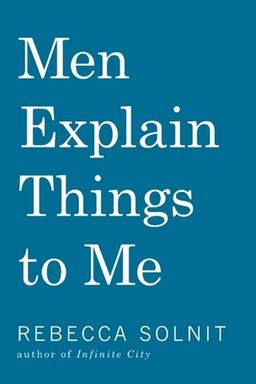
Men Explain Things To Me cover

Men Explain Things To Me

by Rebecca Solnit

Rebecca Solnit''s ''Men Explain Things To Me'' offers a captivating collection of essays that expose the pervasive nature of misogyny. It sheds light on everyday sexism, systemic gender-based violence, and the societal mechanisms that silence women, providing essential insights into combating these deeply ingrained issues.

Explaining Power, Voice, and Gender

Have you ever been silenced—not by violence, but by condescension, by mansplaining, or by being told your own story isn’t credible? In Men Explain Things to Me, Rebecca Solnit explores how the small acts of everyday silencing connect to the vast, global patterns that keep women from full equality and agency. Blending memoir, political analysis, art criticism, and feminist history, she shows how violence, voice, knowledge, and imagination are intertwined in the struggle for gender justice.

The Continuum of Silencing

Solnit begins with a memorable anecdote about a man explaining her own book to her—an amusing but revealing encounter with arrogance. That story becomes a metaphor for a global continuum: from the dinner-party mansplainer to policymakers who disregard women's warnings; from subtle dismissal to physical violence that enforces silence. Solnit contends that these acts form one connected system—each insisting women’s words, thoughts, and bodies have less value or credibility than men’s.

This systemic silencing is not limited to the social sphere. It is embedded in law, politics, and culture. Solnit links disbelief toward women’s testimony in courtrooms to disbelief toward women’s voices in classrooms, online, and public space. For her, belief itself is a civil rights issue; credibility determines whether someone’s truth is accepted, whether a person’s humanity is respected.

The Longest War: Violence and Control

Throughout the book, she argues that violence against women—rape, domestic abuse, femicide—is not random or purely personal. It is structural, recurrent, and patterned by patriarchy. “Violence is first of all authoritarian,” Solnit writes, meaning it begins with the presumption of one person’s right to control another. When that power relationship is normalized through both small social dominance and extreme brutality, society teaches submission as survival.

In this sense, Solnit reframes violence not as isolated tragedy but as a global war—hence her essay “The Longest War.” She shows how the statistics of rape and domestic homicide dwarf terrorist acts, yet remain culturally invisible. This omission, she insists, is political blindness. If we talked about masculinity’s role in violence, rather than deflecting blame to race, class, or economics, we could begin dismantling patterns that harm everyone.

Global and Historical Dimensions

By connecting stories from San Francisco to New Delhi, Afghanistan to Argentina, Solnit exposes shared mechanisms of erasure. Whether through literal disappearances during Argentina's Dirty War or symbolic disappearances in naming conventions that erased women’s genealogies, she reveals that silencing operates across culture and centuries. She expands the frame beyond Western feminism to show how liberation resides in collective acts—from Las Madres de la Plaza de Mayo to the Zapatista women’s uprisings in Chiapas.

Hope, Imagination, and Resistance

Solnit refuses despair. She argues that ideas—once expressed—cannot be forced back into silence, likening feminism’s progress to Pandora’s box or genies released from bottles. Every new voice enlarges public consciousness, and once imagination expands, it reshapes reality. Revolutions, she reminds us (drawing on David Graeber and Virginia Woolf), are primarily revolutions of ideas. Change begins with seeing differently, speaking differently, imagining equality.

Woolf’s presence in the book underscores this imaginative power. Solnit reads Woolf’s concept of darkness—the unknown future—as a metaphor for hope and creative uncertainty. To embrace darkness is to accept that transformation happens in mystery, unpredictably, through acts of imagination and solidarity.

Why It Matters Now

Solnit’s essays form a bridge between personal feminist awakening and global justice movements. They invite you to see sexism as a pervasive system of credibility and control—one that shapes conversations, laws, and nations. Understanding this continuum means recognizing that your ability to speak and be believed is itself political. “Having the right to show up and speak,” she writes, “are basic to survival, to dignity, and to liberty.”

Ultimately, Men Explain Things to Me is both diagnosis and call to action. It implores you to connect the micro and macro: to see the mansplained conversation as kin to state violence; to understand silence as complicity; to identify yourself as part of the ongoing revolution of ideas. It is about reclaiming voice, redefining equality, and believing that imagination—once unleashed—can change everything.


The Power of Credibility

Solnit insists that credibility determines who counts as human. The story of the Aspen dinner party, where a man explained her own book to her, encapsulates how authority shapes perception: the presumption that women know less becomes self-reinforcing. In courts, politics, and personal life, disbelief of women defines hierarchy.

From Mansplaining to Murder

She portrays mansplaining not as benign irritation but as an opening act in a larger drama of silencing. The continuum runs from belittlement to invisibility to violence. When women's words are dismissed, their warnings go unheard—Solnit compares this to the disregard for FBI agent Coleen Rowley’s memo before 9/11, or the disbelief of rape victims whose testimony lacks male corroboration. Discrediting female voice is a precursor to denying justice.

Credibility as Human Right

For Solnit, having a voice is survival itself. She recalls that only after the 1970s did courts begin recognizing marital rape, domestic violence, and sexual harassment as crimes—legal steps that gave women credibility in the public sphere. She argues that these changes marked women’s arrival as full citizens, capable of being believed. Every denial, therefore, is a political act. Every woman told she is ‘delusional’ or ‘overreacting’ faces a cultural system policing reality itself.

(Virginia Woolf’s own struggles with credibility—being dismissed as hysterical or fragile—mirror this pattern. Solnit places Woolf as a formative philosopher of uncertainty, who chose indeterminacy over false confidence.)

From Voice to Solidarity

Solnit’s countermeasure is connection. Each story told collectively—a blog post about harassment, a group testimony at university trials, the global #MeToo chorus—is an act of reclaiming credibility. When many speak at once, disbelief falters. You are reminded that truth does not require validation from power; rather, it gathers strength by amplifying itself.


Violence as Authoritarianism

“Violence is first of all authoritarian,” Solnit writes, describing how assault, rape, and even harassment stem from an idea of ownership. The attacker’s mindset says: I have the right to control you. That assumption mirrors governments, institutions, and patriarchal systems worldwide.

The Longest War

In her essay “The Longest War,” Solnit collects shocking global statistics: nearly a rape a minute in the U.S., hundreds of thousands in South Africa, and domestic violence deaths exceeding 9/11’s casualties every three years. Yet, she notes, no one declares war on this terror. By reframing gender violence as a civil rights and human rights crisis, she exposes the scale of denial.

Masculinity and Displacement

Solnit challenges cultural excuses—poverty, intoxication, mental illness—arguing they obscure the real cause: masculinity constructed as dominance. She points out that 90% of murderers are men, and nearly all rapes involve male perpetrators. In telling these truths, Solnit invites readers to reconsider what manhood could mean beyond control and aggression.

Global Battlefields

From India’s bus rapes to military assaults within U.S. ranks, from Cairo’s attacks on women protesters to femicide in Juárez, Solnit calls this worldwide violence “Manistan”—a grim pseudo-country constructed by male entitlement. Recognizing it as a unified phenomenon rather than isolated tragedies enables strategic change.

Liberation Through Solidarity

Solnit ends not in despair but solidarity. Men who “get it,” she says, are allies redefining masculinity as empathy. Violence curtails imagination and participation; peace expands them. You, as reader, are invited to reject authoritarian control even in miniature—whether in conversation or relationship—guided by kindness, not conquest.


Egalitarian Love and the Threat of Equality

In “In Praise of the Threat,” Solnit provocatively argues that marriage equality should indeed be seen as a threat—not to morality, but to inequality itself. By examining centuries of patriarchal marriage law, she reveals how same-sex unions challenge deep-rooted hierarchies.

Reinventing Marriage

Traditional marriage, she writes, was a system of ownership. She cites eighteenth-century jurist William Blackstone’s assertion that the wife’s legal existence was ‘suspended’ and consolidated into her husband’s. Feminism’s triumph was making marriage between equals possible—transforming hierarchy into partnership.

The Conservative Fear

Conservatives, Solnit suggests, fear equality more than homosexuality. Same-sex marriage reveals that intimacy need not involve unequal power. In this sense, queer unions act as cultural innovation—models of collaboration rather than command. They “open the question of what qualities and roles are male and female,” liberating both genders from rigid scripts.

Threat as Progress

For Solnit, calling equality a threat means celebrating its revolutionary potential. Every social advance—abolition, suffrage, feminism—was once threatening. Progress begins when inequality feels endangered. You are encouraged to see in each reform not a loss of tradition, but a gain of justice and possibility.


Imagination and Revolutions

Solnit believes that revolutions start not with armies, but with imagination. Borrowing from anthropologist David Graeber, she writes that modern revolutions—from 1848 to 1968—succeeded by transforming ideas and institutions, not necessarily seizing power. Feminism, queer liberation, and anticolonial movements are revolutions of mind.

Ideas That Don’t Go Back in Boxes

Drawing on the metaphor of Pandora’s box, Solnit declares that once ideas about equality and rights are released, they can’t be re-contained. Whether Roe v. Wade establishing autonomy or feminist exposure of domestic violence, the imagination of freedom cannot be unimagined. You can abolish rights, but not awareness.

Revolution of Everyday Consciousness

Solnit sees cultural shifts—same-sex couples crowned homecoming royalty, public discussions of ‘marriage between equals’—as milestones of imagination. They signify how possibilities once inconceivable enter common life. She reminds you that progress always unfolds unevenly, but each imaginative leap makes return impossible.

The Role of Hope

Hope, for Solnit, is not naive optimism but acceptance of uncertainty. Echoing Virginia Woolf’s “The future is dark, which is the best thing it can be,” she invites you to act “in the dark,” trusting that effects of imagination will ripple unpredictably across history. Liberation starts by thinking differently.


Art, Memory, and Female Visibility

Solnit collaborates with artist Ana Teresa Fernández to explore visibility through paintings of women hidden by sheets while hanging laundry. These images become metaphors for women’s disappearance from history—covered, obliterated, yet still present in silhouette.

The Web of Grandmothers

In the essay “Grandmother Spider,” Solnit describes women’s erasure from genealogies: family trees that include fathers and sons but no mothers or daughters. Each absent name represents generations of lost creators, thinkers, artists—the “grandmothers” excluded from lineage. She reframes art history not as a line from Picasso to Pollock, but as a web spun by invisible women.

The Act of Appearing

From the disappeared mothers of Argentina to veiled women of Afghanistan, Solnit portrays every act of reappearance—speaking, painting, writing—as victory. “Every woman who appears wrestles with forces that would have her disappear.” Writing becomes a form of visibility, a revolt against being erased.

The Spider’s Lesson

In Fernández’s art, spinning and weaving evoke mythic Spider Grandmother—the indigenous creator deity embodying women’s creative power. Solnit sees her as emblematic: to spin is to create worlds and connections; to weave is to resist linear erasure. You are urged to see stories as webs—complex, non-linear, profoundly inclusive.


Countering Cultural Backlash

Solnit warns that progress triggers backlash. She revives Susan Faludi’s 1991 insight that women are congratulated for equality while being punished for it. Today, backlash operates through online vitriol, political obstruction, and cultural narratives declaring feminism obsolete.

The Volunteer Police Force

Solnit calls misogynists the “volunteer police force” of patriarchy—those enforcing silence through insults, threats, or legislation. She notes how women online receive floods of rape and death threats merely for speaking publicly. This policing aims to put women “back in their box.”

The Politics of Regression

Faludi’s backlash continues in articles lamenting female unhappiness and careerism, and in politicians attempting to dismantle reproductive rights. Solnit connects these attacks to fear of irreversible change. Ideas of equality, once released, can’t be suppressed—but power structures still attempt containment through narrative manipulation.

No Going Back

Solnit reassures readers that while the war continues, its outcome is inevitable. Demographics shift, awareness spreads, genies stay out. Feminism may not yet have reached paradise, but it has irrevocably transformed consciousness. The essential act, she concludes, is to keep telling stories—to ensure that silence never wins.

Dig Deeper

Get personalized prompts to apply these lessons to your life and deepen your understanding.

Go Deeper

Get the Full Experience

Download Insight Books for AI-powered reflections, quizzes, and more.